Three Battles Behind the Q1 Internet Advertising Market
As of this week, the first-quarter financial reports of China's leading internet companies have mostly been released. Based on the combined advertising or advertising-related revenues of the 10 major internet companies that have disclosed their data, the total sample size is approximately 233.4 billion yuan, representing a year-on-year increase of about 5.3%. This indicates that the overall advertising market has not collapsed, but it cannot be said to have strongly recovered, and the growth is not evenly distributed.
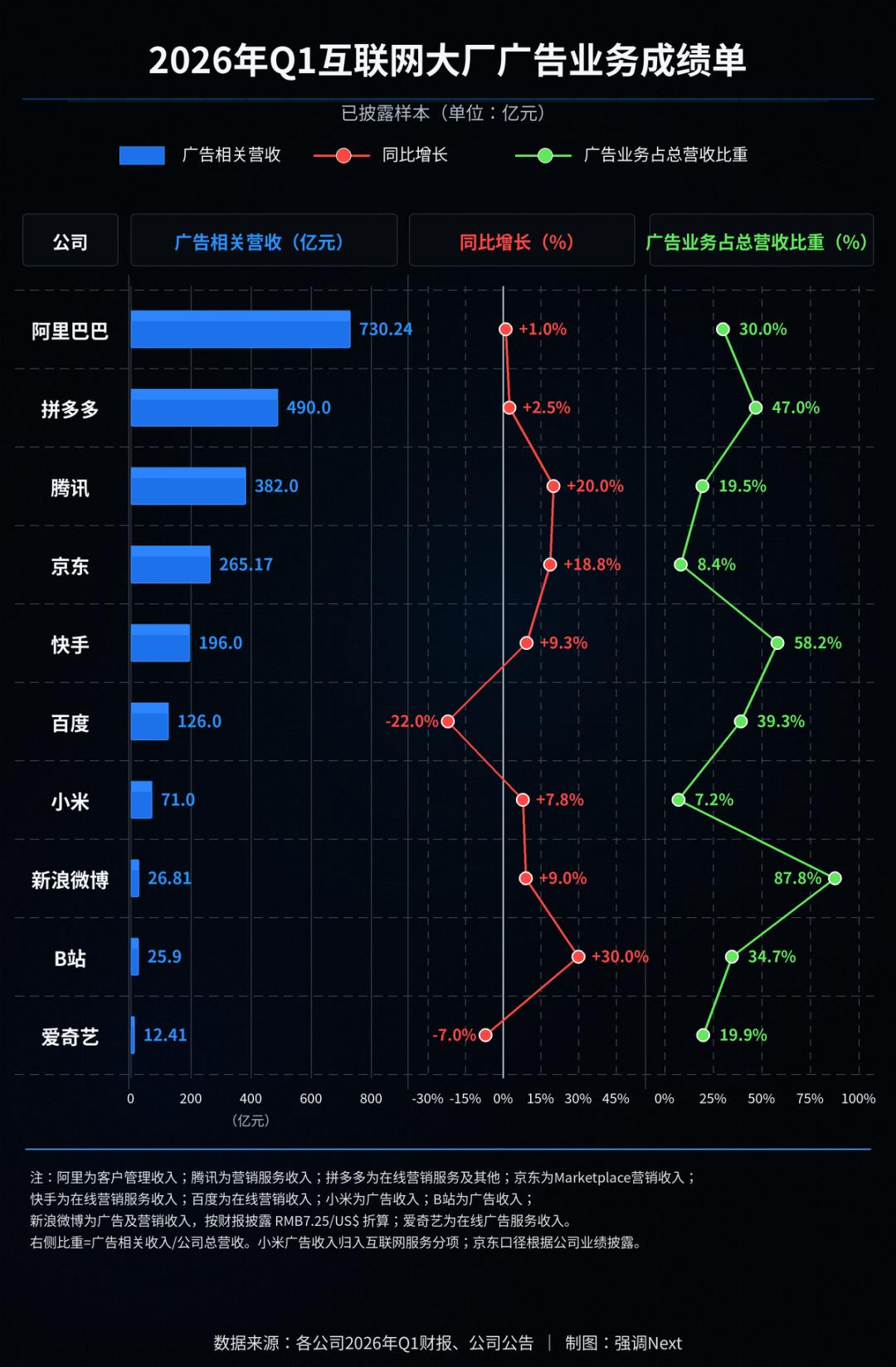
The incremental growth is mainly concentrated in the hands of a few platforms. Tencent, JD.com, Bilibili, and Kuaishou still maintain relatively high growth rates, while Baidu, iQiyi, and Weibo continue to face pressure; the advertising growth of e-commerce platforms such as Alibaba and Pinduoduo has also become more moderate. Advertisers' money has not disappeared; it has just changed hands, flowing from traditional search, long-form video, and other old entry points to platforms that are closer to transactions, more focused on conversion, and more reliant on algorithmic distribution.
Looking back, there are actually three key battles behind the advertising market in the first quarter:
Platforms are competing for the existing advertising budgets, search engines, short-video platforms, and AI assistants are vying for the information entry points, and algorithmic systems are quietly replacing some of the capabilities of advertising agencies and manual ad placements.
These three battles involve different players and have different rhythms, but they are all reflected in this quarter's financial reports.
01.
Advertisers' money flows to places closer to transactions
In terms of advertising volume, Alibaba's customer management revenue is 73.024 billion yuan, and Tencent's marketing service revenue is 38.2 billion yuan. They are still in the first echelon among the companies that have disclosed their data. Coupled with the unlisted ByteDance, the majority of the domestic internet advertising budget is still concentrated in the hands of a few super platforms. Their common feature is not just large traffic but being closer to transactions, content consumption, and user decision-making.
JD.com's Marketplace and marketing revenue is 26.517 billion yuan, a year-on-year increase of 18.8%; Kuaishou's online marketing service revenue is 19.6 billion yuan, a year-on-year increase of 9.3%; Bilibili's advertising revenue is 2.59 billion yuan, a year-on-year increase of 30%. The relatively higher growth rates of these companies indicate that advertisers are still shifting their budgets to platforms where the advertising effectiveness can be more easily verified. E-commerce platforms can track transactions, short-video platforms can measure conversions, and community content platforms can evaluate the efficiency of product promotion and commercial orders.
Another group of old entry points is under pressure. Search engines, long-form video platforms, and traditional social media still have user and content value, but their priority in advertisers' budgets is still declining.
The differentiation among mid-tier and lower-tier content platforms is particularly obvious. Although Bilibili, Weibo, and iQiyi all have advertising revenues within the range of several billion yuan, their trends are completely different.
Bilibili (30% growth) is benefiting from the commercialization of its community users and UP owners, Weibo (3% growth at the same exchange rate) relies more on its existing social advertising market, and iQiyi (-7% growth) is significantly affected by the overall decline of long-form video advertising. The advertising pricing capabilities of these platforms in their respective scenarios have started to diverge.
The data of e-commerce platforms need to be analyzed in the context of the statistical criteria. Alibaba's customer management revenue shows a 1% year-on-year increase on the surface, but after excluding the accounting impact of the new marketing development plan, the comparable growth rate is 8% year-on-year; Pinduoduo's online marketing service and other revenues are approximately 49.9 billion yuan, a year-on-year increase of about 2.5%. However, this statistical criterion combines advertising and transaction services and is also affected by platform support, subsidies, and changes in the monetization rate. Therefore, it cannot be simply equated with a weakening of advertising demand.
Money is continuing to flow from traditional exposure-based entry points to platforms that are closer to transactions, more convenient for verifying ROI, and more reliant on algorithmic distribution.
02.
Why did Tencent achieve a 20% growth rate?
Among all the companies, Tencent's 20% growth rate is the most solid because it meets two conditions simultaneously: a large enough scale (38.2 billion yuan) and a high enough growth rate. It is already difficult to achieve either one of these conditions, and achieving both indicates that Tencent's advertising growth is not a fluke.
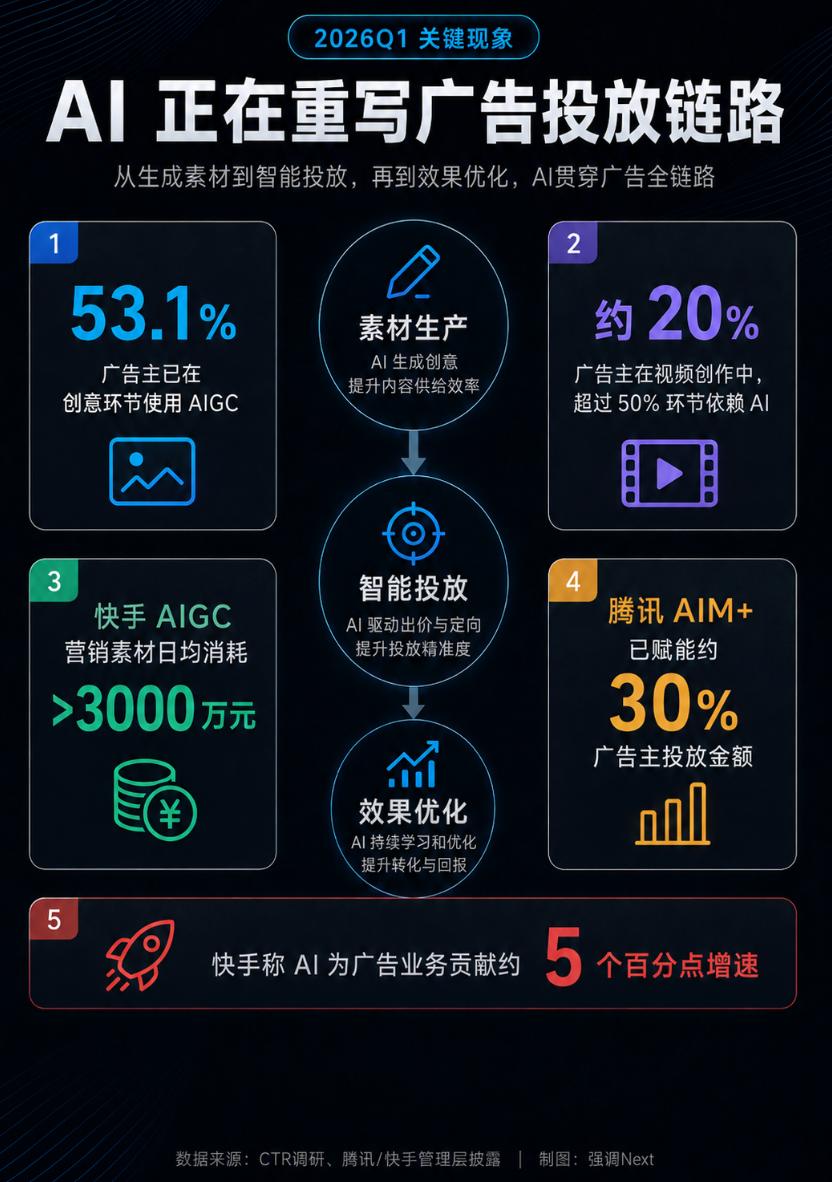
The core reason lies in the maturity of the commercialization closed-loop in the WeChat ecosystem. Video accounts provide a content distribution platform, mini-programs handle transactions, and WeChat stores facilitate repeat purchases. For advertisers on this chain, the data generated by their advertising activities can directly reflect the transaction results, and the cost of verifying ROI is extremely low. Tencent's marketing AIM+ automated advertising tool currently empowers about 30% of the advertisers' advertising spending. The AI model continuously optimizes the bidding and targeting strategies in the background.
In essence, Tencent's advertising is shifting from "media advertising" to "transaction advertising." When advertisers are no longer concerned about exposure and click-through rates but about conversion data directly linked to GMV, Tencent's value proposition has also changed. It is no longer just a traffic entry point but a closed-loop system that can verify business effectiveness. This shift makes advertisers more willing to keep their budgets within the WeChat ecosystem rather than distributing them across multiple platforms for cross-channel advertising.
Bilibili has achieved double-digit advertising growth for 13 consecutive quarters, supported by the scarcity of its user value. Bilibili's highly educated Generation Z user group is unique among mainstream internet platforms. Although Douyin has a larger user base, in the eyes of some advertisers in specific categories, Bilibili users have higher-quality consumption decision-making. This scarcity premium supports Bilibili's high CPM. At the same time, the commercial order model of Huahuo Platform, which connects UP owners and brands, has reached a certain scale, and the iteration of AI advertising algorithms has continuously improved the content matching efficiency.
However, Bilibili also has a hidden concern. Its MAU has only increased by 2.2% year-on-year, and the user growth has basically stagnated. The current 30% advertising growth rate is based on the improvement of the monetization efficiency of existing users. This approach has a ceiling, and it is relatively easy to quantify.
03.
Where has the budget for search advertising gone?
The continuous decline of traditional search advertising is not news.
This quarter, the search engine market has released at least several billion yuan in advertising budgets. Most of this money has followed users to two platforms:
Firstly, short-video platforms (Douyin, Kuaishou) have replaced a large amount of information demand that originally belonged to search engines with more intuitive content consumption; secondly, AI assistants (Doubao, Qianwen, DeepSeek, Wenxiaoyan) have started to directly answer users' questions.
Baidu recognized this trend early on and was the first to bet on AI, with a cumulative AI investment of over 100 billion yuan. The goal was to complete the kinetic energy switch today.
In the first quarter, Baidu's AI business revenue was 13.6 billion yuan, a year-on-year increase of 49%, and for the first time, it accounted for more than 50% of the general business revenue. Among them, AI-native marketing, a new form of advertising based on the Wenxin Big Model, integrated intelligent agents, and AIGC tools, was the fastest-growing segment, with a year-on-year increase of 36% to reach 2.3 billion yuan. However, there is still a certain gap compared to the 3.4 billion yuan decrease in search advertising revenue.
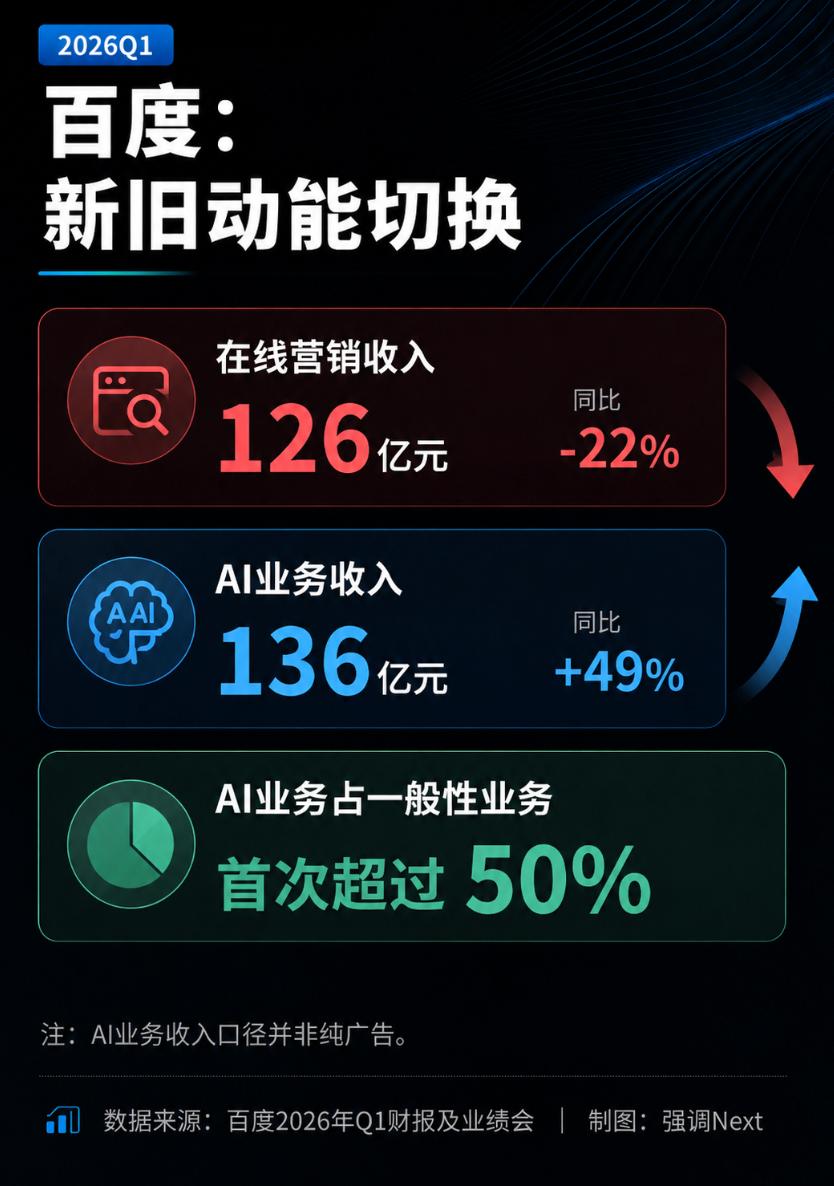
The length of this transition period depends on the scale that the advertising monetization path in the AI assistant scenario can achieve. The logic of SEO and SEM, which has supported the entire search advertising ecosystem, needs to be completely rebuilt in the AI Q&A scenario. OpenAI has started to explore advertising placement in ChatGPT, and domestic companies such as Baidu and ByteDance are also exploring similar paths. However, this area is still uncharted territory, and there are no ready-made successful cases to follow.
04.
AI is rewriting the underlying logic of advertising
The impact of AI on the advertising market is not limited to reconstructing information entry points; it is also improving the efficiency of advertising systems on other platforms.
At the most direct level, AIGC is used for advertising material production. According to CTR's research data, 53.1% of advertisers have used AIGC technology in the creative process, and nearly 20% of advertisers rely on AI to complete more than 50% of the video production process. Kuaishou's daily consumption of AIGC marketing materials has stabilized at over 30 million yuan. Kuaishou estimates that AI has contributed about 5 percentage points to the growth of its advertising business. Tencent's Hunyuan Big Model is used for advertising sorting and targeting optimization, and Bilibili's AI algorithm upgrade has been clearly identified by management as one of the core drivers of its advertising growth.
A deeper impact is taking place at the level of advertising placement logic. In the past few years, Alibaba, Kuaishou, and JD.com have successively launched "full-site promotion" products oriented towards ROI. The logic is the same: advertisers no longer manually set bids and targeting but hand over their budgets to the platform's algorithms for automatic allocation, and the effectiveness is measured by conversion targets. The core engine of these products is AI. Without a strong enough prediction model, it is impossible to make accurate bidding decisions in millisecond-level auctions.
The macro effect of this trend cannot be ignored. As the platform's AI bidding system becomes stronger and advertisers increasingly prefer "managed advertising placement," it means that the value of manual operation and optimization is declining, while the value of platform algorithms is increasing. The most affected are the advertising agencies in the middle: those who used to help advertisers optimize their accounts through manual and refined operations and earn service fees are being replaced by algorithms. The pressure on this industry will be more obvious in 2026 than in 2025.
AI has also brought an unexpected incremental growth to the advertising market: AI application companies themselves have become one of the "most generous" advertisers. Bilibili's AI application advertising revenue increased by 170% year-on-year in the first quarter. Kuaishou's Cheng Yixiao has clearly listed "AI applications" as one of the three major opportunities for advertising growth in 2026.
AI products such as Doubao, Tongyi Qianwen, and Kimi need to invest heavily in customer acquisition advertising during the most intense stage of user scale competition, and their main battlefield is short-video platforms.
05.
Short dramas: An unexpected reservoir
There is also a change mentioned by a few platforms: short dramas and comic dramas are becoming a new reservoir for advertising budgets.
The daily advertising consumption of Kuaishou's comic dramas exceeded 20 million yuan in March 2026, with a growth rate much faster than the overall platform. iQiyi's immersive advertising monetization efficiency for short dramas increased by more than 60% year-on-year. There are two types of budgets flowing in: one is the traffic acquisition and placement by short drama production companies themselves (short dramas need to buy traffic for promotion), and the other is that brand owners are using co-creation of short drama spin-offs as a new form of content marketing. Compared with traditional hard advertising, short drama product placements have higher user acceptance and a more natural conversion process.
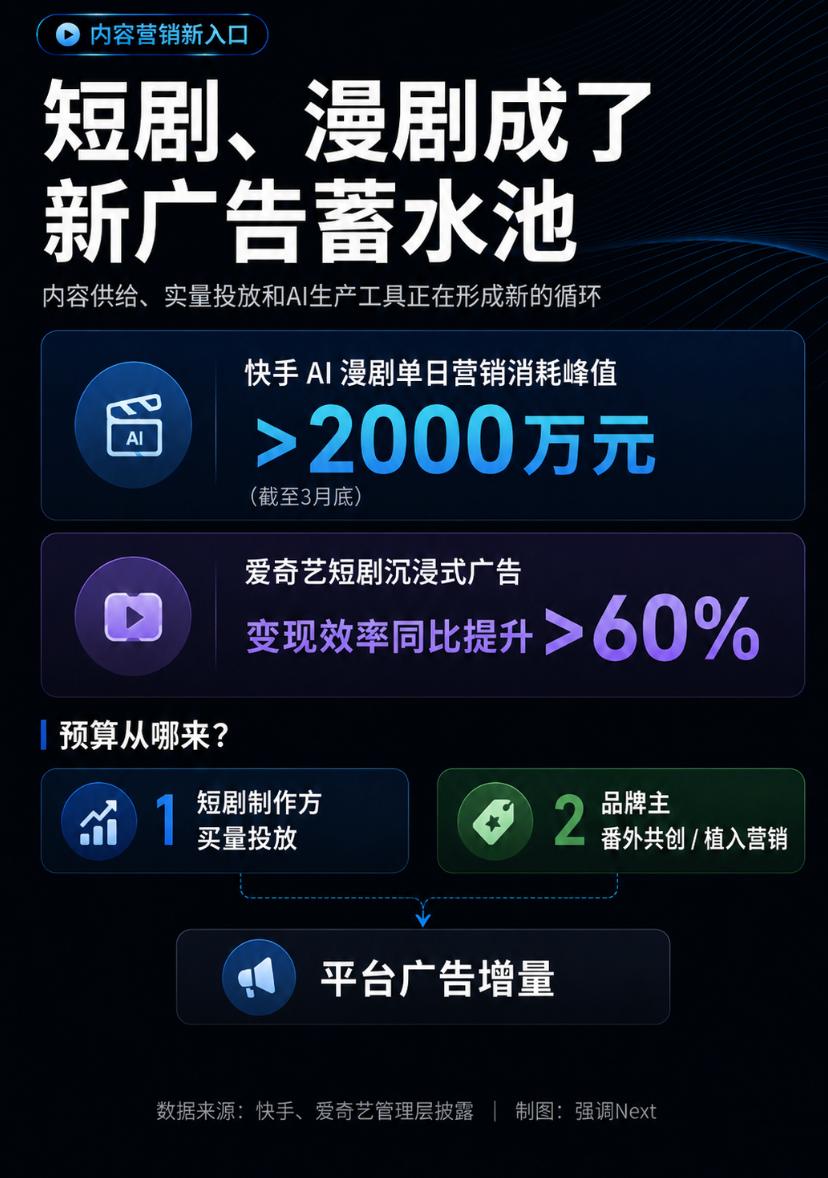
The simultaneous influx of these two types of budgets has created incremental growth for both Kuaishou and iQiyi.
Because Kuaishou has the Kelin video generation tool, it also has an additional layer of AI support. AIGC has reduced the production cost of short dramas, and more short drama content means more traffic consumption needs, forming a positive cycle.
06.
In the battle for existing market share, there is no rising tide
The changes in the Chinese internet advertising market this quarter are mainly due to the redistribution of existing advertising budgets among platforms, and the total amount remains stable.
This quarter, the online retail sales of physical goods increased by 7.5% year-on-year, and the total retail sales of consumer goods in March increased by 1.7% year-on-year. The overall consumption market has not shown an obvious recovery.
Pinduoduo's marketing expenses in the first quarter were 33.8 billion yuan, basically unchanged year-on-year. Pinduoduo is one of the largest buyers in the Chinese performance advertising market. The stability of its marketing expenditure is often an indicator of advertisers' overall attitude.
Tencent's 20% growth comes from the budgets lost by traditional platforms, the shift from offline media, and the concentration of advertisers' budgets on platforms where the advertising effectiveness can be verified.
Bilibili's 30% growth comes from brand advertisers who were originally scattered across other content platforms and the concentration of commercial order budgets from outside the platform to inside.
The incremental growth of Kuaishou and Alibaba comes from products such as "full-site promotion," which have increased the monetization rate: for the same GMV scale, they receive more money from advertisers.
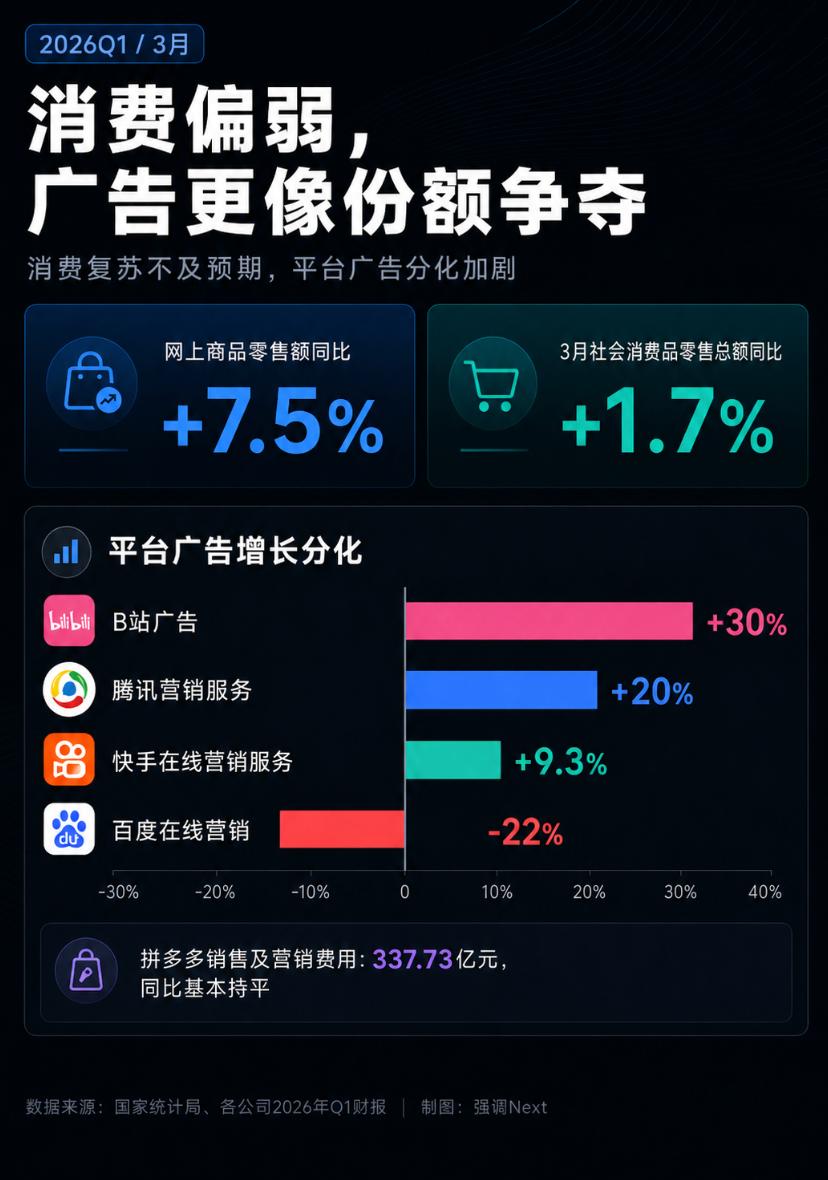
This pattern of existing market share competition means that the advertising market will no longer see a situation where "a rising tide lifts all boats." The advertising growth of one platform means the advertising contraction of other platforms. This battle is becoming more intense, and the temperature of the overall consumption market determines the lower limit of this game.
07.
Epilogue: Will AI expand the advertising market or make it more efficient?
Will AI ultimately expand the total size of the advertising market or make advertising more efficient and thus reduce the total size?
There is some truth to both directions.
AI has improved the advertising conversion rate, which means that advertisers can get more conversions with the same budget. From the advertisers' perspective, this is about saving money, not spending more. However, if the improvement in ROI due to increased advertising efficiency encourages more small and medium-sized businesses that previously could not afford digital advertising to start advertising, the total size of the market will increase.
What we can see from the current financial reports is that the former is the main trend. The dividends of increased efficiency mainly flow to the platforms (higher monetization rate) rather