Domestic large models are standing at the crossroads of Freemium.
In 2006, venture capitalist Fred Wilson coined a term: Freemium, which is a combination of "Free" and "Premium". The core logic of Freemium is to first attract users through free basic services and then convert some of them into paying users for premium services. From the earlier cloud storage services to online video platforms, music platforms, and office software, the business evolution of the Internet industry in the past two decades has almost followed this logic.
Thinking about the domestic situation, Doubao, which ranks first among domestic AI native apps with a monthly active user base of 345 million, has sparked heated discussions in the industry for launching a paid subscription program. While keeping functions like daily Q&A free, Doubao has launched three tiers of paid subscriptions for high - computing scenarios such as PPT generation, data analysis, and film and television production, with the highest tier costing 500 yuan per month. However, even so, a group of users have said they "won't pay".
According to the statistics of "Future Technology World", the C - end commercialization paths of current mainstream AI general large models can be roughly divided into the following three types:
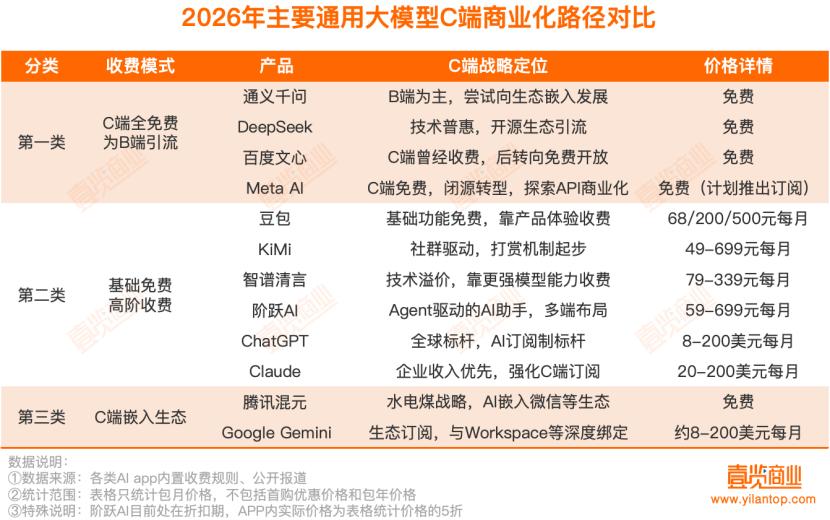
The first type of products choose to exchange free services for an ecosystem, expanding user coverage through open - source or super apps and following the path of technological inclusiveness; the second type of products start to verify the subscription model, attempting to directly convert the model's capabilities into revenue; the third type of products hope to embed AI into existing cloud services, office software, or social systems, becoming part of the ecosystem and proving the feasibility of a mature paid ecosystem combined with a deeply - bound product matrix.
The choice of different paths is also directly reflected in the pricing strategy. Comparing domestic and foreign products, overseas products have a more mature charging system and a wider price range, with the highest tier reaching up to $200 per month.
The most obvious reason is that the willingness of domestic users to pay is relatively low. Based on data from institutions such as a16z and Bessemer, the C - end payment rate of AI products in the North American market is about 15% - 40%, while in the Chinese market, it is only 3% - 13%, with a gap of 3 to 4 times. More importantly, the willingness of users to pay for AI products is highly correlated with the frequency of use.
The "Research on Netizens' AI Consumption" report by the Tencent Research Institute shows that the payment ratio among AI users is 9.8%. The monthly payment amount is mainly concentrated in the range of 30 - 100 yuan (accounting for 44.7%), followed by the range of 100 - 300 yuan (accounting for 32.4%). The overall monthly expenditure is basically controlled within 300 yuan. The payment rate of daily active AI users can reach 18.5%, while that of monthly active users is only 0.9%, with a difference of about 20 times.
The deeper problem behind this is "scenario mismatch".
The current core usage scenarios of AI are still concentrated in work and study: writing materials, modifying code, making PPTs, searching for information, and generating pictures, which are essentially productivity needs. Once users leave their desks, classrooms, or task scenarios, many of them quickly lose the reason to use AI.
However, the consumption habits of Chinese Internet users in the past two decades have been formed under another set of logic. Compared with paying for tools, domestic consumers are more accustomed to paying for "entertainment experiences" - live - streaming rewards, game skins, short dramas, online literature memberships, and video platform subscriptions, which are essentially emotional consumption and instant gratification. In the field of tool software, China has long been shaped by the "free + advertising" Internet model: from search engines, social platforms to content platforms, users have become accustomed to getting one - stop free services in super apps and are naturally sensitive to subscription payments for independent software.
In contrast, the software subscription culture in the North American market has been developing for decades. A survey by DepositAccounts shows that American consumers hold an average of 4.5 digital subscriptions, with an average monthly expenditure of $84. Users have long accepted the idea of "continuously paying for tools and services". The mature software consumption culture also makes it easier for AI to continue the existing C - end business model.
It takes time to cultivate users to pay for Tokens, but the exponential growth of computing power costs is forcing large - model manufacturers to shorten the cultivation cycle. According to data from OpenRouter, the total number of global AI large - model calls last week alone reached 28.9 trillion Tokens, rising for five consecutive weeks. CICC has even calculated that when the Agent penetration rate reaches 8%, the total Token consumption it brings is equivalent to that of pure Chatbots.
This global competition around AI commercialization is exposing a cruel reality: The speed of technological breakthrough has far outpaced the pace of users' habit change. Large - model manufacturers have to find a difficult balance between the bottomless pit of computing power costs and the strong resistance of users to pay. Otherwise, no matter how amazing the technological breakthroughs are, they will eventually be unable to move forward in the face of high Token bills.
This article is from the WeChat official account "Yilan Business" (ID: yilanshangye), written by Zhang Yongkun and published by 36Kr with authorization.