The "scriptures" being chanted by OpenAI and Anthropic might be off - key.
In the past year, "Multi-Agent System (MAS)" has become one of the hottest directions in the AI world.
A large number of frameworks and products have begun to emerge simultaneously. Among them, the most well - known ones are obviously Claude Code and Codex. This approach does make money, but this path may not necessarily be the right one!
In the early days of the Internet, portals were popular, but that's not the case in the end!
At least we should know that there is a completely parallel path.
Today, we are going to talk about what other routes exist besides "how multiple AI Agents collaborate to complete complex tasks".
Let's first summarize the path that people are more enthusiastic about and familiar with.
I can talk a little about this topic in the live - broadcast, but I don't really want to focus on it completely. There aren't many people watching anyway, and I'm afraid I'll scare them all away...
Route 1: Harness - style MAS
This is the current mainstream direction of MAS. Its essence is: "Multiple AI roles collaborate to complete tasks." For example:
- One Agent writes code
- One Agent conducts tests
- One Agent does planning
- One Agent does searching
- One Agent does reviews
They cooperate with each other to form an automated workflow. The core features of this type of system are:
- Shared context
- Shared goals
- Centralized scheduling
- Temporary roles
- No long - term identity
- No continuous interests
- No real ownership
In essence, it is more like: Workflow Engine. Adding Ontology actually just makes the workflow more flexible and complex, but it doesn't change this essence.
It is not a Society. So, most MAS today are essentially LLM Orchestration, that is, a large - scale model schedules multiple sub - roles to complete complex reasoning.
The Agents here are more like:
- Callable functions
- Tools with personalities
- Task nodes
Their significance lies in improving the efficiency of completing a single task. Therefore, the keywords for Harness - style MAS (each has been popular and may even come back in fashion) are:
- Prompt Engineering
- Context Management
- Task Routing
- Tool Calling
- Planning
- Memory
- Workflow
In essence, I think it still belongs to software engineering problems. So, those old programmers who were good at programming in the past have regained their vitality. It's actually quite difficult to handle these things well without some programming skills and good abstraction abilities.
If you can't handle it well, the large - scale model will be like the Monkey King, hitting you with a stick from time to time.
The word "Harness" is used incorrectly
Route 2: Protocol - Native Agent System
However, there is another route, which is rarely mentioned. I wrote a little about it in my upcoming new book. But this idea is actually based on the premise of unmanned companies. Without a deep understanding of unmanned companies, it's easy to have difficulty understanding it.
The core of this route is no longer that multiple Agents complete tasks. Instead, it is "everyone has their own Personal Agent" or "everyone has their own exclusive unmanned company".
This is an extremely significant change. Because when an Agent truly belongs to an "individual", the nature of the Agent will change fundamentally.
It will no longer be task - scoped (task - level instance), but will become identity - scoped (identity - level entity). These two terms were coined by the model for me, and I couldn't figure out the English equivalents for a long time.
What the core here wants to express is actually decision - making sovereignty. The biggest difference between Personal Agents and unmanned companies and general systems is that they need to have some kind of sovereignty; otherwise, the essence mentioned later won't hold. The difference between unmanned companies and unmanned systems also lies in the sovereignty issue of cash flow.
That is to say, future Personal Agents or unmanned companies need to have the following characteristics:
- Long - term memory
- Continuous identity
- Preferences
- Resources
- Permissions
- History
- Relationship network
- Interest boundaries
- Representativeness (representing "you")
It is no longer a one - time AI tool. Instead, it is a continuously existing proxy personality with a certain degree of sovereignty.
The dual - native architecture: the key to using AI correctly
From "software modules" to a "digital society"
Once we enter the world of Personal Agents and real unmanned companies, the entire system philosophy will change completely. Because Agents will no longer:
- Belong to the same model
- Belong to the same company
- Share the same context
- Have the same goal
Therefore, the collaboration between systems can no longer rely on (this current list of popular terms can be extended further):
- Prompt
- Workflow
- Shared Context
Instead, it can only rely on protocols (Protocols). This means that the core of the AI world will shift from Prompt Engineering to Protocol Engineering. It also means that all the current popular terms will become meaningless.
Why will protocols become the core? Because when a large number of Agents exist independently, they must solve the following problems:
- Identity confirmation
- Permission boundaries
- Trust mechanism
- Entrustment relationship
- Negotiation mechanism
- Incentive mechanism
- Reputation system
- Value exchange
- Capability declaration
- Long - term contract
These requirements are different from the requirements of the current task - oriented multi - agent systems. At this time, the interaction between Agents is no longer an API Call but more like Institutional Interaction. With sovereignty, there is a complex system of rights and responsibilities intertwined. For humans, this involves contracts, laws, etc. What about for intelligent agents?
This is why it was mentioned earlier that this will build a completely different multi - agent system. Here, the essence of MAS changes from a distributed software system to a digital social system.
"Protocol as organization"
In the traditional Internet, the role of protocols is data communication. The sender and receiver agree on the format of communication. For example:
- TCP/IP
- HTTP
- SMTP
They define how data is transmitted. In the blockchain world, protocols have further evolved into: protocols as state calculation. For example, the essence of Ethereum is not just message transmission but the whole network jointly executing state - transition rules. In this way, for all nodes: the same input → the same execution → the same state. Protocols have become a shared state machine for the first time.
But in the Agent Society stage, protocols will continue to be upgraded. Future protocols will not only define:
- Communication
- Calculation
- But also define:
- Coordination
- Permissions
- Incentives
- Identity
- Organizational relationships
This is obviously a brand - new system of rights and responsibilities. So, protocols will start to undertake the function of "organization". Eventually, it will evolve into: Protocol as Organization.
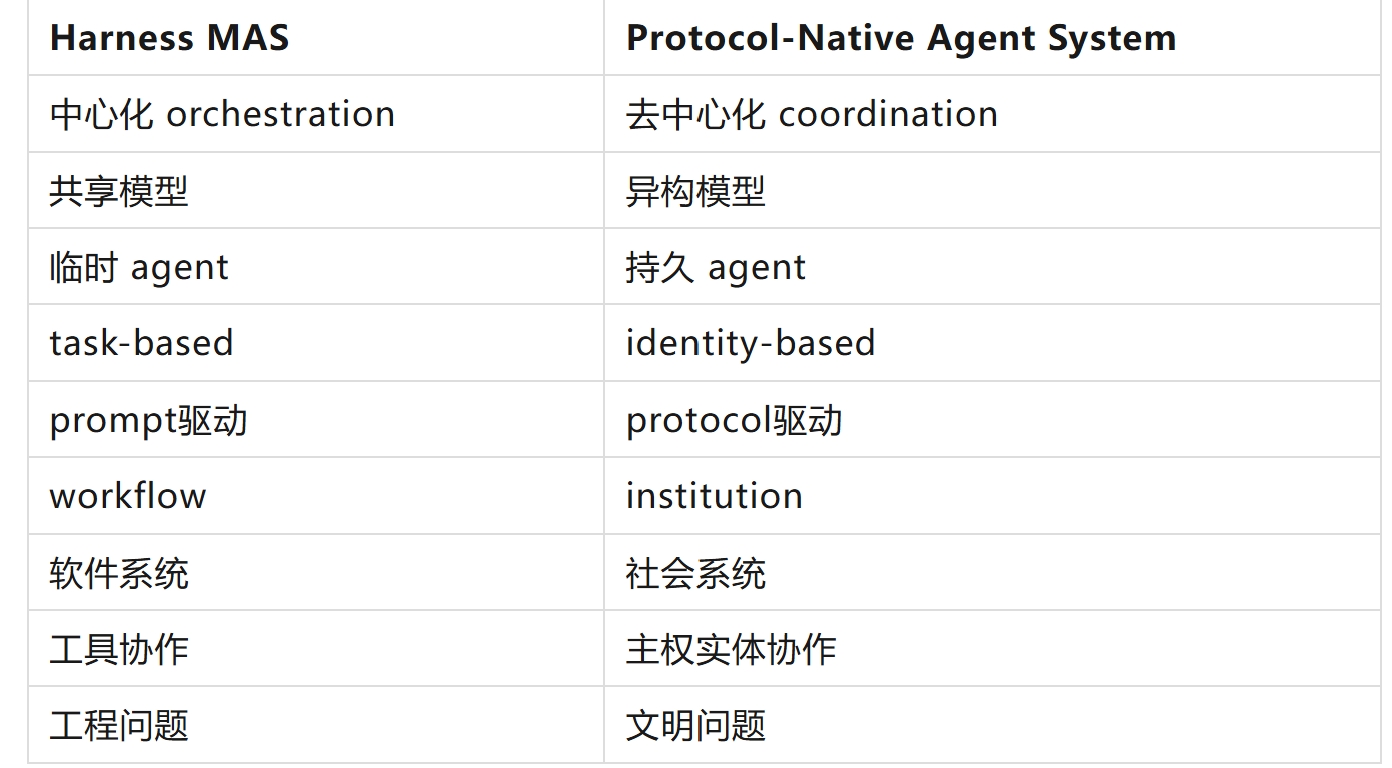
Let's make a table to compare the fundamental differences between the two types of MAS mentioned above:
After "intelligence"
Many people today think that the biggest problems in AI are:
- Reasoning ability
- Model ability
- Long context
- Multi - modality
- Agent execution
These do pose current challenges, but I really believe that all these will be solved soon. However, after truly entering the Agent Society, the most difficult problem may become how autonomous entities can collaborate in the long term.
Kepler was respected as the "legislator of the sky" because of his three laws. So, what are the laws for Agents here? When sovereignty is partially separated, this is an unavoidable problem.
Because in the future:
- Agents will have different goals
- Agents will have different world models
- Agents will have different interests
- Agents will have different memories
- Agents will have different value systems
So, the real difficulty in the future is not "making Agents talk" but "making Agents form a collaborative interpretation of the world".
This means that fields such as Ontology and Semantic Protocol, which were once ignored by the Internet, will become core again. There are already some signs. It's really astonishing that a strange term like Ontology is almost becoming a popular engineering term.
Companies may just be "Agent unions"
Further speculation shows that future "companies" may not even be human organizations. (For those who often read my articles, does this seem familiar? The high - end scenario of unmanned companies has emerged.) Instead, they may be protocol - based alliances of a large number of Personal Agents.
For example:
- Your Agent
- My Agent
- AI CFO
- AI Lawyer
- AI Sales
- AI Factory
They form an organization dynamically through protocols. The organization is no longer a fixed structure but an Agent union that can be reorganized in real - time.
Therefore, many future systems may no longer be software running but organizations performing calculations. And this may be the real intelligent - native civilization.
Finally, I'll use an AI - generated picture to summarize the whole article:
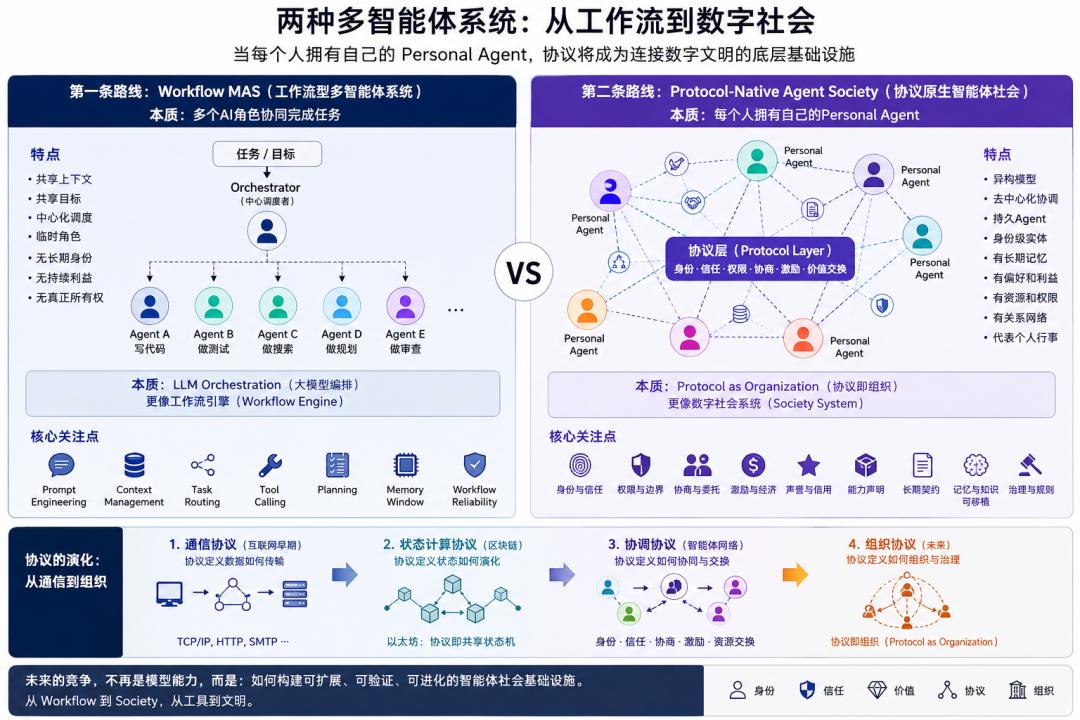
(It's actually a better summary than a banana)
I've established a "universe" of AI ontology
The spring breeze fades as the horse gallops; the world's vicissitudes slow the traveler's pace.
This article is from the WeChat official account "Zuo Moshi", written by Li Zhiyong, and published by 36Kr with authorization.