Why doesn't Guangzhou's foreign trade look good?
No one could have imagined that Guangzhou's foreign trade has actually lost its momentum.
The foreign trade report card for the first four months has been released. Many cities have achieved remarkable results, but only Guangzhou has presented a rather underwhelming performance: the total import and export volume reached 399.9 billion yuan, with only a 0.3% year-on-year increase. Among the top ten foreign trade cities, its growth rate ranked last.
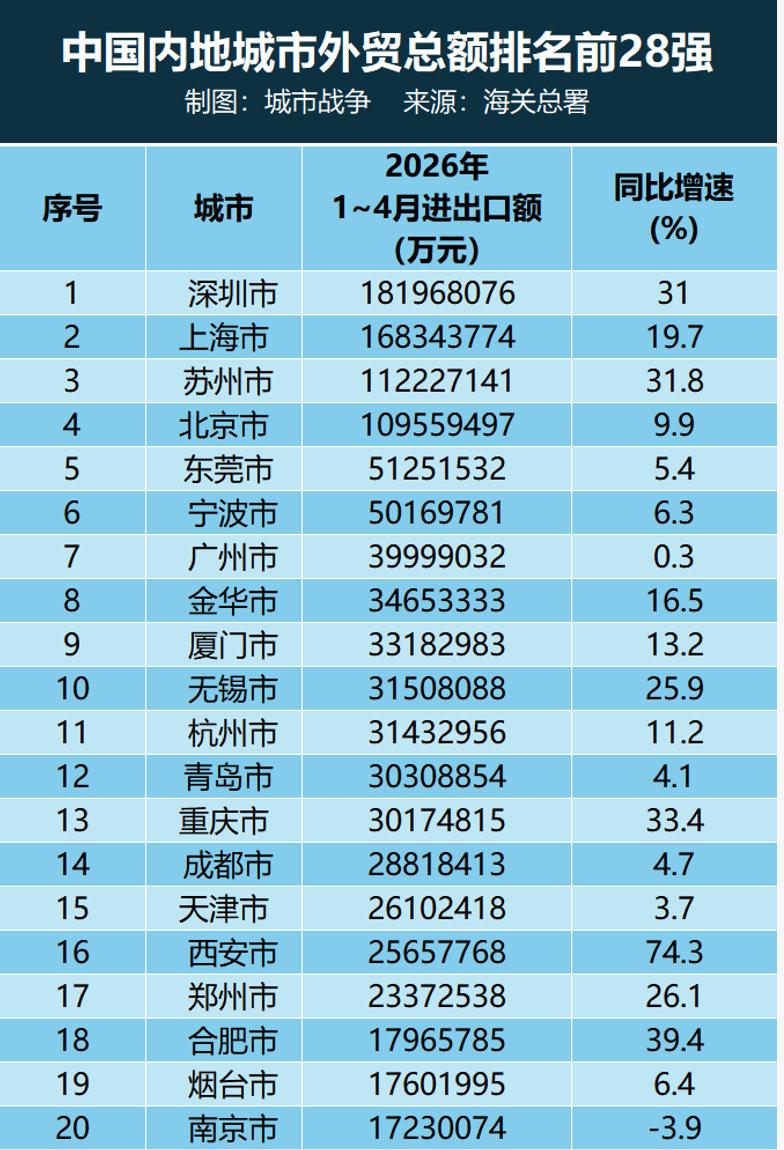
However, if we look back at the same period last year, Guangzhou was still a well-deserved "top student".
From January to April 2025, Guangzhou's import and export volume was 400.2 billion yuan, with a growth rate as high as 17.6%, ranking among the top in major foreign trade cities across the country. In just one year, the situation has changed dramatically, from "leading the pack" to "trailing behind". What exactly has happened behind this?
01
Many people's first reaction is: Has the foreign trade situation taken a turn for the worse? But looking at the national level, from January to April this year, the country's total import and export volume reached 16.23 trillion yuan, a significant increase of 14.9%. The overall situation is clearly booming.
Looking at other cities: Shenzhen's growth rate was 31%, Suzhou's soared by 31.8%, Shanghai's increased by 19.7%, and Xi'an even skyrocketed by 74.3%. This is not a sign of a weak foreign trade; it's clearly a "huge windfall", but Guangzhou just couldn't catch it.
Actually, the problem lies not in foreign trade itself, but in the industrial structure behind it.
Many people fail to understand that this year's significant increase in foreign trade is not a comprehensive one, but a structural bull market in hard technology driven by AI: large enterprises are investing heavily in AI, directly driving up the upstream industrial chain. The demand for storage chips and high-end electronic components has skyrocketed, and their prices have doubled.
Therefore, all the cities with significant foreign trade growth this year are supported by the AI industrial chain:
Xi'an can be regarded as the biggest dark horse of the year. It has gathered storage industry chain enterprises such as Samsung, Micron, and Yisw. Among them, the production capacity of Samsung's Xi'an factory accounts for 40% of Samsung's global NAND flash memory production.
In the first four months, Xi'an's exports of mechanical and electrical products doubled. The exports of integrated circuits soared by 171.6%, and it managed to boost its foreign trade growth rate to 74.3% through chips. In short, Xi'an's foreign trade is a "carnival of storage chips".
Shanghai is deeply integrated into the global AI supply chain. The import and export of AI core products such as integrated circuits and storage components in a single month soared by 85.7%. The exports of the "new three" - new energy, photovoltaic, and lithium batteries - nearly doubled, and it received an overwhelming number of high-end and high-value-added orders.
Shenzhen has fully capitalized on the chip dividend. The proportion of mechanical and electrical product exports reached as high as 75.7%. The exports of integrated circuits exceeded 100 billion yuan, a 56.8% increase. The import side was also very strong, with the import of integrated circuits reaching 347.98 billion yuan, a 42.8% increase. The "chip content" is also off the charts.
Suzhou is also very strong. The exports of the computer, communication, and other electronic equipment manufacturing industries reached 346.14 billion yuan, a 49.2% increase, contributing 83.3% to the exports. Among them, the electronic components related to AI increased by 129.7%.
You see, these cities are exporting chips that are priced by the gram, not clothing and footwear that are priced by the container. The unit price and profit are not on the same level as those of traditional manufacturing.
02
In contrast, Guangzhou's weaknesses are quite obvious.
Although Guangzhou also has exports of mechanical and electrical products, with exports reaching 130.27 billion yuan from January to April, a 17% increase, the proportion of mechanical and electrical product exports is only 50.8%, far lower than the levels of Shenzhen (75.7%) and Dongguan (72.9%). Moreover, most of Guangzhou's mechanical and electrical products are complete vehicles, ordinary equipment, and spare parts, lacking high-end electronic components.
Let's look at a heart - wrenching data comparison: from January to April 2026, Guangzhou's exports of integrated circuits were only 1.7 billion yuan (a 206.5% increase), while in the same period, Shenzhen's exports of integrated circuits were 106.07 billion yuan, and Dongguan's were 42.48 billion yuan. That is to say, Guangzhou's chip export volume in the first four months of this year is less than 2% of Shenzhen's and 4% of Dongguan's. The gap is really huge.
While many cities are winning easily with "chips", Guangzhou can hardly even make it to the game table.
Of course, Guangzhou's traditional strengths are still very competitive: the exports of clothing and clothing accessories reached 12.17 billion yuan, a 22.4% increase; the exports of luggage were 5.41 billion yuan, a 24.2% increase; the exports of cosmetics were 4.543 billion yuan, a 29.7% increase; and the exports of furniture were 4.3 billion yuan, a 20.1% increase.
These figures are not bad; in fact, they are quite stable. But the problem is that the added value of traditional products is low. There is a heart - wrenching joke on the Internet: "The value of a whole container of clothing and footwear exported from Guangzhou is still less than that of a suitcase of integrated circuits exported from Shenzhen or Shanghai."
This is the core dilemma of Guangzhou's foreign trade: Last year, when traditional foreign trade recovered, Guangzhou reaped all the benefits and led the country. This year, with the arrival of the AI wave, Guangzhou lacks upstream hard - technology industries and has missed out on the market trend.
So, it's not that Guangzhou's foreign trade is failing (the foreign trade of traditional goods is still quite stable) , but that Guangzhou's industrial structure is too traditional: it has long been deeply involved in the mid - and downstream application markets, but is severely lacking in upstream sectors such as chip manufacturing, chip design, and packaging and testing.
What's even more interesting is that Guangzhou is not without a demand for chips. From January to April, Guangzhou's imports of integrated circuits reached 10.57 billion yuan, a year - on - year increase of 39.1%. Since it can't produce them on its own, it has to spend a large amount of money to buy them from outside. The huge "trade deficit" clearly exposes Guangzhou's weakness of "lacking chips".
03
In fact, Guangzhou has long recognized this problem. In recent years, it has been making efforts to move upstream in the industrial chain. A number of key semiconductor projects, such as Yuexin Semiconductor, Nansha Xinyueneng, and Zengcheng Zengxin, have been successively launched, aiming to break the old pattern of "lacking chips".
In January this year, the fourth - phase project of Yuexin Semiconductor, headquartered in Huangpu District, was officially launched. The total investment of the project is about 25.2 billion yuan, and it is planned to build a 12 - inch digital - analog hybrid specialty process production line with a monthly production capacity of 40,000 wafers. It is scheduled to be completed and put into production by the end of 2029. Yuexin is in the first echelon of domestic analog chip foundries and is the only 12 - inch analog chip foundry in the Greater Bay Area in mass production, with great development potential.
Even more significant is that on May 25th, the Guangdong Provincial Strategic Emerging Industry Guidance Fund with a total scale of 100 billion yuan was launched in Tianhe, Guangzhou. This fund is the first "patient capital" for perpetual operation in the province. It doesn't seek quick profits but focuses on long - cycle sectors, precisely targeting upstream hard - technology fields such as semiconductors and new materials.
However, the semiconductor industry requires large - scale investment, has a long cycle, and high barriers. Without the perseverance of ten - year - long efforts, it's difficult to achieve results.
For example, many of Shanghai's semiconductor companies were established around 2000. It wasn't until the last five years that they started to achieve results. The cycle is indeed long, and Guangzhou only started to get involved in the past ten years or even the past five years, lagging behind by at least 15 years. It's difficult to catch up in the short term.
Therefore, Guangzhou is still in the painful period of industrial transformation.
The weakness of Guangzhou's foreign trade this year is another wake - up call: in the era of technological explosion, being overly risk - averse is another form of backwardness. When other cities are switching to high - value - added hard - technology sectors, if Guangzhou is still satisfied with the "small certainties" of traditional industries, even if it doesn't make mistakes, it may gradually be left behind by the times.
Fortunately, Guangzhou's industrial awakening is accelerating, and the pace of overcoming difficulties has already begun. We look forward to seeing not only a wide variety of fashion and beauty products but also shiny chips among Guangzhou's future export goods.
This article is from the WeChat official account "Urban Warfare", written by the Sun Bushu team and published by 36Kr with authorization.