Will AI enable HR to take off instantly?
In the era of AI, SSC is one of the HR functions most severely impacted and at the highest risk. The essence of this module is to handle standardized, high - frequency, and large - volume transactional work, which is exactly the absolute advantage area of AI and automation. The pursuit of human employees should be to maintain the efficient operation of this module. Therefore, they need to manage two aspects: one is the model building; the other is to handle exceptions, emergency matters, or employees' emotions that AI cannot handle.
Interestingly, if SSC operates in this way, after human employees build the model, they can only become assistants to AI, and their value will be greatly reduced. SSC practitioners will also lose their bright future. In fact, SSC has also been impacted by digital tools in the past. However, the power of AI has exponentially increased the degree of this impact.
The solution lies in "upgrading the dimension". SSC should shift from the simple "process operation" in the past to high - value work such as "data operation", "product operation", "solution", and "data planning". They need to plan the data structure of human resource management functions based on the background of strategy, business, and culture, promote data precipitation, execute data cleaning, and provide basic ammunition for the operation of each HR module. They also need to directly deliver products or solutions. I even believe that in the AI era, a good SSC can be as important as OD.
01
Basic HRM Process Operation - Unmanned Factory
For this kind of standardized work, digital tools have already largely replaced human work. With the involvement of AI, it can almost completely operate without HR intervention. In other words, HR practitioners in this field are at the greatest risk of being eliminated.
Handling Procedures for Joining, Leaving, Transferring, and Promotion - AI can automate the entire process, including electronic signing, automatically opening/closing system accounts, generating labor contracts, and pushing to - do lists. Paper - based filling, manual review, and manual permission opening have disappeared.
File Management and Data Entry - Employees can self - print certificates of employment and income. The electronic file system automatically classifies, retrieves, and archives files. RPA robots automatically enter leave applications into the payroll system. Full - time data entry clerks and file administrators have basically disappeared.
Payroll/Attendance/Social Insurance Data Verification - The system automatically connects to attendance records, leave approvals, and overtime sheets, and automatically calculates and completes the addition/deletion of social insurance participants.
Employee Consultation Service - Chatbots (such as conversational AI) can answer common questions about attendance, leave, salary, and social insurance 24/7 with extremely high accuracy and almost zero cost. According to statistics from various institutions, this kind of AI can directly replace about 50% - 70% of front - line inquiries.
In the above work, human employees only need to handle exceptional situations. For example, when ID information cannot be recognized, special approval processes are required, VIP - style face - to - face services (such as for senior executives' onboarding) are needed, or system errors need to be handled. There is no doubt that AI will become the protagonist in this field, and enterprises should build it in the way of an "unmanned factory". Once human employees intervene excessively, it will become a bottleneck for efficiency.
Currently, several pioneer enterprises are firmly investing in this "visible - effect" field.
Siemens collaborated with IBM to create an AI HR agent named CARL (Cognitive Interaction User Relationship and Continuous Learning Assistant). This agent runs on the IBM cloud platform and is driven by IBM watsonx Orchestrate and Watson Discovery technologies. Since 2019, Siemens has integrated generative AI into its shared services. Through tools like CARL, it has achieved highly efficient automation of HR services, with an employee satisfaction rate of 8.7/10 and has integrated more than 350 email channels.
In addition, Hoag Health System replaced its Outlook - based HR process with Zendesk AI agents. Employees can directly get instant answers, and the time to resolve HR work orders has been reduced by 86%. AXA Partners has achieved full digitalization of employee document management, onboarding management, and employee requests by deploying the Neocase HR solution.
02
Data Analysis and Optimization - Efficiency Accelerator
Based on the "unmanned factory - style" operation, SSC can generate a large amount of standardized data, which provides a lot of space for AI to exert its analysis ability. AI can automatically analyze data such as the number of service work orders, response time, employee satisfaction, complaints, turnover, and communication conflicts, identify high - frequency problems, form optimization plans, predict employee needs, and rationalize resource allocation.
It should be clear that the purpose of SSC is not to directly intervene in human resource management actions, but to form a model framework, monitor the operation efficiency of various human resource management functions, and initially identify problems so that each module of COE can intervene deeply and introduce corresponding policies and plans.
If this premise is clear, the remaining tasks for human employees are model building and (preliminary) in - depth diagnosis. They will design corresponding digital processes for various human resource functions (joining, leaving, transferring, performance, payroll, etc.) and establish an efficiency dashboard. Based on the data, they will analyze the underlying reasons, make preliminary judgments, and then hand over the work to each module of COE.
03
Products and Solutions - Product Manager
Sometimes, just presenting the problem is not enough. Sometimes, a single module in the human resources department cannot solve the problem. At this time, SSC needs to take on the role of a product manager. SSC directly provides products for employees (manifested as service modules presented on SaaS, APPs, and enterprise accounts). From this perspective, I highly approve of Tencent's practice of promoting SSC to SDC (Shared Delivery Centre). Its core idea is to actively provide delivery according to the needs of internal users (employees, managers, and HR).
Considering the technological environment of AI, the active delivery of SDC may be divided into two types: one is to provide module products urgently needed by internal users, for example, training chatbots and updating the underlying knowledge base; the other is to provide accurate and complex solutions urgently needed by internal users. This is originally the orientation for SDC, and with the addition of AI tools, it will surely be more powerful.
Here is a typical example.
The project team of Tencent's Honor of Kings faced the risk of losing core planners and artists, which directly affected the quality of version iteration and the launch schedule. Traditional SSC could only calculate the turnover rate, but could not diagnose the reason, let alone intervene. Tencent's SDC integrated multi - dimensional data such as attendance, performance, payroll, internal job mobility, and satisfaction surveys, combined with business schedules, overtime intensity, and intelligence on poaching by competitors, and constructed a "talent health index". They found that the high - turnover group was not the "high - intensity overtime workers" as commonly believed, but the "middle - level lead artists (artists) who had not participated in core gameplay design for three consecutive months and had no performance feedback".
Tracing back to the human resources system, this is a problem of "single - minded work content + lack of promotion channels", rather than simply a salary problem. So, SDC collaborated with COE to design a "key position retention allowance + core gameplay rotation plan" and conducted targeted communication with high - risk employees. In the long term, SDC established a "talent echelon dashboard" for the project team, predicted the turnover probability quarterly, and provided a priority channel for internal job mobility. In this process, SDC sent personnel to the project site to jointly formulate an action list with the project manager, and the SDC back - end was responsible for data tracking and effect review.
Imagine if the "talent health index", "talent echelon dashboard", and "review framework" can be taken over by AI, then the "solution" will become a "module product" and can be promoted on a larger scale, thereby improving the overall efficiency of human resource management.
04
Data Management - Data Warehouse Maintainer
In the AI era, computing power is not a scarce resource. The core competitiveness of an enterprise lies in algorithms (large models, small models, etc.) and data. A popular saying is that enterprises should build their own closed data garden (Walled Data Garden). This data garden is not open to the outside world and only serves the enterprise's own decision - making. The richer and higher - quality the data in the data garden, the more accurate the enterprise's decision - making will be.
According to this concept, SSC should build a data garden in the field of human resource management. In various functions of human resource management, which data should be available at which nodes should be planned by SSC data administrators. These practitioners are responsible for the scope, scale, and quality of the data. For this reason, SSC should be deeply involved in the planning of the human resource system and need to have a deep understanding of macro variables such as strategy, business, and culture. In the past, SSC seemed to only need to mechanically and passively execute various human resource processes. In most enterprises, they have almost become subcontractors or construction units of COE. Now, they need to stand higher and look farther. It can even be said that their vision determines the upper limit of human resource professionalism.
Further, the data management position in SSC should be the one that understands data best in the entire human resources department. Here, the most top - notch data scientists in the department should be concentrated. The reason is simple. If each human resource function module is asked to establish an efficiency dashboard, except for the human efficiency management in OD, other functions such as recruitment, payroll, performance, and training will claim that their work efficiency is excellent, which is equivalent to letting athletes be referees. But SSC is different. They are naturally neutral and can speak with objective data. In other words, the deeper the understanding of data by the SSC data management position, the more scientific the data framework can be established, and the more the operation analysis and optimization position can identify problems based on this framework and drive each human resource module to improve efficiency. In fact, I always believe that SSC should be the vanguard in the data - driven work of human resources.
Ultimately, the data management position in SSC is equivalent to providing fuel for AI. They have a natural collaborative relationship with AI, and there is no substitution effect. As the wave of AI approaches, they will be the protagonists on the forefront.
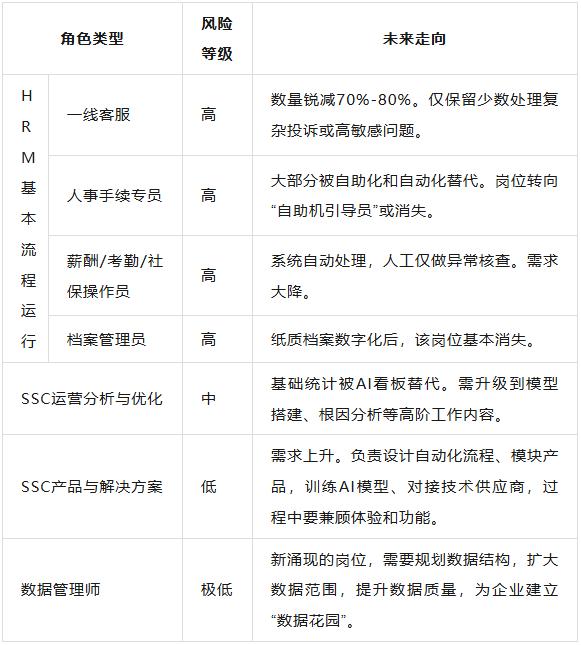
Table: Forecast of SSC Position Structure Changes. Source: Musheng Consulting
This article is from the WeChat official account "Musheng Office" (ID: hrm - yun), written by Musheng, and is published by 36Kr with authorization.