These four important trends have emerged.

Source: On May 16, 2026, Notesman's PPE (Politics, Economics, and Philosophy) Academy held the first module of the PPE Class of 2026, "Sociology of AI", in Liangzhu, Hangzhou. This is the essence of the notes from that course.
Guest speaker: Zhang Xiaoyu, the tutor for the AI Sociology module of the PPE Class of 2026 at Notesman's PPE Academy and a rising scholar in the history of science and technology.
When AI can perform most jobs, the question is no longer "Will it replace you?" but whether your organizational and management methods can keep up with this transformation.
Zhang Xiaoyu, the tutor for the AI Sociology module of the PPE Class of 2026 at Notesman's PPE Academy and a rising scholar in the history of science and technology, proposed four principles for understanding AI applications: Human Equivalent, CTK (Tacit Knowledge) Projection, Interaction as Interface, and the Free Association of AI Natives.
Today's article will tell you how to find a starting point for action in this race between humans and AI.
I. One of the Four Principles of AI Application:
Human Equivalent, an Established Mathematical Relationship
In all causal chains, the most direct one is the mathematical relationship. In the process of human civilization and social change, some things are determined mathematically, which is the most solid foundation for making predictions across cycles.
Those who do historical research know that it is almost impossible to predict the future over a span of three or four decades. People in 1910 could not foresee the founding of the People's Republic of China in 1949. But standing in 1910, two things were certain: geography and population.
Geography remains unchanged for thousands of years, and population growth can be calculated mathematically. The most powerful historical predictors in that era were demographers. John Maynard Keynes predicted that a world war was inevitable in twenty years based on the fact that the population in Eastern Europe would triple.
Twenty years ago, when Steve Jobs held up the first-generation smartphone, a mathematical relationship was already established: You obtained a terminal with a cost of accessing the Internet that was a fraction of that of a computer, and it accompanied you for a longer time than a computer and could be carried around.
Based on this relationship, you can deduce that a series of business and social forms will emerge. You just need to wait for a generation. Because the previous generation cannot understand new things with native thinking, while the next generation is born with the screen being naturally interactive.
For the AI era, the same mathematical relationship has already been established. In the next 20 years, you just need to see how this mathematical relationship unfolds at various levels of social engineering.
I call this mathematical relationship "Human Equivalent". We all know that TNT equivalent refers to the explosive power of an atomic bomb being equivalent to how many tons of TNT explosives. Human Equivalent is to calculate how many people's production efficiency an AI large model is equivalent to. It is difficult to calculate precisely, but the order of magnitude of the estimate is very certain.

Students are attending class attentively
The upper limit of the tokens output by a human per day is at most 200,000. The cost of an AI producing 1 million tokens in the United States today is about one dollar. I earn 100 yuan a day and still worry about starving, while an AI can do my five-day workload for just one dollar. As long as you are still calculating ROI and considering cost-benefit, there is no need to explain this further.
What about the quality? In terms of emotional intelligence, AI has passed the Turing test; in terms of intelligence, it reached the level of a doctor in 2024. Among the educated people in the world, those with a doctorate degree account for only about 1%. AI has outperformed 99% of people, and the cost is so low.
This mathematical relationship has been established since last year or the year before. We are just waiting for it to gradually unfold in application forms.
A rough estimate is that for everything that can be discussed with explicit knowledge, AI can reduce the cost to one-thousandth of the original. If we also take into account the cost and time of training a person to a doctorate level, this ratio far exceeds one-thousandth.
It's just that we are living in an extremely complex social control system. Humans need to adapt to AI, and AI needs to adapt to the human consumption system. This process takes time. The challenges and difficulties faced in this process are what people call "specific implementation" today.
From the end of last year to this year, the ability of vibe coding has become very powerful. Programming is not only a tool but also a language for you to communicate with the digital world. AI has no problem with programming.
The criterion for judging an AI-native company is that its programmers no longer write code by hand at all, and all code is generated by AI.
AI has mastered all the tools for controlling the digital world. What it needs to do next is to continuously refine the text projections of human explicit knowledge or tacit knowledge (those feelings, intuitions, tastes, and judgments that you know but can't express), and then gradually use these tools accurately to complete increasingly complex tasks. This is the main form of an Agent.
My way of collaborating with AI has become using AI Desktop as the operating system, and all my work is completed in the dialogue with it.
II. From "AIgora" to Personal Knowledge Base,
A Great Leap in Productivity
I developed a system that organized the catalogs, main works, and core ideas of more than 100 important thinkers in human history. When I need to discuss a problem, I directly let AI hold a "discussion meeting".
I designed six permanent roles for the meeting: divergent thinkers, literature review experts, logicians, questioners, synthesizers, etc. There are also top experts in various fields such as Michael Polanyi, Michael Oakeshott, James C. Scott, Hayek, Ludwig Wittgenstein, Andy Clark, and Daniel Kahneman.
For example, when inputting "The significance of tacit knowledge in education", the divergent thinker will first raise five levels of questions - at the epistemological level, teaching practice level, the return of the apprenticeship system, the critical dimension, and the level of civilization inheritance.
The literature review expert will then introduce important works and theories in history from these levels. There will also be Agents imitating specific thinkers participating in the discussion.
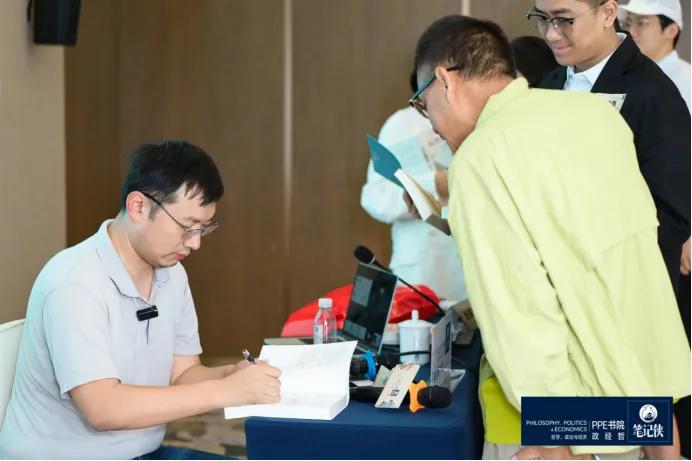
Teacher Zhang Xiaoyu is signing books for students
I call this system AIgora, which is a place for free discussion among AIs.
After a product manager from a game company tried it, he said that using it to discuss product ideas was more efficient than their own meetings. Several problems that were previously unclear became clear after running this system.
I have made this system into an open-source script on the GitHub platform, which can be directly downloaded and used. After some friends used it, the time for the company's brainstorming meetings was significantly shortened. Everyone runs it through AIgora first, and only needs to align the unaligned parts at the meeting.
This year, I made a major upgrade to this system: Build a personal knowledge base and refine my own tacit knowledge.
My knowledge base does two things.
First, I read about 300 to 500 books and papers every year, all of which are digitized and put into the knowledge base; my own writings, speeches, and interviews are also all put in.
Second, I set up four Agents, responsible for AI research, historical research, philosophical research, and geopolitical research respectively. Every day, they each push three items to me. The first two are related to my research topics, and the third is in an area that I don't know much about but am likely to be interested in.
What are the benefits of doing this? AI can track the trajectory of my thinking changes. After it records the changes in my thinking trajectory every day, it can gradually know where my knowledge blind spots are. More importantly, it knows that outside the blind spots, there are some things that, although I don't know about them, are consistent with my existing theoretical framework.
For example, if I study political science, and there is a theoretical framework in biology that is consistent with mine, it will recommend this biology paper to me.
Now the way my AI collaborates with me is very much like me guiding a doctoral student from Tsinghua University or Peking University. It will even actively remind me one day: "I read a literature today that is very relevant to your research. For some of the problems you were thinking about before, there is a new quantitative research method here that can be used for more accurate research."
1. A Three-Hour Paper: How AI Innovates Actively
For example, in my second book, Commerce and Civilization, I discussed a view: The premise of the modern political structure is that merchants can form horizontal alliances within the political entity, form a balance of different opinions, and restrict power. However, in Chinese history, "horizontal political alliances" were naturally "wrong" in China. I only had a small section discussing this issue in the book.
One day, AI suddenly told me that it read a paper in which someone had done a similar study using quantitative analysis, which could verify my view. "Do you want me to do this research?"
I roughly looked at the abstract and thought the direction was right, so I told it, "Okay, go ahead." Three hours later, it produced this paper.
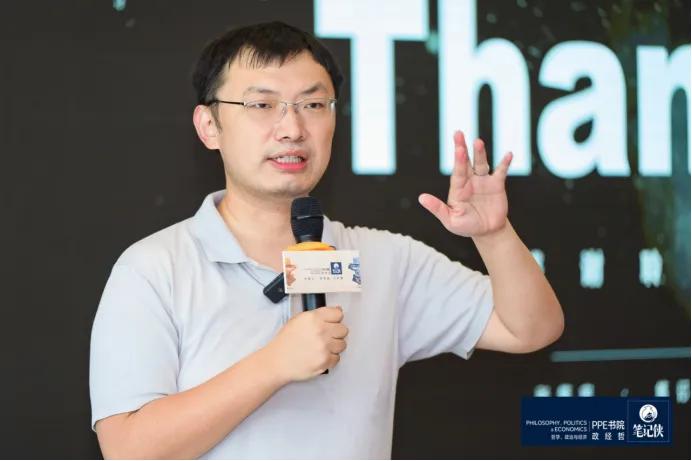
Teacher Zhang Xiaoyu is giving a lecture
How did it do it? First, it directly pulled down the 2,500-year classical Chinese corpus from the Internet. At first, I thought it was joking with me, but when I opened the folder, the data was really there. Second, it vectorized the semantics using embedding and made corresponding mappings in the space. Some words are associated with positive values, while others are associated with negative values.
Then it further analyzed: What are the words representing horizontal political alliances in ancient China? "Alliance" and "political party". In the vector space, are these words closer to "positive words" or "negative words"?
It analyzed all dynasties in three hours. Traditional historians cannot write such a study because they don't understand this technology. And I didn't even actively ask it to do this. This is a qualitative improvement in productivity.
Another example is a project where a school of geographical determinism research tries to analyze to what extent human social systems are determined by geography in a quantitative way.
A classic paper divided the world into more than 70,000 hexagonal grids, assigned climate data, geographical data, and vegetation data to each grid, and calculated how much grain each grid could grow. There is a Malthusian curve relationship between grain and population.
When the population increases, it will put pressure on other grids. Simply put, when there are too many people in one place and they can't be supported, they will seize the outside areas. By letting these grids conquer and merge with each other, the rise and fall of political entities are simulated.
I reproduced the logic of this paper. In my simulation, after running ten times, there was always a large unified political entity in the area of present-day China, while Italy, France, and Spain in Europe always remained divided into three.
To a large extent, the unity of ancient China and the division of Europe are determined by geography. The debate on geographical determinism has lasted for 500 years, from Montesquieu to the present. Today, I can easily study it in a quantitative way.
I also added two variables to the original model. First, I changed the linear population growth function to the Malthusian exponential relationship. Second, I added the Dunbar number, which means that the upper limit of the number of stable and intimate relationships a person can establish in a lifetime is about 150, and in management, the number of people a person can directly manage is about 10 to 15.
From the perspective of cybernetics, when an additional management level is added, noise will increase, important information will be lost, and specific agent interests will arise in the middle layer, that is, corruption. The more layers there are, the greater the loss.
After adding these two variables, the second version of the model showed the rise and fall of dynasties. You will find that the unity of China and the division of Europe are no longer so absolute. Sometimes China is more divided, and sometimes Europe may be more unified. This brings you back from pure geographical determinism and allows you to more deeply understand the relationship between geography, culture, system, and tradition.
This research took me more than a month. In the past, I was completely unable to do it because I didn't know how to write code. Now AI can write it, and you just need to have an idea. If you want to publish a paper, you can do it at any time.
2. Connect Global Intelligence and Discover Unseen Connections
Another example: I combined the open-source real-time data of global conflicts, such as the time and location of a missile explosion in a certain place in Iran, which was uploaded to social media after being filmed and verified, with the real-time shipping data of global key shipping lanes.
This combination was reminded to me by my AI, and I never thought of it myself. After the combination, a concept was created: Supply Chain Mutually Assured Destruction. The United States' control of key shipping lanes is certain, and China does not have the ability to challenge it. However, China's control of the global processing and refining industry chain is also monopolistic. Once the shipping lanes are destroyed, it will in turn damage the global industrial chain.
This is why China and the United States will never trust each other, but they also cannot suddenly turn against each other because both sides have to bear the great uncertainty of the global supply chain. With this framework, you can immediately understand the basic structure of the Sino-US geopolitical conflict in the next 10 to 20 years.
During this research process, AI also told me some things that I had never realized before. For example, at the beginning of this year, the refinery in Qatar was attacked by Iranian missiles, resulting in a sudden reduction of 50% in the global helium supply.
Helium is a by-product of oil refining and is also a necessary material for some key components in the upstream of the semiconductor industry. Qatar is trying to repair its production capacity, but repairing the refinery requires gas turbines, which are now in short supply globally because AI companies are expanding their data centers on a large scale.
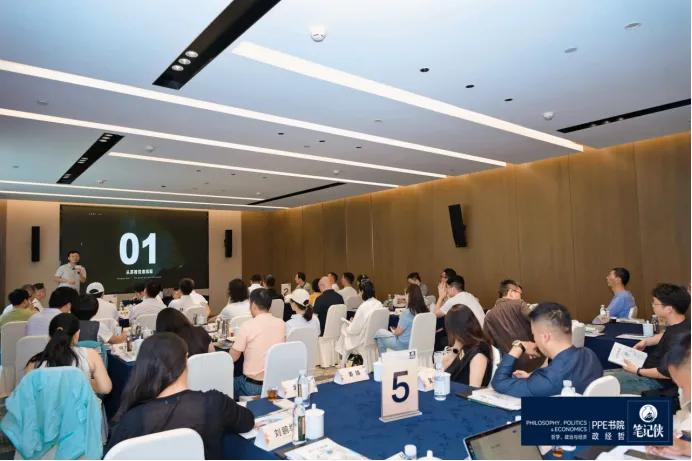
Students