Those crew members who won't be replaced by AI
AI is sweeping through the film and television industry at an unprecedented speed.
From topics like "AI-generated promotional materials" and "whether screenwriters will use AI to write scripts" to the current topic of "AI actors replacing real human actors", as long as it involves AI, it will be hotly discussed and even trend on social media.
When about to go undercover in Hengdian, Xiaoyu thought she would see a typical case of AI anxiety. For example, actors worried about losing their jobs, assistants afraid of being replaced by robots, designers having their jobs snatched by AI, and everyone learning prompt words, researching tools, and desperately proving that "humans still have value".
But after actually arriving at the film crew, Xiaoyu found that a very absurd reality is emerging at the front line of the film and television industry.
AI is indeed becoming more and more like a "human". It can retouch photos, write copy, generate storyboards, assist in voice-over, and even mass-produce animated dramas. But at the same time, many positions in the film and television industry are becoming less and less like "jobs" and more like "emotional consumables".
The "hard workers" in the film and television industry are coming up with all sorts of tricks to keep their jobs. Some stay on the set to crack jokes with the director and chat with him. Some run around to show that they are better at "taking care of people" than AI. Some people know that AI is already a mature design, but the client company still needs a living person who can bow and scrape to "take the blame".
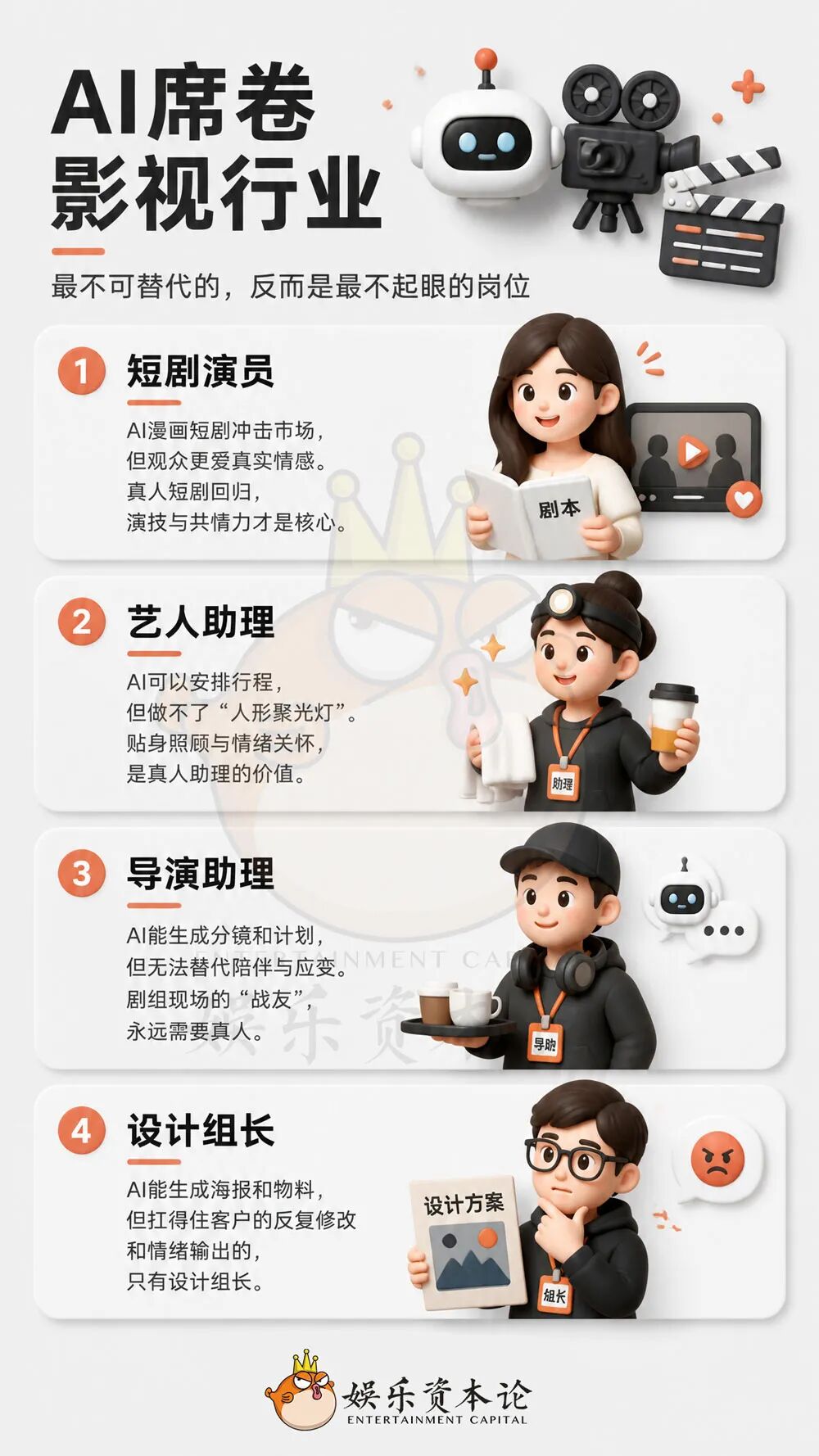
Yule Zibenlun (ID: yulezibenlun) had a chat with four front-line practitioners in the film and television industry on the set. Gradually, we found that the most black-humorous thing is that the most inconspicuous, hardest-to-quantify, and even a bit "servile" work in the film and television industry has become the most difficult position for AI to replace at this stage...
This is also the third article in Yule Zibenlun's "Front-line Records of the Cultural and Entertainment Industry" series. Previously, we went to Hengdian to observe the industry shock after the decline of short dramas. We also went undercover in the fan circle for 180 days to expose the gray business of photo agents, fan club leaders, and the "leakage economy". This time, Xiaoyu entered the film crew and found that after AI swept through the film and television industry, the first thing to change may not be technology, but "people".
# This article has interviewed four relevant people, who are also the 195th - 198th interviewees of Yule Zibenlun in 2026.
1
To keep my job of "serving tea and water", I'm having an "office intrigue" with AI
Interviewee: Xiaolin, 25 years old, assistant to the director
Xiaolin's major in university was related to psychology. After graduation, she didn't stay in her major but became a life assistant to a film and television director. She originally thought that the film crew was a great place to observe "people". People from different teams and positions get together for a few months to work on a drama, like a small society. All emotions, relationships, and power structures will be magnified, even more real than a psychological counseling room.
Unexpectedly, less than two years after entering the industry, she encountered AI first.
The director Xiaolin follows is an 80s generation, a "youngster" in the film and television directing field. He grew up with streaming media and is particularly willing to try new things.
An actor always mispronounces a word in the lines? Just use AI to modify the lip-sync and dub in the post-production. The prop document needs to be changed temporarily? Just use AI to generate a new one quickly. While watching the monitor and guiding the actors on the set, the director said, "If only I could dictate what I want and AI could immediately pass it on to the actors."
Xiaolin's director boss has wild imaginations about AI. To cater to the boss's preferences, Xiaolin also started actively learning about AI. She even asked a classmate to find a senior sister who knows a lot about AI to "manually popularize" the uses of AI tools like Doubao and Chatgpt for her.
"These AI tools can't completely replace humans, of course, but they have strong data collection capabilities. So they are most suitable to replace young people who have just graduated two or three years and have little work experience as assistants to the boss."
"Just graduated two or three years? Isn't that just talking about me?" The senior sister's unintentionally heart - stabbing words made Xiaolin's heart sink.
Recalling the time before entering the set, the boss loved to study new AI gadgets. When he saw a service - type AI intelligent robot, he even asked Xiaolin if she wanted to buy one, saying, "To relieve your burden."
"My job is just to serve tea and water and do odd jobs for the director. If the AI robot does it, what will I do?"
Because of this, Xiaolin gave the boss a half - hour "brainwashing".
"What if the robot falls on an uneven road? What if the technology is not mature and it spills the tea and coffee? What if it gets knocked over when it's busy? What if everyone is curious about the robot and wants to play with it, which delays the work..." As she went on, Xiaolin herself thought it was a bit absurd. It seemed that she wasn't really analyzing the robot but desperately trying to stop the director from finding someone to compete with her for the job.
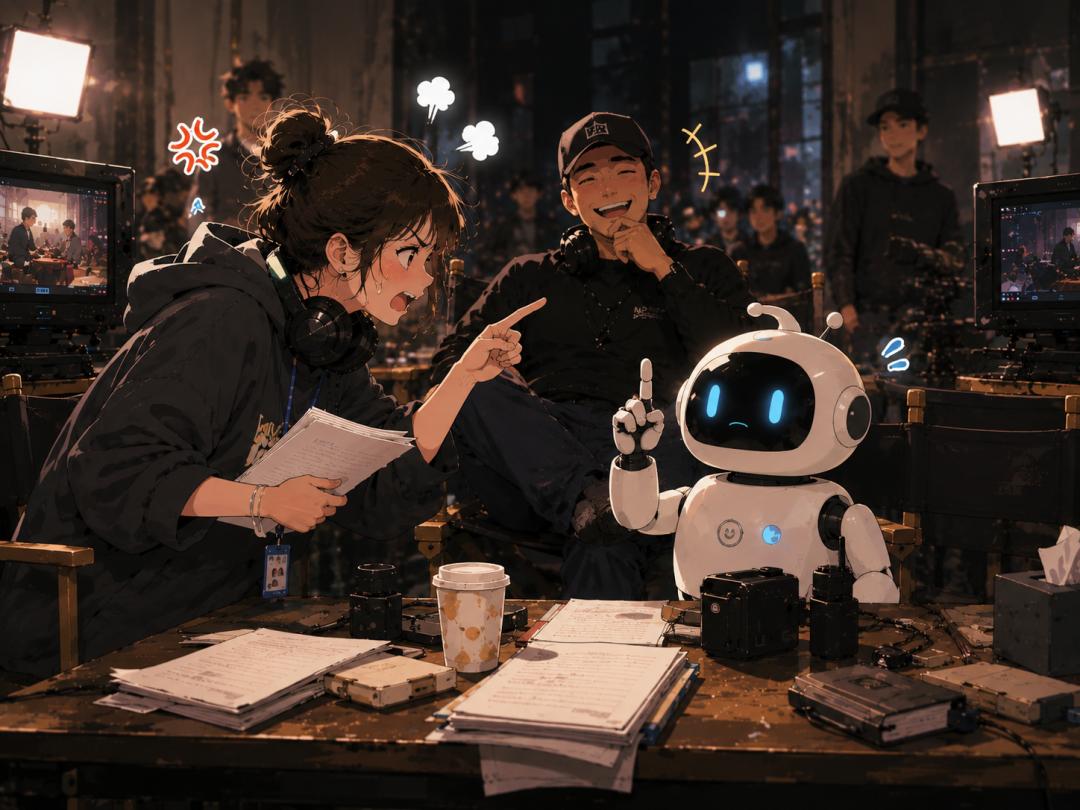
Normally, the boss always asks the same question to Xiaolin and then to Doubao. Xiaolin always tries extra hard to answer better than Doubao to prove her "value as a human". Over time, she vaguely felt that she was having an intrigue with AI, which was very absurd.
During that period, her AI anxiety suddenly became particularly severe.
Because she studied psychology, she is more sensitive than many people and better at perceiving her own emotional changes. She began to find that she would repeatedly search for AI - related news and couldn't help but think, "Will many positions not need real humans in the future?"
When she was bored waiting for the scene on the set, Xiaolin found that Doubao also had a voice - call function. During a night shoot, she even cried while chatting with Doubao. "I thought it was really embarrassing later. A person who studied psychology was finally made to cry by AI."
But from that stage on, she gradually became less anxious.
Because she found that although the boss talked about AI all the time, he didn't really want to replace anyone. The boss liked to throw the same question to her and AI at the same time. He just liked to stir up and say, "Why are you not as good as AI?" when AI answered faster, and then everyone on the set would laugh.
"Later I realized that the boss was just having fun," Xiaolin said. "When work was boring and the set was dull, he just hoped to have someone around who could crack jokes and create an atmosphere."
AI is of course very useful, but at least for now, it can't replace the very subtle sense of companionship on the set.
Finally, Xiaolin told Xiaoyu that in her understanding, AI can help the director improve efficiency, but at least for now, the director still wants to keep someone on the set who can complain, stay up late, and pass the boring time together.
2
A 'human spotlight' more 'competitive' than Doubao
Interviewee: Haijia, 22 years old, assistant to an artist
When Haijia was on the set, they shot a particularly exhausting night scene.
That scene was set in an old house on a rainy and thundery night. The crew had spent a long time building the set in advance. The rain machine was spraying water outside all the time, and the on - site lights were very dim. The wall paint was made to look old, damp, and moldy. Her boss, the actress playing the second female lead, was huddled in a small room with a wet and messy look after being in the rain, brewing her emotions while reading the script.
But the problem arose.
It was cold and wet on the set. The artist had just finished a crying scene, was shivering from the cold, and was so weak from crying that she could hardly see the script clearly. Haijia was holding a towel in one hand and a hot water cup in the other, so she didn't have a free hand.
Fortunately, Haijia, who had rich experience on the set, had prepared a head - mounted lighting device in advance. "As soon as the artist lowered her head to read the script, I would turn my head reflexively. When she turned the page, I would follow suit. When she moved, I would also move, always making sure the light shone on her script."
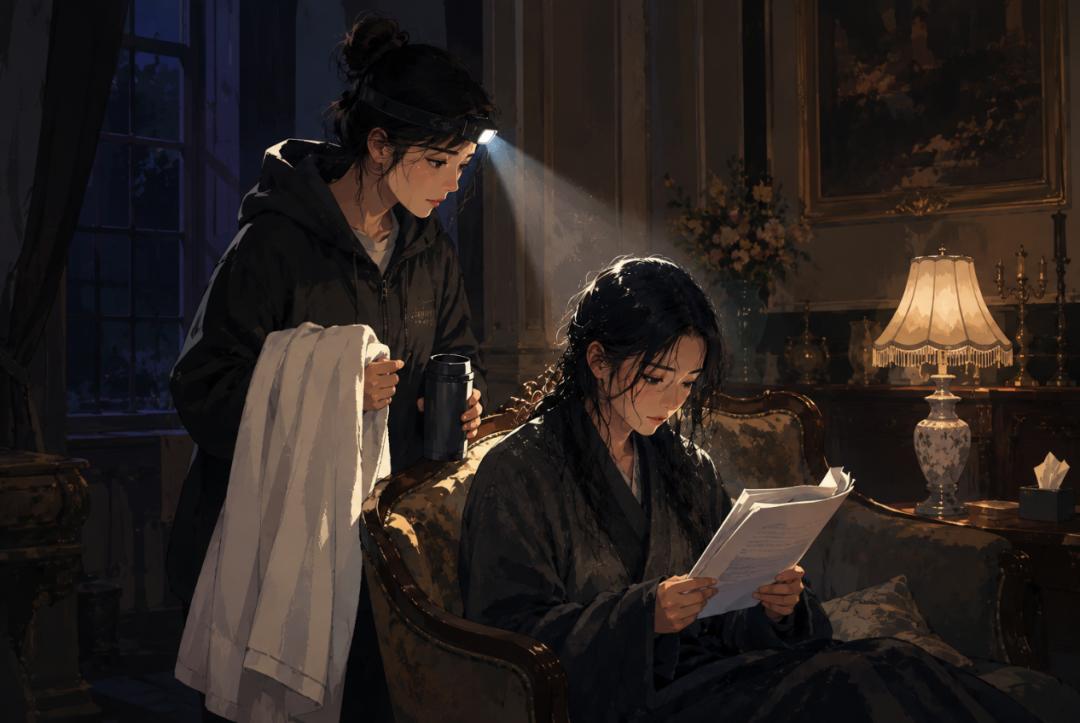
Because it was so dark on the set, from a distance, people could only see a beam of light following the script. Later, the other artists in the same group laughed their heads off. Some said she was like a gold miner, and some said she was like a "human spotlight". After that scene was shot, the artist specially praised her to others for being "very sensible".
Recently, Haijia often comes across topics like "AI actors will replace real human actors in the future" and "many service - type jobs will disappear". Many people have also asked her if she is worried about losing her job, but she is not that anxious.
People think that being an artist's assistant is just a servile job, but Haijia has her own thoughts. She thinks that taking the incident of her being a "human spotlight" as an example, in the future, there may really be more advanced AI - sensing lights that automatically turn on when a person lowers their head, automatically follow when the page is turned, and can even recognize a person's movements and emotions in advance.
But in many cases on the set, what is actually lacking is not a "smarter light", but someone who always pays attention to the artist in this chaotic, high - pressure, and disordered environment. Artists actually like this feeling of "being taken care of".
Xiaoyu believes that Haijia understands in her heart that the artist doesn't need a robot - controlled light, but an assistant who always puts the artist's needs first.
3
After AI replaced interns, the client found that there was no one to 'take the blame'
Interviewee: Li He, 27 years old, team leader of the design group in a marketing company
As the team leader of the design department in a marketing company, Li He is mainly responsible for producing promotional materials for film and television dramas, such as stills, posters, and retouching photos of artists. Image design was one of the first groups to be impacted by AI.
When he first started using AI tools in his work, Li He still thought it was good because it could really improve efficiency. But for the boss, "increasing efficiency" also means "reducing costs".
So the boss quickly started laying off employees. Originally, there were three groups with 10 people in the design department. Later, it was directly reduced to two groups with 5 people. The reason was that "AI has made the design work less saturated, so there is no need to hire so many people."
As a result, not long after, the company started recruiting interns again. And they were those low - paid and highly mobile intern positions.
Li He didn't understand at first and started to review. He recalled that once he was chased by the client to modify an artist's poster at 2 am. Suddenly, his emotions broke down, and he directly said in the company group, "Why don't you just ask AI to retouch it?" He even took an annual leave and went on a "strike".
It was after he returned to work from that annual leave that the boss started recruiting again. Li He gradually realized that the boss's re - recruitment of interns didn't seem to be because the work couldn't be finished.
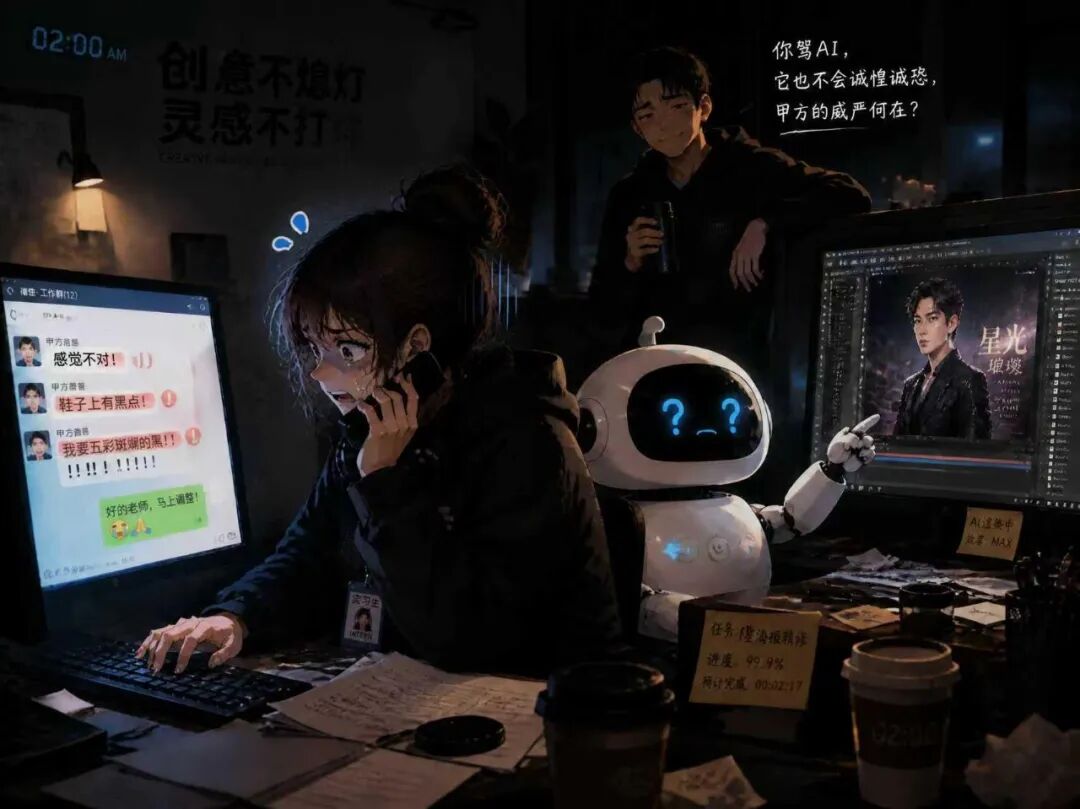
For example, when it comes to refined photos of celebrities, the client often suddenly says in the middle of the night, "The shadow on the neck is wrong!", "Why is there a black spot on the shoes?", "Why doesn't it have a sense of high - end?" Most of the time, the client either can't clearly say what's wrong and just says "It doesn't feel right", or wants a "colorful black".
When there were more people in the design group before, this pressure could be dispersed. Now, after the lay - offs, once the client pursues responsibility, the firepower will instantly focus on a few people. Some people have a breakdown after continuously modifying the pictures and say they quit. Some people are scolded by the client one moment and then have to smile and say, 'Okay, teacher, I'll adjust it right away' the next moment.
"Maybe AI can really make pictures, but it can't smile and apologize..." Li He sighed.
When the client gets angry, they need someone to constantly reply, "Okay, teacher, I'll adjust it right away." They need someone to answer the phone, explain, and comfort. And many times, the client is not really discussing whether the materials are good or not, but showing off their "client" status.
"If you scold AI, it won't be in awe. Where is the client's dignity?" Li He laughed.
So some people are ostensibly recruiting design interns, but actually recruiting "blame - taking" interns.
"AI is now very much like a mature designer," Li He said. "But it's not like a mature service provider yet."
Xiaoyu can't help but sigh that perhaps the real operating logic of the film and television industry is still that there has to be a living person to catch the emotions that the "client" throws over the phone or the Internet at any time.
4
Two months after shouting 'AI will replace real human actors', they started shooting ten live - action short dramas in a row
Interviewee: Yu Shutian, 30 years old, short - drama actor and self - media creator
Yu Shutian felt that there was an atmosphere in Hengdian after the Spring Festival this year that "live - action short dramas are almost over".
She remembered very clearly that right after the Spring Festival, AI - generated animated dramas suddenly started flooding the Moments. Many bosses who used to shoot live - action short dramas overnight started talking about AI. Some shouted that "real human actors will be unemployed in the future", and some directly disbanded the live - action department and started researching AI - generated animated dramas, as if whoever didn't talk about AI would be left behind by the times.
