In just one year, Alibaba has forcefully integrated all its business into AI, attempting to secure a position in the implementation of AI applications.
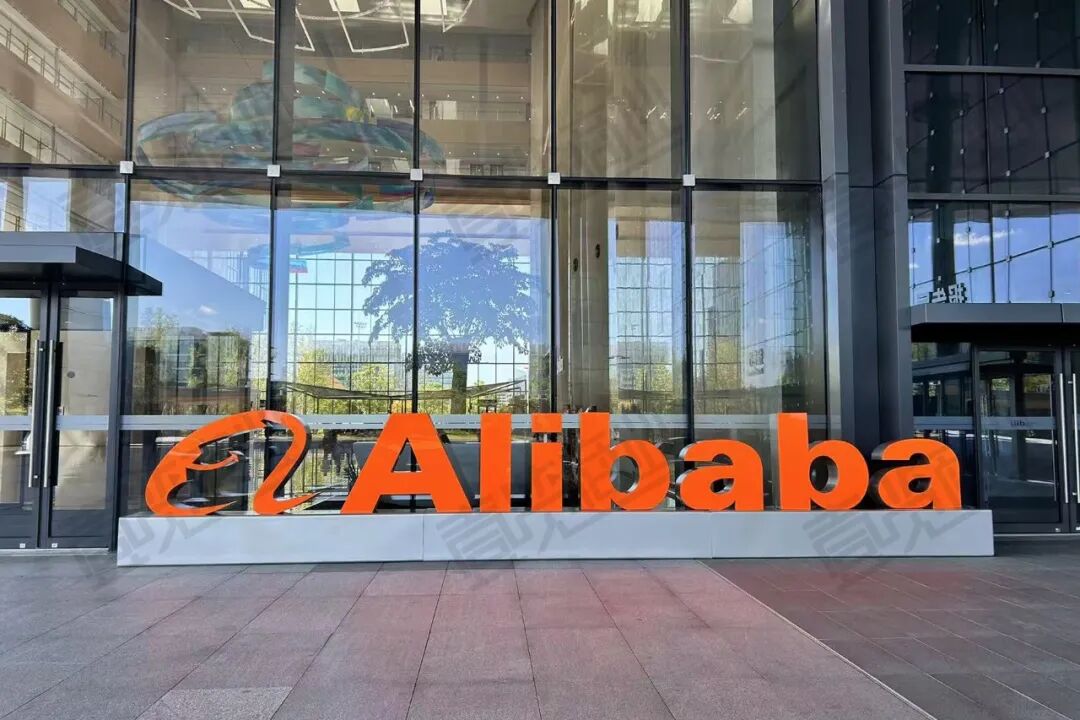
If 2023 was the first year of global AI, then 2026 should be the year when AI applications are implemented in China.
In May 2024, Cai Chongxin and Wu Yongming issued the first letter to shareholders after the new leadership team of Alibaba took office. The letter stated, "In the next decade, no industry will be immune to the disruption brought by AI."
Two years have passed, and Alibaba has gradually become one of the platforms with the heaviest investment and the deepest layout in China's AI industry.
According to the "China AI Cloud Market Share 2025" report released by Omdia, Alibaba Cloud ranks first in both the AI IaaS and MaaS - MPS core sub - markets, further consolidating its leading position in China's AI infrastructure field.
On May 20th, Alibaba Cloud announced at the summit that it had completed the full - stack Agentization upgrade of "chip - cloud - model - inference", and simultaneously launched a new AI product official website "Qianwen Cloud", a super - node server equipped with the self - developed AI chip Zhenwu M890, and the latest flagship model Qwen3.7 - Max.
From underlying chips and cloud computing to large models and Agent platforms, Alibaba is rapidly filling in its full - stack capabilities in the AI era.
Meanwhile, Yilan Business noticed that in the past year, Alibaba has tried to integrate all its businesses into AI, and the launch of AI products for some businesses seems a bit hasty.
Alibaba's E - commerce: Fully Online with AI
According to incomplete statistics by Yilan Business, almost all of Alibaba's core e - commerce and lifestyle service businesses have intensively launched AI products between 2024 and 2026.
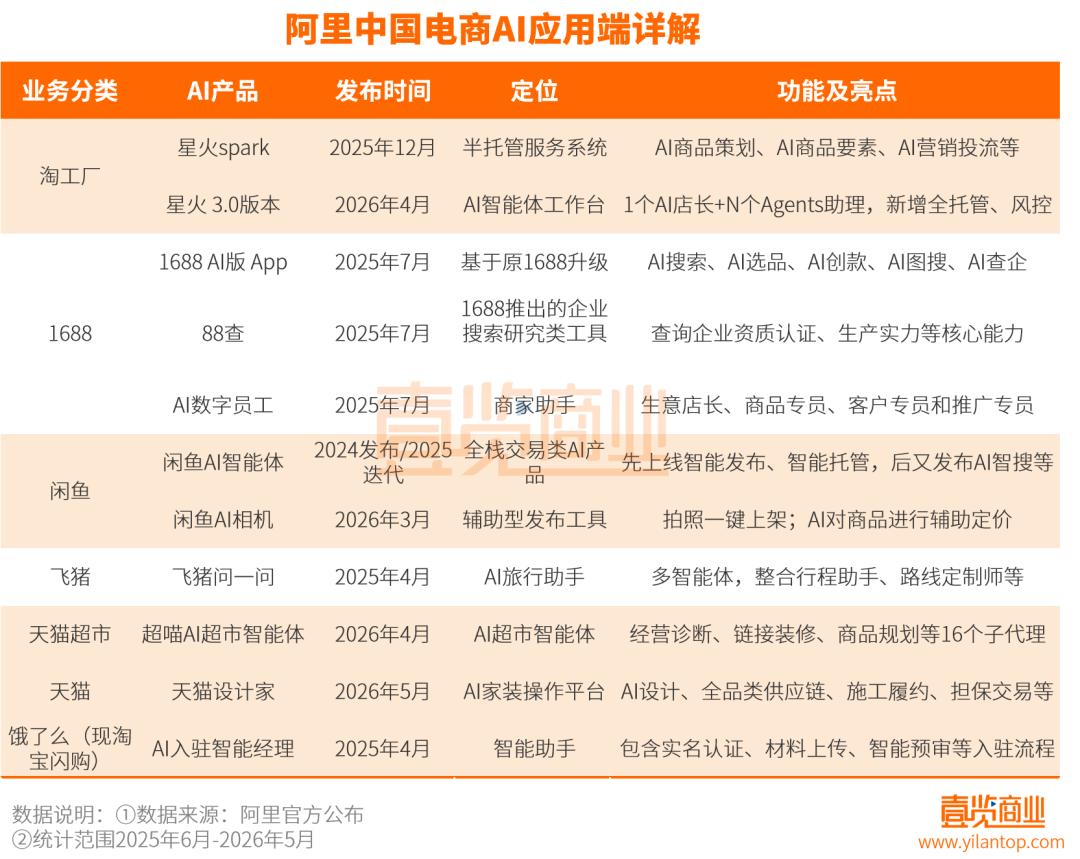
Based on the actual implementation of AI in multiple businesses such as Taogongchang, 1688, and Tmall Supermarket, Alibaba's AI has shown the following characteristics:
First, the depth of AI penetration has basically evolved to "intelligent agent hosting".
The earliest AI products, such as the intelligent publishing and intelligent hosting functions launched by Xianyu in 2024, were more like auxiliary tools to simplify the operation process. However, from the end of 2025 to 2026, Taogongchang's "Spark 3.0" has built an architecture of "1 AI store manager + N Agent assistants", achieving a full - hosting model; Tmall Supermarket's "Super Cat AI Supermarket Agent" covers 16 business sub - agents, including business diagnosis, advertising management, and intelligent replenishment.
Second, the breadth of AI coverage has also extended from a single "goods circulation" to a closed - loop of decision - making and service.
1688 has not only launched an AI version of its app but also independently launched "88 Search", an enterprise search and research tool, and an "AI digital employee" merchant assistant. Fliggy's "Ask" integrates multiple professional roles such as itinerary assistants, route planners, and hotel consultants to form a multi - agent - driven travel service. Tmall's "Designer" directly enters the home improvement market, providing a full set of capabilities from AI design to the supply chain and construction fulfillment. AI is no longer just a button but the underlying operating system of the entire business.
Finally, the implementation of AI in e - commerce business mainly focuses on improving "transaction efficiency" on the merchant side.
Whether it's Taogongchang's Spark, 1688's digital employees, Tmall Supermarket's agents, or Ele.me's AI settlement intelligent manager... They all address issues related to "goods circulation" such as product selection, pricing, product launch, advertising, customer service, replenishment, and supply chain management. This echoes Wu Yongming's statement that "C - end AI is the creator of token - consuming scenarios" - only by enabling merchants to use AI first and achieve efficiency can it drive a larger data flywheel and upgrade the user - side experience.
However, most of these AI products are currently only in the testing phase. Relatively mature platforms are those closer to the industrial end, like 1688. Products such as Xianyu's AI photo - taking and Tmall Supermarket's intelligent agent have only been launched for a few months, and it will take time to establish user habits and verify the business model.
More Test Beds: Redoing Niche Scenarios
In addition to e - commerce, Alibaba has thousands of scenarios suitable for being redone with AI. Yilan Business has counted the most typical ones.
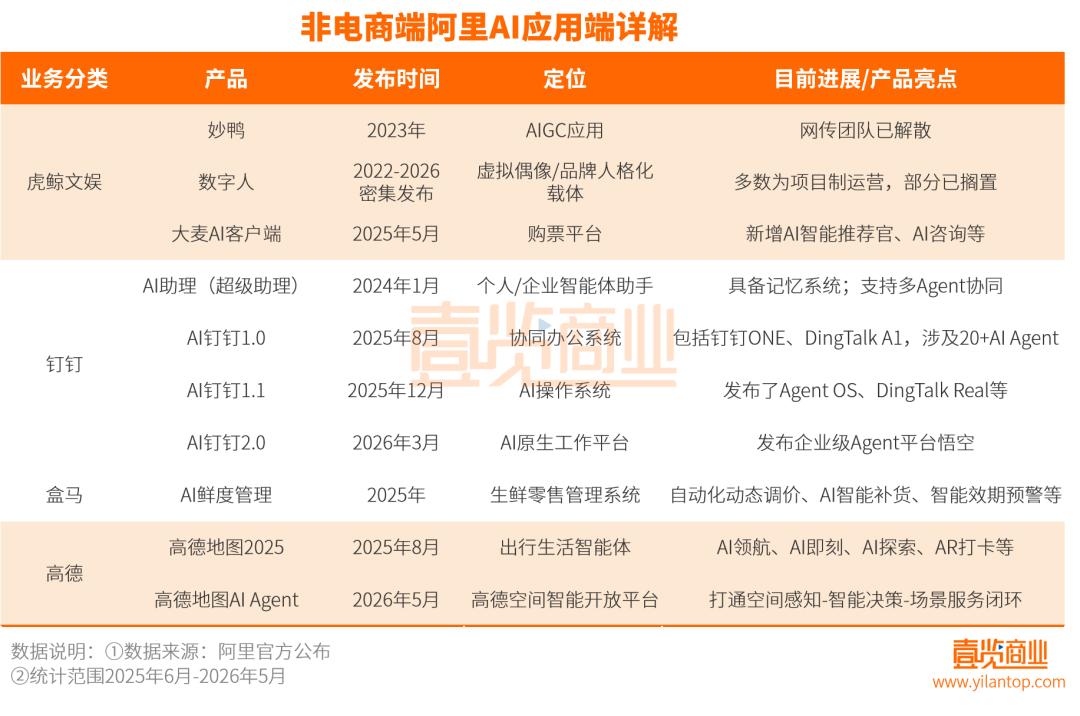
DingTalk is Alibaba's carrier for the enterprise - level first - tier in the AI era. Its product line is iterated at a pace of a major version every six months: first, creating an Agent entrance (AI assistant), then building the system underlying (Agent OS), and finally turning it into an enterprise - level Agent platform. DingTalk has hundreds of millions of enterprise users and tens of millions of organizations, naturally having high - frequency and high - value data scenarios, which are exactly the "fuel" needed for AI training and inference. It can be said that DingTalk is the AI business within Alibaba, aside from e - commerce, with the greatest potential for a "data flywheel".
There is also Gaode Map, which has been very active recently. Gaode's unique value lies in the fact that its location and travel data are the only high - frequency entrance to the "offline physical world" in the Alibaba ecosystem. Whether it's food delivery, taxi - hailing, local life, or tourism, Gaode can be the starting point for decision - making. Therefore, Gaode's AI upgrade first focused on intelligent agent functions such as AI navigation and AI instant service. By May 2026, it was further upgraded to the "Gaode Spatial Intelligence Open Platform", connecting the closed - loop of spatial perception, intelligent decision - making, and scenario - based services.
In contrast, within the Alibaba ecosystem, the AI scenarios of Huijing Entertainment are more focused, but the room for imagination is relatively limited. Recently, there were reports that the team of Miaoya Camera under Huijing Entertainment had been disbanded; Huijing Entertainment's digital human project is a representative of its AI transformation, but Yilan Business observed that most of these projects are operated on a project - by - project basis, and some digital humans have been put on hold.
What users can currently perceive more is its Damai client, but it only has basic functions such as an AI intelligent recommender and multi - intention recognition.
In addition to these in - house businesses, Alibaba has three more moves in its layout of C - end AI entrances: Quark, Qianwen, and UC Browser, which take completely different paths.
Among them, Qianwen is the product in which Alibaba has made the deepest bet on independent AI native applications. According to QuestMobile data, as of March 2026, Qianwen's monthly active users had reached 166 million, ranking second only to Doubao among similar products. Different from most AI assistants that still focus on Q&A, writing, and search, Qianwen's difference lies in "getting things done".
In January 2026, the Qianwen app announced its integration with Alibaba ecosystem businesses such as Taobao, Alipay, Taobao Flash Sale, Fliggy, and Gaode, attempting to repackage the transaction, payment, fulfillment, and service capabilities in the Alibaba ecosystem into an AI entrance.
Quark plays a different role. It is undergoing AI transformation based on high - frequency tool scenarios such as search, learning, office work, and file processing. Compared with Qianwen, which is more of a strategic bet on the "future entrance", Quark is more like a mature example of Alibaba promoting AI penetration in its existing traffic pool. Its value lies in verifying whether AI can be embedded in the user - familiar search and tool links and increase usage frequency and retention.
UC Browser has chosen a lighter path. In January 2026, UC Browser launched the "AI group chat" function. The default members include UC's native AI assistant "Xiaoyou", Quark AI, Tongyi Qianwen, and the externally - cooperated DeepSeek, adopting a multi - Agent architecture. Users can ask multiple agents the same question. This function currently has a deep entrance and has not been widely promoted, more like a small - scale experiment by Alibaba on the traditional traffic entrance of browsers.
Overall, compared with the e - commerce side, the AI applications on Alibaba's non - e - commerce side cover a wider range of areas, from enterprise collaboration to retail operations, from travel navigation to cultural and entertainment consumption, almost touching every aspect of lifestyle services.
Four Tests for Alibaba's AI: Efficiency, Users, Ecosystem, and Entrance
In fact, after three years of development, China's AI industry has fully shifted from a simple long - distance race in model technology to a fierce "positioning competition" centered on application implementation.
The prominent features of this competition are the high concentration of capital, the rapid expansion of the user scale, and the intense competition among giants. Data shows that in 2025 alone, the financing in the domestic AI application field exceeded 100 billion yuan, and the monthly active users exceeded 446 million; during the Spring Festival in 2026, giants such as Tencent, Alibaba, and ByteDance spent over 8 billion yuan on red envelopes to seize entrances. The monthly active users of ace products such as Doubao, Qianwen, and DeepSeek have all exceeded 100 million, forming differentiated competition paths such as "traffic × experience", "ecosystem × closed - loop", and "technology × word - of - mouth".
Therefore, from a higher perspective, the core purpose of Alibaba integrating all its businesses into AI is to gain a foothold in this fierce "positioning competition" centered on application implementation. At the same time, for Alibaba now, rushing to integrate all businesses into AI is also a way to force the businesses to undergo a four - fold stress test to some extent:
The first test is whether AI can bring real business results. If AI cannot be converted into quantifiable business returns, it is just an expensive technological gimmick.
The second test is user acceptance. The value of AI must be realized through continuous user usage, and the premise of user usage is that the product is truly embedded in the daily decision - making process. It is indeed gratifying to create an AI native application with over 100 million monthly active users, but to achieve commercialization, the key lies in solving the problem of getting users to pay willingly.
The third test is the ecosystem synergy ability. Alibaba has many scenarios such as e - commerce, payment, logistics, local life, office work, and travel. However, history has proven that integrating the internal traffic pool is never easy. Whether AI can truly break down organizational barriers and enable seamless flow of data and services within the ecosystem will directly determine whether the vision of "one AI entrance to manage all" can be realized.
The fourth and most fundamental test is: where will the AI entrance be? Alibaba's bets on multiple paths at the same time precisely show that the entire industry is still looking for the answer.
The full - stack layout gives Alibaba the confidence to stay in the game, but the real decisive factor lies in who can first establish a positive flywheel of "AI efficiency improvement - merchants making money - user retention - continuous token consumption". There is no standard answer for this test, and time will give the score.
This article is from the WeChat public account "Yilan Business" (ID: yilanshangye), written by Li Yan and published by 36Kr with authorization.