Behind the popularity of the "Chinese version of Love, Death & Robots": AI short - film players are entering the market in batches, with some commercial orders quoted as high as one million yuan.
On May 9th, Mx-Shell (real name Liu Ziyu) released an AI short film he produced himself. This video, made out of personal interest, sparked a viral trend on global social platforms in just a few days.
This short film titled "Zombie Scavenger" presents a story of a cowboy robot wandering in a post - apocalyptic zombie background in an atomic punk style. Many netizens call it the Chinese version of "Love, Death and Robots" and it has become a phenomenon - level work.
Liu Ziyu, 29, became an overnight sensation. The private messages flooding in on social platforms, the continuous phone calls, and the overwhelming media interviews, and even the cooperation invitation from well - known Hollywood AI film producer PJ Ace, have made this AI creator, who graduated from secondary vocational school and is not from a film - related major, completely break out of the circle.
"(This kind of traffic and exposure) was not what I wanted from the beginning," Liu Ziyu said in an interview with a reporter from Time Weekly recently. "I can't say the quality of this film is top - notch. Initially, I would have been very happy if it could get 500,000 views. But perhaps it was the combination of various contrast factors that led to its popularity."
Before starting to release AI short films on social platforms at the beginning of this year, Liu Ziyu's main job had little to do with it. He mainly shot videos and made posters for some family businesses in his hometown county to help with promotion. In his spare time from daily work, he came into contact with AI creation tools and tried to generate videos from some effect design drawings through AI, and quickly got the hang of it.
Currently, the AI short - film track is booming. New technologies have lowered the threshold for film and television content creation, making it a reality to produce AIGC content with a shorter cycle and lower cost. Liu Ziyu's short film only took 10 days to produce, and as for the production cost, "I didn't even spend a cent. It was all thanks to the platform's support."
When the technical threshold is significantly lowered, the "director's dream" of ordinary people is no longer far away. From individual hit players to professional creators, and then to professional teams, they have all flocked to this field, jointly forming a diverse picture of the AI short - film track. However, under the boom, for players to go a long way, they can't avoid the real proposition of how to continuously produce content and achieve stable monetization.
Although AI technology has impacted the traditional film and television content production methods, in the view of many practitioners, AI still has obvious shortcomings. "With current AI creation tools, even if you give it the exact same prompt words and pictures, the results will be different every time. You can't achieve 100% precise expression, and it can't produce exactly what you want," Liu Ziyu said.
On the commercial level, according to the interviews conducted by Time Weekly reporters, the current mainstream revenue channels in the AIGC industry include taking commercial orders, platform traffic sharing, IP copyright derivatives, and AI teaching. Some top AI short - film creators can charge up to one million yuan for a high - quality commercial order, and some companies have even completed their first - round financing. However, this is also a highly competitive track. Players need to continuously break through between technical bottlenecks and market recognition to firmly hold onto this trend.
"Catching the trend is also quite important"
"Zombie Scavenger" uses the Seedance 2.0 model and was made with almost no reference pictures and no start - and - end frames. In other words, it was basically generated by AI based on the prompt words.
However, this process was not smooth. Liu Ziyu introduced that the shot that took the longest time to make was a 15 - second shot that took a whole day to polish. It was a scene where a robot rode an ostrich and hit a coconut tree. He wanted to combine various scene elements, including the details of coconuts falling from the tree and the tone of swearing, but the effect was not good. It wasn't until he "tuned" it for a whole day that he was finally satisfied.
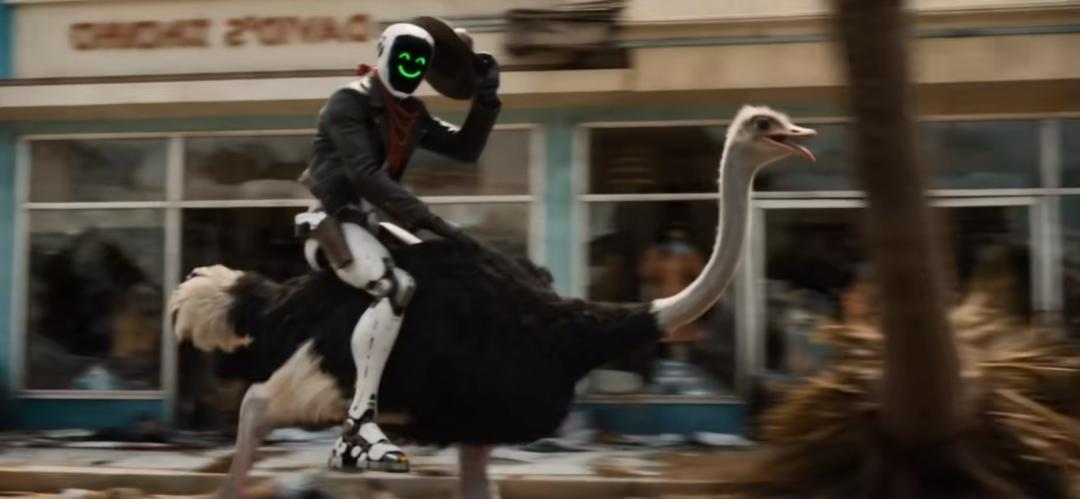
△ Mx - Shell's AI work "Zombie Scavenger". Source: Screenshot from a video website
"If you look closely, there are quite a lot of continuity errors in this film. For example, at the arm joints of the mannequin, you can clearly see the traces of brush strokes (hand - drawn drafts were used as a reference here), and it's not very realistic. But people seem to be more immersed in the plot and ignore these things," Liu Ziyu said.
Compared with traditional film and television works, this is undoubtedly a low - cost production. Before it became popular, Liu Ziyu's AI works had already caught the attention of the platform. The platform invited him to join the "High - quality Creator Program" and gave him some free points and helped with promotion. Therefore, the cost of producing "Zombie Scavenger" can be ignored.
"I just made this film for fun at the beginning. I didn't think too much about it. I was a bit at a loss after it became popular," Liu Ziyu told a reporter from Time Weekly. He said that recently he has to reply to countless messages and phone calls every day and can't keep up. Later, he only left his WeChat ID for some people seeking cooperation, but most of the cooperation invitations were rejected by him.
Some creators enjoy the trend more.
Li Rang, a senior student majoring in classical dance at Nanjing University of the Arts, was short - listed for the AIGC unit of the Beijing International Film Festival with his "Farewell" series of AI short films and received millions of likes on Douyin. On the day when "Farewell 1" became popular, he immediately stayed up all night to produce "Farewell 2". "Sure enough, the effect was better than the previous one," he said.

△ AI short film "Farewell". Source: Screenshot from a video website
Li Rang has not systematically studied film and television production and AI technology. His professional background gives him a certain sense of aesthetics and shots. Coupled with his operation of a new media account, he is sensitive to traffic. "After this series became popular, I realized that I should deeply engage in AIGC. Catching the trend is also quite important," he told a reporter from Time Weekly.
In Li Rang's view, the most difficult part in the process of AI short - film creation lies in the script, just like in the traditional film and television industry. This is where people need to exert their abilities the most. After having the script, it is then split into shot scripts, and then the scripts are converted into prompt words. AI can provide assistance in this link, and finally the video is generated.
Although the creation is difficult, it is very important to keep up in this highly competitive track. "I update at a relatively fast frequency so that I can keep up with others," Li Rang said. In addition to the creation itself, he has also started to rush to select a location for his AIGC brand, and his schedule is also filled with media interview invitations.
Commercial orders have multiplied, and a company claims to have completed the first - round financing
The huge traffic can bring great motivation to creators, but in the AI short - film track, traffic based on high - quality content is even more precious.
Some practitioners believe that the current industry is uneven. Some works simply aim for traffic and imitate the model of popular short videos. For example, they only focus on grabbing people's attention in the first three seconds, while abandoning the core that high - quality works should have. Not many people appreciate good content, but content that only releases dopamine has high traffic. This situation is not conducive to the development of the industry.
"Zombie Scavenger", which is considered to reach a professional level, seems to let the industry see more possibilities. After it became popular and broke out of the circle, multiple domestic and foreign teams, MCN agencies, and copyright holders have issued invitations. Liu Ziyu only selectively finalized cooperation in the film, television, and game sectors. Among all the monetization paths, IP copyright derivatives may have the highest revenue ceiling and the most commercial sustainable value, which has enlarged the monetization space of high - quality content like "Zombie Scavenger".
The cooperation on the film and television side is mainly about secondary plot adaptation. The cooperation partner extended an olive branch before the short film became popular. In Liu Ziyu's view, this shows that the partner truly recognizes the content of his work, rather than just focusing on the popularity. Regarding the development of game IP authorization, Liu Ziyu said that this is a direction he is interested in. The other party wants the original plot settings, world - view framework, etc. He will participate more in this area in the future and deeply involve himself in the long - term derivative development of the IP.
Different from many individual creators, there are also some startup companies that are quickly exploring this market through institutionalized operations.
Yang Hanhan, who is engaged in e - commerce entrepreneurship, said that she was first amazed by the ability of AI to generate images, and then she and two colleagues "struggled" to create an AI video. She quickly realized that an opportunity had come.
In just one year, Yang Hanhan formed her own AI creation team and established a company. Currently, the team has more than 30 members. The popular AI short film "Huo Qubing" was made by three members working 12 hours a day for four days.
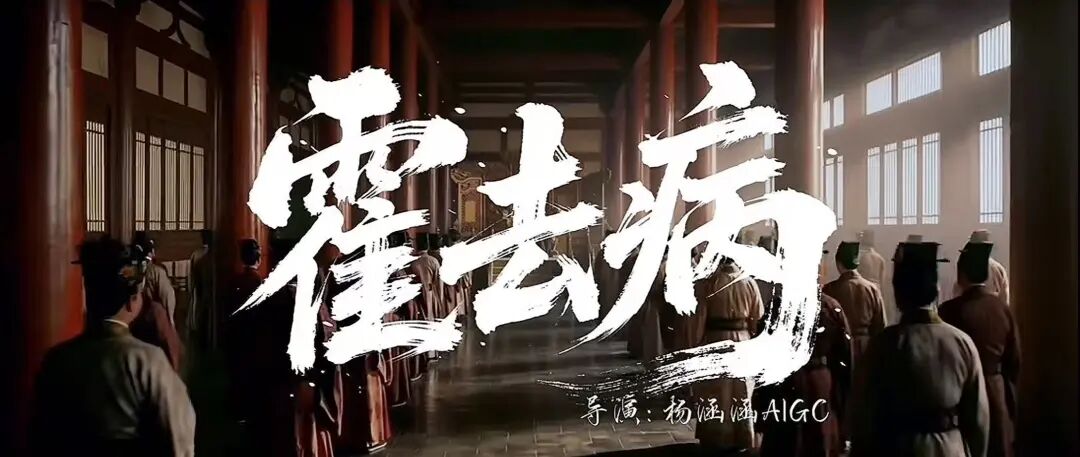
△ AI short film "Huo Qubing". Source: Screenshot from a video website
"The most difficult thing now is the scarcity of compound talents. There are too few people who understand film and television narrative and AI technology," Yang Hanhan said. "The current industry entry threshold is low, and a large number of newbies are flocking to create homogeneous entertainment - oriented content. However, there is a large gap for teams that can undertake mainstream projects with high - quality narrative and cultural core."
The unclear industry prospects and the need to explore the direction of funds and technology are also the problems she is currently considering. In order to stably produce high - quality content in batches, the company has established a standardized work process, covering all processes from topic planning to model testing, shot decomposition, AI batch generation, manual film review and editing, and then to business docking and operation.
Adopting the high - quality production route has brought more opportunities to Yang Hanhan's team. She told a reporter from Time Weekly that the company's current commercial orders include advertisements, government and enterprise publicity, and brand customization, with quotes ranging from tens of thousands to millions of yuan, mainly affected by the video duration and the difficulty of specific requirements. "After 'Huo Qubing' became popular, the team's commercial orders tripled. Now the company has completed its first - round financing, and the profit is expected to reach tens of millions of yuan this year," Yang Hanhan said.
However, for practitioners, whether they can digest commercial orders in time is also a test. Li Rang admitted that it takes a long time for him to complete a commercial order. The script needs to be revised many times, and considering the review process of the other party, the cycle may be extended to 15 days or even a month.
Equal access to creation does not mean equal access to creativity
Although creators have become popular because of AI, they still need a lot of running - in to cooperate with it skillfully.
A very real problem is that the current AI large - model text - to - video generation lacks sufficient differentiation. In many cases, without reference pictures and start - and - end frames, the characters generated by AI will be highly homogeneous, that is, they all have an "AI face".
Taking her own creation as an example, Yang Hanhan told a reporter from Time Weekly that AI is most likely to go wrong in three aspects: character consistency, long - shot emotional coherence, and large - scene spatial logic, resulting in deformed faces, disordered clothing, action penetration, and chaotic scenes of thousands of troops. The biggest difficulty in making "Huo Qubing" was to ensure the consistency of Huo Qubing's juvenile expression, facial features, and armor throughout the film, while also controlling the grand war scenes without chaos. Finally, by building a dedicated digital asset library, disassembling the shots frame by frame, and repeatedly adjusting the prompt words, this problem was solved.
In this situation, it may not be wise to forcefully confront AI. She said bluntly that forcing AI to do things it can't do is just making things difficult for AI. In daily creation, the team does not completely rely on intelligent generation. For tasks such as fine editing and picture retouching that are difficult for AI to complete, they will use traditional film and television tools such as AE to manually polish and make up for the deficiencies, using traditional methods to make up for the shortcomings of AI creation. "Many picture problems are not the problem of people, but the limitations of the model itself. These inherent shortcomings can only wait for subsequent technological iteration and optimization. There is no need to insist stubbornly."
Liu Ziyu also believes that in the creative process, AI is prone to misunderstandings and it is difficult to fully realize the pictures envisioned by people. Facing such problems, arguing with AI is useless. You can change the prompt words according to AI's thinking and don't forcefully reverse AI's logic. Many minor detail deviations may have to be sacrificed for the overall feeling of the picture.
"If you want perfection, you can only fix the picture with start - and - end frames, but this will sacrifice AI's creativity. And if you choose to use text prompt words, it may do a poor job, but it may also bring unexpected surprises," he said.
While new technologies are constantly being run - in and iterated, the question that follows is where the film and television industry may be headed.
Although he became popular overnight with his AI works, Liu Ziyu said that he still likes traditional "manual production" and always believes that AI cannot replace true feelings. "No matter how emotional AI is, it can't deceive my tears." He compares AIGC with the traditional film and television industry to digital cameras and film cameras. After the emergence of digital cameras, film cameras lagged behind in terms of convenience. "But as time goes by, some people will fall in love with film cameras again, loving their texture and color."
Li Rang believes that AIGC and the traditional film and television industry are not on the same track. AIGC will not follow the path of traditional film and television industrialized filming in the future, but will become a carrier and outlet for the emotions of ordinary people. "In the future, AI may not be used in the film and television industry, because everyone can use AI. If you use AI to make a movie, who would be willing to pay to watch it in the cinema?"
AI has brought about a reduction in the threshold, which is a typical equal access to creation. Undoubtedly, equal access to creation will bring about a great deal of creative prosperity in the industry and promote new opportunities for the film and television industry. However, equal access to creation does not mean equal access to creativity. The aesthetic gap, content connotation gap, and even the gap in industrial production capabilities among creators will become more and more obvious.
Yang Hanhan predicts that in the next 1 - 2 years, AI film and television will enter a standardized and industrialized stage from a wild - growth state. The dividends for individual scattered creators will fade, and the model of corporate and team - based operations will become the mainstream. By then, what players will compete for is no longer the tools, but the narrative ability, technical system, and resource integration ability.
"Traditional film and television is irreplaceable. AIGC is complementary to it, not a substitute. AI solves efficiency, cost, and grand scenes, while traditional film and television delves into delicate performances and in - depth narratives. The integration of the two is the future trend. And it is not ruled out that production teams in the traditional film and television industry will also enter the field of AIGC," she said.