Xiaomi announced its Q1 performance: Total revenue reached 99.1 billion yuan. A new large SUV model was revealed. LU Weibing said: It will be launched this year and won't be named YU9. LEI Jun said: Xiaomi will invest 60 billion yuan in the AI field in the next three years.
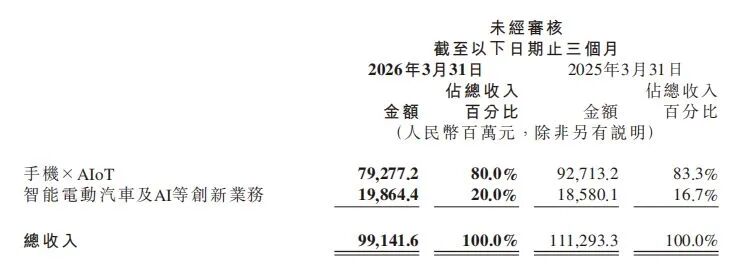
On the evening of May 26th, Xiaomi Group (HK01810, stock price HK$29.760, market value HK$769 billion) disclosed its performance for the first quarter of 2026: total revenue was 99.142 billion yuan, a year-on-year decline of 10.9%; adjusted net profit was 6.072 billion yuan, a year-on-year decline of 43.1%. Among them, the revenue of the Xiaomi Mobile × AIoT (Artificial Intelligence Internet of Things) segment was 79.3 billion yuan, with a gross profit margin of 22.5%, and the revenue of the innovative business segments such as smart electric vehicles and AI (Artificial Intelligence) was 19.9 billion yuan.
At the earnings conference call on the same evening, Lu Weibing, President and Group Partner of Xiaomi Group, highlighted the future work of Xiaomi Group. Regarding the mobile phone business, when answering questions from a reporter from NBD (National Business Daily), Lu Weibing said that not only Xiaomi and the mobile phone industry, but the entire consumer electronics industry is under pressure. The smaller the memory capacity of a product category, the greater the pressure it bears. The negative factor of rising storage prices is difficult to eliminate in the short term. AI will be the biggest incremental opportunity in the mobile phone industry, and this year is expected to be the "Year of AI Mobile Phones".
Regarding IoT (Internet of Things) and consumer products including major home appliances, Lu Weibing said that this year, Xiaomi will accelerate its expansion overseas, especially the export of major home appliances. In the future, the proportion of major home appliances such as air conditioners, refrigerators, and washing machines in the overall revenue will increase from being "negligible" to becoming increasingly important.
Total revenue in the first quarter of this year was 99.142 billion yuan
The earnings report data shows that in the first quarter of 2026, Xiaomi Group's total revenue was 99.142 billion yuan, a year-on-year decline of 10.9% and a quarter-on-quarter decline of 15.2%; the adjusted net profit was 6.072 billion yuan, a year-on-year decline of 43.1% and a quarter-on-quarter decline of 4.4%. When talking about the first-quarter performance, Xiaomi Group said in the earnings report that during the reporting period, geopolitical uncertainties have disrupted the global economy. At the same time, the sharp rise in the prices of core components including storage and commodities, as well as intensified industry competition, have continued to have a negative impact.
Breaking down the business, in the first quarter of this year, the revenue of the Xiaomi Mobile × AIoT segment was 79.3 billion yuan, with a gross profit margin of 22.5%. The revenue of the innovative business segments such as smart electric vehicles and AI was 19.9 billion yuan.
Specifically for the smartphone business, in the first quarter of this year, Xiaomi Group's global smartphone shipments reached 33.8 million units, and the revenue from the smartphone business was 44.3 billion yuan, with a gross profit margin of 10.1%. It ranked third in global smartphone shipments, with a market share of 11.3%. The average selling price (ASP) of smartphones increased by 8.2% year-on-year to 1,310 yuan, reaching a record high. The proportion of high-end smartphones in the domestic market in the overall smartphone sales volume was 23.5%.
When talking about the rising storage prices, Lu Weibing said at the earnings conference call on the same evening that Xiaomi judged in the third quarter of last year that this round of memory cost increase cycle is a "super cycle", and the increase will be relatively sharp. "I think the entire industry may need to adapt to the new normal of rising costs, and don't expect the memory cost to drop significantly in the short term."
When answering a reporter from NBD's question about inventory control and pressure, Lu Weibing said that not only Xiaomi and the mobile phone industry, but the entire consumer electronics industry is under pressure. The smaller the memory capacity of a product category, the greater the pressure it bears. The cost of some product categories has even increased by nearly 10 times. Lu Weibing said that Xiaomi will not raise prices just for the sake of raising prices. It will reposition its products and achieve a balance between scale and profit through the upgrade of the product matrix and software optimization.
The IoT business has nearly four times the growth potential
It is worth noting that Lu Weibing also mentioned that despite the unfavorable factor of rising storage prices, there are actually opportunities in the mobile phone industry, that is, the combination with AI. "We will seize this wave of AI opportunities, especially with Miclaw and Super Xiaoai. In the future, Super Xiaoai will be oriented towards users, and Miclaw will be integrated into Super Xiaoai to become a capability support behind Super Xiaoai." He emphasized that AI is the biggest incremental opportunity in the mobile phone industry. In July and August this year, Xiaomi will also release a new generation of OS (Operating System).
In Lu Weibing's view, 2026 may be the "Year of AI Mobile Phones". "I think the biggest difference between AI mobile phones and the previous ones is that the previous mobile phones were centered around apps, while in the future, they will be centered around agents. In the past, individuals controlled apps to complete certain tasks. In the future, I think agents will be able to understand your intentions and help you complete all executions and operations."
Lu Weibing said that in his view, a very important core for future mobile phone manufacturers to succeed is the framework. However, having only the framework is not enough; there must also be a model. "As you can see, in the current closed beta of our Miclaw, it is connected to our MiMo model. Having our own model and framework, and having them cooperate with each other, will definitely give us an advantage in terms of experience, reaction efficiency, reaction speed, and cost." Lu Weibing said that in the next five years, one of Xiaomi's very important tasks is to build a "full ecosystem of vehicles, homes, and people" that is comprehensively upgraded, empowered, or reconfigured by AI.
In addition to smartphones, there have been many rumors in the industry this year that Xiaomi will increase its investment in the major home appliance business. From the earnings report data, in the first quarter of 2026, the revenue of the IoT and consumer products business including the major home appliance business was 24.7 billion yuan, with a gross profit margin of 25.2%. The overseas revenue of IoT and consumer products reached a record high.
When talking about the IoT and consumer products business, Lu Weibing said that Xiaomi has started to independently develop relatively core product categories, such as air conditioners, refrigerators, washing machines, and sweeping robots. In addition, this business has also benefited from the development of Xiaomi's new cars. "Because many products need to be experienced offline, especially high-end products. As you can see, in the past, the proportion of our ecological chain products offline was relatively low, and now it can basically reach more than 20%."
Lu Weibing also mentioned that affected by factors such as "national subsidies", the pressure on this business department has increased this year. "In this situation, we confirmed last year that we must accelerate the overseas expansion of the IoT business this year."
There are mainly two ways of expansion: one is to increase cooperation with overseas e-commerce platforms, such as Amazon; the other is to accelerate the export of major home appliances.
"This year, you will find that major home appliances such as air conditioners, refrigerators, and washing machines, which we thought were negligible in our overall revenue last year, will become increasingly important this year. I believe that next year, the harvest will be even greater. Another very important thing is that we will continue to deepen local operations." Lu Weibing emphasized that Xiaomi's IoT business still has a lot of room for growth, and combining the domestic and overseas markets, there is nearly four times the growth potential.
The revenue of smart electric vehicles increased by 5.1%, and the annual delivery target of 550,000 vehicles remains unchanged
It is worth noting that in the first quarter of this year, the revenue of Xiaomi Group's smart electric vehicles was 19 billion yuan, a year-on-year increase of 5.1%, accounting for more than 19% of the total revenue.
"This is mainly due to the increase in vehicle deliveries, but partly offset by the decline in the average selling price (ASP) of vehicles," Xiaomi Group explained.
Official data shows that in the first quarter of 2026, the delivery volume of Xiaomi cars was approximately 80,900 units, a year-on-year increase of 6.6%. Xiaomi Group said that the launch of the Xiaomi YU7 series drove the increase in delivery volume, but part of the increase was offset by the decrease in the delivery volume of the first-generation Xiaomi SU7 series due to its discontinuation in the first quarter.
Lu Weibing, Partner and President of Xiaomi Group, also said at the earnings conference call that the Xiaomi YU7 series models were mainly delivered in the first quarter of Xiaomi cars. "As of May 6th, the cumulative order volume of the new-generation SU7 has exceeded 80,000 units within 48 days of its release. Our automotive business has withstood severe challenges and has passed the most difficult time," Lu Weibing said.
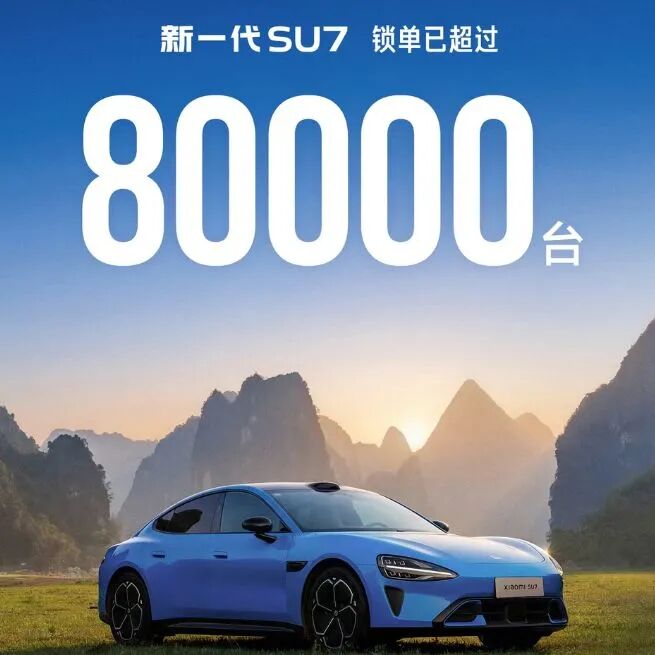
Image source: Xiaomi Auto WeChat official account
According to the plan, Xiaomi Auto's sales target for 2026 is 550,000 vehicles. In the first four months of this year, the cumulative delivery volume of Xiaomi cars exceeded 109,000 units, completing 19.8% of the annual sales target.
In response to the question of whether Xiaomi Auto will adjust its annual sales target, which is of concern to the outside world, Lin Shiwei, CFO (Chief Financial Officer) of Xiaomi Group, replied that the company will still carry out the annual vehicle delivery according to the target set at the beginning of the year. "In the second half of the year, we will have more innovative models launched, which will reflect Xiaomi's understanding of different markets and different users," Lin Shiwei revealed.
In response to the rumored YU9 model in the market, Lu Weibing replied: "Everyone is very concerned about a large SUV that has been spotted on the road (referring to road testing). However, it needs to be clarified that the name of this car is not YU9. Please don't be misled."
Previously, road test photos of what was allegedly the third model under Xiaomi Auto were exposed on social platforms. The car continues the design of Xiaomi's family-style teardrop rearview mirror and vertical taillights, and uses a single-motor + 1.5T four-cylinder range extender power solution. It is known as the "Xiaomi YU9" in the outside world.
Lu Weibing emphasized that Xiaomi Auto's latest model will definitely be launched this year and "there will be a lot of innovation."
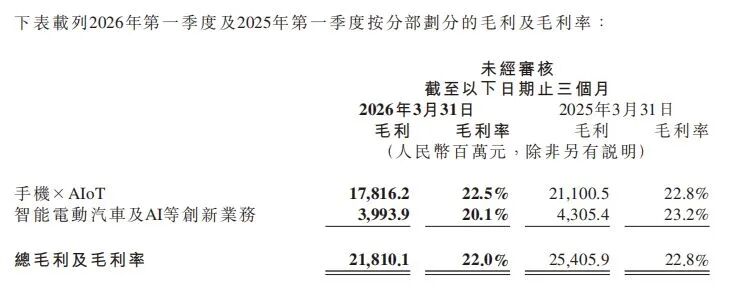
The earnings report shows that in the first quarter of 2026, affected by vehicle purchase tax subsidies and the rising prices of core components, the gross profit margin of Xiaomi Group's innovative business segments such as smart electric vehicles and artificial intelligence (AI) was 20.1%. During the same period, the operating loss of Xiaomi Group's innovative business segments such as smart electric vehicles and artificial intelligence (AI) was 3.1 billion yuan.
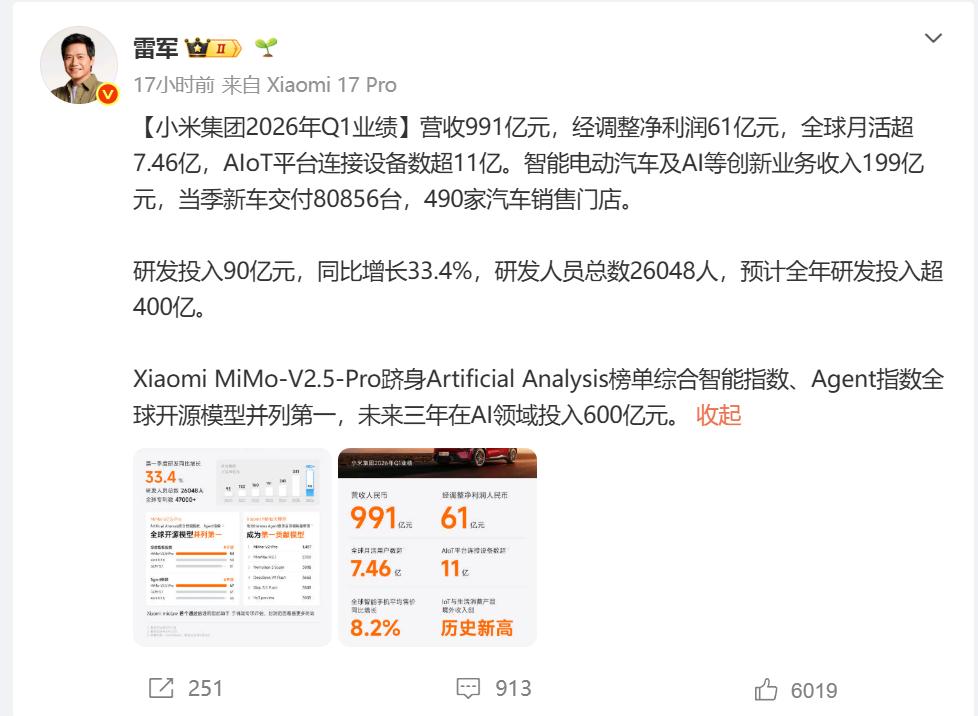
In the first quarter of this year, Xiaomi Group's R & D expenditure was 9 billion yuan, a year-on-year increase of 33.4%. "In the past five years, Xiaomi Group has invested a total of 105.5 billion yuan in R & D, and will invest another 200 billion yuan in the next five years," Lei Jun, Founder, Chairman, and CEO of Xiaomi Group, said recently.
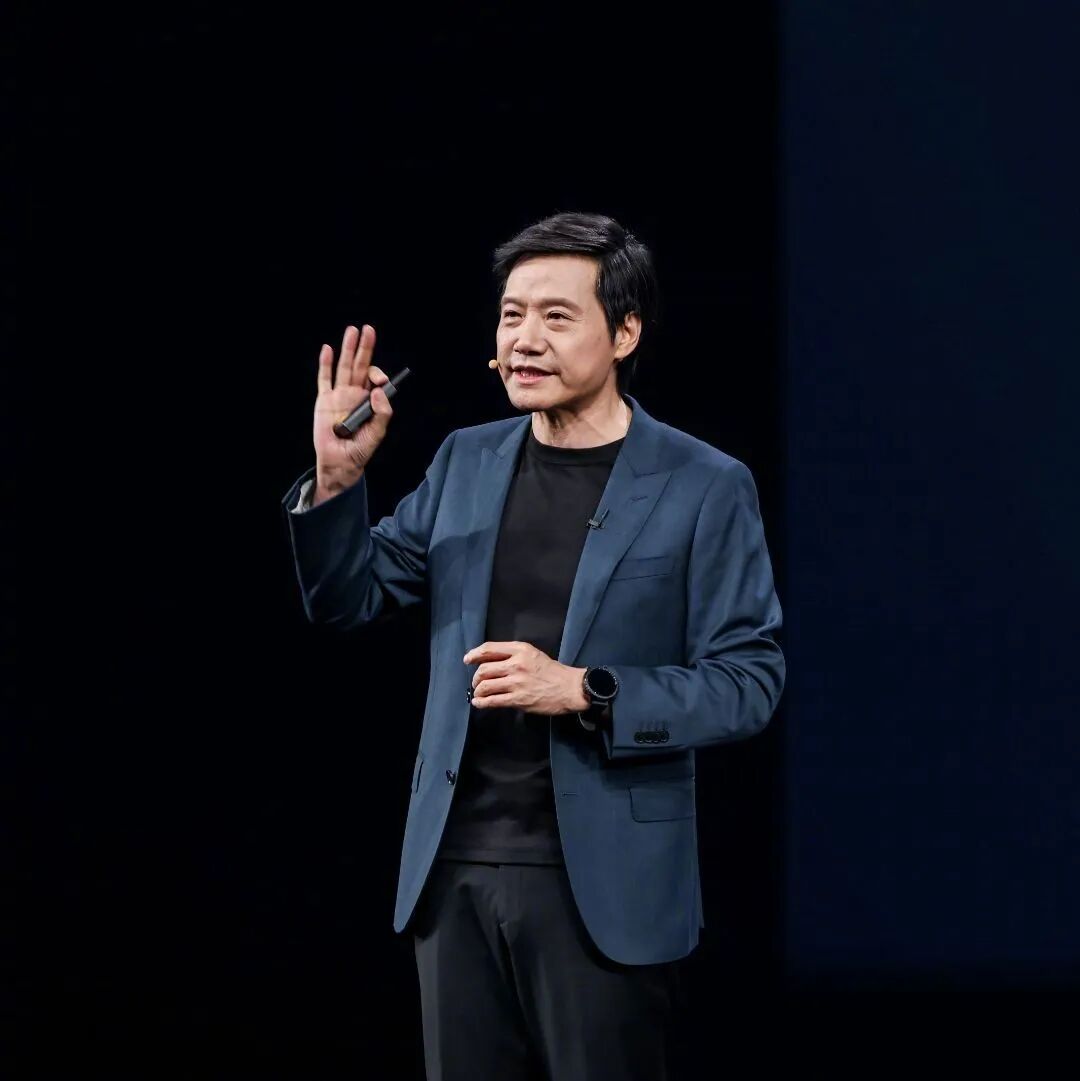
Image source: @Lei Jun
Lei Jun also said on Weibo that Xiaomi MiMo-V2.5-Pro ranks first among global open-source models in the comprehensive intelligence index and agent index of the Artificial Analysis list. Xiaomi will invest 60 billion yuan in the AI field in the next three years.
(Disclaimer: The content and data in this article are for reference only and do not constitute investment advice. Investors operate at their own risk.)
This article is from the WeChat official account "National Business Daily", author: Yang Hui, Li Xing. Republished by 36Kr with permission.