Xiaomi, which has stabilized its basic market, is closely chasing DeepSeek.
The day after Xiaomi released its first-quarter financial report, MiMo took new actions.
Just now, Xiaomi announced a permanent price cut for the MiMo-V2.5 series of APIs, with a maximum reduction of 99%. The usage volume of the Token Plan at the same price has increased by 5 to 8 times. A few days ago, DeepSeek changed the 25% discount on V4-Pro to a permanent price. Xiaomi's follow-up this time means that MiMo is accelerating its participation in the large model competition with a lower threshold.
"In the short term, we are facing the challenges of the superposition of the cost cycle, demand cycle, and competition cycle. In the long term, we are entering a new stage of AI reconstruction of the entire ecosystem of vehicles, homes, and people." Yesterday, at the first-quarter earnings conference call, Lu Weibing, the president of Xiaomi Group and a partner of the group, summarized Xiaomi's current position in this way.
In the first quarter of this year, the rising storage prices transmitted pressure to the entire terminal hardware industry. Under such pressure, Xiaomi still delivered a more resilient financial report.
In the past few months, the demand for AI servers, HBM, DRAM, and NAND has increased simultaneously, and the global storage supply and demand have been tightened again. Data from TrendForce shows that in the first quarter of 2026, the contract price of regular DRAM (memory) increased by 90% - 95% quarter-on-quarter, and the contract price of NAND Flash increased by 55% - 60% quarter-on-quarter.
This round of price increase is not a short-term disturbance faced by Xiaomi alone, but an industry variable that terminal hardware companies such as mobile phones, PCs, and IoT are facing together.
Lu Weibing also mentioned in the conference call that as early as the third quarter of last year, Xiaomi judged that this round of memory cost increase cycle was a "super cycle."
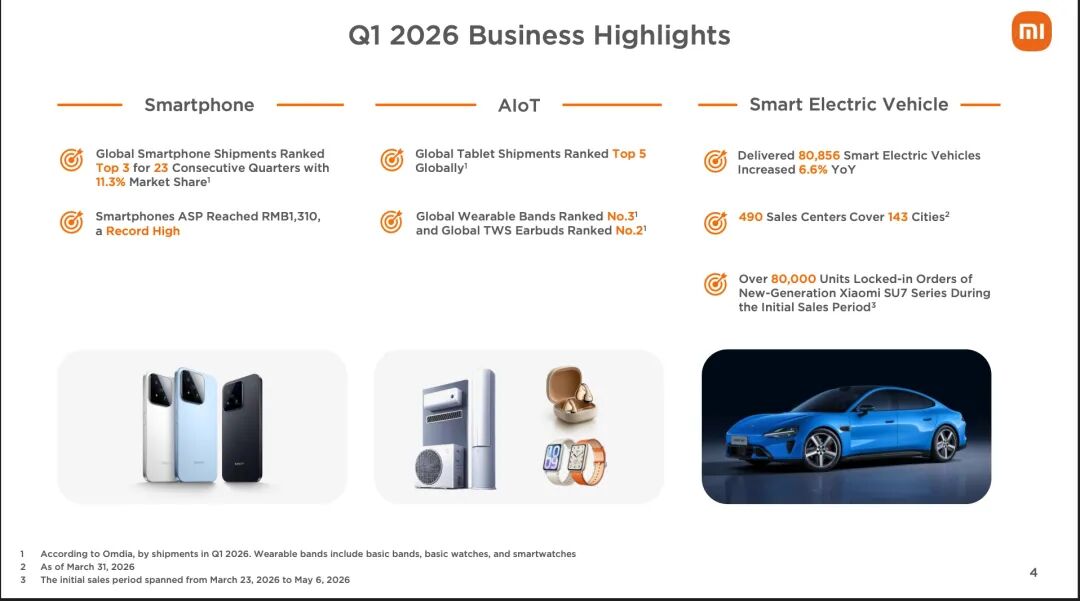
The financial report shows that Xiaomi achieved revenue of 99.1 billion yuan in the first quarter, with an adjusted net profit of 6.1 billion yuan and a comprehensive gross profit margin of 22.0%. Against the backdrop of rising storage prices and intensified terminal competition, Xiaomi still maintained a single-quarter revenue scale close to 100 billion yuan.
Behind this is the industrial structure under Xiaomi's "vehicle, home, and people" ecosystem, which has already had a foundation to resist industry risks.
At the conference call, Lu Weibing pointed out the structural changes in this set of data: the contribution of mobile phones to the group's gross profit decreased from 31% to 20%; the contribution of IoT to the gross profit increased from 24% to 28%; the new automotive business increased from 0% to 25%.
On the other hand, Xiaomi did not choose to reduce its investment in AI during the pressure period, but firmly bet on the future of AI.
In March this year, Lei Jun, the founder and CEO of Xiaomi Group, said at the spring new product launch that Xiaomi will invest at least 60 billion yuan in the AI field in the next three years, and the R & D and capital investment in the AI field this year will exceed 16 billion yuan.
"In the hardcore technology track, Xiaomi may be relatively low - key, but in fact, the progress speed may be much faster than what the outside world sees." At the launch, Lei Jun summarized in this way.
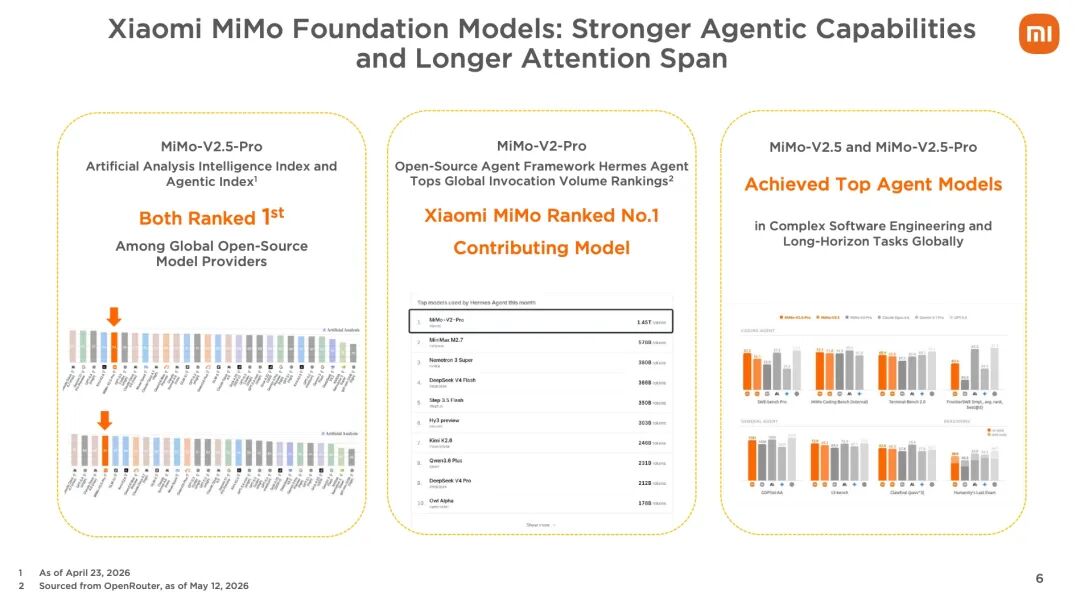
As Xiaomi's self - developed large model, the MiMo series of models is an important technological foundation for Xiaomi in the AI field. The first - quarter financial report mentioned that MiMo - V2.5 - Pro has reached the global top - level Agent model level in dimensions such as general intelligent agent capabilities, complex software engineering, and long - range tasks.
In terms of capital investment, Lin Shiwei, the CFO of Xiaomi, said at the conference call that since 2026, Xiaomi has repurchased more than HK$8 billion worth of shares, exceeding the repurchase scale of the whole last year. The company will also apply for a HK$20 billion repurchase plan, which will be implemented in the next 12 months if approved by shareholders.
In the cycle of short - term performance pressure, share repurchase is a more direct statement: Xiaomi still believes in its long - term value because the seeds of AI have germinated.
1
Judging from the financial report, Xiaomi did not retreat to a defensive position during the storage price increase cycle. It continued to seek growth poles globally in the high - end of mobile phones, the high - end potential of automobiles, and IoT.
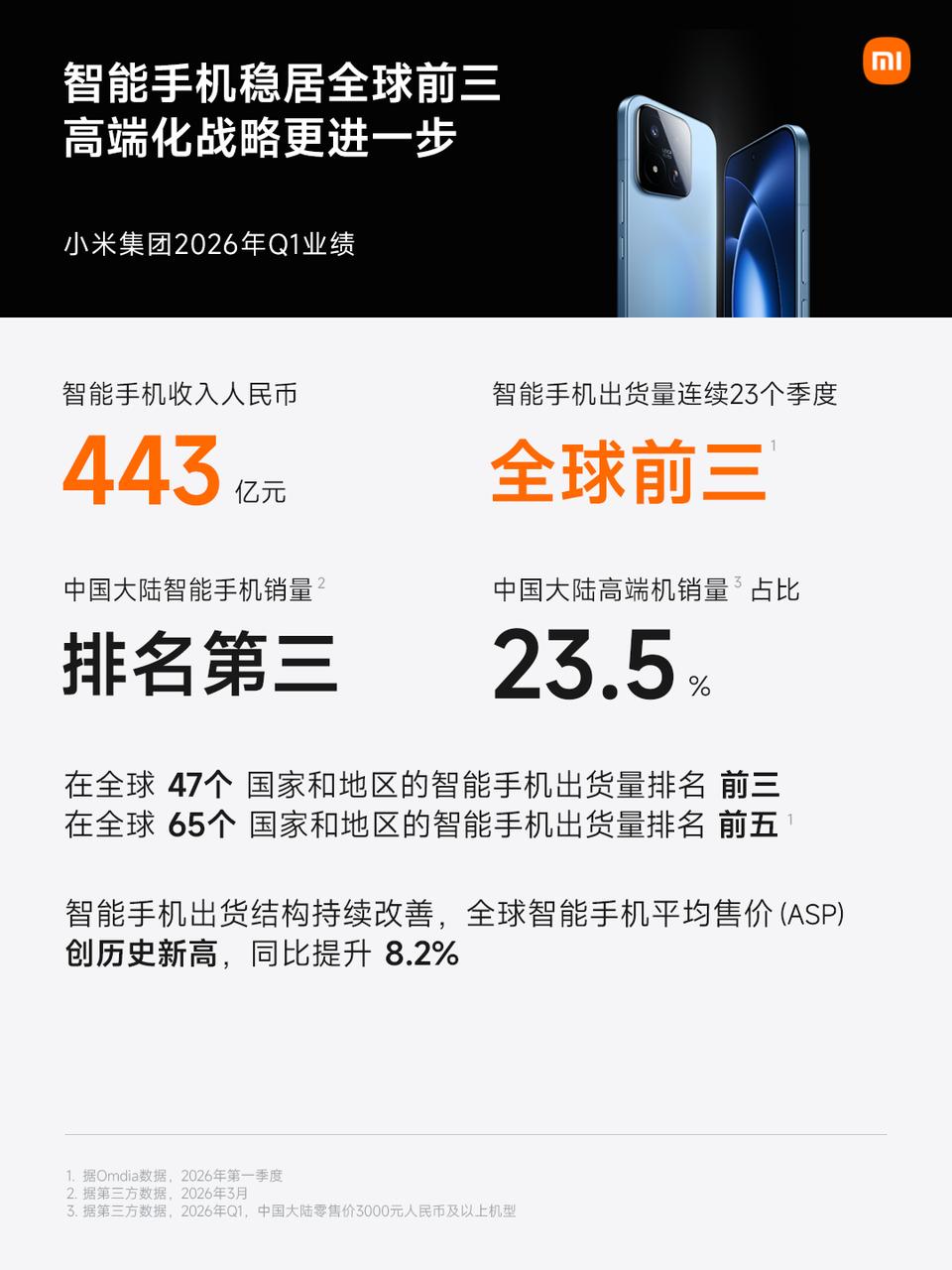
In the first - quarter financial report, Xiaomi's smartphone revenue was 44.3 billion yuan, with a shipment volume of 33.79 million units. The ASP (average selling price, that is, the average selling price of a single mobile phone) of smartphones increased by 8.2% year - on - year, reaching a record high. The gross profit margin of smartphones was 10.1%, a quarter - on - quarter increase of 1.8%. The sales volume of high - end smartphones in the Chinese mainland accounted for 23.5%.
Lu Weibing mentioned in the conference call that Xiaomi actively controlled the shipment of mid - and low - end products and channel inventory in the first quarter and dynamically monitored the health of channel inventory.
According to Omdia data, in the first quarter of 2026, Xiaomi's global smartphone shipment market share was 11.3%, ranking among the top three globally for 23 consecutive quarters. Xiaomi's smartphone shipments ranked among the top three in 47 countries and regions around the world and among the top five in 65 countries and regions.
Facing the upstream pressure of rising storage prices, Lu Weibing said: "We will not simply transfer the rising costs linearly to consumers. Instead, we will re - position user needs, upgrade the product matrix, optimize software, and use our own operational capabilities to strike a balance between scale and profit."
He also mentioned that after predicting this round of memory price increase cycle in the third quarter of last year, Xiaomi set an internal principle: try not to increase the price of old products that have been on the market; if a price increase is necessary, "it is best to be the last one to increase the price, and the increase should be as small as possible."
The rising storage prices are most likely to squeeze mid - and low - end models. Xiaomi can still promote the upward movement of ASP, and high - endization is a more important buffer during the cost cycle.
The same brand upgrade is also happening in the automotive business.
In the first quarter, the revenue of Xiaomi's intelligent electric vehicles and innovation businesses such as AI was 19.9 billion yuan, of which the revenue of intelligent electric vehicles was 19 billion yuan, and the revenue of other related businesses was 900 million yuan.
Xiaomi delivered a total of 80,856 new cars in the first quarter. As of March 31, Xiaomi has opened 490 car sales stores in 143 cities in the Chinese mainland.
According to the terminal sales ranking of Yiche from January to April 2026, Xiaomi SU7 ranked first in the sales volume of pure - electric sedans priced over 200,000 yuan, and Xiaomi YU7 ranked second in the sales volume of SUVs. The two main models firmly occupy the high - end new - energy mainstream market.
At the conference call, Lu Weibing mentioned that Xiaomi's automotive business "has emerged from the most difficult period." Lin Shiwei also mentioned that in the first quarter, the sales volume of the domestic new - energy market decreased by more than 20% year - on - year, but Xiaomi still delivered 80,856 new cars, a year - on - year increase of 6.6%.
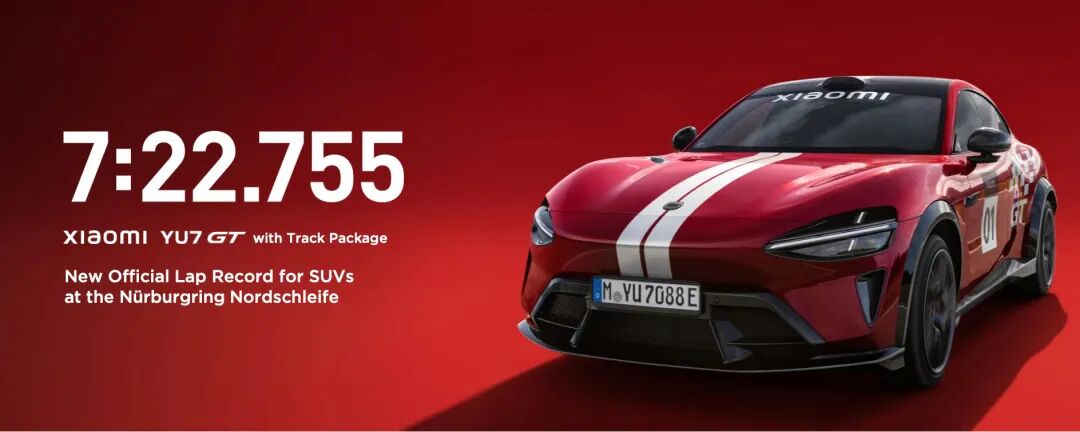
A few days ago, Xiaomi just released a new model, YU7 GT, with a starting price of 389,900 yuan. Lei Jun called it a "pure - blood GT" at the launch, positioning it as a sports - car - level SUV suitable for long - distance travel.
Lu Weibing revealed in the conference call that YU7 GT achieved a result of 7 minutes and 22 seconds on the Nürburgring track, breaking the SUV lap - time record. He also mentioned that this car has attracted three types of users: SU7 Ultra users, users who originally considered YU7 Max but are willing to pay more, and some users of high - performance cars from Mercedes - Benz and BMW.
"More than half of the users directly selected the fully - equipped version priced at 429,900 yuan." Lu Weibing said that this result exceeded Xiaomi's expectations.
During the Beijing Auto Show, Xiaomi introduced its European automotive R & D center for the first time.
Hu Zhengnan, the CTO of Xiaomi's automotive department, mentioned that the European R & D center is responsible for the development of high - performance cars, the definition of luxury cars, and the research on European user needs and product definitions. Public reports also show that YU7 GT is the first model deeply participated in the R & D by the Xiaomi European R & D center team.
Combined with the experience of the European R & D team, Xiaomi's high - end automotive path is highly bound to its globalization strategy.
On the other hand, the IoT business is also continuing to expand Xiaomi's user ecosystem, so that Xiaomi no longer relies on a single business to maintain user growth.
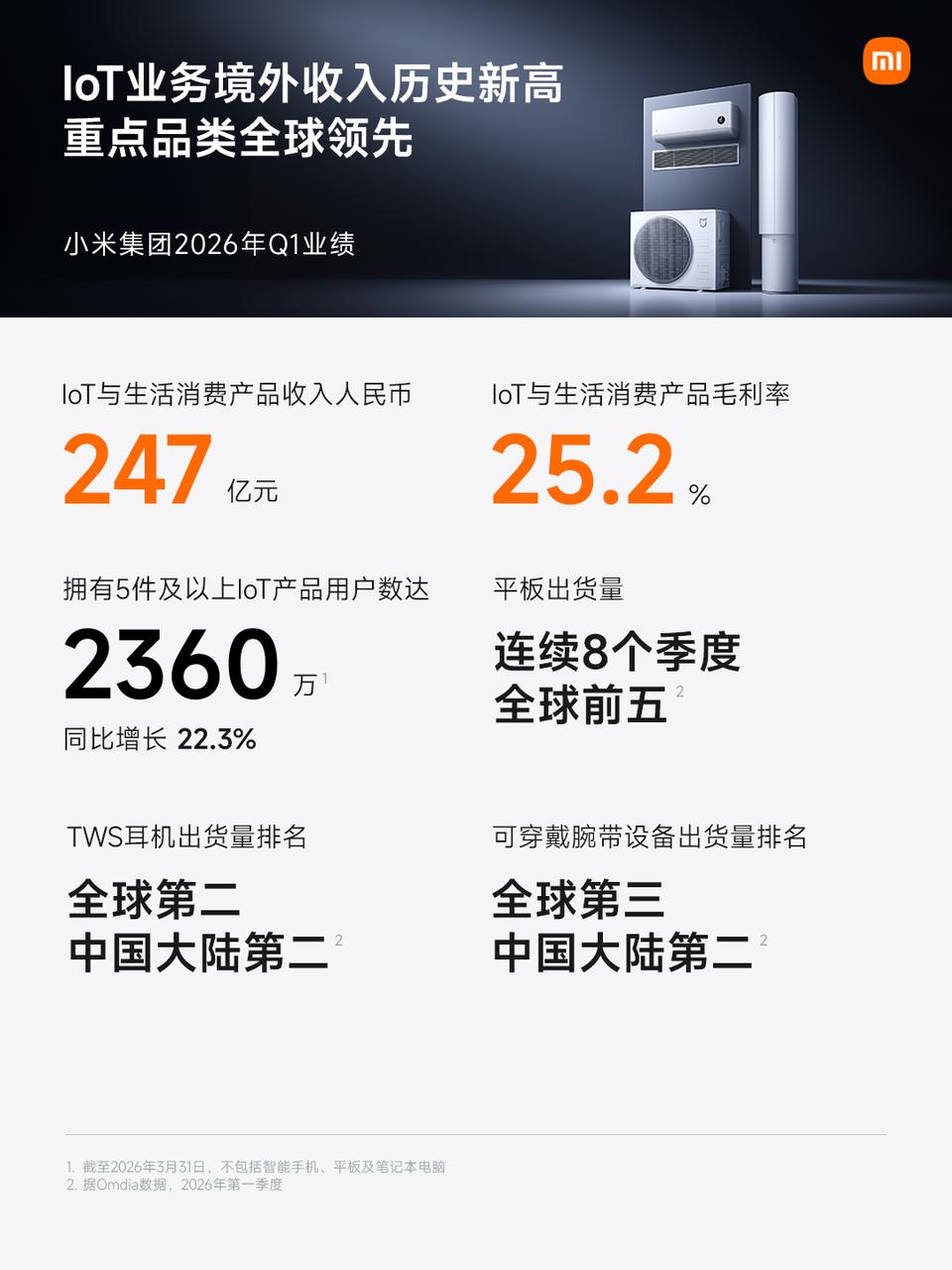
The financial report data shows that the monthly active users of the Mi Home App reached 117 million, a year - on - year increase of 10.0%. The monthly active users of Xiaoai reached 169.3 million, a year - on - year increase of 15.5%. The number of connected devices on the AIoT platform reached 1.1187 billion, a year - on - year increase of 18.5%. The number of users with five or more AIoT devices reached 23.6 million, a year - on - year increase of 22.3%.
Lu Weibing disassembled the growth of IoT into several sources at the conference call: the full - scale self - development of core categories, the promotion of offline experience by the development of new retail, the rapid expansion overseas, and the stimulation of national subsidies in the Chinese market last year.
Since this year, Xiaomi has focused on overseas IoT expansion, global e - commerce development, the export of large home appliances, and local operations. Lu Weibing mentioned that as of April, Xiaomi has 33 local markets globally.
He also gave a set of space judgments: "The overseas market is about twice the size of the domestic market. However, the proportion of IoT revenue in our internal revenue, the overseas market only accounts for about half of the domestic market." This also means that there is still a long growth path for IoT overseas.
The growth of Mi Home, Xiaoai, and large home appliances shows that the "home" end of Xiaomi is no longer an accessory to mobile phones. In the first quarter, Xiaomi's IoT gross profit margin increased quarter - on - quarter to 25.2%, and the overseas IoT revenue reached a record high.
This shows that the "vehicle, home, and people" ecosystem is evolving into Xiaomi's basic user base. It doesn't have to rely on a single business for growth, and it also leaves a broader entrance for subsequent AI capabilities to enter daily life.
2
Xiaomi has always been labeled as a "cross - border player" in the field of AI. However, since this year, the MiMo series of large models have proved with strength that Xiaomi is serious about AI.
At the conference call, Lu Weibing said: "If we don't develop our own large model, our understanding of the base model will always be like looking at flowers in the fog. Only by mastering core technologies from end to end can we truly create products with differential competitiveness."
In March this year, Xiaomi released the flagship base model MiMo - V2 - Pro for the Agent era, as well as MiMo - V2 - Omni and MiMo - V2 - TTS.
Lei Jun previously said on Weibo that MiMo - V2 - Pro ranked eighth globally on the Artificial Analysis global large - model comprehensive intelligence ranking list and fifth globally among large - model brands.
MiMo - V2 - Pro was previously tested anonymously on OpenRouter. After the launch, MiMo - V2 - Pro quickly reached the top of the daily, weekly, and monthly lists.
At the conference call, Lu Weibing added further data: In the week of March 31, the weekly Token consumption of MiMo - V2 - Pro exceeded 4 trillion. After the free - trial period ended, the weekly average Token retention rate reached 35%.
Xiaomi also launched the Xiaomi MiMo Token Plan in April, which includes four levels: Lite, Standard, Pro, and Max, and the progress has been smooth.
In late April, Xiaomi continued to launch the upgraded MiMo - V2.5. The first - quarter financial report disclosed that MiMo - V2.5 - Pro has reached the global top - level Agent model level in dimensions such as general intelligent agent capabilities, complex software engineering, and long - range tasks.
On the Artificial Analysis list, the comprehensive intelligence index of MiMo - V2.5 ranks first among global open - source large models and fifth among global large models in total. The Agent index ranks first among global open - source large models.
The long - range Agent ability of MiMo - V2.5 - Pro is very outstanding. Public reports mentioned that in the course project of "Compilation Principles" at Peking University, it completed the development of the SysY compiler in 4.3 hours with 672 tool calls and achieved a full score in the hidden test.
Previously, Luo Fuli, the person in charge of Xiaomi's MiMo large model, said in an interview that the large - model competition has entered the second act: "The first act is Chat, which mainly releases intelligence through pre - training and short - context dialogue. The second act is Agent, and the core has become a complex Agent framework, multi - round long - range tasks, post - training, and reinforcement learning scaling."
She also mentioned that "success in the previous era does not mean leadership in the next era," and the next competition point is Agent post - training.
In March this year, Xiaomi miclaw started a small - scale closed - beta test. This product is built based on Xiaomi's MiMo large model. Compared with traditional AI assistants, miclaw has system - level capabilities, personal context capabilities, multi - modal interaction capabilities, and active execution capabilities.
Since April, miclaw has successively covered multiple terminals such as mobile phones, tablets, PCs, Macs