ByteDance denies self-developing mobile phones
Is ByteDance developing its own mobile phones? "This is a false rumor." This morning, ByteDance responded to PencilNews, stating that the recent market rumor about "ByteDance restarting its self - developed mobile phone project" is untrue.
01
Over 300 Related Job Positions Posted
Previously, multiple media outlets reported information such as "ByteDance is massively recruiting a mobile phone team" and "restarting the self - developed mobile phone project". The rapid spread of these rumors has a core reason: ByteDance has indeed been intensively recruiting a large number of positions related to "mobile phone underlying capabilities" recently.
According to PencilNews' review of public recruitment information, currently, the number of positions at ByteDance related to mobile phones, mobile OS, and edge - side AI has exceeded 300. Among them, there are approximately 83 positions related to Doubao Mobile Assistant and about 236 positions related to mobile OS. These positions are mainly located in Beijing, Shanghai, and Shenzhen.
The involved areas include: Android Framework, HAL/Vendor interface adaptation, chip drivers, power consumption and thermal management, Telephony/RIL, radio - frequency antennas, edge - side AI deployment, long - term memory for agents, and ODM/OEM mass - production collaboration. Some positions even mention typical keywords for mobile phone mass production such as "foldable screen", "LIPO packaging", "IP68/IP69K", and "NPI trial production introduction".
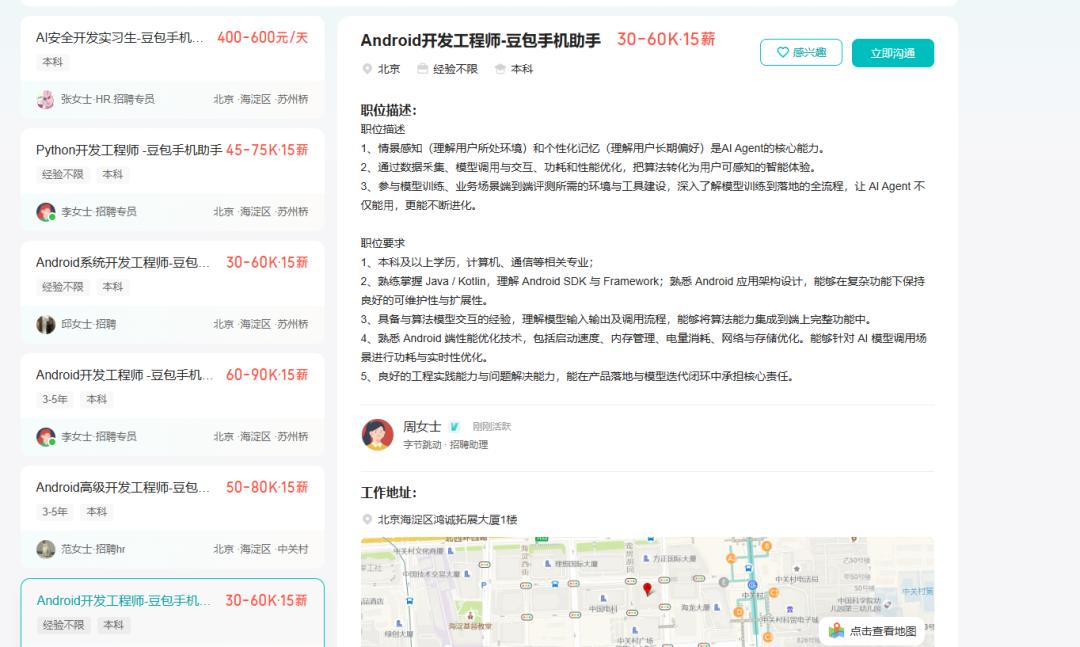
Some of the positions ByteDance is recruiting are highly related to mobile phones.
This is why the outside world quickly formed a judgment: Is ByteDance going to make mobile phones again? However, the latest situation shows that this is not the case.
02
Targeting AI Terminal Infrastructure
However, what really deserves attention in this matter may not be "whether ByteDance will make mobile phones or not".
If you look closely at these positions, you will find an important feature: Many of them are not just "traditional mobile phone R & D positions", but more like "AI terminal infrastructure positions".
For example, the Telephony RIL Modem Architect position requires familiarity with Qualcomm/MediaTek cellular network delivery, Telephony systems, RIL drivers, CTA certification, field testing, and radio - frequency development.
The Android System Expert position requires overall management of the entire process from project initiation, system design, integrated development, to mass - production delivery.
What does this mean? AI is moving from the "chat box" to the "system layer". In the past, large models mainly answered questions; now, more and more AIs are starting to directly operate mobile phones.
For example, automatic ticket booking, automatic price comparison, automatic coupon collection, cross - app task execution, calling the photo album, calendar, and contacts, and long - term memory of user behavior. These capabilities require more in - depth system permissions, as app - layer permissions alone are no longer sufficient.
In other words, even if an AI company doesn't make mobile phones itself, it must master more mobile OS capabilities; otherwise, the agent will always remain just an "external assistant".
03
Competing for Entrance Control
There is another reason for the high sensitivity of the outside world: ByteDance has previously explored the combination of "AI + mobile phones". In December 2025, ByteDance jointly launched an AI engineering prototype with Nubia, which was equipped with Doubao's capabilities.
According to public reports, the first batch of about 30,000 units, priced at 3,499 yuan, were sold out on the first day. This was also Doubao's first attempt to transform from a chatbot into an "agent in the mobile phone", capable of completing tasks such as checking train tickets, comparing prices, collecting coupons, placing orders, and cross - app operations with a single command.
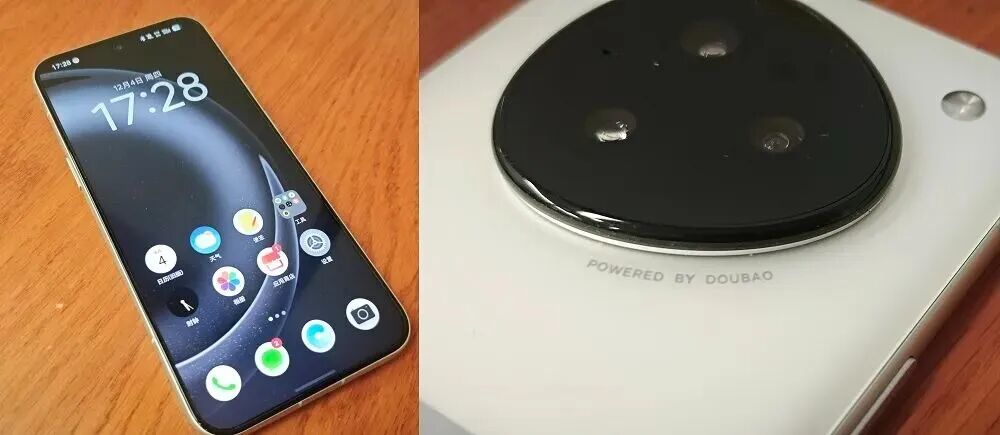
ByteDance × Nubia M153 Doubao AI Engineering Prototype in December 2025
However, problems soon emerged: Platforms such as WeChat, Taobao, and Alipay gradually encountered obstacles in being called.
The reason is simple: These super apps are not willing to hand over the entrance control to AI. Once the agent truly takes over the operations, who will control the traffic? Who will manage the recommendations? Who will own the transaction data?
Thus, a more practical problem arises: If an AI company doesn't have a system entrance, it essentially operates within someone else's ecosystem.
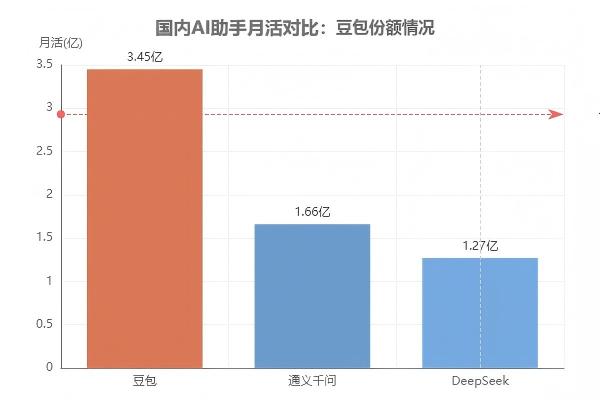
This is why, despite Doubao's monthly active users reaching 345 million (data from QuestMobile in March 2026), it still faces a major problem: Users cannot complete a real closed - loop within Doubao.
To check flight tickets, users need to call Ctrip; to order takeout, they need to call Meituan; and for payment, they need to connect to Alipay or WeChat.
Once the interfaces are restricted, the agent's capabilities will be weakened. This is why what the AI industry is really competing for today is no longer "chatting ability", but the system entrance.
The problem is that in the mobile phone industry, the most difficult part is not just AI, but also channels, supply chains, brands, and after - sales services. And these are exactly the weakest areas for ByteDance in the past.
In 2019, ByteDance acquired part of the team and patents of Smartisan Technology. Subsequently, it released the Nut Pro 3 in 2019, the Nut R2 in 2020, and stopped the R & D of Nut mobile phones in 2021.
As of today, the cumulative sales of the Nut R2 on JD.com and Taobao are still less than 100,000 units.
04
Previous Hardware Attempts
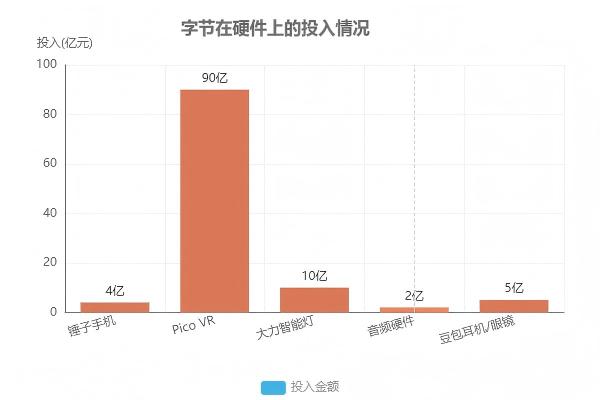
It's not just about mobile phones. In the past few years, ByteDance has almost tried every consumer hardware category: After acquiring Pico for 9 billion yuan, it has continued to incur losses, and its consumer business has significantly shrunk. Some media have estimated that the cumulative losses have exceeded 20 billion yuan; the Dali Smart Lamp has been impacted by the "double - reduction" policy; some audio hardware projects were halted before their release; and the Doubao earphones and AI glasses have not yet achieved scale.
Why? One of the core reasons is the offline channels.
Today, an extremely invisible but difficult - to - cross barrier in the Chinese mobile phone industry is the offline stores. Public data shows that Huawei has over 10,000 offline stores, Xiaomi Home has over 16,000 stores, and the total number of OPPO and vivo's offline terminals has long remained in the hundreds of thousands. ByteDance hardly has an offline consumer electronics system.
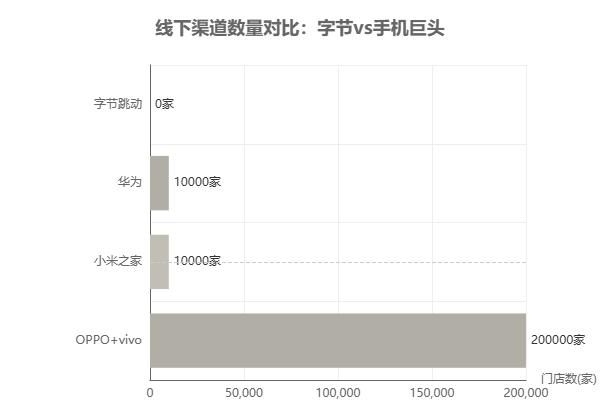
This means that even with strong AI capabilities, the mobile phone industry is still an extremely asset - heavy industry.
More important than "whether ByteDance will make mobile phones" is that the entire AI industry has started to compete for terminals again.
Recent supply - chain and industry news shows that OpenAI is reported to be researching AI hardware; Apple is comprehensively promoting Apple Intelligence; Google is strengthening the integration of Gemini and Android; Huawei, Xiaomi, and Honor are continuously advancing their AI OS; and AI glasses, AI earphones, and AI agent devices are becoming increasingly popular.
The reason is actually quite simple: The competition among large models is shifting from "who is better at chatting" to "who truly has the user entrance".
Because once the agent matures in the future, AI will call not only apps but also cameras, microphones, contacts, payment systems, calendars, file systems, location permissions, and system scheduling rights. These capabilities essentially belong to terminal sovereignty.
From this perspective, ByteDance's large - scale recruitment of positions related to mobile OS, edge - side AI, and system capabilities does not necessarily mean "immediately making mobile phones". But it at least shows that it may have realized that if AI doesn't have terminal control, it may always be confined to someone else's system.
This article is from the WeChat official account "PencilNews" (ID: pencilnews). Author: Aiyu, Editor: Wang Fang. Republished by 36Kr with permission.