A Shenzhen couple risked their entire fortune and made a whopping 3.3 billion yuan in just three months.
In May this year, the market value of Deminli soared past the 150 billion yuan mark. Driven by this, the wealth of the couple, founder Li Hu and Tian Hua, expanded rapidly. In just five months, their combined net worth skyrocketed by over 34 billion yuan at its peak. Starting from scratch with just 60,000 yuan in Huaqiangbei as "USB flash drive resellers" to locking in 12.19 billion yuan worth of low - price wafers at the darkest moment in the industry, this couple's comeback is due to the engineers' precise grasp of the storage cycle. However, behind this textbook - style comeback, they are also walking on a tightrope.
In the A - share market, Deminli achieved in just a few months what other companies take a "lifetime" to achieve in terms of stock price increase. At the close on May 22nd, Deminli's stock price settled at 674 yuan, with a total market value of 152.894 billion yuan. It has seen triple - digit growth for two consecutive years. At the beginning of last year, its stock price was around 60 yuan.
After the stock price soared, the market value of the shares held by Deminli's founder Li Hu and his wife Tian Hua reached over 50 billion yuan. Retail investors who bought at around 200 yuan and sold at over 600 yuan saw their accounts double. Some others held on firmly, shouting "I won't sell until it reaches 1,000 yuan."
What gave them confidence was Deminli's financial report for the first quarter of 2026. Its revenue reached 7.5 billion yuan, a five - fold increase; the profit was 3.3 billion yuan, a 50 - fold surge. The most astonishing part is that the profit earned in one quarter was more than the total profit of the company in the past 10 years.
In the A - share storage circle, Deminli is known as "the most elastic and the fastest - growing." This extreme contrast has piqued everyone's interest. After all, in the first half of 2025, Deminli was still in the red, with a loss of 118 million yuan. Some stockholders sighed, "It's like going straight from the ICU to the KTV."
Many people say that Deminli bet right on the cycle. But Li Feng, a senior storage industry insider, told "Caixin Global": "They are not resellers; they are engineers."
01
Mortgaging the house to 'burn money'
In Huaqiangbei, if you say you're an "engineer," you might get a disdainful look. In this place, daily transactions are all about "spot goods, cash payment, and immediate pick - up." But in the storage circle, when people mention Li Hu of Deminli, there is a hint of respect in their tone.
Let's rewind the clock to 2000. In Shenzhen at that time, the air was filled with the smell of solder and opportunities. Li Hu had just graduated from Xidian University and plunged into Shenzhen Jinghaili Electronics, a typical Huaqiangbei company. Li Hu's job was not glamorous: he carried a bag full of samples like USB flash drives and memory cards and spent his days at the counters and in factories in the Pearl River Delta.
After eight years, he had a thorough understanding of the price fluctuations of NAND particles. As Deminli became more and more successful, Li Hu felt increasingly disheartened. At that time, a harsh truth was that the thousands of module factories in Huaqiangbei were essentially "assembly plants." The most core main control chips mainly relied on manufacturers like Phison and Silicon Motion. Once the upstream original manufacturers like Samsung and SK Hynix cut off the supply, everyone would be in a difficult situation.
Everyone didn't want to be in such a predicament, and Li Hu was no exception. In 2008, after Li Hu invested 60,000 yuan and co - founder Ma Ke (who gradually faded out later) invested 40,000 yuan, a company called Demingli (originally named Demingli) was born in a small cubicle in Huaqiangbei, Shenzhen. Li Hu was bold in his ideas and actions. In 2010, when Deminli was just starting to make progress, he did something unexpected: he decided to pour all the hard - earned money into chip research and development. Chip development is a bottomless pit. One tape - out could cost millions of yuan, and there was no guarantee of success.
In 2011, when Li Hu was constantly pouring the money earned from trading into R & D without seeing any results, a key figure, Tian Hua, who holds a master's degree in business administration from Zhejiang University, joined Deminli and has held positions such as general manager and chairman. Looking back today, this was a perfect combination: Li Hu was in charge of dreaming and focusing on technology; Tian Hua was responsible for making the dreams come true, managing finances, personnel, and the company's listing. The two, with their "technology + finance" balance, contributed to Deminli's success.
The process was tortuous. Public information shows that during this period, Deminli's capital chain was extremely tight. Li Hu and Tian Hua had to raise funds everywhere, even mortgaging their personal properties to keep the R & D tape - out and the company's operations going. It was a truly dark time. They endured for six years. Until 2016, when the first self - developed main control chip was mass - produced, Deminli gradually increased the adaptation rate of its self - developed main control and replaced some purchased components with self - developed ones, greatly reducing its dependence on purchased main controls from Phison and Silicon Motion.
During these six years, while peer companies like Jiangbo Long and Baiwei Storage were making money quietly, Deminli was struggling with R & D. However, it was this chip that gave Deminli more initiative in module product solutions, cost structure, and supply chain adaptation. Before going public, industry capital such as Dongguan Jinhong and Qianshan Mifang invested real money. They were attracted by the "Chinese chip" in Li Hu's hands.
By the time of its listing in 2022, Deminli held 110 patents, and no one laughed at Li Hu as a "reseller" anymore. Many industry insiders know that it was Li Hu, the "engineer," with his profound understanding and persistent adherence to technology, the cycle, and the industry chain that led him to make a crazy decision in the subsequent cold winter.
02
While others cut losses, he adds positions
In 2023, if you were in the storage business and didn't lose money, you'd be embarrassed to talk to people.
It was the coldest winter in nearly 20 years. The price of DRAM was cut in half from its peak, and the decline of NAND was even deeper. The "Big Three" in the storage industry, Samsung, SK Hynix, and Micron, lost more in a year than they had earned in the past. The entire industry was panic - selling.
Many domestic storage factories were making a profit at a loss, and among the small bosses in Huaqiangbei, some had their capital chains broken, and some closed their businesses. Deminli was not spared either. Its gross profit margin was only 16%, and its net profit shrank by two - thirds. If it were someone else, they would have cut orders desperately just to survive, but Li Hu was on a shopping spree.
Li Hu practiced Buffett's investment philosophy of "be fearful when others are greedy and greedy when others are fearful": he used the huge trade cash flow to lock in wafers and stockpile goods. In response to external doubts, "Caixin Global" found that Li Hu clearly responded in several investor relations communication activities: "Our inventory strategy is mainly based on demand - based stocking and dynamic adjustment. We have a forward - looking layout for the industry." This time, he almost bet his entire fortune.
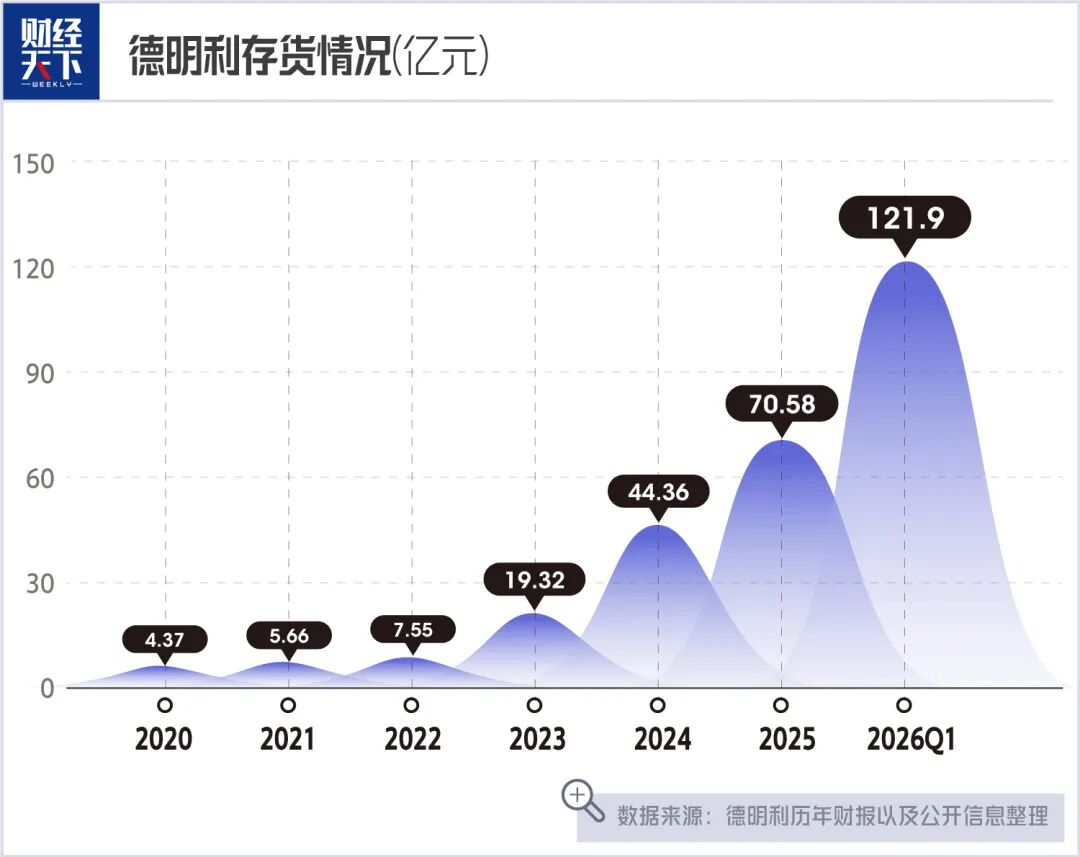
By the end of 2025, the inventory on Deminli's books had reached 7.06 billion yuan. In March 2026, this figure soared to 12.19 billion yuan, accounting for more than two - thirds of the total assets. It's like an ordinary person leveraging to the maximum and buying a dozen luxury houses in full.
One of the reasons why Li Hu dared to make a counter - trend move is that Deminli's main control chip and firmware solutions have capabilities such as LDPC error correction, wear leveling, and bad block management. This ability can turn non - top - grade wafers, which others might think are "not so good," into storage modules with stable performance through intelligent error correction and bad block management. With this, Deminli has a wider range of procurement options and lower cost advantages.
The second advantage is "direct sourcing from the source." Deminli has maintained long - term cooperation with YMTC and established long - term strategic partnerships with original manufacturers or major distributors such as CXMT and SK Hynix. This is equivalent to having a stable supply channel from leading original manufacturers and agents, leaving a cost buffer for the inventory worth tens of billions with the direct - purchase price from the original manufacturers.
The third and most crucial "card" is "having orders in hand." Many people thought he was stockpiling goods to bet on price increases, but as of the first quarter of 2026, Deminli's contract liabilities reached 1.334 billion yuan, a surge of over 3300% compared to the same period last year. This shows that downstream customers have been queuing up to pay him, and the inventory is supported by real orders, not a desperate bet on the cycle.
The turning point came more violently than expected. In the second half of 2025, AI continued to explode. NVIDIA's GPUs were in short supply, which boosted the AI server market. The memory requirement of an AI server is 10 times that of an ordinary server. Seeing that this business was more profitable, Samsung and SK Hynix significantly reduced the production capacity of ordinary DRAM and concentrated their resources on the more profitable HBM.
As a result, the supply of ordinary memory was severely squeezed, and the supply dropped sharply. According to data from TrendForce, in the first quarter of 2026, the price of DRAM soared by 90% - 95% quarter - on - quarter, and NAND increased by 55% - 60%, the largest single - quarter increase in the past 10 years. At this time, the 12.19 billion yuan worth of inventory in Li Hu's hands instantly became "hard currency."
Deminli uses the "month - end weighted average method" for accounting. This means that the cost of the products it sells now is calculated based on the low price a few months ago, but the selling price is based on the current market price. With this difference, in the first quarter of 2026, its gross profit margin directly reached 57.42%, far exceeding the industry's average level of about 20% - 25%. Just in the first quarter of this year, Deminli net - earned 3.346 billion yuan.
As soon as Deminli's financial report was released, the entire capital market was shocked. Many stockholders who didn't have high hopes and cut their losses at the bottom watched the stock price soar and regretted their decisions. "This is not just luck," Li Feng told "Caixin Global." Deminli has obvious differential advantages in the depth of self - developed main control, cost control, and the flexibility of enterprise - level AI server orders. This might be the confidence that allowed Li Hu to increase his positions at the bottom.
03
Dancers on the edge
Deminli's operation this time is a textbook - style comeback, but it also hides huge potential risks.
As of the end of March 2026, Deminli had 12.19 billion yuan worth of inventory on its books. It's like buying a dozen luxury houses in full. If the housing price goes up, you'll be a billionaire; if it goes down, you'll lose everything. This is Deminli's biggest concern.
Li Feng believes that if Samsung and SK Hynix don't cut production in the second half of 2026, or if the AI boom doesn't meet expectations, once the storage price peaks and falls, Deminli will have to make a huge impairment provision, which will wipe out all its previous profits. This is not an exaggeration. During the storage price slump in 2018, several module factories with high inventory went bankrupt overnight. In fact, Deminli has always regarded the "risk of inventory write - down" as its biggest enemy in its annual financial reports.
What's even more worrying is that although Li Hu has gained more confidence in front of downstream customers, he is still the "passive party" in front of upstream storage original manufacturers. According to data from IC Insights and TrendForce, giants like Samsung, SK Hynix, and Micron control more than 90% of the global DRAM market share. They can raise prices or cut off supplies at will. Deminli's self - developed main control technology can only be regarded as a "defensive skill" in the face of such absolute production capacity advantages.
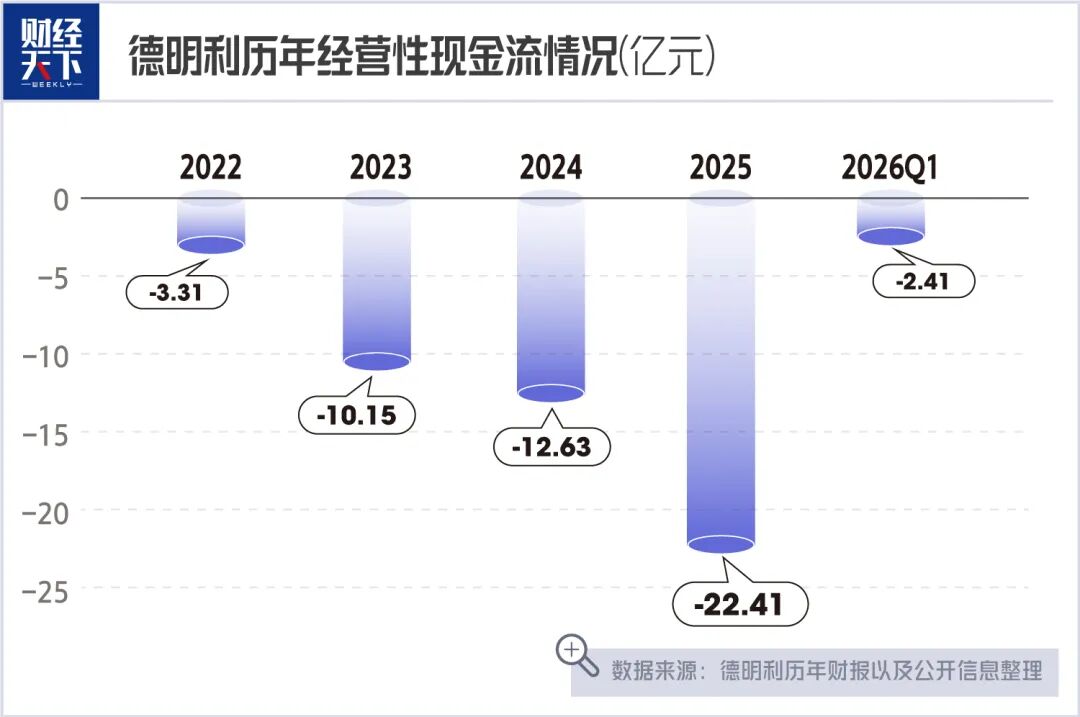
There is also the tight cash flow. At the end of 2025, Deminli's asset - liability ratio was close to 70%, and it owed 4.4 billion yuan to the bank. The annual interest expense was 144 million yuan. In the past few years, due to stockpiling, the company's operating cash flow has been negative for three consecutive years. Although it made a lot of money in the first quarter of 2026, it still has no money in hand and has to rely on a 3.2 billion - yuan private placement to survive. This high - leverage game has a low margin of error.
Fortunately, Li Hu hasn't been carried away by success. He knows very well that making money by stockpiling and reselling is not the way of an engineer. He is accelerating Deminli's transformation from "trading + inventory gambling" to "technology - driven, high - value - added manufacturing." In May 2026, Deminli's intelligent manufacturing base in Guangming District, Shenzhen, was officially put into use. What is produced there is not ordinary USB flash drives, but high - end products such as enterprise - level SSDs, which are the hard nuts to crack in the storage industry but also a lucrative market.
Deminli has released its latest H3361 enterprise - level main control chip and is still working hard on the second growth curve and the next - generation RISC - V architecture with more potential for self - control. From all the signs, stockpiling seems more like a tactical "blitzkrieg." Li Hu has always emphasized in many public occasions that he is building a moat to cross the cycle with technological barriers.
Looking back at Li Hu and Tian Hua's 18 - year journey, starting from 60,000 yuan to having a net worth of tens of billions now. This couple has shown everyone through an extreme cycle operation that Deminli's success seems to be riding on the AI wave on the surface, but in fact, it is about predicting the cycle and magnifying the value of technology with the cycle.
As for whether this company with 12 billion yuan worth of inventory can survive the next winter with its technology, no one knows. But at least for now, they have won. The future of Deminli is another story. However, the capital market usually remembers the huge profit of this quarter; what Li Hu has to face is whether the 12.19 billion yuan worth of inventory will be gold or dynamite when the next cycle comes.
(The name Li Feng in the article is a pseudonym)
This article is from the WeChat official account "