Will AI quietly replace Xiaohongshu?
Since around three years ago, the statement "young people use Xiaohongshu instead of search engines" has become a landmark industry judgment. As more people develop a stable search habit on Xiaohongshu, a large amount of brand budgets have migrated from Baidu to this platform.
Now, does this trend still hold?
Yesterday, the "Research Report on the Credibility Logic and Source Preference of AI Platforms" released by QuestMobile gave a different answer. Although the report's data doesn't directly mention Xiaohongshu, it's precisely this "absence" that is the most alarming signal.
01.
The scenarios where AI penetration is the deepest are exactly where Xiaohongshu is strongest
According to the data in the QuestMobile report, the total monthly active users of AI-native apps represented by Doubao increased from 142 million in January 2025 to 462 million in April 2026, tripling in 15 months. During the same period, from January to October 2025, Xiaohongshu's DAU was about 118 million, always hovering around "100 million".
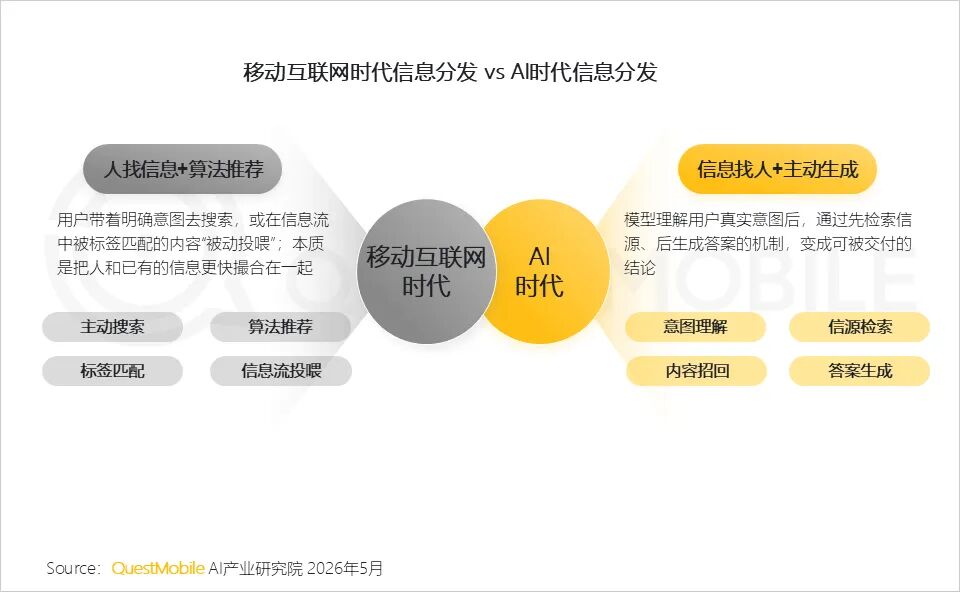
QM emphasizes that in the AI era, the entry point for users to obtain information is shifting to AI-native apps.
However, the growth of AI is not uniform. The report data shows that the TGI of the active penetration rate of AI-native apps among online travel users is 192.2, and for photo beautification, it is 184.0, ranking first and second respectively. These two are exactly the most core content areas of Xiaohongshu. In contrast, the TGI of search engine users is only 107.3, almost equal to the average across the whole network.
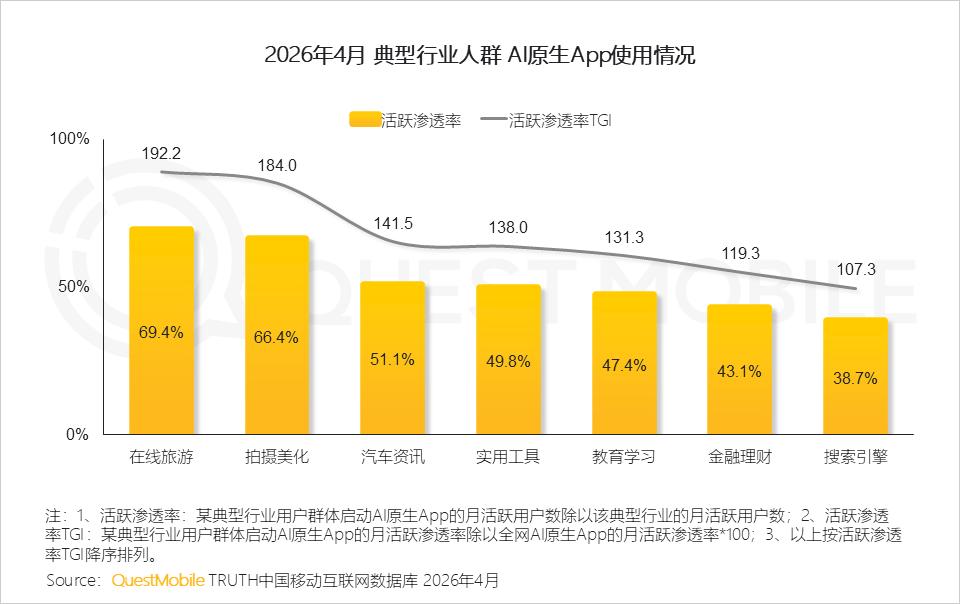
In other words, the group of people who use AI most intensively is not the so - called "heavy search engine users" in the traditional sense, but precisely the core users on Xiaohongshu who have a strong demand for content consumption in tourism, beauty, and lifestyle.
This means that Xiaohongshu and AI-native apps are competing for the same type of needs of the same group of users.
The research data of iiMedia Research in 2025 also proves this point. The information types most frequently searched by users on Xiaohongshu are beauty and skin care (50.57%), skill learning (44.05%), and travel guides (41.93%), which highly overlap with the industries with the highest AI penetration rate.
Gartner warned in 2024 that by 2026, the search volume of traditional search engines would decline by 25%, being diverted by AI chatbots. This prediction is even more of a blow to Xiaohongshu.
From asking Baidu when having questions, to searching on Xiaohongshu, and now asking Doubao/DeepSeek, the speed of users' habit change is faster than the previous time.
02.
The top AI platforms don't use Xiaohongshu at all when answering "where to go"
The penetration rate shows where users are going. The more crucial question is: When users make decisions in AI, whose content appears on the scene? Brands spend their budgets to buy the opportunity to appear at this touchpoint.
The report takes "questions about discovering tourist destinations" as an example and conducts a detailed evaluation of the source citation rate. When dealing with "questions about discovering tourist destinations", the top 10 sources cited by the three major platforms, Doubao, DeepSeek, and Qianwen, are Ctrip (58.3%), Douyin (35.4%), Toutiao (34.8%), Sohu (32.0%)... Xiaohongshu doesn't make it into the top 10 of any platform in the citation data for the travel scenario.
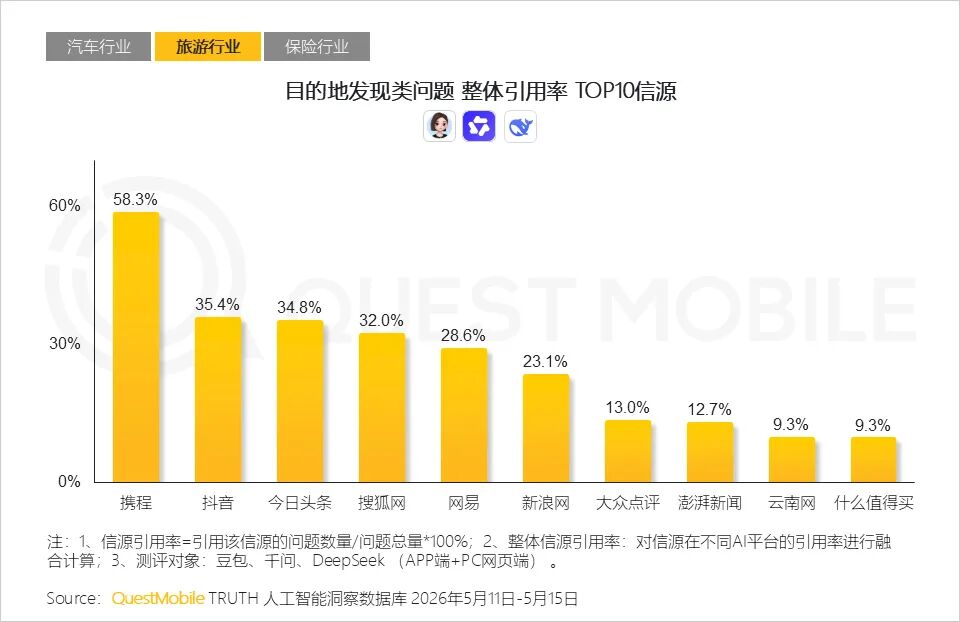
Not only in the travel scenario, but also in the automotive and insurance scenarios mentioned in the report, Xiaohongshu doesn't make it into the top ten. This shows that it's not a problem of a single scenario, but a systematic absence.
When users open Doubao and ask "what's fun in Chengdu", the AI's answer comes from Ctrip and Douyin, and Xiaohongshu's content can't enter this decision - making process at all. The "discovery moment" that brands pay for is no longer on Xiaohongshu.
Whether it's Xiaohongshu actively blocking or these AI platforms deliberately bypassing Xiaohongshu, the result is the same for users and brands: In AI's answers, Xiaohongshu is invisible. This has a particularly profound impact on the budget allocation of advertisers.
03.
Douyin is taking over Xiaohongshu's ecological position
If Xiaohongshu is absent from the important content ecological supply, who has filled in the gap?
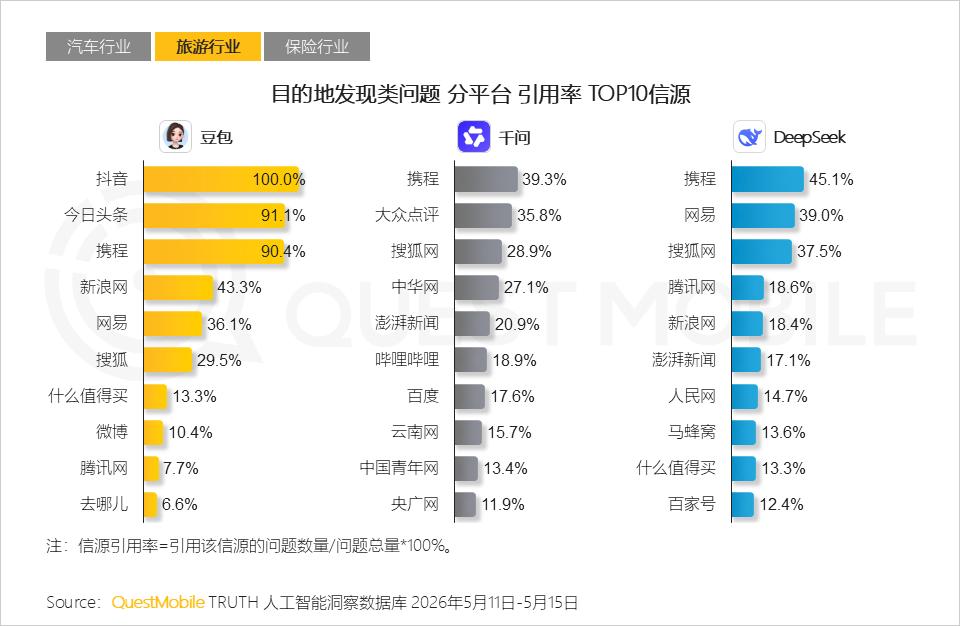
The three major platforms have their own focuses, but Doubao, which has the largest number of users, is more representative of the trend. Its answer is Douyin.
In Doubao's content citation system, Douyin has a 100% citation rate in most of the evaluated scenarios. This is basically the case for car model recommendations, tourist destination recommendations, travel guides, and insurance knowledge.
Moreover, this advantage is continuously strengthened by ByteDance's ecological advantage. Douyin has deeply integrated Doubao into its in - app search scenario. According to the 2025 Douyin Search Business Trend Report, the daily average PV of Douyin's AI search has reached 300 million. AI not only optimizes search results but also provides a large amount of video and graphic content for Doubao's citation training. The two form a positive flywheel: Doubao cites Douyin, and Douyin's data feeds back to Doubao, making Doubao more inclined to cite Douyin.
In the report, the top 10 citation sources of Qianwen and DeepSeek are relatively scattered overall. There are vertical platforms such as Ctrip and Autohome, as well as comprehensive platforms such as Toutiao, Bilibili, Baidu, and Baijiahao. However, none of them cite Xiaohongshu.
Whether Doubao's high citation of Douyin is due to the objectively leading content quality or the bias within the ByteDance ecosystem, the report doesn't give an answer because the algorithm is opaque. But no matter which explanation is correct, the result is the same for Xiaohongshu: In the AI citation map, its position has been occupied by other platforms such as Douyin.
04.
Why it's difficult for Xiaohongshu to regain the right to speak
Xiaohongshu has also realized that the fire of AI has reached its feet. Last month, it carried out the largest organizational structure adjustment in its history and added a first - level AI department to accelerate comprehensively.
But before catching up, there is a more fundamental contradiction to figure out: Xiaohongshu's moat is real UGC and a sense of real people, while AI prefers structured, authoritative, and verifiable content.
There is a natural opposition between the two. If Xiaohongshu optimizes its content structure for AI, it will damage the "sense of real people" on which it is based; if it adheres to the "sense of real people", it will be difficult to enter the AI ecosystem. This is not just a technical problem but a strategic dilemma.
Last year, Xiaohongshu quietly changed its slogan from "Your Life Guide" to "Your Life Interest Community". The strategic result is to strengthen the "community" sense of real people and weaken the search attribute behind the "guide".
Xiaohongshu tries to forcibly bridge the two with "Ask a Question", taking a middle - way between the "sense of real people" and "AI efficiency". This idea is not without value. For users who originally trust the community atmosphere of Xiaohongshu, it can indeed provide a differentiated experience.
But this path can at most retain the existing users who are already stuck in the Xiaohongshu ecosystem, rather than the incremental users who try to open Doubao to ask questions. Bridging internal contradictions and regaining external entry points are two different things.
The real technical gap is not in the organizational chart but in data accumulation. ByteDance has the behavioral data and video materials of billions of Douyin users. Doubao's training set naturally contains a large amount of structured content from Douyin. Xiaohongshu's content materials are relatively closed, mainly in the form of pictures and texts, and it is at a disadvantage in the innate accumulation of multi - modal training. This gap cannot be bridged in one or two iteration cycles.
When the AI system evaluates the citation weight, it favors content that is verifiable, backed by institutions, and can be cross - verified. Ctrip's hotel ratings have numerical anchors, and Douyin's videos have geographical tags and topic aggregations. However, AI has no extraction interface for the value of Xiaohongshu's "girlfriend recommendation feeling".
In 2025, Xiaohongshu disposed of more than 4.6 million AI - generated fake notes, which itself has become a negative signal that can be retrieved. AI platforms will comprehensively evaluate the content credibility of the platform when constructing the citation weight. Once the user trust is cracked, it is difficult to repair. It is also logical for AI to deliberately avoid UGC platforms with questionable credibility when screening travel and beauty information sources.
The window left for Xiaohongshu will only become narrower. DeepSeek uniformly implements a citation rule of 6 to 10 articles for 100% of the questions, and Qianwen controls 81.1% of the questions about discovering tourist destinations within 6 to 10 articles. These limited spots have been occupied by Ctrip, Douyin, and comprehensive portals. Every empty spot has to be snatched from the competing platforms that have already occupied them.
The migration of users is gradual, while the decision - making adjustment of advertisers is much more sensitive. According to media reports, Xiaohongshu's advertising revenue decreased by 18% year - on - year in Q4 2025, while the advertising revenue of AI tools increased by 200% year - on - year during the same period. Brands' money moves faster than users.
05.
Conclusion: History is repeating itself, just with different roles
About seven years ago, Baidu began to vigorously promote its mini - program ecosystem, and Xiaohongshu was one of the first representative cooperation partners. However, the cooperation between the two didn't last long and ended up in vain. Fundamentally, their interests were not aligned: Baidu wanted to use Xiaohongshu's high - quality content to keep users in its own ecosystem, while Xiaohongshu wanted to guide Baidu users back to its own app.
Less than three years after that cooperation, Xiaohongshu gradually became one of the biggest threats to Baidu Search. Young people began to bypass Baidu and directly search on Xiaohongshu for "how to choose sunscreen" and "worthwhile small shops in Chengdu". It took Baidu a long time to realize that the threat didn't come from another search engine but from a picture - text community.
Xiaohongshu replaced search engines back then by using "real user experiences" to outperform "keyword - optimized content". Users trust real - person recommendations more than articles piled up by SEO.
Now, AI is reconstructing a new set of entry points and the content screening criteria behind them: structured, authoritative, and extractable. In this set of criteria, Xiaohongshu's content is naturally at a disadvantage; on the contrary, Douyin's video content and the content of top vertical platforms are more likely to be recognized and cited by AI because of their perfect label systems and clear topic aggregations.
History is repeating itself, just with different roles.
The content that users like and the content that AI calls when making decisions are splitting into two different things. Xiaohongshu may still be a place that users like to visit, but it is disappearing from AI's "discovery moment". And that moment is where its real commercial value lies.
Baidu failed to anticipate Xiaohongshu's threat back then because the rise of content communities was too implicit, and by the time it realized it, the traffic had already gone. The question now is: After seeing this AI citation data, will Xiaohongshu also recall how it won five years ago?
· Data and main information sources:
QuestMobile Research Report on the Credibility Logic and Source Preference of AI Platforms, statistical period from April to May 2026, iiMedia Research "2025 Survey on the Media - Touching Habits and Consumption Willingness of Chinese Xiaohongshu Users"; Qianguadata "2025 Active User Research Report"; relevant reports from Huxiu and The Paper, etc.
This article is from the WeChat official account "Emphasize Next", author: Xin Jian, editor: Xiao Bai, published by 36Kr with authorization.