First-hand Observation of AI in Silicon Valley: The Anxiety of Big Tech Behind One Person Spending $500,000 on Tokens
Text by | Zhou Xinyu, Deng Yongyi
Edited by | Zhang Yuxin
The anxiety of Token - Maxxing (Token Arms Race) that had persisted in Silicon Valley for over two months came to a halt when Meta put an end to it in a playful way.
As we all know, in March 2026, in order to promote itself as an "AI - Native" company, Meta launched an internal "Claudeonomics" list: the more Tokens an employee consumed, the higher their ranking; employees at the bottom of the list faced the risk of being laid off.
However, when we arrived in Silicon Valley at the end of April, our friends at Meta shared the follow - up of the story: one month after the list was launched, the top - ranked employee had run up a Token consumption equivalent to nearly $500,000 per month, which is equivalent to nearly 300 billion Tokens.
Not long after, Meta removed the list. There was no clear explanation from the company about the reason for its removal, but employees speculated that it was because "the cost of Tokens consumed under the abnormal competition far exceeded Meta's expectations."
The start of 2026 in Silicon Valley was full of anxiety and a touch of the surreal.
"If you had come to the Bay Area six months ago, people were in a pretty good mood," said Ryan, a Chinese - American Agent entrepreneur, in a Korean soup restaurant in San Jose.
Mandarin could be heard all around. The Chinese people here, either employees of top - 10 global companies or entrepreneurs seeking opportunities across the ocean, form the absolute main force of the Silicon Valley AI army.
Currently, there are roughly two things that stir the emotions of the Chinese community in the Bay Area:
The first is the anxiety of Token - Maxxing and large - scale layoffs.
Tokens, "the smallest unit of AI information processing," are replacing indicators such as DAU and GMV as a new dimension of comparison for Silicon Valley companies.
Whether it's setting up a list of employees' Token consumption or generously giving employees an "unlimited" Token quota, Silicon Valley companies are showing deep anxiety: no one wants to fall behind in the AI transformation.
However, on the other side of the AI revolution, layoffs have a legitimate reason. After Salesforce laid off 1,000 employees at the beginning of the year and Amazon announced the cut of 16,000 positions this year, Meta also "snapped its fingers" at its employees: on May 20, it started laying off 10% of its staff, affecting about 8,000 people.
The second is the reversal of the Manus acquisition case.
On December 30, 2025, a Meta acquisition document worth billions of dollars catapulted Manus to the altar of "the light of Chinese entrepreneurship." However, just four months later, the acquisition was forcibly halted due to compliance issues.
This is an epitome of the compliance anxiety, identity anxiety, and survival anxiety of Chinese entrepreneurs in the face of the changing situation. The classic global arbitrage methodology of "Chinese team - Singapore shell - seeking funds and buyers in the US" is starting to fail.
Ryan said bluntly, "To be Chinese or not to be, that's a choice that a startup has to make on Day 1."
However, even though the situation is not as good as before, the most advanced models, the global market and resources, and the more diverse funds in the primary market still make Silicon Valley the Jerusalem of AI entrepreneurship.
On May 2, a small venue in San Francisco was packed with nearly 200 Chinese people. The tickets for this AI entrepreneurs' salon titled "Build For the NEXT Wave" were sold out in less than three days after its release.
Qian Jinkai, the co - founder of the Global AI community Linkloud and one of the organizers, told "Intelligent Emergence" that Chinese entrepreneurs in Silicon Valley are generally much more relaxed than those in China. He remembered that many entrepreneurs who were anxious in China sighed after coming to Silicon Valley: "The entrepreneurial environment in Silicon Valley is really great!"
"In Silicon Valley, the tolerance for failure in entrepreneurship is very high. If one direction doesn't work out, you can quickly pivot (adjust the direction), which is very normal in Silicon Valley, after all, the industry is changing at a very fast pace," he summarized.

△Blue Bottle in Palo Alto, where many entrepreneurs and investors gather to discuss projects
Below are the pictures we saw in Silicon Valley regarding Token anxiety, the shadow of layoffs, and overseas entrepreneurship. Enjoy!
What does the anxiety of Silicon Valley's big tech companies look like?
I'm afraid to write documents at Meta now
Among the big tech companies in Silicon Valley, Meta is often considered the one that hasn't found its place in the AI race. The competition in Token usage and the radical layoffs have also spread anxiety among employees.
"A colleague told me the other day that they're afraid to write documents from now on," a Meta employee told "Intelligent Emergence."
The open culture in Silicon Valley is being severely impacted by AI. Silicon Valley giants like Meta and Google have long implemented a highly open code - sharing mechanism. Employees from different product lines (such as WhatsApp and Messenger) can view and reuse code changes from each other, aiming to share good ideas and drive business development rapidly.
But Vibe Coding has changed all that.
"If you write your ideas in a shared document and other employees see it, they might take it and use an Agent for coding," the above - mentioned employee said. Once a good product is developed, the person who provided the idea can only get design credit, while the execution credit (which is a more core basis for promotion) goes to the employee who developed the product.
More radical organizational adjustments
Recently, Meta forcibly transferred over a thousand employees from various departments to form a new department - the Applied AI Engineering department, which mainly provides support for Meta's most popular MSL laboratory (Super Intelligence Lab), including developing AI tools, annotating data, and establishing evaluation sets.
The transferred employees have few options or the opportunity to move to other positions, which is rare in the organizational adjustments of big tech companies in Silicon Valley. "After joining this department, many people were assigned to do data labeling," the above - mentioned Meta employee said.
This is because high - quality data is still the bottleneck for current model training. Meta believes that having internal employees handle data can better support model training.
Meanwhile, Meta also launched the Model Capability Initiative, forcing employees in the US to install a new software on their computers to collect all their daily computer operations as a data source for improving model capabilities. This has led to fierce protests from Meta employees.
The complex emotions of anger and anxiety are overwhelming the employees here: "I don't know when I'll be replaced. Maybe I should go home and learn how to fix pipes first," another Meta employee told "Intelligent Emergence."
Entrepreneurship targeting Zuckerberg
Although the dream of Manus being acquired has shattered, Chinese entrepreneurs in Silicon Valley still have a good chance of selling their companies to big Silicon Valley tech companies.
According to Crunchbase statistics, just three companies, Salesforce, OpenAI, and Snowflake, completed 35 public acquisition transactions in the past three years.
Among them, Meta is one of the few companies willing to acquire Chinese - founded AI companies. For example, Scale AI founded by Alexandr Wang and the embodied brain company Assured Robot Intelligence founded by Chinese researcher Wang Xiaolong from NVIDIA were both acquired by Meta.
On the contrary, a Meta researcher told us directly that Meta's "lenient" acquisition strategy has been criticized in Silicon Valley. "Many of the companies acquired in recent years were less than a year old and hadn't been tested by the market."
A Chinese entrepreneur in Silicon Valley said bluntly: "Now in Silicon Valley, it's popular to start a business targeting Zuckerberg because he's not very picky when buying companies."
Silicon Valley - style "horse - racing"
When we naturally tried to visualize the anxiety of big tech companies through internal competition, we were surprised to find that most employees who joined big Silicon Valley tech companies around 2023 were unfamiliar and confused about the term "horse - racing."
There is a consensus in Silicon Valley: "The waste of resources and talent caused by horse - racing itself may be higher than that caused by failure," a researcher from Google DeepMind told "Intelligent Emergence" at an exhibition in San Jose.
Therefore, the common practice of big Silicon Valley tech companies is to let the smartest "brains" explore relatively freely and then provide them with the greatest computing power support - projects like Claude Code and Nano Banana were not initially in the company's strategic plan but originated from the sudden ideas of some researchers. Once they were identified as important directions, they were given sufficient support.
Instead of internal horse - racing, the competition mechanism of big Silicon Valley tech companies is usually: racing against the global state - of - the - art (SOTA).
NVIDIA has long been Meta's main chip supplier. However, Meta has always aspired to develop its own chips to get rid of its dependence on external computing power suppliers and control the core links of model training and inference. Therefore, the goal of Meta's chip business, MTIA, is to "match NVIDIA's performance and ecosystem."
The final result of this external competition will be judged by Meta's model business codenamed "Avocado," and the winner will be selected for procurement. "Being selected by Avocado is MTIA's ultimate goal this year," this entrepreneur summarized.
For example, within Google, DeepMind is the only department allowed to use competing models such as Claude Code and CodeX without limit (Google uses local deployment to ensure data security). While using top - notch coding models to improve efficiency, a Google employee told us that DeepMind aims to keep an eye on the changes of its competitors at all times.
A top - level project
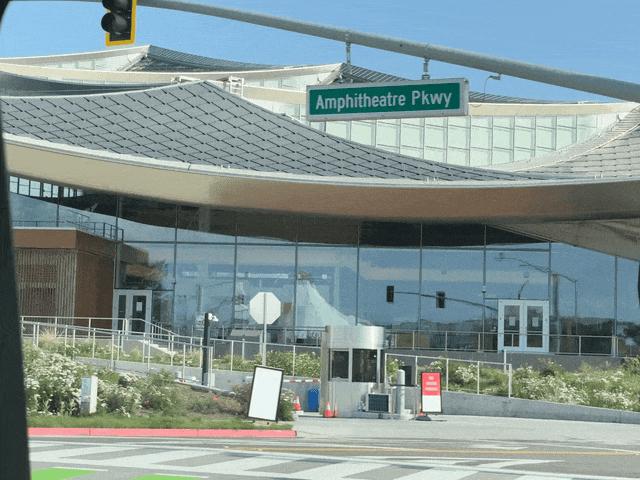
DeepMind building.
In Mountain View, it's hard not to be attracted by a huge glass building covered with a hydraulic solar roof.
A friend at Google told us that there are two types of people who can work inside: one is the high - level executives at the director level of Google, and the other is the researchers at DeepMind. In China, this kind of office model is probably equivalent to Zhang Yiming staying at Seed for work.
This extremely flat organizational form in terms of space means: AI has become Google's top - level project.
In the extremely open Google campus, this building is almost isolated from the outside world. Our friend mentioned that the office buildings of other Google businesses have interconnected access rights, and employees can use their work cards to enter any office building. Only the DeepMind Office is an exception.
"Extreme focus, extreme bottom - up," a DeepMind researcher summarized the culture of DeepMind in this way.
How far has Token - Maxxing gone?
Does more Token - Maxxing mean a more advanced company?
In Silicon Valley, people are starting to demystify Token - Maxxing.
A friend at Google told "Intelligent Emergence" that since the company encouraged non - developers to use Antigravity (Google's Coding Agent) for Vibe Coding, the code volume in the department has increased by 3 - 4 times, but the acceptance rate has also decreased by 30%.
In Q1 2026, the engineering management software company Jellyfish collected data from 7,548 engineers. They also found that the engineers with the highest Token consumption only achieved a two - fold increase in production capacity at a ten - fold Token cost.
This means that Token - Maxxing only increases the quantity of code, not its value.
The hidden management costs increased by AI are often overlooked. "If you have several crayfish, they'll fight with each other. Who will manage them?" An entrepreneur named Sharon has observed conflicts between humans and Agents in many companies: one Agent modifies the code, and another Agent is unaware and continues to run on the old version; two Agents optimize the same piece of logic at the same time and may produce contradictory results.
In this case, the value of AI in improving efficiency has not been seen yet, but it has become a new management burden.
Compared with using Tokens to push employees, "businessman" Musk wants to sell Tokens for real money
Among the top Silicon Valley tech companies engaged in Token - Maxxing, Tesla is a bit special.
Several friends from big Silicon Valley tech companies told us that there are strict restrictions on employees' Token usage within Tesla and SpaceX.
As for the reason, a friend guessed that compared with using Tokens to push employees, "businessman" Musk wants to sell Tokens for real money.
"Stop Hiring Humans"

Artisan AI's billboard
An AI marketing company named Artisan AI has been placing a large number of billboards in the Bay Area since 2024, with the slogan "Stop Hiring Humans."
This somewhat warning and provocative slogan can be seen everywhere on hot air balloons in the sky, helicopters pulling banners, and large billboards on the roadside.
However, Artisan AI's large - scale advertising campaign is largely for the sake of attracting attention. Artisan AI CEO Jaspar Carmichael - Jack later admitted in a blog that this slogan was designed to spark controversy and discussion.
"The Bay Area is a place with a strong sense of performance," Silicon Valley entrepreneur Ryan commented. "Token - Maxxing and layoffs are ultimately performances by big tech companies to show their advancement."
Another slogan floating in the sky is: SaaS is Dead.
Where are the business opportunities for entrepreneurs?
"I'm almost taking my visa - processing business public"
What's the fastest - money - making business in Silicon Valley? One of the answers must be H1 - B work visa processing.
Neil, who has been based in the Bay Area for many years, told me that his H1 - B work visa agency service for Chinese entrepreneurs is already booked until the end of 2026. "Some people are even willing to pay extra to jump the queue." When I asked him how much money he had made in the past two years of visa processing, he told me mysteriously, "I'm almost taking my business public."
In Palo Alto, where top - tier US dollar funds are concentrated and Stanford University is located, there are many Visa Agencies with annual revenues of millions of dollars. When you're waiting in line at Nagi, the most popular ramen shop in Palo Alto, you can see the hard - sell advertisement of the neighboring Visa Agency: "Waiting for ramen? What about your visa?"
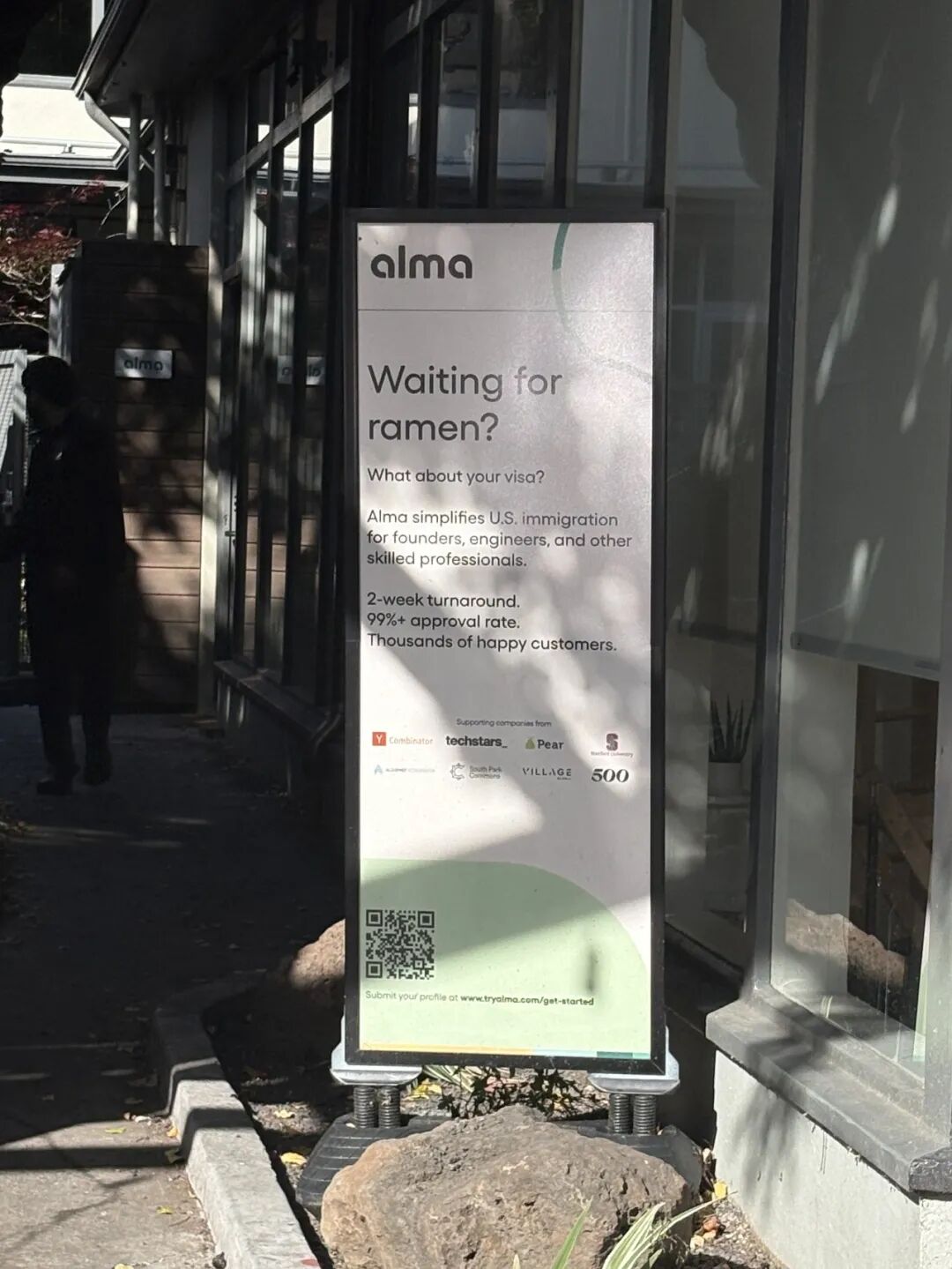
Advertisement of