HSG and China Renaissance invested in the "Yelp for AI products". We had a chat with its founder, who was born in 2002.
Text by | Zhou Xinyu
Edited by | Zhang Yuxin
Open "Guancha", and you can see an AI startup ecosystem that is completely different from what the institutional investment lists present:
There are rarely projects with valuations of hundreds of millions of dollars. Those active in the community are often not entrepreneurs with backgrounds from prestigious universities or large companies. Instead, they are more ordinary designers, product managers, and even retired teachers.
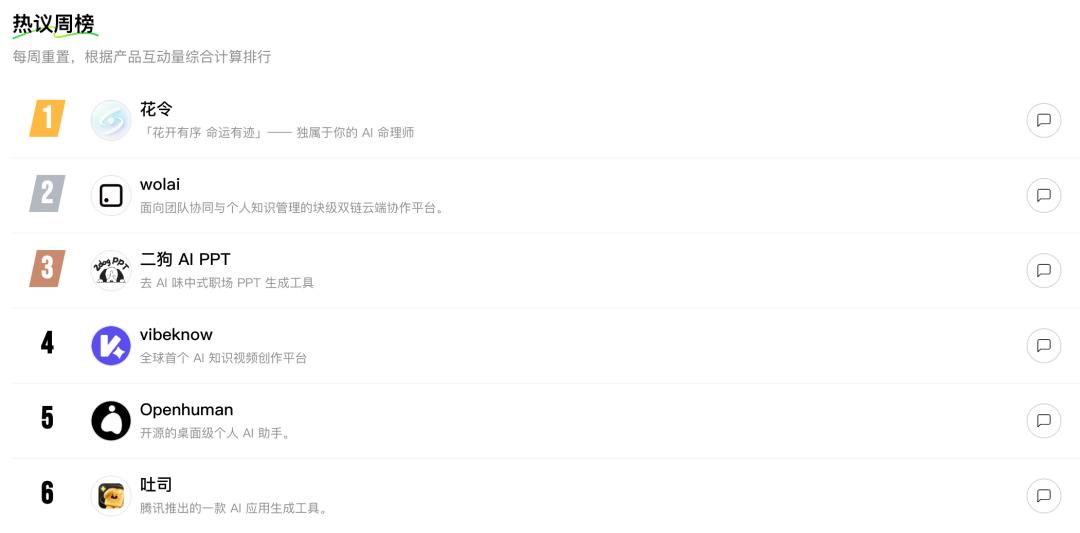
Guancha.
Zhong Tai, the founder of "Guancha", told me: "This is the most real ecosystem in the AI industry."
Zhong Tai is a well - known name among AI entrepreneurs and developers. This tall and thin boy born in 2002, wearing black - framed glasses, has been an entrepreneur for as long as six years. He created a test - question exchange platform in his senior year of high school and a question - answering community for exam questions in his freshman year. In 2023, at the peak of the AI wave, he founded the tech self - media "Agent Universe".
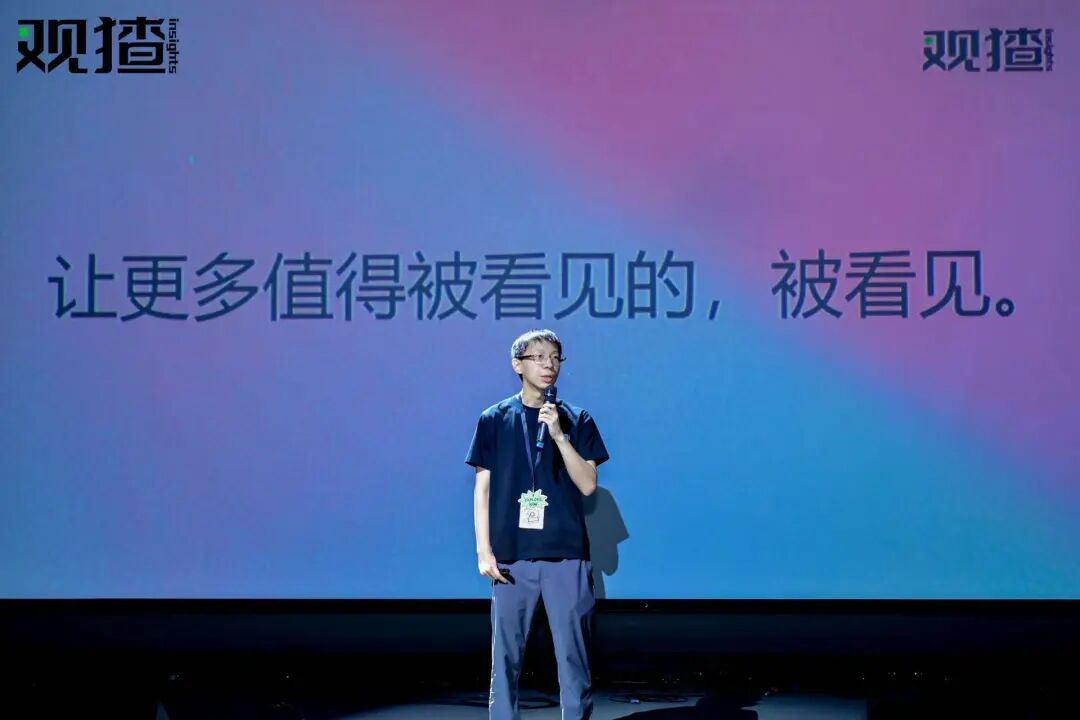
Zhong Tai.
The AI product evaluation community platform "Guancha", which was launched in July 2025, is his most ambitious entrepreneurial project.
After dealing with AI projects for two or three years, Zhong Tai has tried more than a thousand products. He realized that only a very small number of projects can get financing and have the resources for promotion. "Many projects are not bad, but they just don't have the opportunity to be seen by the public."
The original intention of creating "Guancha" comes from a simple idea: Beyond the financing amount and team background, create a new evaluation system for AI applications to give early - stage startups exposure opportunities.
In order to ensure the "fairness" of opportunities as much as possible, "Guancha" has designed a strict evaluation mechanism:
Only those who are specially invited or pass an online exam of 50 questions can become "Guancha members" who are qualified to write product reviews. The reviews must be written by real people and pass both machine and manual reviews. The weight of the reviews posted also varies according to the activity level and the number of likes of the "Guancha members".
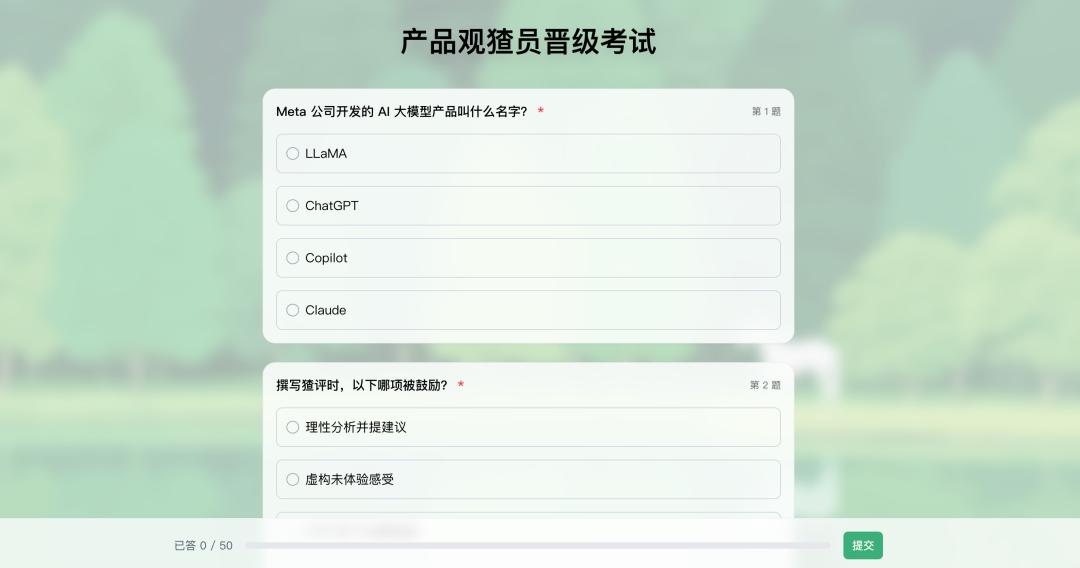
Guancha member exam.
On the contrary, there are almost no thresholds for projects to enter "Guancha". "Even for homogeneous projects, we are very inclusive." Zhong Tai told "Intelligent Emergence", "In the end, we leave it to the general users to judge the quality of the projects."
Since its launch six months ago, thanks to the spread of word - of - mouth, nearly 2000 projects have entered "Guancha", the number of "Guancha members" has increased to nearly 5000, and the monthly active user number of the community has reached hundreds of thousands. Many projects such as OiiOii, QClaw, Aivilization, and Paper2Gal started here, received attention, and then obtained financing.
Many people call "Guancha" the "Chinese version of Product Hunt". However, in Zhong Tai's view, Product Hunt only provides an exposure channel, while early - stage startups and the increasingly prosperous OPC (One - Person Company) need more, such as third - party components for improving product infrastructure, GTM (go to market) methodology, and more affordable Token resources.
Therefore, "Guancha" provides services such as unified login SDK, unified payment SDK, and marketing. "For entrepreneurs without product operation experience, the learning cost and time cost of running through the entire login, payment, and marketing system are very high." Zhong Tai explained.
In addition, there is Token subsidy. "Guancha" has launched its own third - party model integration platform, TokenDance, which provides APIs for entrepreneurs at a low - cost channel price. As the only 'losing - money' project on the platform, Zhong Tai told us, 'TokenDance doesn't need to make money', after all, many early - stage entrepreneurs can hardly afford the Token cost.
"Guancha" wants to do a lot of things, but Zhong Tai feels that he has to do them. The more projects emerge, the more needs need to be solved. "Intelligent Emergence" learned that recently, "Guancha" (Siyi Technology) completed a seed - round financing from Sequoia China and Huaxing Capital.
Gong Yuan, a partner at Sequoia China, told "Intelligent Emergence", "Guancha is a super node that brings together many young entrepreneurs and builders. It is also a discovery and distribution platform for cutting - edge AI products, where you can feel the most cutting - edge signals. We look forward to the Guancha team being able to observe more new knowledge and insights in the uncertain future."
Wang Lixing, the CEO of Huaxing Capital, said when talking about Guancha, "The uniqueness of Guancha lies in that it stands between AI builders and real users. It is close to the innovation supply on the developer side and can also sense the real feedback on the user side. What we value is the team's in - depth understanding and iterative speed of the new - generation AI application ecosystem. As the AI application ecosystem continues to enrich, Guancha has the opportunity to precipitate its own platform value in the process of connecting products, users, and commercialization paths."
Below is the exchange between "Intelligent Emergence" and Zhong Tai about "Guancha" and the AI startup ecosystem:
We are 'robbing the rich to help the poor'
Actually, only a very small number of AI applications can be seen by most people.
Many teams haven't got financing and can't afford to promote on some channels. There are also many entrepreneurs with technical backgrounds who don't know how to create content or do marketing. So what "Guancha" wants to do is very simple: Create a new evaluation system for AI applications to give early - stage startups a fair exposure opportunity.
There is no AI product review platform in China.
In 2023, I wanted to create a community for AI communication, similar to Douban or Twitter. But at that time, I didn't have much money, and the short - term commercialization was not clear, so I didn't do it.
In 2025, I found a starting point: first create the Chinese version of Product Hunt, and then expand it into a community for the release and communication of new AI products.
The reason for choosing a product form like Product Hunt is, first, there is no such AI product review platform in China; second, large companies can't do it because they have developed and invested in many AI products themselves, which is not fair enough. This needs to be done by a third - party platform.
"Guancha" provides Token subsidies, and its business model mainly consists of advertising and channel fees.
When a technical team doesn't know how to create content or do marketing, our colleagues will teach them. If the product is really good, we will even help promote it for free.
When the product is more mature, we will provide the "unified login" system of "Guancha". The users on "Guancha" are very targeted AI users. They can directly log in to the application with their Guancha accounts without registering with a mobile phone number or email.
Now we are also exploring the "unified payment" service of "Guancha". For small - scale startup teams and some OPCs, there is a certain learning cost in the payment, settlement, and operation processes involved in the transition from product to commercialization. In the future, if the transaction cycle is completed through Guancha's payment SDK, as the channel and service provider, we will also charge a certain fee.
Recently, we also created a model API aggregation platform similar to OpenRouter, TokenDance (Token Jump). We have subsidized many college student teams with Tokens. For them, a daily Token consumption of more than 1000 yuan is already a lot. When they start commercializing, we will provide Token discounts.
We can afford to lose money on Token subsidies because for most early - stage entrepreneurs, Tokens are a high - consumption and expensive resource. The sources of income are advertising and channel fees.
Currently, most of the popular products on the list are still from large companies. This is a normal phenomenon, after all, the products of large companies are more mature, and users are more willing to use them in the early stage.
However, we tend to connect with early - stage startup teams and OPCs, and provide services such as Tokens to improve their products and give them more exposure.
Now we are cooperating with large companies to make some money and then subsidize the developers. It's like "robbing the rich to help the poor" (laughs).
The scarcest asset in the industry is 'authenticity'
Regarding the mechanism of "Guancha", we didn't initially plan to start with voting because voting is too easy to be'manipulated'.
We referred to the mechanisms of rating websites such as Steam, Douban, Rotten Tomatoes, and Hupu, and finally formed a mechanism that allows both positive and negative reviews.
Compared with most channels, the difference of "Guancha" is authenticity. Too many false reviews, exposures, and data can be bought with money, and authenticity has become a scarce resource.
The "Guancha" community is a two - sided network, with builders on one side and users on the other.
If we want both sides to have good retention, we need a group of core users to produce objective and high - quality reviews and content for the community. These users are the "Guancha members".
Currently, the number of "Guancha members" has expanded to nearly 5000. To control the quality of "Guancha members", our review mechanism has changed from targeted invitations to an online exam, just like the entrance exam of Bilibili. Only by passing the online exam can one get the qualification to write project reviews.
Becoming a "Guancha member" doesn't mean one can post reviews at will. The platform has set up two review mechanisms, machine and manual. Once it is found that a member uses AI to fool or the quality of the review is low, the member's qualification will be revoked.
We are also building a weight mechanism. According to the activity level and the number of likes, the weight of the reviews and ratings given by "Guancha members" to projects will vary.
There is a basic threshold for projects to enter "Guancha". Projects created by just 10 - minute Vibe Coding won't work.
Projects that meet the basic threshold can be listed, but whether the platform promotes them or not will still be judged according to the project's popularity and rating. This is the recommendation mechanism of "Guancha".
We don't restrict copycat projects. After all, the App Store doesn't either.
When a product becomes popular, it's natural for copycat projects to appear. But in the end, users will judge the quality of the products.
The survival window period of AI products is only 3 months
The bubble of OPC (One - Person Company) is a bit big. Everyone is blowing bubbles, but no one is really solving problems.
OPC requires a very high - quality entrepreneur. They need to be sharp enough to capture opportunities in the rapidly changing market, quickly develop products, commercialize them, and make money. Very few people can run through this path.
Currently, only 30% of the projects on "Guancha" are OPCs, and the other 70% are relatively mature companies.
The survival window period of AI products is getting shorter and shorter.
According to my observation, the time from a product's launch to being forgotten was 6 months a year ago, and now it's only 3 months.
We have always been planning a section called "AI Graveyard". All the discontinued products will be included here, and people can come to remember them or analyze the reasons for their failure.
Failure itself is worth recording. Many times, failure is not the problem of the product itself, but may be due to timing, the track, or team adjustments.
The lowering of the threshold of Vibe Coding has satisfied many niche needs.
For example, AI fortune - telling. At first, many people didn't understand it, and the projects were similar. But after I read the comment section of "Guancha", I found that the fortune - telling needs are also very segmented, with methods such as the Book of Changes and Tarot.
In the future, the implementation scenarios of AI projects will become more and more segmented.
Nowadays, hackathons are very lively, but nothing really valuable is left after the excitement.
After the contestants win awards, in fact, no one really cares about the product's development soon. I hope "Guancha" can cover the entire chain of hackathons, including follow - up project services and resource docking services.
Now, the speed at which startup teams pivot (adjust their entrepreneurial directions) is getting faster and faster because the capabilities of the base models are still evolving at a high speed.
Pivoting is a normal phenomenon, or even a 'good thing'. This means that the cost of entrepreneurial trial - and - error is decreasing.
The dilemma of early - stage projects lies in the lack of channels to match with seed users
Most AI products in China don't have many users, with an average of only twenty or thirty thousand.
For a product to continuously iterate and obtain financing, it cannot do without seed users.
Many early - stage OPCs come to "Guancha" to acquire early - stage seed users. We are also planning relevant service models. In the future, through algorithms and a certain amount of manual work, projects on "Guancha" can be matched with at least 1000 seed users.
According to the "1000 True Fans" theory, a project doesn't need to be liked by the whole world. As long as it has 1000 users who are really willing to support it, it can theoretically support itself.
There is a current view: Traditional software is dead, and apps are meaningless. Everyone will use personal agents to call skills.
I agree that this is a trend, but it is still a long way off. Looking at the larger consumer group, in fact, people's understanding of Vibe Coding is still very basic, and this market needs to be educated. Most people's operation habits are still on apps, and their needs don't reach the level of using OpenClaw.
So, at least in the next 3 - 5 years, I think AI software will still have a big explosion. In the short term, various AI production tools will develop faster. However, in the AI + pan - entertainment field, there are still many companies that have raised a lot of money but are still exploring, and there are still great opportunities.
There are quite a lot of non - consensuses about Skills. Some people think that Skills are a transitional thing and will be swallowed up by the capabilities of the next - generation models.
There are also non - consensuses about the Skill Market. Can personal experience be well "distilled" by AI? Especially in the case of a very complex workflow