In the first quarter when Luofuli went all out in AI, Xiaomi's net profit dropped by 43% while R & D investment increased by 33%.
On May 26, Zhidx reported that Xiaomi officially released its financial report for the first quarter of 2026. Both its revenue and net profit declined. Lei Jun posted on Weibo to report the performance to netizens.
In the first quarter, Xiaomi's revenue was 99.1 billion yuan, a year-on-year decrease of 10.9%; the adjusted net profit was 6.1 billion yuan, a year-on-year decrease of 43.1%. In terms of R & D expenses, Xiaomi spent 9 billion yuan in the first quarter, a year-on-year increase of 33.4% and a quarter-on-quarter decrease of 6.7% compared with 9.6 billion yuan in the fourth quarter of 2025. As of March 31, 2026, the number of Xiaomi's R & D personnel reached 26,048, a record high.
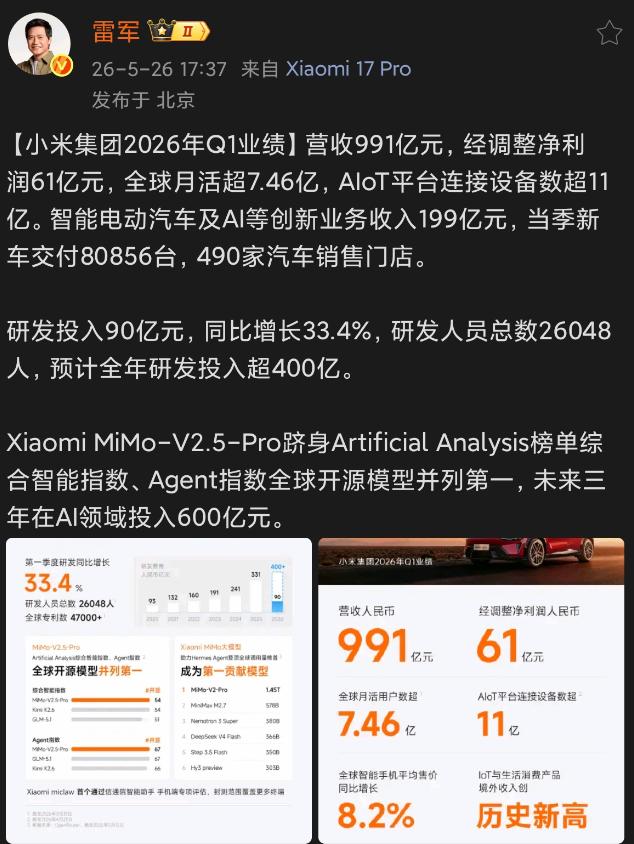
▲ Lei Jun posted on Weibo to report the first - quarter performance (Source: Lei Jun's Weibo)
The revenue of the mobile phone and AIoT segment in the first quarter was 79.3 billion yuan, a year-on-year decrease of 14.5%, accounting for 80% of the total revenue; the revenue of the innovative business segments such as smart electric vehicles and AI in the first quarter was 1.99 billion yuan, a year-on-year increase of 6.9%, accounting for 20% of the total revenue. This segment had an operating loss of 3.1 billion yuan this quarter.
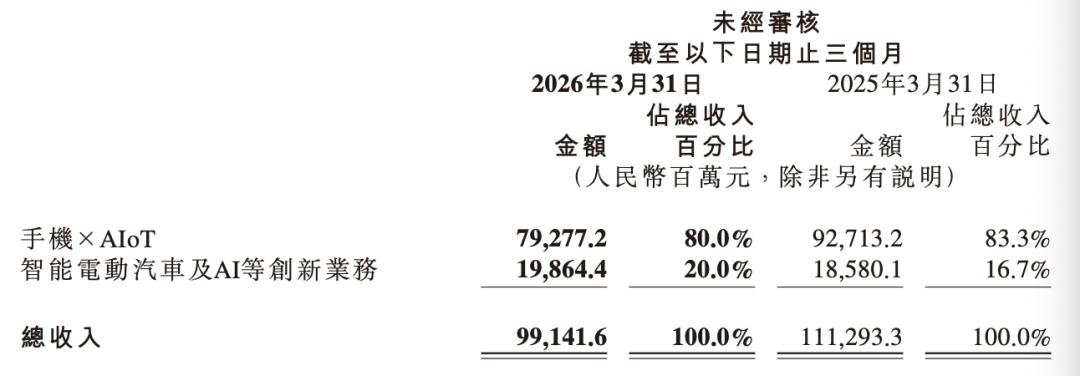
▲ Revenue of the mobile phone and AIoT segment and innovative business segments such as smart electric vehicles and AI in the first quarter (Source: Xiaomi's financial report)
In the field of artificial intelligence, Xiaomi launched the public beta of the Xiaomi MiMo - V2.5 series of large models. Among them, Xiaomi MiMo - V2.5 - Pro ranked among the top five in the global ranking of large models on the Artificial Analysis large - model comprehensive intelligence list. At the same time, its Agent index ranked first among global open - source large models.
At the just - ended earnings conference call, Lu Weibing explained the decline in revenue and profit. He said bluntly that Xiaomi Group had experienced two difficult periods, and it would become stronger after each difficult period. This time, under the influence of factors such as rising costs and the reduction of national subsidies, Xiaomi Group actively adjusted its business.
Specifically, Xiaomi Group hedged the pressure brought by the rising memory cost by reducing the shipment of mid - and low - end smartphones globally. In addition, it also actively adjusted its sales strategy. In the first quarter, the average selling price (ASP) of Xiaomi smartphones increased by 8.2% year - on - year, reaching 1,310 yuan, a record high. The gross profit margin of mobile phones was 10.1%, up from 8.3% in the previous quarter.
Lu Weibing specifically mentioned the strategy to deal with the rising memory price. Xiaomi aims to produce products that satisfy users and sell them at a reasonable price, rather than simply passing the cost on to consumers. For old products, Xiaomi's strategy is not to raise prices or to raise prices later.
When it comes to the AIoT (Artificial Intelligence and Internet of Things) business, Lu Weibing defined it as a strategic choice for Xiaomi Group to relieve the pressure of rising memory costs. In the first quarter, the gross profit margin of IoT and consumer products reached 25.2%, a quarter - on - quarter increase of 5.1 percentage points, which is a balancer for dealing with memory pressure in the future.
In terms of AI, Lu Weibing mentioned that the entire industry is still exploring the ultimate form of the combination of AI and hardware. But if you want to do well in such products, you must invest in the base model. Lu Weibing believes that Xiaomi's large AI models should serve the business, and the coupling with the business is very important. For example, "Lobster" miclaw is being promoted rapidly and will be actively integrated into Xiaomi's "car - home - person" ecosystem in the future.
In addition, when asked about the AI investment plan of 16 billion yuan at the beginning of the year, Xiaomi Group's CFO Lin Shiwei believes that the future AI investment plan will be adjusted according to the development of the AI business and is expected to increase.
While releasing the financial report, Xiaomi Group announced a share repurchase plan. It is expected to repurchase HK$20 billion worth of shares in the next 12 months until the company's general meeting of shareholders this year.
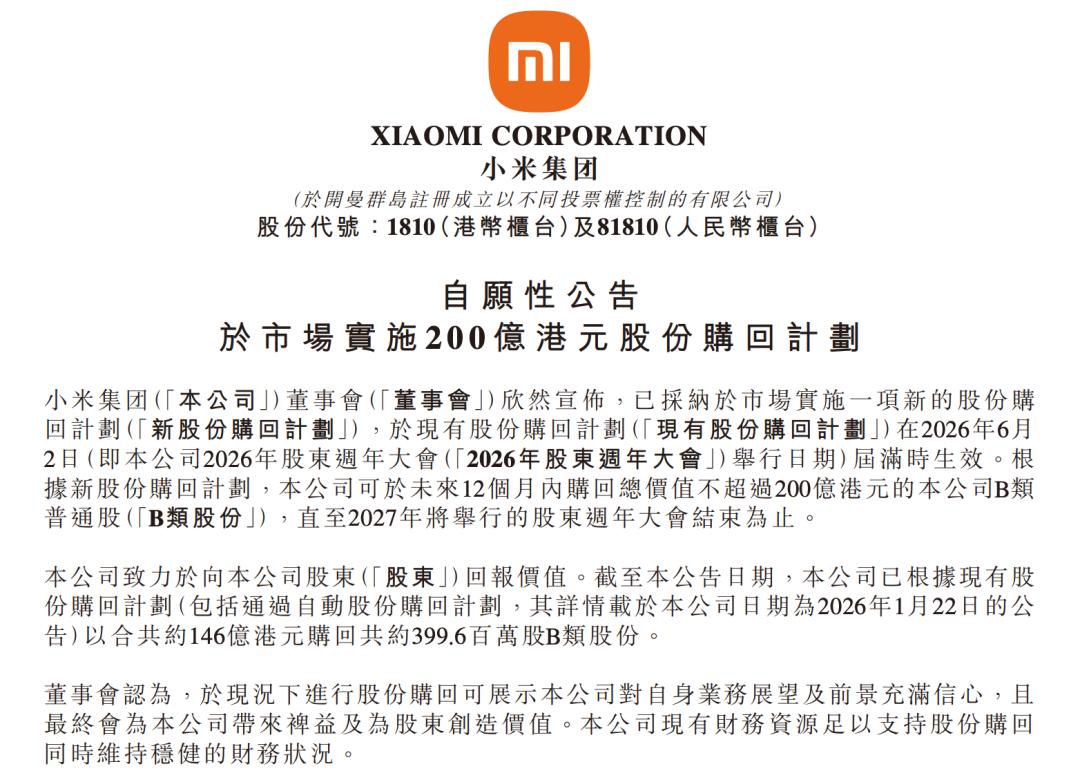
▲ Xiaomi Group's share repurchase announcement (Source: Xiaomi)
After the market closed today, Xiaomi Group's latest market value was HK$769 billion (equivalent to about 666.78 billion yuan). The stock price fell 0.8%, and the current stock price is HK$29.76 (equivalent to about 25.80 yuan).
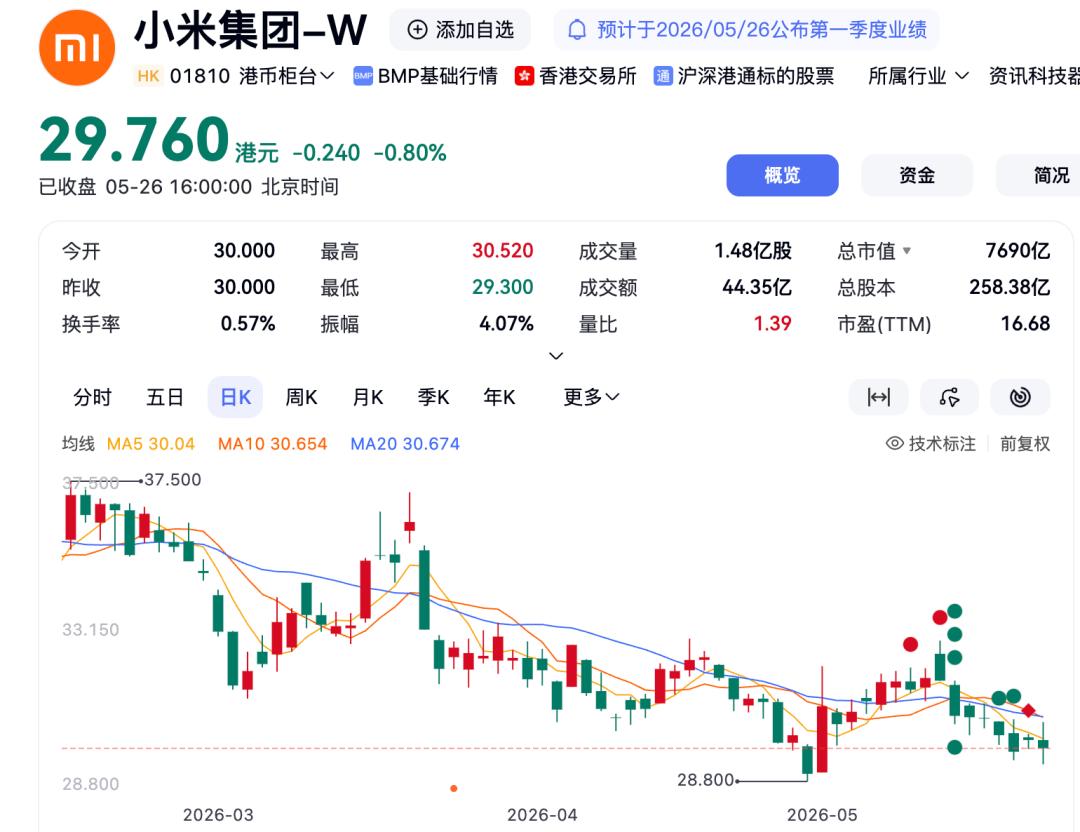
▲ Xiaomi Group's stock price (Source: Baidu Stock Market Connect)
01.
Under the continuous pressure of rising memory costs
Xiaomi seeks high - end solutions
Throughout 2025, Xiaomi's revenue and net profit were relatively stable in the first three quarters. In the fourth quarter, affected by factors such as the rising memory price, the net profit declined significantly. In the first quarter of 2026, it failed to recover, and both the total revenue and net profit declined.
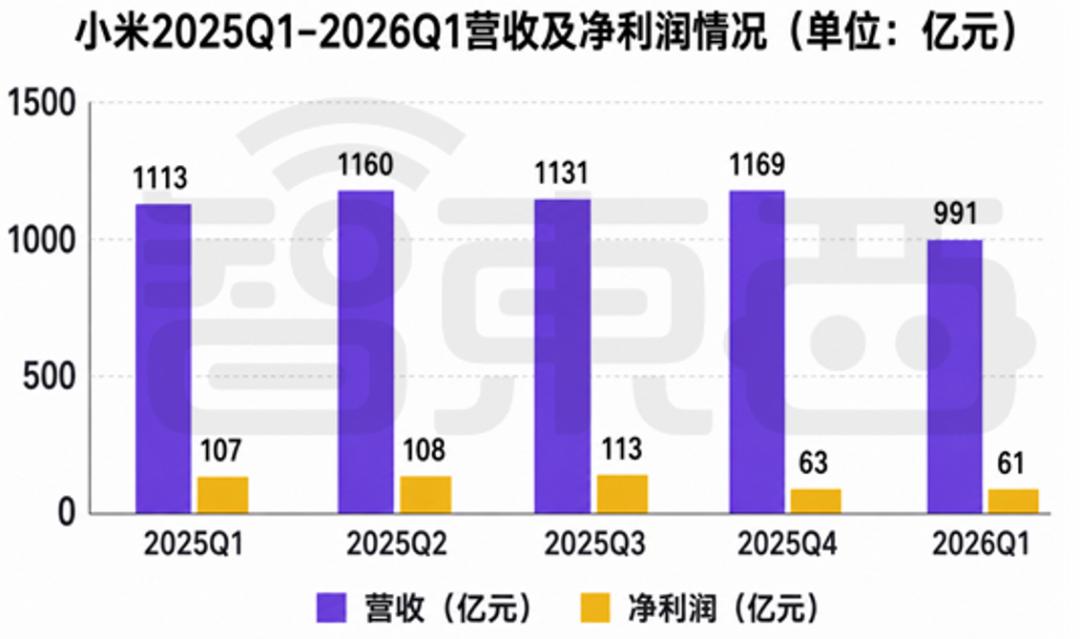
▲ Xiaomi's revenue and net profit in the past five quarters (Charted by Zhidx)
In the mobile phone business segment that Zhidx focused on, Xiaomi's smartphone revenue decreased by 12.5% from 50.6 billion yuan in the first quarter of 2025 to 44.3 billion yuan in the first quarter of 2026.
In the first quarter, Xiaomi's global smartphone shipments were 33.8 million units. According to Omdia data, Xiaomi ranked third in global smartphone shipments this quarter, with a market share of 11.3%, ranking among the top three globally for 23 consecutive quarters.
In terms of regional performance, Xiaomi's smartphone shipments ranked second in Latin America, with a market share of 17.4%, a quarter - on - quarter increase of 2.0 percentage points; it ranked third in Europe, Southeast Asia, the Middle East, and Africa, with market shares of 17.2%, 16.9%, 13.0%, and 9.2% respectively. In the first quarter, Xiaomi's smartphone shipments ranked among the top three in 47 countries and regions globally and among the top five in 65 countries and regions.
Lu Weibing believes that for the mobile phone business, the rising memory cost has been expected, and it is predicted that it will continue to increase later. Although the increase rate will decrease from the third quarter, the pressure is still very high. It not only affects mobile phones but also has a huge impact on the entire consumer electronics industry. However, Xiaomi will not simply pass the cost pressure on to consumers. It will enable consumers to buy good products at a reasonable price through product upgrades and sales - strategy adjustments. Lu Weibing also specifically mentioned AI. He said bluntly that it is very important to seize AI during this period of rising memory prices.
Xiaomi is continuously promoting its high - end strategy. According to third - party data, in the first quarter of 2026, the sales volume of Xiaomi's high - end smartphones in the Chinese mainland accounted for 23.5% of the total smartphone sales volume.
Driven by the rising storage cost and the high - end strategy, the average selling price (ASP) of smartphones increased by 8.2% year - on - year to 1,310 yuan, a record high. The gross profit margin of mobile phones was 10.1%. Although it decreased by 2.3 percentage points year - on - year, it rebounded from 8.3% in the previous quarter.
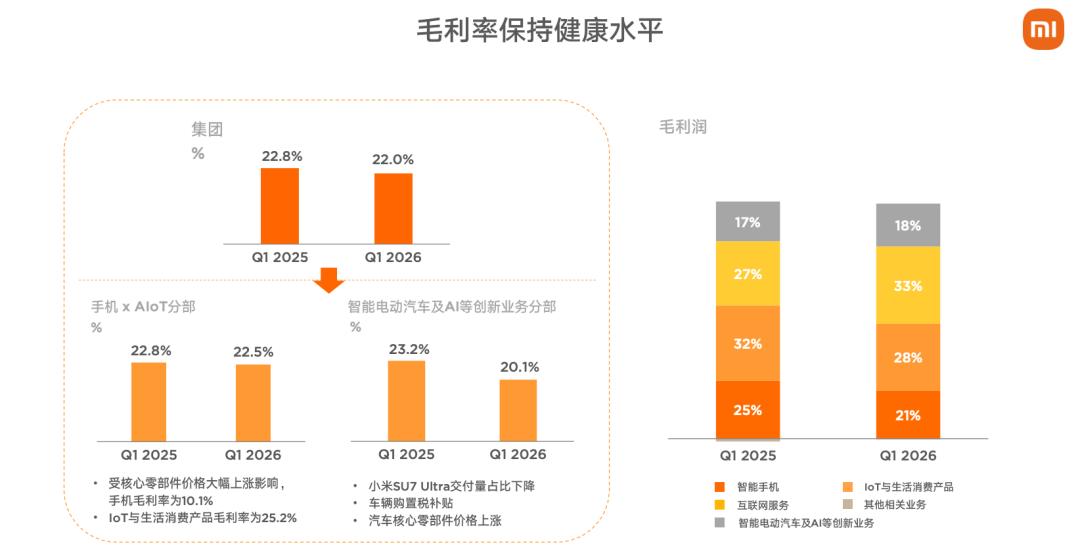
▲ Gross profit of various businesses (Source: Xiaomi's financial report)
02.
The large model ranks among the top in the world
AI empowers the entire "car - home - person" ecosystem
In the field of large AI models, on April 23, 2026, Xiaomi officially launched the public beta of the Xiaomi MiMo - V2.5 series of large models. This series includes MiMo - V2.5, V2.5 - Pro, V2.5 - TTS Series, and V2.5 - ASR. Among them, Xiaomi MiMo - V2.5 - Pro reached the global top - level Agent model standard in dimensions such as general intelligent agent ability, complex software engineering, and long - range tasks, achieving an all - around leap compared with the previous - generation MiMo - V2 - Pro.
On the Artificial Analysis large - model comprehensive intelligence list, the comprehensive intelligence index of Xiaomi MiMo - V2.5 - Pro ranked first among global open - source large models, ranking among the top five in the global ranking of large models. At the same time, its Agent index ranked first among global open - source large models. On April 28, 2026, Xiaomi officially open - sourced the Xiaomi MiMo - V2.5 series, using the MIT license, supporting commercial reasoning deployment and secondary training without additional authorization.
Xiaomi is comprehensively empowering the "car - home - person" ecosystem with AI capabilities. In April 2026, Xiaomi officially launched a small - scale closed - beta test of the PC and screen - equipped speaker versions of Xiaomi miclaw. After the expansion of the closed - beta categories this time, Xiaomi miclaw already supports multiple terminals such as mobile phones, tablets, PCs, and screen - equipped speakers, and its cross - terminal ability has been significantly upgraded. Recently, the China Academy of Information and Communications Technology launched an evaluation of the mobile - phone - end intelligent assistant (Claw), and Xiaomi miclaw became one of the first domestic mobile - phone - end intelligent agents to pass this authoritative evaluation.
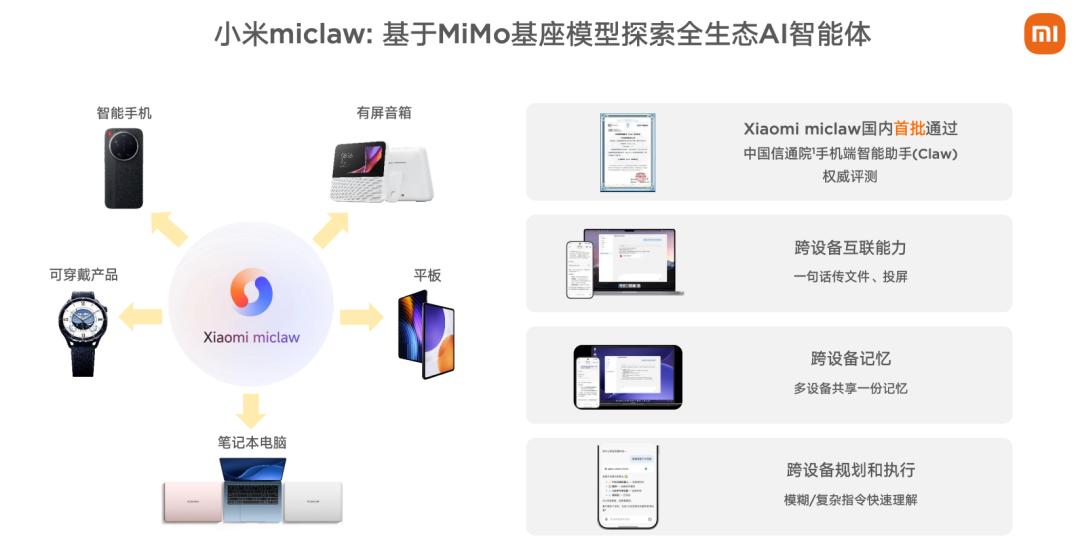
▲ Multi - terminal interaction of Xiaomi miclaw (Source: Xiaomi's financial report)
In the field of embodied intelligence, in April 2026, Xiaomi officially released and open - sourced the whole process of post - training of the real - machine of the embodied model Xiaomi - Robotics - 0, comprehensively opening up a complete set of data processing, training methods, and reasoning codes, hoping to lower the technical threshold of robot intelligence through open - source methods.
03.
Revenue rebounds and gross profit rises
Xiaomi uses AIoT to resist the pressure of rising memory costs
Affected by factors such as the reduction of national subsidies, Xiaomi's revenue from IoT and consumer products in the first quarter of 2026 was 24.7 billion yuan, a year - on - year decrease of 23.7%, but a slight increase of 0.3% compared with 24.6 billion yuan in the fourth quarter of 2025.
Thanks to the expansion of overseas channels and the increase in product categories, Xiaomi's overseas revenue from IoT and consumer products reached a record high. In this quarter, the gross profit margin of Xiaomi's IoT and consumer products reached 25.2%, a quarter - on - quarter increase of 5.1 percentage points, maintaining a healthy level.
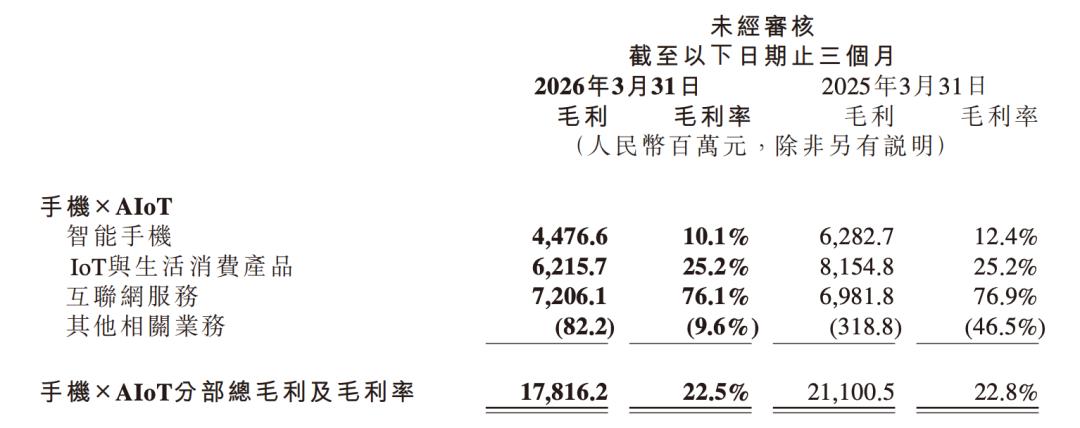
▲ Gross profit and gross profit margin of the mobile phone and AIoT segment in the first quarter (Source: Xiaomi's financial report)
When answering questions related to AIoT, Lu Weibing repeatedly mentioned that IoT is an important strategic choice for Xiaomi Group to deal with the rising memory cost. Xiaomi has adopted different development strategies in the domestic and overseas markets. In the domestic market, it attaches importance to the R & D and sales of high - end products, such as high - end products like ear - clip headphones, high - power air conditioners, and refrigerators.
Overseas, it focuses on quickly expanding the market. Lu Weibing is optimistic about the future sales volume in the overseas market. He said bluntly that although the overseas market requires market access, Xiaomi solved most of the market - access problems last year. This year, the number of Xiaomi Homes and e - commerce sales have doubled. It is predicted that the future market potential overseas will be twice that of the domestic market.
As of March 2026, the number of Xiaomi Homes in the Chinese mainland exceeded 16,000, including more than 260 new - retail large stores over 500 square meters. At the same time, the number of new - retail stores overseas exceeded 520, covering regions such as Southeast Asia, Europe, East Asia, Latin America, the Middle East, and Africa.
Currently, the number of IoT devices (excluding smartphones, tablets, and laptops) connected to Xiaomi's AIoT platform has reached 1.1187 billion, a year - on - year increase of 18.5%; the number of users with five or more devices (excluding smartphones, tablets, and laptops) connected to the AIoT