Qianwen is "possessing" Alibaba Cloud
On May 26, Alibaba Cloud launched a new AI product official website, Qwen Cloud, an Agent product, MuleRun, and a series of updates to the intelligent agent programming platform Qoder and the general desktop intelligent agent QoderWork in Singapore for the overseas market. Simultaneously, it achieved an upgrade of the cloud infrastructure for Agents.
This is a continuation of the Alibaba Cloud Summit a few days ago. At that time, Alibaba Cloud launched the AI product official website "Qwen Cloud" for the domestic market in the era of Agents.
When looking at these two press conferences together, the focus becomes clearer. Alibaba Cloud is putting "Qwen" in a more prominent position, enabling it to serve as the model brand, product entry point, and commercial front - end simultaneously.
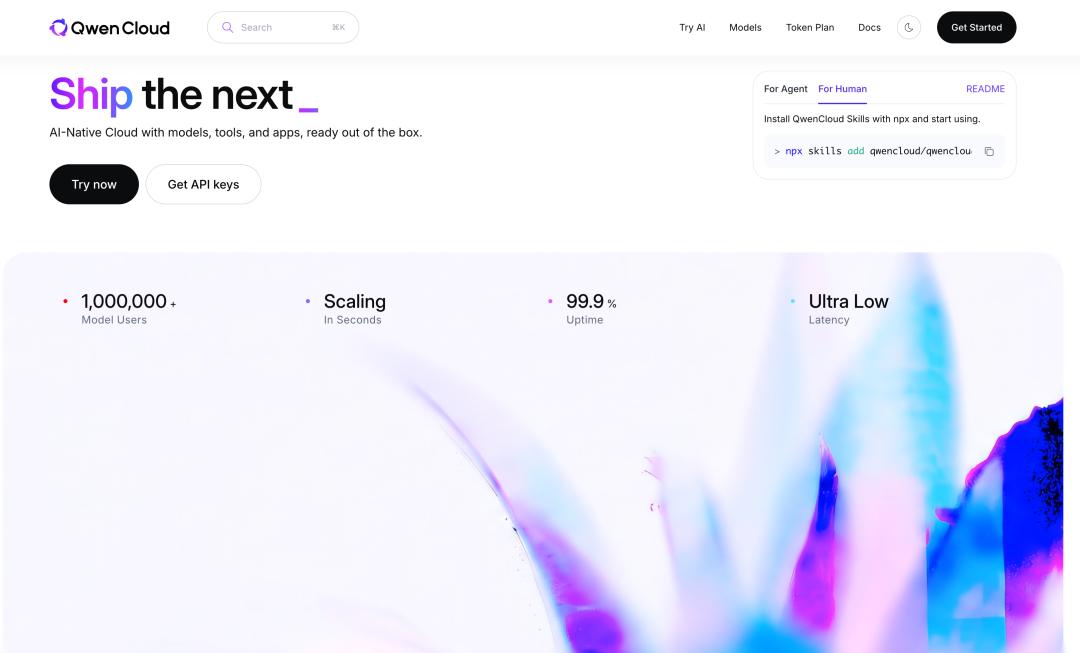
In the past, the typical entry points for Alibaba Cloud were the cloud official website, console, and a series of basic cloud products. Now, model calls, Token Plans, Skills, CLI, and Agent tools are aggregated under Qwen Cloud. The users of cloud services are also changing. In addition to human developers, there are now Agents that can independently call tools and models. It can even be said that silicon - based users are the main ones, with carbon - based users as supplementary.
Why is Qwen Cloud being pushed to the forefront?
There is a notable detail between the domestic and overseas press conferences.
In China, Qwen Cloud was launched at the Alibaba Cloud Summit. It still falls within the framework of "Alibaba Cloud launching new products", indicating an upgrade of Alibaba Cloud's model service platform. In the overseas market, the name of the press conference became the Qwen Conference, and Qwen became a more prominent protagonist. This change shows that Qwen already has independent communication value overseas.
This is related to Qwen's accumulation of developer awareness through open - source initiatives in the past few years. For overseas developers, Qwen is a specific model brand that frequently appears on Hugging Face, GitHub, developer communities, and Agent frameworks.
Compared with traditional cloud provider brands, Qwen has more direct technical labels and a stronger sense of community. Alibaba Cloud's choice to launch Qwen Cloud at the Qwen Conference is to transform the model reputation formed in the open - source community into an entry point for overseas cloud services.
On the official website, Qwen Cloud positions itself as a MaaS (Model as a Service) platform. However, from the official introduction and product form, its scope is broader.
It aggregates model APIs, Token Plans, Skills, CLI, Qwen3.7 - Max, and several tools and applications related to Agents, attempting to reorganize the processes of model selection, authentication configuration, usage query, command - line calls, and Agent - readable instructions.
This is also the difference between Qwen Cloud and Bailian. Bailian is closer to Alibaba Cloud's mature large - model development and application platform, focusing on the production backend and capability platform. Qwen Cloud, on the other hand, is more of a front - end entry point and brand entry point, packaging these model service capabilities, various supporting tools, and related products into a form that is easier for developers and Agents to use.
Qwen Cloud is the first independent product official website launched by Alibaba Cloud outside its official website in 17 years since its establishment.
It seems that Qwen is "taking over" Alibaba Cloud. This view didn't just pop up in my mind; it has become an increasingly strong judgment over the past period. What is Qwen? It covers both C - end products and basic models. In fact, it has become the unified concept of all AI businesses in the Alibaba system and is the soul of Alibaba's ATH business group.
The reason for saying that Qwen is "taking over" Alibaba Cloud is that Alibaba's growth logic has shifted.
Investment banks predict that Alibaba Cloud's AI - related revenue will increase from RMB 24 billion in FY2026 to RMB 585.5 billion in FY2031 at a compound annual growth rate (CAGR) of 90%. By then, its proportion of total cloud revenue will jump from 15% to 70%.
Among them, MaaS revenue will grow at a CAGR of 235%, surging from approximately RMB 1 billion in fiscal year 2026 to RMB 438.6 billion (approximately $62.6 billion) in fiscal year 2031, accounting for 53% of Alibaba Cloud's total revenue at that time.
It is not difficult to understand why a separate brand of Qwen Cloud is created for this business that grows from zero to more than half of the total in just a few years.
The Model Fulcrum
The keyword behind this change is Agent.
In the past, cloud services assumed that the users were humans. Humans opened the console, read documents, compared parameters, copied code, and debugged APIs. The usage method of Agents is different. They require parsable, executable, and combinable capability interfaces.
Qwen Cloud encapsulates model selection, model calls, authentication configuration, and usage query into Skills and CLI, aiming to enable Agents to call model services like tools. The more complex tasks an Agent can complete, the more frequently it calls models and tools, and the more likely Token will become a new cloud measurement unit.
The establishment of Qwen Cloud is premised on strong model capabilities. Without a stable and competitive model, it is difficult to form continuous use of Skills, CLI, Token Plans, and the front - end entry point. Therefore, the newly launched Qwen3.7 - Max is worth observing separately.
According to the official statement, Qwen3.7 - Max is a new flagship model designed for Agent scenarios, with enhanced capabilities in programming, reasoning, and tool calls, and can cooperate with mainstream Agent frameworks such as Claude Code, OpenClaw, and Hermes Agent.
It is reported that this model can independently complete end - to - end delivery of complex projects, support long - term continuous operation for 35 hours, and handle complex long - range tasks with more than 1000 tool calls in total. In the latest ranking of the programming list Code Arena under LMArena, Alibaba's latest flagship model, Qwen3.7 - Max, scored 1541, ranking second globally among large - model providers.
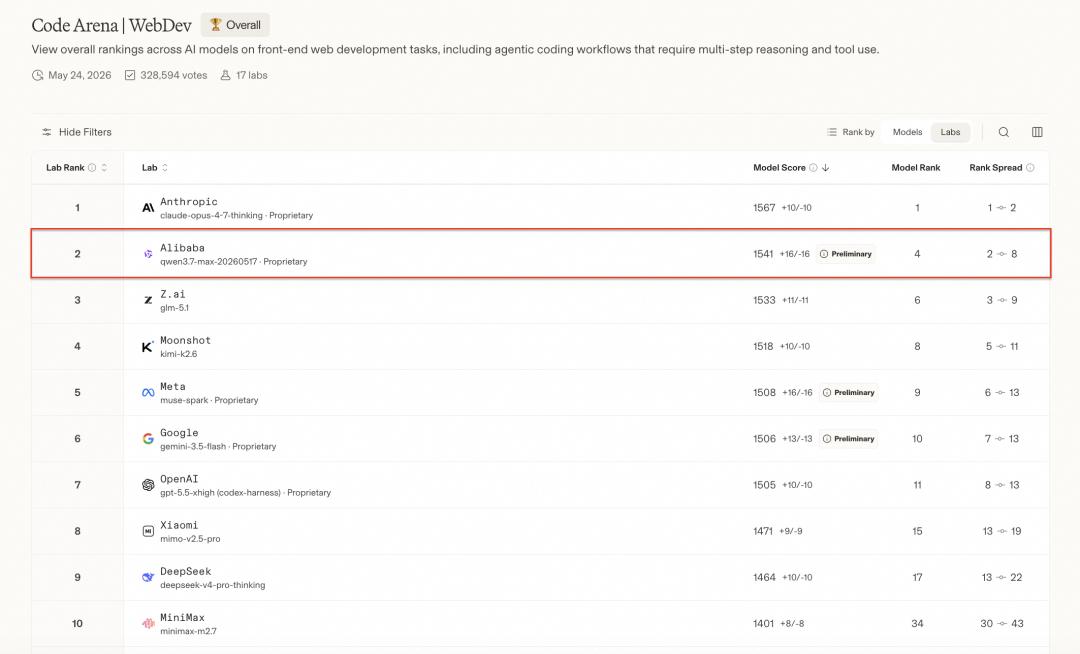
The relationship between Qwen3.7 - Max and Qwen Cloud can be understood as the cooperation between the capability layer and the entry layer. Qwen Cloud solves the problem of how developers and Agents can access model services, while Qwen3.7 - Max provides the model capabilities that Alibaba Cloud hopes to promote. For Alibaba Cloud, putting the latest flagship model into Qwen Cloud also helps to tie together the model brand, cloud entry point, and MaaS commercialization.
Of course, the description of the model's capabilities at the time of release is just the starting point. Agent scenarios are particularly dependent on real - world usage feedback. Factors such as long - range task performance, API cost and stability, tool call success rate, and code generation quality will all affect whether developers continue to make calls.
Can MaaS Going Global Open up New Growth for Alibaba Cloud?
Alibaba Cloud has a certain share in the global cloud market and has long - term accumulation in the Asia - Pacific market. However, in the overseas traditional cloud market, it faces a rather severe competitive situation. AWS, Azure, and Google Cloud completed their global layouts earlier and have entered the IT systems of multinational enterprises, developer ecosystems, SaaS partners, and system integrator networks.
Cloud computing is a business with a strong first - mover advantage. Once an enterprise completes its cloud selection, it is easy to form inertia in database, network, security, operation and maintenance, talent training, and procurement processes.
Alibaba Cloud's overseas business started later than these international cloud giants and is also affected by factors such as compliance, trust, channels, and ecosystems. Traditional cloud going global originally requires a long cycle of customer education and organizational penetration. Compared with traditional cloud computing services, the business model of selling tokens is much simpler.
The decision - making chain for enterprises to adopt model APIs is usually shorter than that for migrating core infrastructure. As long as the model capabilities keep up, replacing APIs can be transparent to upper - layer applications.
Customers can first access model services in scenarios such as AI programming, customer service, marketing content, data analysis, cross - language communication, and Agent office work. If the call results are good and Token consumption continues to increase, it will gradually drive more consumption of cloud resources and tool chains.
This is especially important for latecomers.
The entry point for traditional cloud is migration, while the entry point for MaaS is calling. Migration means changing the underlying architecture, while calling can start from an API Key, an Agent workflow, or a programming task.
If Alibaba Cloud can rely on Qwen's developer awareness to bring overseas users into model calls first and then precipitate them into Qwen Cloud and related cloud services, it has the opportunity to bypass some of the resistance faced by traditional IaaS going global.
However, there are also real - world pressures on this path. Price competition in the model API market will continue to exist. Open - source models and local deployments will divert demand, and overseas enterprises will also put forward higher requirements for data security and compliance.
It is not accidental that Singapore became the overseas launch site for Qwen Cloud. Alibaba Cloud laid out data centers and international business capabilities in Singapore early on, and Singapore is the regional headquarters for Southeast Asia.
The digital economy in Southeast Asia is still growing, and scenarios such as cross - border e - commerce, fintech, content industry, and multilingual customer service may all become test beds for AI tools. Alibaba also has a foundation in e - commerce and local ecosystems in Southeast Asia. These factors combined make Singapore a suitable window for Alibaba Cloud to test the path of AI cloud going global.
Qwen Cloud and Qwen Cloud provide Alibaba Cloud with a new narrative: Make Agents new users of cloud services, make Token a new variable in cloud revenue, and make Qwen a new brand in the overseas developer market.
This direction is clear and in line with the development trend of AI cloud. The more crucial question next is whether Alibaba can continuously maintain its lead in model capabilities and cost.
This article is from the WeChat public account "Xiang Xian Zhi", author: San Qing. Republished by 36Kr with permission.