Xiaomi's revenue in the first quarter reached 99.1 billion: net profit was 4.7 billion, and a 20 billion share repurchase plan was launched again.
After consecutive quarters of high-speed performance growth, Xiaomi Group (HK01810) encountered significant challenges in its development in the first quarter of 2026.
Xiaomi Group released its performance announcement for the first quarter of 2026 today. The financial report shows that Xiaomi's revenue in the first quarter of 2026 was 99.1 billion yuan, a 10.9% decrease compared to 111.293 billion yuan in the same period of the previous year, and a 15.2% decrease compared to 116.917 billion yuan in the previous quarter.
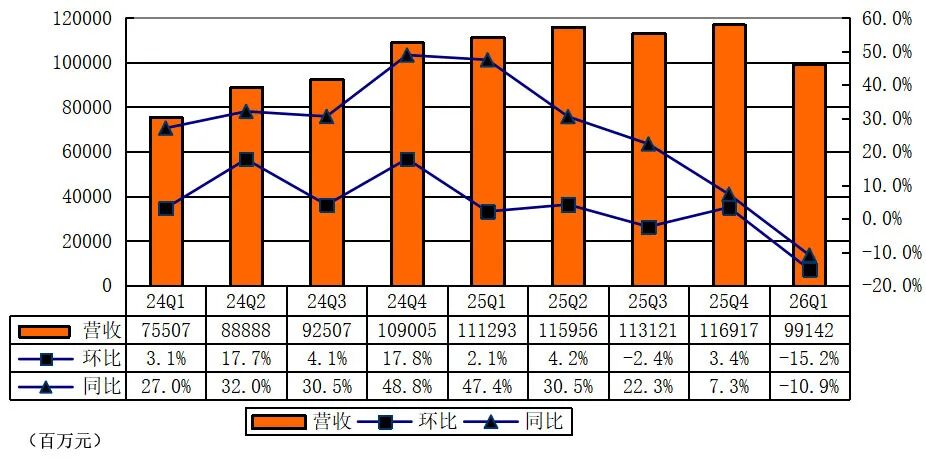
After maintaining quarterly revenues of over 100 billion yuan for five consecutive quarters, Xiaomi failed to maintain the achievement of 100 billion yuan in revenue this quarter.
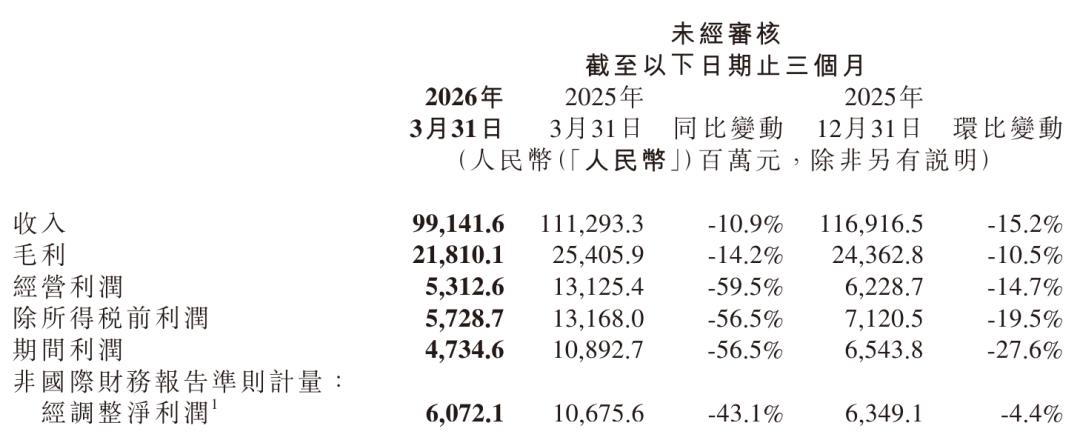
Xiaomi's gross profit in the first quarter of 2026 was 21.8 billion yuan, a 14.2% decrease compared to 25.4 billion yuan in the same period of the previous year, and a 10.5% decrease compared to 24.363 billion yuan in the previous quarter.
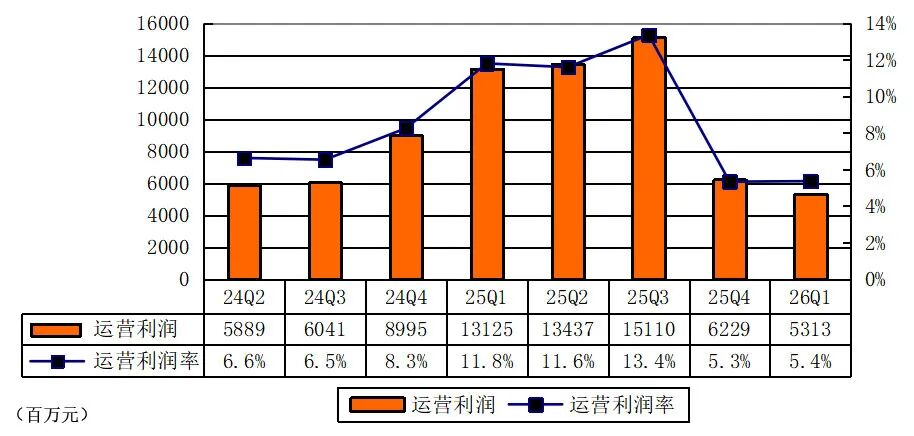
Xiaomi's operating profit in the first quarter of 2026 was 5.313 billion yuan, a 59.5% decrease compared to 13.125 billion yuan in the same period of the previous year, and a 14.7% decrease compared to 6.229 billion yuan in the previous quarter.
Xiaomi's profit for the period in the first quarter of 2026 was 4.735 billion yuan, a 56.5% decrease compared to 10.893 billion yuan in the same period of the previous year, and a 27.6% decrease compared to 6.544 billion yuan in the previous quarter.
Xiaomi's adjusted net profit in the first quarter of 2026 was 6.072 billion yuan, a 43.1% decrease compared to 10.676 billion yuan in the same period of the previous year, and a 4.4% decrease compared to 6.349 billion yuan in the previous quarter.
Restart the 20 billion share repurchase plan, with the second - highest repurchase intensity in the Hong Kong stock market, second only to Tencent
Xiaomi Group released an announcement of a HK$20 billion share repurchase plan today. The announcement states that this share repurchase plan will take effect on June 2nd this year and will last for one year.
The announcement also states that the board of directors believes that this repurchase plan demonstrates the company's confidence in its business outlook and prospects.
It is reported that Xiaomi has continuously increased its repurchase intensity since this year. As of now in 2026, the cumulative total repurchase amount has exceeded HK$8.4 billion.
Xiaomi's CFO, Lin Shiwei, said that since Xiaomi went public nearly eight years ago, it has always attached importance to continuously creating value for shareholders, and the repurchase intensity has significantly increased since this year. As of now, the cumulative repurchase in 2026 has exceeded HK$8 billion, more than the whole of last year, and the repurchase intensity ranks second in the Hong Kong stock market.
In November 2025, Xiaomi's CEO, Lei Jun, personally invested HK$100 million in repurchasing shares, which once curbed Xiaomi's sharp decline at that time and once boosted the confidence of many investors in Xiaomi.
As of today's close, Xiaomi's stock price was HK$29.76. Based on today's closing price, the company's market value is HK$769 billion.
It is reported that Xiaomi's stock price exceeded HK$60 a year ago. The decline of Xiaomi since September 2025 has "buried" many investors who bought at the peak.
Lu Weibing: Reconstruct the entire ecosystem of vehicles, homes, and people with AI
Lu Weibing, the president of Xiaomi Group, said in a conference call that Xiaomi's major direction in the next five years is to reconstruct the entire ecosystem of vehicles, homes, and people with AI and promote AI to move from the virtual world to the physical world.
Lu Weibing introduced Xiaomi's multi - layer layout of AI.
The first layer is the basic large - model. Xiaomi's MiMo large - model layout is becoming more and more perfect. MiMo - V2.5 - Pro has achieved very good results among open - source large - models. "You will see a more outstanding and powerful model soon."
The second layer is to apply the large - model to embodied intelligence and intelligent driving. Since last year, Xiaomi has successively released the VLA large - model and the tactile - driven fine - grasping fine - tuning model for robots. The XLA cognitive large - model architecture released not long ago has enabled assisted driving to move from perception and imitation to understanding and reasoning.
The third layer is to promote the large - model to be applied. Xiaomi's miclaw is promoting cross - device execution and will be integrated with Super Xiaoai in the future. At the same time, Miloco is deepening the smart home Agent experience, and Xiaomi's humanoid robot has also entered the factory scenario for practice.
Lu Weibing said that by empowering the entire ecosystem of vehicles, homes, and people with AI, Xiaomi's business model and competitive moat will reach a new level in the next five years.
Smartphone business revenue in Q1 was 44.3 billion, a 12.5% year - on - year decrease
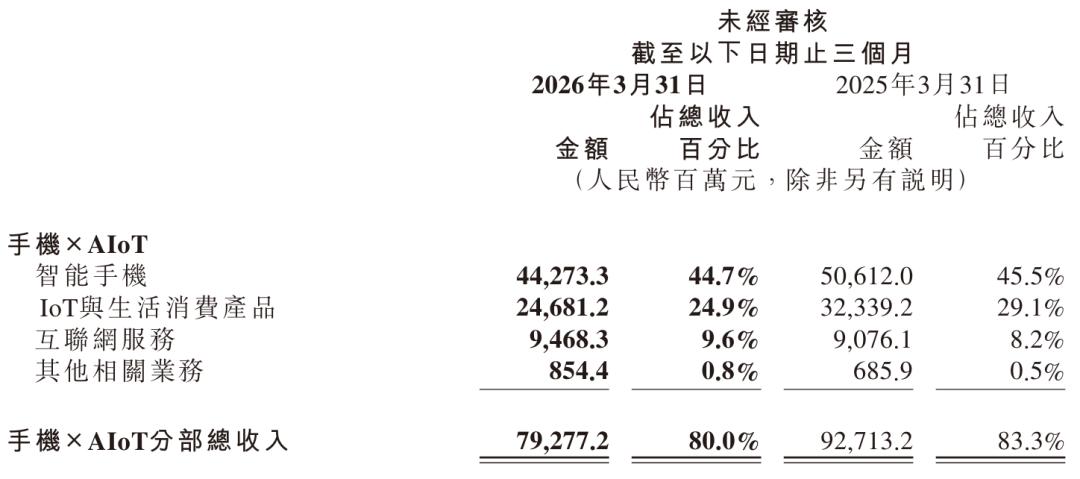
Xiaomi's revenue from mobile phones × AIoT in the first quarter of 2026 was 79.277 billion yuan, a 14.5% decrease compared to 92.7 billion yuan in the same period of the previous year.
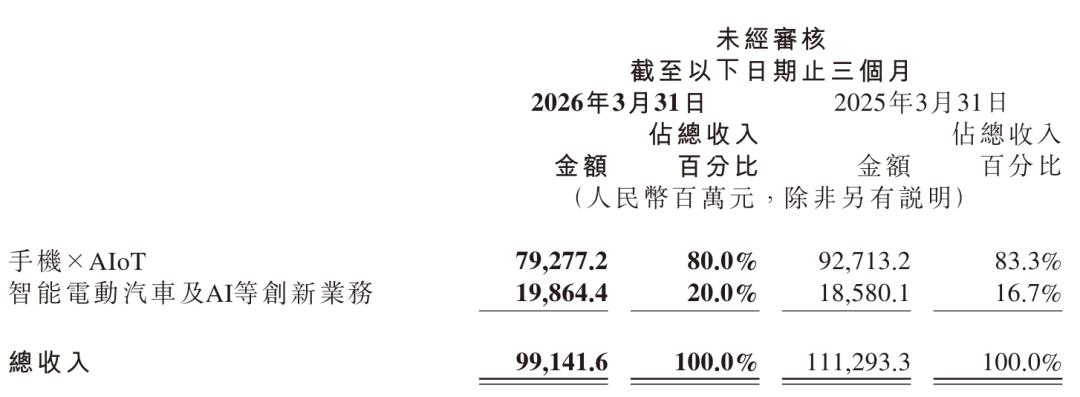
Xiaomi's mobile phones × AIoT include smartphones, IoT and consumer products, Internet services, and other related businesses.
Against the background of rising memory prices, Xiaomi's mobile phone business is facing severe challenges. Xiaomi's smartphone business revenue in the first quarter of 2026 was 44.3 billion yuan, a 12.5% decrease compared to 50.6 billion yuan in the same period of the previous year, mainly due to the decrease in smartphone shipments, which was partially offset by the increase in the ASP of smartphones.
Xiaomi's smartphone shipments in the first quarter of 2026 were 33.8 million units, a 19.2% decrease compared to 41.8 million units in the same period of the previous year, mainly due to the optimization of the product matrix and the decrease in the shipments of mid - and low - end smartphones. The ASP of smartphones increased by 8.2% from 1,210.6 yuan per unit in the first quarter of 2025 to 1,310.1 yuan per unit in the first quarter of 2026, mainly due to the increase in the proportion of high - end smartphone shipments.
In addition, Xiaomi's CEO, Lei Jun, said at a media communication meeting that in 2025, Xiaomi was the first domestic enterprise to issue a warning about the rising memory prices. Looking back now, the memory price has increased many times in the past year. Mobile phone enterprises were the first to feel the pressure, and now it will also cover other sectors such as laptops and TVs. The memory price of TVs has increased by 10 times, and the price increase is very crazy.
"I think the prices of new mobile phones will follow the market and start to rise. So I'm telling the truth today. If you want to change your phone in the next year, the earlier the better."
Lei Jun pointed out that in the face of rising memory prices, Xiaomi is using various methods internally to improve efficiency and try to absorb these cost - increasing factors internally. It hopes to be the last one to raise prices instead of simply passing on these cost pressures to consumers, but Xiaomi's ability is indeed limited.
Lu Weibing said in Xiaomi's earnings conference call today that despite the pressure on the entire industry this quarter, Xiaomi's mobile phones have shown strong resilience in key indicators: the global market share has remained in the top three for 23 consecutive quarters, the average price of mobile phones and the average price overseas have both reached record highs, and the gross profit margin of mobile phones has exceeded market expectations.
In the face of the storage price increase cycle, Lu Weibing said: "We cannot simply transfer the increase in memory costs to consumers. We need to re - position our products." He will achieve a balance between scale and profit through the upgrade of the product matrix and the optimization of software.
He pointed out that on the one hand, Xiaomi will firmly promote the high - end and globalization strategies, and on the other hand, it will firmly reshape the mobile phone business with AI. "The combination of Super Xiaoai and miclaw this year will be a key node."
Lu Weibing emphasized that AI is the biggest incremental opportunity in the mobile phone industry. He revealed that a new - generation OS will be released in July or August this year, bringing a different interactive experience. "The entire industry is facing a revolution."
Xiaomi's revenue from IoT and consumer products in the first quarter of 2026 was 24.7 billion yuan, a 23.7% decrease compared to 32.3 billion yuan in the same period of the previous year, mainly due to the reduction of revenue in the Chinese mainland caused by the withdrawal of national subsidies, which was partially offset by the increase in overseas market revenue driven by smart TVs and tablets.
Xiaomi's Internet service revenue in the first quarter of 2026 was 9.5 billion yuan, a 4.3% increase compared to 9.1 billion yuan in the same period of the previous year, mainly due to the increase in advertising business revenue.
Automobile and AI business revenue in Q1 was 19.864 billion, a 6.9% year - on - year increase
The revenue from innovative businesses such as smart electric vehicles and AI was 19.864 billion yuan, a 6.9% increase compared to 18.58 billion yuan in the same period of the previous year.
Xiaomi's smart electric vehicle revenue in the first quarter of 2026 was 19 billion yuan, a 5.1% increase compared to 18.1 billion yuan in the same period of the previous year, mainly due to the increase in vehicle deliveries, which was partially offset by the decrease in the ASP of vehicles. The vehicle deliveries increased by 6.6% from 75,869 units in the first quarter of 2025 to 80,856 units in the first quarter of 2026, mainly due to the launch of the Xiaomi YU7 series, which was partially offset by the decrease in the deliveries of the Xiaomi SU7 series due to the suspension of sales of the first - generation Xiaomi SU7 series this quarter.
The ASP of Xiaomi's smart electric vehicles in the first quarter of 2026 was 235,116 yuan, compared to 238,301 yuan in the same period of the previous year, mainly due to Xiaomi's vehicle purchase tax subsidy and the sale of in - stock vehicles with a lower ASP.
Xiaomi's revenue from other related businesses in the first quarter of 2026 was 900 million yuan, a 70.6% increase compared to 500 million yuan in the same period of the previous year.
At the earnings conference call that night, Lu Weibing, the president and partner of Xiaomi Group, responded to market rumors and said: "The test vehicles on the road currently are not the YU9. The new model will definitely be launched this year."
Xiaomi recently released two new cars, the YU7 GT and the YU7 standard version, further enriching the YU7 series family. Lu Weibing revealed in the conference call that more than half of the users chose the fully - equipped YU7 GT at 429,900 yuan. In terms of car paint color, more than half of the users chose cherry red.
Lu Weibing also said that the new YU7 will start formal deliveries this week. After the production capacity is improved, the delivery cycle is much shorter than before. The standard version can be delivered in about two or three months, and there are still a small number of in - stock vehicles. The production of the YU7 GT is ramping up slowly due to its flagship - level positioning, with an initial monthly production of about 2,400 units.
This article is from the WeChat official account “Leidi” (ID: touchweb), written by Lei Jianping, and is published by 36Kr with authorization.