From "Anti-illegal Drone Flight" to "Low-altitude Security": A Multi-billion-dollar Market Catalyzed by a Single Law
Introduction: The Landscape of the Drone Countermeasure Industry from the Perspective of Policy Forcing
On January 1, 2024, the Interim Regulations on the Flight Management of Unmanned Aerial Vehicles were officially implemented. For the first time, there was a special administrative regulation for drone supervision. One and a half years later, on January 1, 2026, the newly revised Law on Public Security Administration Punishments came into effect. Article 46 clearly defined "illegal drone flights" as acts endangering public safety. Those with relatively serious circumstances could be detained for five to ten days.
Five months later, on May 18, 2026, the Ministry of Public Security announced a batch of typical cases of illegally cracking drone flight control systems. All the suspects involved were taken into criminal coercive measures.
A control network woven by administrative regulations, public security laws, and criminal crackdowns is redefining "illegal drone flights" from a "bad behavior" in the past to a legal event involving public safety. The implementation of this network has given rise to a considerable - scale industry.
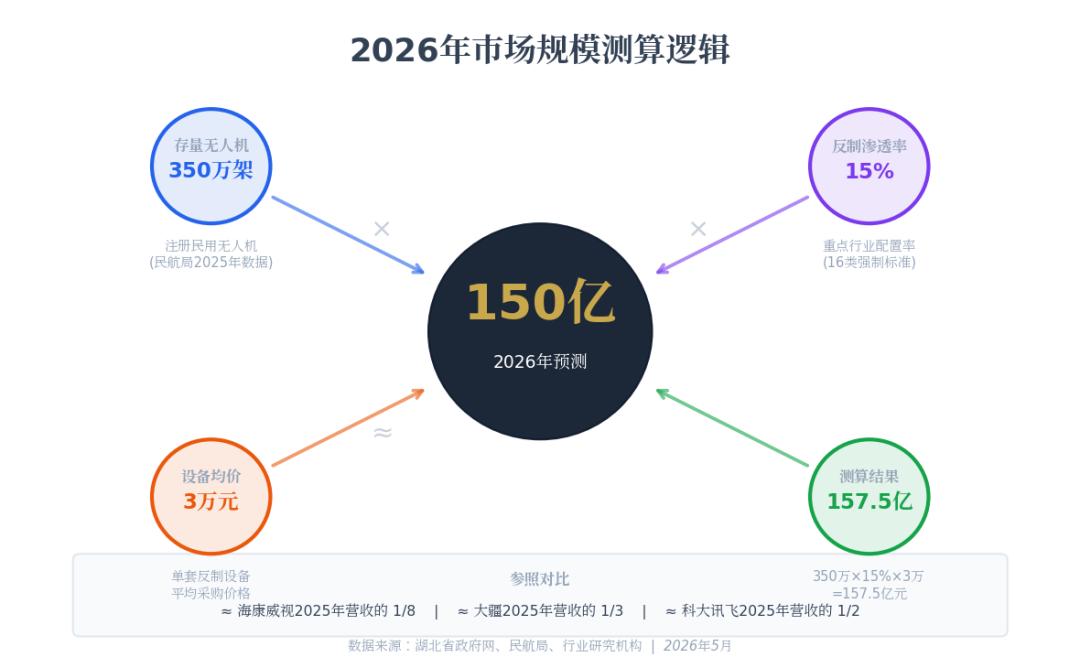
Some research institutions predict that the market scale of drone countermeasure equipment in China is expected to exceed 15 billion yuan in 2026.
The Era of a 500 - Yuan Fine Is Over
Before January 1, 2026, the punishment for "illegal drone flights" was mainly based on the Interim Regulations on the Flight Management of Unmanned Aerial Vehicles. This administrative regulation imposed a fine of less than 500 yuan for general violations. For serious cases, the equipment would be confiscated, and a fine of 1,000 to 10,000 yuan would be imposed.
The problem with this punishment model is that it lacks deterrence. For a professional - grade drone worth tens of thousands or even hundreds of thousands of yuan, a fine of a few hundred yuan hardly constitutes an economic constraint.
Article 46 of the newly revised Law on Public Security Administration Punishments has changed everything.
Although the expression "relatively serious circumstances" leaves room for discretion, the provision of detention for more than five days and less than ten days means that those who engage in "illegal drone flights" will face restrictions on personal freedom. This change in the legal nature directly raises the cost of illegal acts and provides a compliance basis for enterprises and institutions to equip countermeasure equipment.
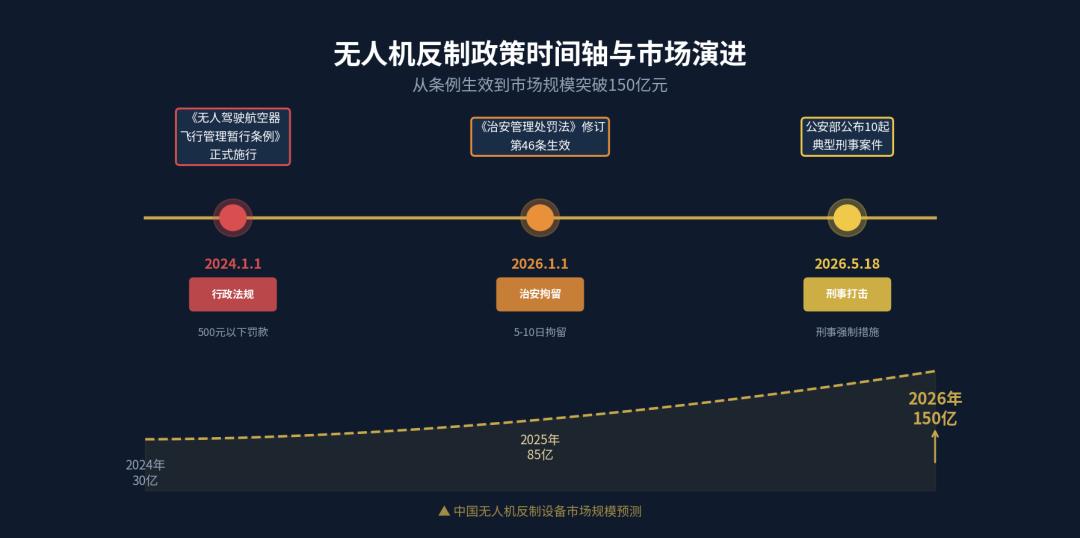
The typical cases announced by the Ministry of Public Security on May 18, 2026, further sent a law - enforcement signal.
These cases covered 10 provinces and cities such as Luzhou in Sichuan, Fengxian in Shanghai, Xiamen in Fujian, and Wuhan in Hubei, spanning from 2019 to 2026. They involved various acts such as illegally cracking the height - limit and no - fly area restrictions of drones and tampering with the factory - set load parameters. All the suspects involved were taken into criminal coercive measures, based on crimes such as illegally controlling computer information systems and providing intrusion tools.
From a 500 - yuan fine to ten - day detention and then to criminal liability, the formation of a three - tier punishment system has fundamentally changed the risk pricing of "illegal drone flights".
Airports, power facilities, and organizers of large - scale events, who are potential victims of drone intrusions, have begun to seriously evaluate the legal and operational risks of not equipping countermeasure equipment.
One Law Is Not Enough
The law is just the starting point. What really drives the increasing demand for countermeasure equipment is a compliance system that is taking shape.
On June 1, 2024, the national standard GB 42590 - 2023 "Safety Requirements for Civil Unmanned Aerial Vehicle Systems" was officially implemented, putting forward unified safety requirements for functions such as remote control, positioning, and electronic fences of drones. Although this standard targets drone products themselves, it establishes a technical benchmark for subsequent supervision.
More importantly for the industry, a series of anti - terrorism prevention industry standards issued by the Ministry of Public Security and the National Counter - Terrorism Office clearly require the configuration of drone countermeasure equipment and timing protection devices in 16 key industries such as railways, power, petroleum and petrochemicals, hazardous chemicals, military industry, and nuclear facilities.
The transmission path of policies is clear. The state - level issues mandatory or guiding standards, which are gradually refined and implemented by provincial and industry authorities, and finally translated into specific items on the enterprise procurement list. One law opens the situation, a set of standards consolidates the foundation, and a batch of cases strengthen the implementation. This is the growth environment for the countermeasure industry in 2026.
Four Types of Buyers, Four Types of Algorithms
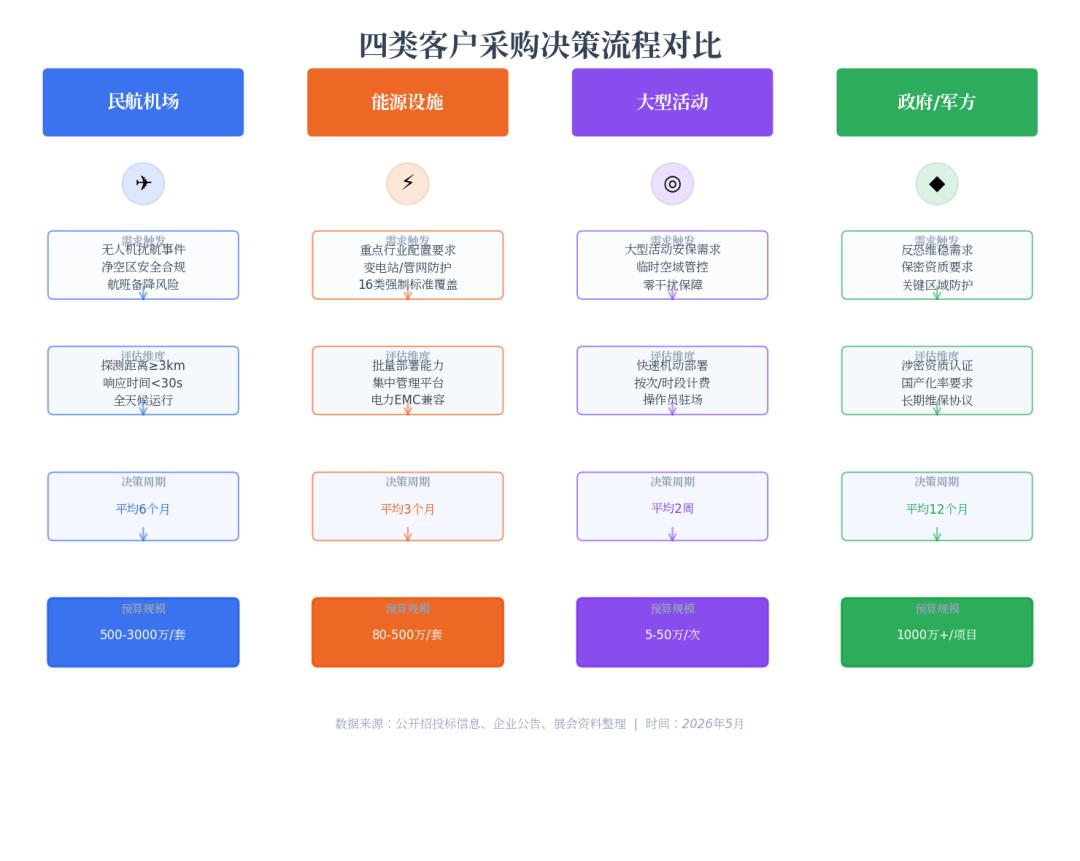
The buyer profile of countermeasure equipment is expanding from a single source of government and military in the past to a diversified structure. The procurement logics of different buyers vary greatly, so applying the same sales strategy won't work.
Airports: Without It, Flights Will Have to Circle
Airports are one of the scenarios with the most rigid demand for countermeasure equipment. In recent years, civil aviation management departments have continuously listed drone interference with flights as one of the important risk factors affecting the normal operation of flights. The TDOA X1B drone detection equipment of Shanghai Tegin Wireless Technology Co., Ltd. has been deployed in many domestic airports. A single device can independently detect and identify drones, and multiple devices in a network can accurately locate and track targets within 2 to 6 kilometers in an urban environment.
The procurement logic in the airport scenario is straightforward. Without countermeasure equipment, once a drone intrudes into the airspace, the cost of flight diversion or circling can easily reach hundreds of thousands of yuan, and the safety risk is immeasurable. Compliance is a necessity, and price is not the primary consideration.
Power: Substations Are Not Afraid of Hackers, but of Illegal Drone Flights
The power and oil and gas facilities are another rapidly growing market. As the core customers of Yunxiang Technology, the State Grid and China Southern Power Grid have deployed timing safety isolation and protection devices and drone countermeasure equipment in about 30 provinces and municipalities they cover. The funds for this type of procurement usually come from safety production expenses. The decision - making chain is led by the deputy production manager and implemented by the equipment department. They have a medium sensitivity to price and value the reliability of the equipment and the speed of operation and maintenance response more.
The countermeasure demand for power facilities has its own characteristics. High - voltage transmission lines and substations are widely distributed and have many points. What is needed is a systematic solution that can be deployed in batches and managed centrally, rather than high - end single - point equipment. In the vocabulary of the power industry, there is no such word as "cool". Stability and maintainability are the passkeys.
Large - Scale Events: Renting for Three Days Is More Cost - Effective Than Buying for a Year
The countermeasure demand for large - scale events has a pulsed characteristic. The 2026 World Drone Conference itself requires the deployment of countermeasure equipment around the venue to ensure safety, which is actually a real - world drill for low - altitude security products.
The core consideration in this scenario is cost. The cost of purchasing a set of fixed countermeasure equipment ranges from 800,000 to 5 million yuan. However, if a three - day event adopts the rental model, the cost may be only one - tenth of the purchase cost. This comparison of economic accounts determines that the large - scale event market tends to the service - based model rather than the asset - based model.
Government and Military: The Most Expensive Customers with the Longest Payment Cycles
The procurement logic of the government and military is completely different from the previous three civilian markets. Price is not the main consideration. Whether the product meets confidentiality requirements and has passed relevant qualification certifications is the key. This market is characterized by extremely high entry thresholds and extremely long procurement processes, but once a company enters the supply chain, the relationship is extremely stable.
Selling Equipment, Selling Services, Selling Platforms
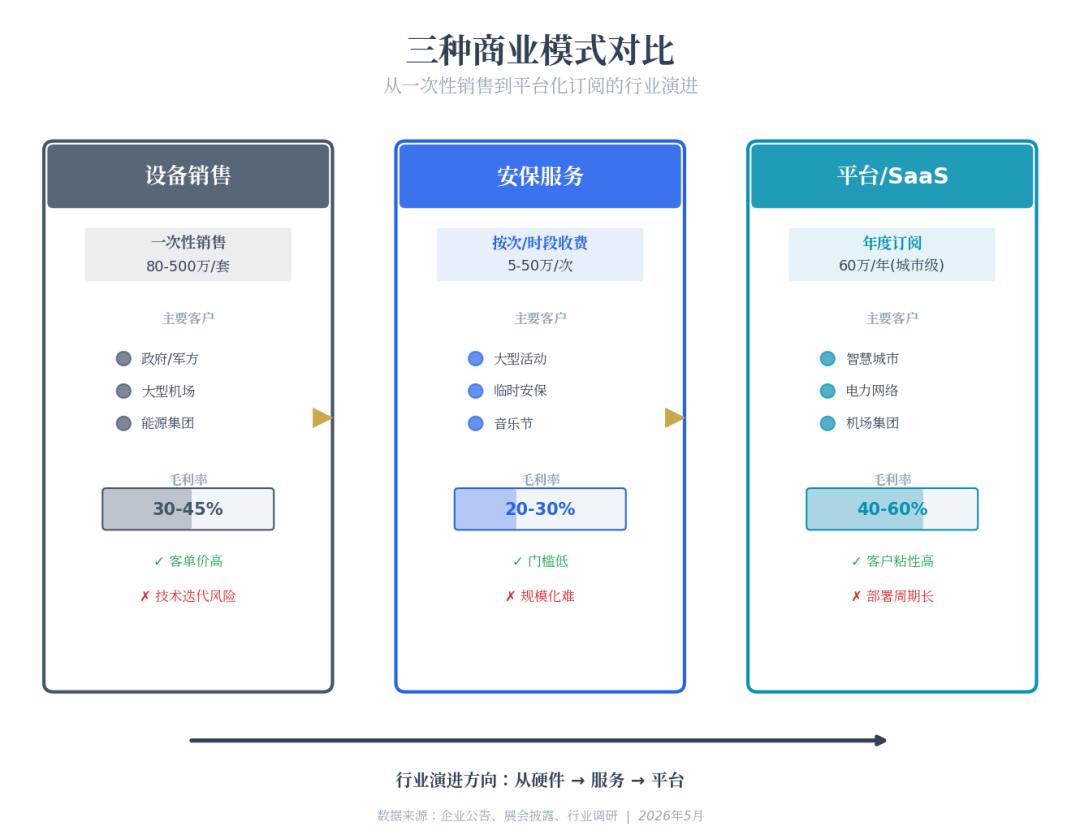
The countermeasure industry is differentiating into three business models. Their customer overlap is low, and their profit logics are completely different.
Equipment: What You Buy Today May Be Outdated Tomorrow
Li Gong Quansheng globally launched four new products at the 2026 World Drone Conference: the BAT - 7050 full - frequency - band detection, strike, and lure integrated equipment, the BAT - S300 multi - mode detection integrated equipment, the BAT - SL01 drone identification shoulder lamp, and the BAT - 8000 low - altitude safety management and control platform. Among them, the BAT - 7050's detection and countermeasure cover an ultra - wide frequency band from 300 MHz to 8 GHz, which can deal with various threats such as conventional drones, FPV racing drones, and non - standard modified models.
Prodrone Technology first unveiled the AU100 integrated drone countermeasure system at the same exhibition. It integrates "detection, strike, connection, deployment, and data", has the ability of vehicle - mounted mobile deployment, can accurately detect and counter "illegal drone flights" within a 5 - kilometer range, and has capabilities such as voice warning, multi - frequency - band directional interference, navigation deception, protocol hijacking, and drone net capture.
Services: Charge by Results
The essence of the service model is result - oriented. Customers don't need to own a set of countermeasure equipment. They only need to ensure that there are no unauthorized drones in a specific area during a specific period. Service providers offer a combination of equipment and operators and charge by the time or event.
The advantage of this model is that it lowers the decision - making threshold for customers. For institutions that only hold one or two large - scale events a year, the depreciation cost of purchasing a set of fixed equipment is much higher than the cost of renting as needed.
Platforms: Connect Dozens of Points into a Network
The BAT - 8000 low - altitude safety management and control platform of Yunxiang Technology and the TDOA grid system of Shanghai Tegin represent the third direction. They connect multiple single - point devices into a networked system that can be centrally commanded and respond hierarchically.
The value of the platform - based model lies not in the hardware itself, but in the data integration and collaborative response capabilities. When dozens of detection nodes cover the low - altitude area of a city, the system can achieve cross - regional target tracking, threat classification, and disposal scheduling. The construction cycle of this ability is longer, the technical threshold is higher, and the customer stickiness and barriers are also correspondingly higher.
Who Stands on the Supply Chain?
The supply chain of countermeasure equipment can be roughly divided into three links: upstream, mid - stream, and downstream.
The upstream is the core device layer, including radio spectrum sensing chips, navigation deception modules, photoelectric detection components, etc. This layer has the highest technical barriers, and domestic substitution is still in progress.
The mid - stream is the system integration layer, which is currently the most competitive battlefield.
Li Gong Quansheng occupies a place with the scientific research background of Beijing Institute of Technology and military resources; Prodrone Technology has extended from drone manufacturing to the countermeasure field and has a "defense - offense integrated" product matrix; Yunxiang Technology has established a differentiated advantage through in - depth penetration in the power and energy industry; Shanghai Tegin has formed a unique position in airport and city - level scenarios with TDOA grid technology.
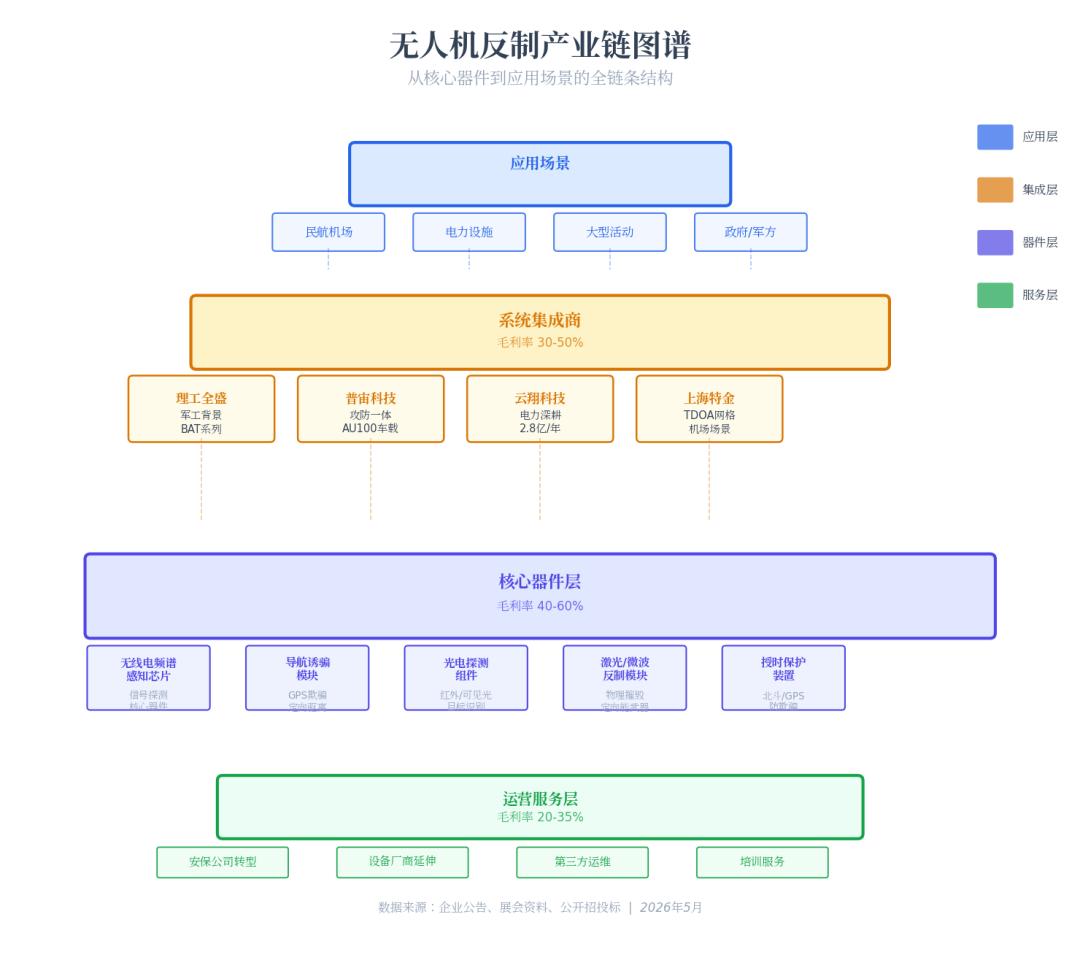
The downstream is the operation service layer. The participants include both the service teams extended from the above - mentioned equipment manufacturers and new players transformed from traditional security businesses.
The market pattern at this layer has not been solidified yet, and issues such as service standards, pricing models, and liability definitions are still being explored.
Three Pitfalls, Can't Be Avoided?
The risks come from three directions.
The pressure of technological iteration is the most direct.
FPV racing drones use frequency - hopping and spread - spectrum technologies, which greatly reduce the effectiveness of traditional interference means based on fixed frequency bands. Li Gong Quansheng has adopted a domestically - pioneered integrated frequency - hopping and spread - spectrum demodulation technology in its BAT - H1030 portable equipment. The effective interference distance is said to be more than three times that of ordinary equipment on the market.
This technological arms race means continuous high R & D investment.
Price pressure is also accumulating.
The number of players in the mid - stream integration layer is increasing, and the product homogeneity is rising. When multiple manufacturers can provide interference equipment covering mainstream frequency bands, a price war is almost inevitable. For service - type enterprises with already low gross profit margins, this will further compress the profit space.
The ambiguity of compliance boundaries is the third risk point.
Countermeasure equipment essentially intervenes in the electromagnetic spectrum. If high - power radio interference equipment is not properly managed, it may have a collateral impact on legal communications. How to find a balance between effective countermeasures and electromagnetic compatibility is an issue that regulatory policies need to continuously refine.
This shot of countermeasures is just the beginning.
The current stage of the drone countermeasure industry is a bit like the network security industry twenty years ago. At that time, the business model was to sell firewalls and anti - virus software, which was a single - point defense thinking.
Later, the evolution direction was from products to services, from services to platforms, and from platforms to ecosystems, and finally formed a complete security system covering endpoints, networks, clouds, and data today.
The safety management of the low - altitude economy will probably follow a similar path.
Today's countermeasure equipment manufacturers may become suppliers of low - altitude traffic management systems tomorrow. Yunxiang Technology's layout on its three core software platforms has already reflected this strategic intention of transitioning from products to platforms.
As the opening of the low - altitude airspace continues to deepen and the flight density continues to increase, the concept of "anti - illegal drone flights" may be covered by the more grand "low - altitude traffic management". By that day, today's enterprises selling countermeasure guns and jammers will either have completed the transformation into platform operators or have been integrated into a larger industrial ecosystem.
From "anti - illegal drone flights" to "low - altitude security" and from "low - altitude security" to "airspace management", this is an industrial evolution path initiated by legal pressure, supported by technological capabilities, and driven by business models.
The 15 - billion - yuan market scale is just