This graduation season, those papers "killed by AI"
"It is said that the review of AI content in papers is stricter this year," said Xiao A, a college student who is busy preparing his graduation thesis.
As the graduation season approaches, more and more Chinese college students have to go through an additional check - AIGC detection - before submitting their theses.
The history of this check is not long. According to public information, CNKI's AIGC detection function was launched in 2024. At that time, the AIGC detection was only piloted in a few institutions, and most schools were still observing. By 2025, more than 60% of undergraduate institutions and 80% of postgraduate training units had included AIGC detection in the thesis review process.
However, there is no unified standard yet, and the "AI content" thresholds vary from school to school. Judging from the publicly available notices and media reports, most schools set the "AI content rate" at no more than 40%, and some schools have tightened it to 20% or even 15%.
If a thesis is detected to have too high an AI content, the student may be urged by the supervisor to make revisions. In more serious cases, the student may be barred from the defense. In a very small number of cases, students may have their graduation postponed or even have their degree qualifications revoked due to a high AI rate.
Graduation theses have become more efficient and easier because of AI, but also more complex and difficult to handle. Against the backdrop of the times, this is a difficult problem without a perfect solution.
How is AIGC detection carried out?
According to the public notices from universities, many institutions use CNKI, VIP, Wanfang, or other third - party detection systems in the AIGC detection process. For example, a college of Zhejiang University's notice for the 2025 undergraduate graduation theses states that the detection "connects to the CNKI system". In the notice for Nanjing University of Finance and Economics' 2025 undergraduate graduation theses, the thesis duplication rate is detected by CNKI and VIP, and the AIGC detection is carried out by VIP and embedded in the graduation project system. Nanjing University's 2025 notice opens the "VIP AIGC detection" to colleges and provides a dedicated school login address. The notice from the Graduate School of Guangdong University of Finance and Economics for the 2025 session requires students to upload their theses separately for AIGC detection through the "CNKI" detection channel.
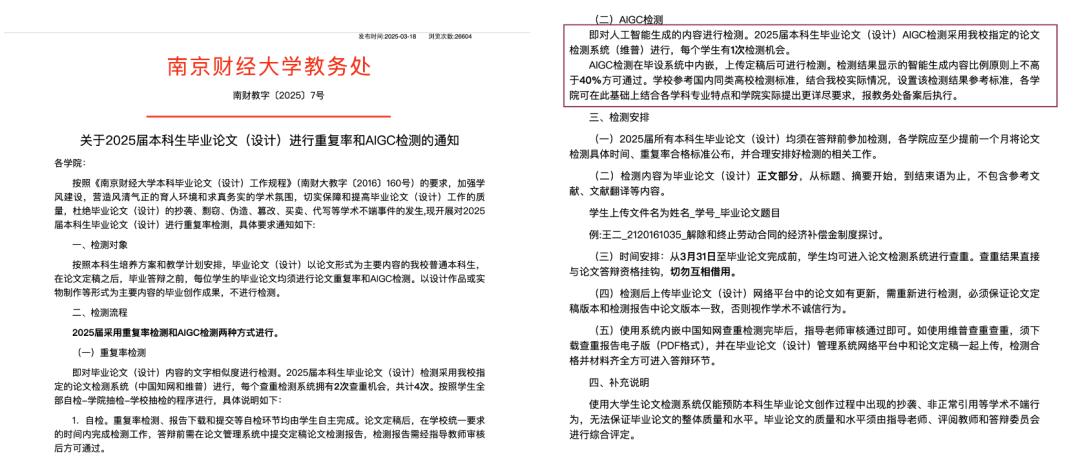
Figure: Official instructions on AIGC detection of theses from Nanjing University of Finance and Economics
It should be noted that some universities have built or commissioned the construction of "graduation thesis management systems", which are mainly process platforms responsible for functions such as thesis submission, detection entry, report circulation, supervisor review, and version management. The underlying plagiarism checking and AIGC judgment mostly still rely on the detection capabilities of third - party platforms such as CNKI, VIP, and Wanfang. According to the official notices of universities that have been reviewed, schools mainly play the roles of purchasing services, system access, process management, and rule - making.
However, in terms of detection methods, the public descriptions of several mainstream manufacturers mostly remain at the product introduction level. CNKI calls its detection product "Knowledge - enhanced AIGC detection technology", which is based on large - scale literature data and identifies AI - generated content in Chinese texts from aspects such as "language patterns" and "semantic logic". VIP's official description is that it "is based on the independently developed AI detection technology", which can detect texts generated by mainstream models such as DeepSeek, Tongyi Qianwen, Wenxin Yiyan, and Doubao. Wanfang's "Wenchacha" system claims to use an "AIGC text recognition deep - learning model" to make judgments based on the differences between AI texts and human expressions in terms of coherence, logic, and structure.
However, from the public pages, these manufacturers have not disclosed the composition of features, the basis for setting thresholds, the source of training data, the false - positive rate, the false - negative rate, or the third - party independent evaluation criteria. That is to say, it is difficult for the outside world to judge the accurate boundaries of their detection capabilities based solely on the manufacturers' introductions, and it is also difficult to review the reliability differences between different systems.
In terms of the qualitative nature of the detection results, the public statements of manufacturers and some universities mostly position AIGC detection as "auxiliary reference". The official VIP platform states that AIGC detection measures the "probability that content segments in the thesis are likely to be AI - generated". The "AI rate detection" page of Wanfang also reminds that the AIGC value has nothing to do with the quality of the thesis. The detection result only indicates whether it is suspected to be AI - generated and is for reference only, and there may be errors. CNKI emphasizes that the AIGC value in the detection result represents the probability of the article being AI - generated and has nothing to do with the quality of the article.
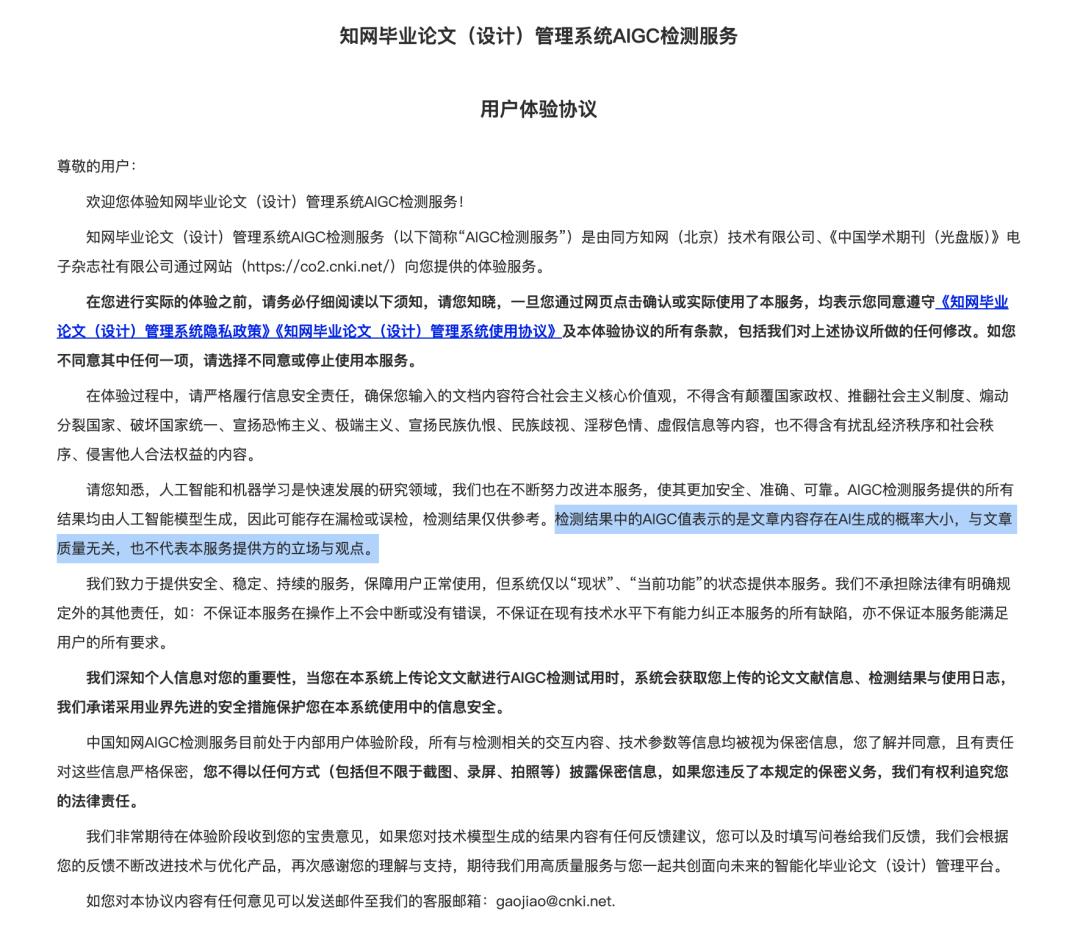
According to the university notices, a typical AIGC detection process for graduation theses is roughly as follows: After students complete their theses, they need to get the final confirmation from their supervisors before entering the detection stage. Students or colleges upload the theses to the school's graduation thesis management system or the designated detection platform, and the system calls a third - party engine for duplication rate and AIGC detection. The detection usually focuses on the main body of the thesis, and non - main - body content such as titles, formulas, charts, and references generally do not participate in the detection. The number of detections is limited, usually one or two free attempts.
After the detection is completed, some schools require students to download and submit the detection report and upload it to the system together with the final version of the thesis for review by supervisors, colleges, or graduate schools. If the thesis is modified before the defense, some schools also require re - detection and emphasize that the submitted version must be consistent with the final version; otherwise, it may be regarded as an act of academic dishonesty. Some universities also require students to submit records of AI use.
Regarding the consequences of a high AI rate, the handling methods vary greatly from school to school. Some universities clearly position the AIGC detection result as an auxiliary reference, emphasizing that it is a probabilistic analysis based on an algorithm model with technical limitations and is only used as an auxiliary reference for academic norms, not as a basis for judging the originality of the thesis.
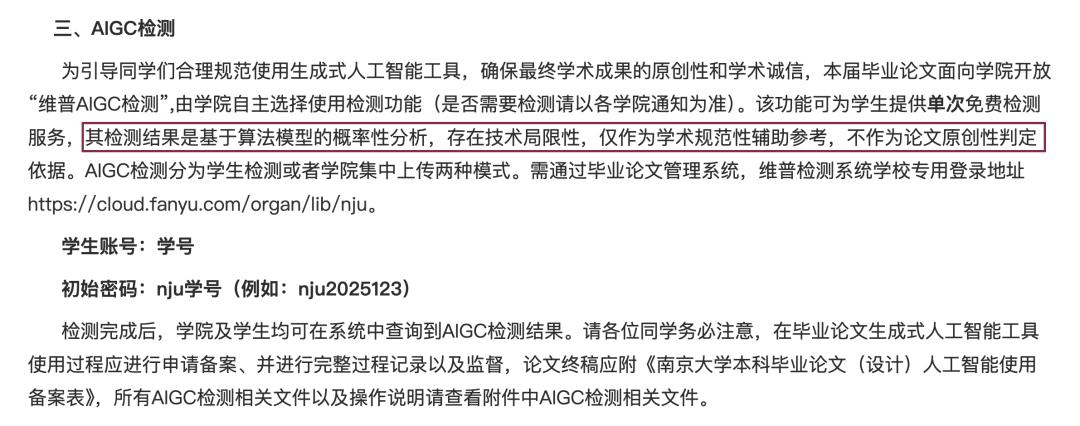
Figure: The official notice from the Undergraduate School of Nanjing University, stating that the AIGC detection result is only used as an auxiliary reference for academic norms
Other universities set clear thresholds and use the threshold judgment as a trigger for warnings, revisions, postponed defenses, or even qualification processing. For example, the Graduate School of Guangdong University of Finance and Economics stipulates that if the AIGC detection result of a master's thesis exceeds 40%, the graduate school will feedback the result to the training unit and issue a warning to the supervisor and the graduate student, requiring self - inspection and necessary revisions to the thesis. The student can only defend the thesis after obtaining the supervisor's consent.
Hefei University of Economics generally sets the "full - text suspected AIGC generation rate" at no more than 40%. If it exceeds the standard, the supervisor will issue a warning and urge the student to make revisions. The regulations of the Graduate School of Heilongjiang University are even stricter: If the proportion of AIGC - generated content is between 40% and 70%, the student must revise the thesis for at least six months before reapplying for the defense; if it exceeds 70%, the student's qualification to apply for a degree will be revoked.
Therefore, the effectiveness of the AIGC rate in university systems is not unified. Traditional thesis plagiarism checking usually corresponds to a relatively clear red line for the text duplication ratio and re - check rules, while AIGC detection may only be an auxiliary reference in some schools or may become the basis for revisions, postponed defenses, or qualification processing in others.
The "AI - based research" with mixed feelings
In the AI era, how should university education coexist with AI? Xiong Yuxuan, an assistant professor at the School of Artificial Intelligence and Education of Central China Normal University, said, "In our daily teaching and research, we also encounter students using AI tools. I don't oppose students using AI; in fact, I even encourage them to use it more often on weekdays. However, in the process of writing a thesis, students should cooperate with AI reasonably, use AI critically, and not blindly copy."
But what is a reasonable degree of AI use? There is no unified standard yet.
A large - model algorithm engineer said, "AIGC detection judges whether a piece of text has the statistical characteristics of machine - generated text. The most commonly used indicator is 'perplexity': When people write, there are often jumps, hesitations, and personalized expressions, and the local stability is not high; the text generated by models is more uniform, smoother, and has a higher probability. The detector trains a classification model based on this to learn the differences in sentence - length distribution, vocabulary diversity, and the use of transitional words. Some systems also maintain a dynamically updated 'AI feature word bank'. For example, if high - frequency transitional phrases such as 'In summary' and 'Undoubtedly' appear in clusters, the suspicion score will increase significantly."
This logic can only judge "whether it is similar", not "whether it is".
A study published in the Patterns journal by Stanford University in 2023 provided the most convincing evidence to date: The research team used seven mainstream GPT detectors to evaluate the writing of non - native English speakers, and more than half of the TOEFL essays were misjudged as "AI - generated", with an average false - positive rate of 61.22%.
More extremely, 18 out of 91 TOEFL essays were unanimously judged as AI - generated by the seven detectors, and 89 were marked by at least one detector. However, the detectors hardly made mistakes when judging the essays of eighth - grade students in the United States. The researchers explained that the essays that were unanimously misjudged had significantly lower perplexity, and the detectors may be penalizing writers with limited language expressions.
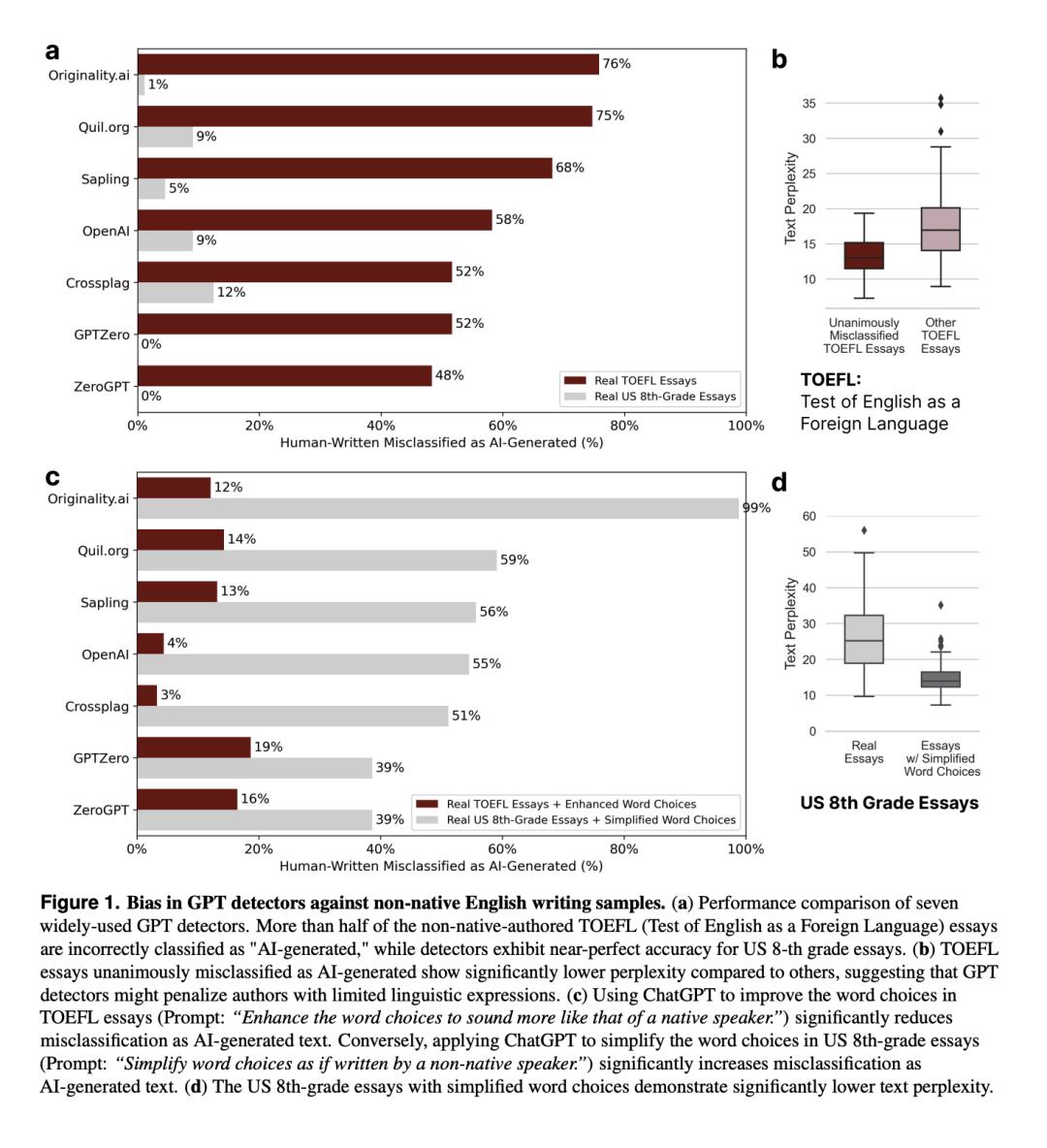
Figure: For human - written original works, the proportion of non - native speakers' TOEFL essays misjudged as "AI - generated" by the seven detectors ranges from 48% to 76%, far higher than the 0% - 12% of essays written by American native students. Source: Liang et al., Patterns, 2023.
"The current AIGC detection is just an expedient measure to play a certain supervisory role and prevent students from copying AI results. However, the method is by no means perfect," said a professor from a top - tier university.
This "expedient measure" is causing real confusion for students. According to the feedback from many undergraduate and master's graduates and postgraduate students, AI has deeply penetrated into thesis writing, course presentations, and scientific research training. They generally believe that AI should not replace them in completing the thesis, but they will use AI in some specific aspects.
A postgraduate graduate said that he would use AI to "sort out his thoughts", organize chaotic ideas into a logical framework, and also let AI polish the colloquial expressions to make them more in line with academic norms.
Another undergraduate graduate described AI as the "execution end" in scientific research tasks: Students first clarify the research questions, give clear instructions, then review and verify the code or processing results generated by AI item by item, and finally decide on the next step. In his view, AI can participate in the execution, but the review, judgment, and final decision - making must still be the responsibility of the students themselves.
However, students' dependence on AI varies. Some students said that they rarely use AI because their research directions are relatively specialized, and the content generated by AI is not very useful. He also mentioned that it is obvious that some published articles have traces of AI - generated content, which makes him rethink the academic writing atmosphere.
However, graduates' doubts about universities using the "AI rate" as a threshold for graduation thesis management mainly focus on three points: The detection tools are not stable enough and may misjudge original content; the detection rules can be easily adapted in reverse, giving rise to strategies to "reduce the AI rate"; Judging solely by the AI rate cannot distinguish between "AI - assisted" and "AI - ghostwritten" work, which is out of touch with the actual human - machine collaboration in scientific research.
Many graduates mentioned that they or their classmates have encountered situations where "the content they wrote was marked as high AI - generated by the detection system". Some long and complex sentences, academic expressions, stylized structures, and even texts that students have revised repeatedly may be judged to have a high AI rate.
A postgraduate student said that she had modified the text to make it more in line with her language habits, but the AI rate was still over 30%, which made her feel that there was an "algorithmic black box" in the detection standards and mechanisms.
Students are also worried that strictly limiting the AI rate will shift the focus from improving the quality of the thesis to "how to pass the detection". A graduate said that some of his classmates have been summarizing the rules of AIGC detection, such as which words, sentence patterns, and structures are more likely to be marked, and have formed strategies to "reduce the AI rate" based on this. As a result, the text actually generated by AI may escape detection through rewriting, while the text written by humans may be misjudged.
However, most people understand the school's original intention of combating "AI ghostwriting" and upholding the bottom line of academic evaluation. In their view, what academic assessment really needs to distinguish is whether students have developed problem - awareness, independent judgment, and the ability to be responsible for their achievements, rather than how well the text can pass the reverse review.
Therefore, many interviewees believe that the use of AI is inevitable, and the key is not to simply ban it but to define reasonable boundaries.
Some schools require students to fill in records or explanations of AI use, but this kind of system may also encounter difficulties in implementation. A postgraduate graduate said that the school requires students to state whether they have used AI and in which specific aspects. Once such a requirement is made, many people tend to fill in "no use" because admitting to using AI may arouse more suspicion.
Based on this, a postgraduate student in a university suggested that schools can require students to disclose the scope of AI use, such as whether it is used for data organization, language polishing, code generation, data processing, or idea generation. On the other hand, schools should also evaluate whether the thesis author truly understands their research through the thesis proposal, mid - term inspection, defense questions, original materials, revision records, and descriptions of the research process.
Compared with an isolated detection ratio, these process - based evidences can better reflect whether students have taken the lead in the thesis work.
A problem of the era
Producing original research results through independent thinking and proving one's ability to work independently in a specific professional field is the last hurdle for every graduate before leaving school.
Because of the existence of AI, it has become more difficult to prove "originality". Li Yunkai, a partner at Tianyuan Law Firm, said, "Even from a legal concept, the term 'originality' is more commonly used than 'creativity' at present.
Originality usually has two meanings: First, the work is independently completed by the author and is not a plagiarism, copy, or reproduction of others' works; second, the work reflects the author's intellectual input.