Fresh-made snacks are taking over the B1 level of shopping malls.
「Key Points」
With Juewei and Mingming Busy entering the market, can freshly-made snacks tell a new story?
The B1 floors of shopping malls in first-tier and new first-tier cities are witnessing the emergence of some new snack retail species that are hard to categorize.
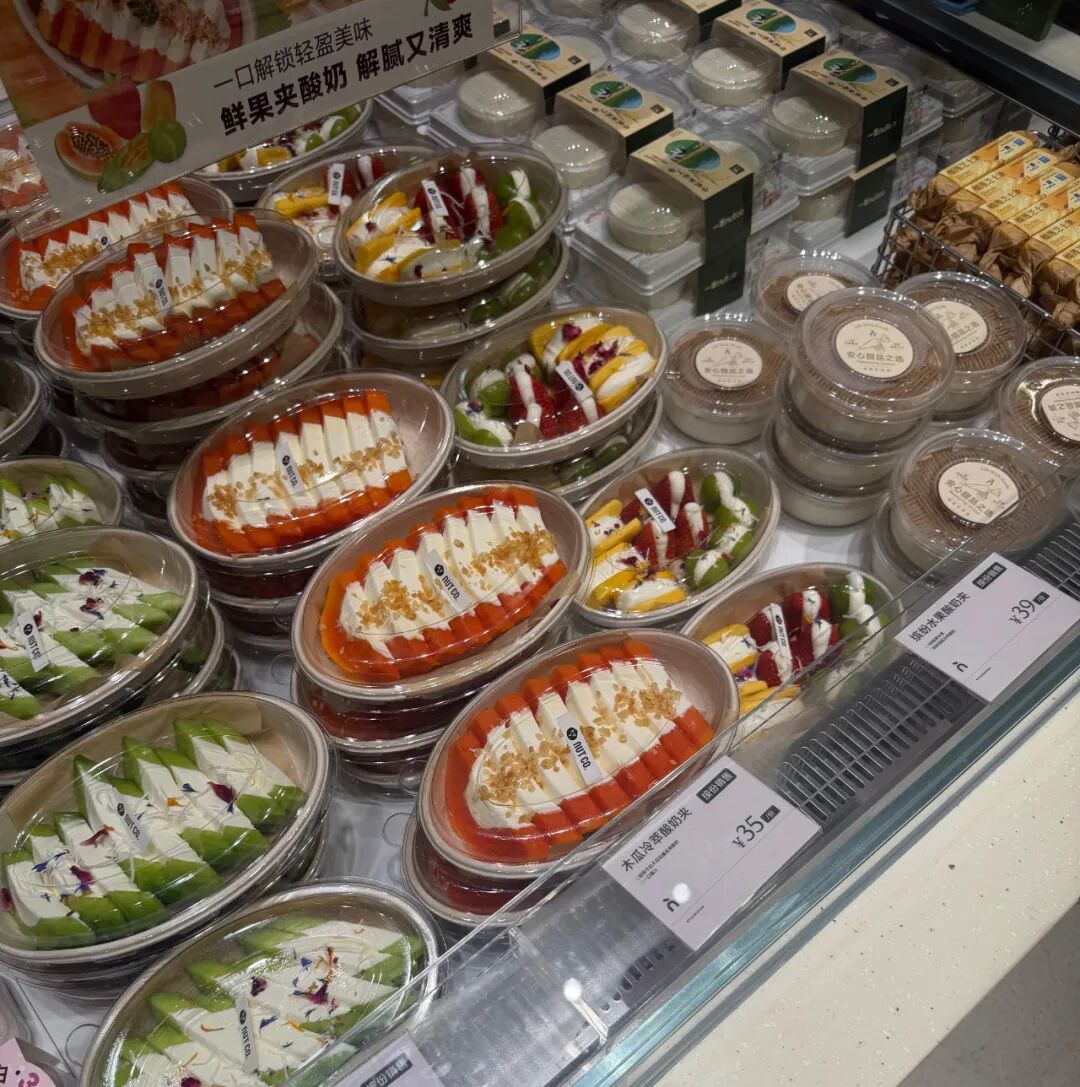
For example, at the Joy City in Chaoyang, Beijing, you can see some snack stores that are slightly larger than traditional roasted nut stores but more compact than supermarkets like Hema. The shelves are filled with a variety of products, ranging from puffed snacks like taro chips, roasted nuts, and instant tea to puff pastry bread, cold-brewed yogurt with fruits, and even freshly ground nut butter. Customers pick up a few items as they stroll around, and long queues form in front of the counters. Similar bustling scenes are happening in multiple cities such as Changsha and Chengdu.
This new species is the emerging “freshly-made snack” stores.
Actually, the new consumer retail sector has been rather quiet since the boom of discount snack stores. An investor told Baobian that since 2025, there have been so few market-oriented consumer retail projects that “there aren't even any notable events.” Most brands are focusing on maintaining their sales volume in the short term.
Freshly-made snacks have brought a glimmer of warmth to the consumer side. A person who has long been concerned about commercial real estate told Baobian that some of his friends have started businesses in this sector, and some investors have begun to pay attention to the freshly-made snack brands that have just emerged in South China.
Against the backdrop of a challenging consumer environment, are freshly-made snacks just a passing fad or a new solution that can withstand market cycles?
Saying Goodbye to Single Categories?
The trend of freshly-made snacks started in 2025.
In this year, “Yili nutco,” which evolved from a traditional nut processing workshop in Shenyang, opened its store in Hopson One Mall, one of the commercial areas in Beijing where young people gather. “Jiduofull,” a snack brand incubated by the well-known stinky tofu brand Heise Jingdian, opened its first store in Changsha. Jinlimen, which started to transform into a freshly-made snack brand in 2021, has been continuously opening new stores in Changsha and is planning to expand to East and South China.
These brands have grown in the fertile consumer markets of first-tier or new first-tier cities and are gradually subverting people's traditional perceptions. In the past, ice cream shops mostly sold only ice cream, bakeries only sold bread, and roasted nut stores only sold roasted nuts. It was already rare to have one or two overlapping categories. However, now, freshly-made snack brands are putting ice cream, cakes, marinated foods, milk tea, and roasted nuts in the same store. This product selection logic is called “wide category, narrow SKU,” that is, a large variety of products with a small number of SKUs.
The store layout, which is as diverse as a supermarket, has successfully targeted the consumption concept of the younger generation: the joy of the shopping process itself is greater than the joy of buying things, that is, experiential shopping.
In different cities, there are also clear distinctions in the target customer groups for this “experience.” Yili, which is mainly located in first-tier cities, has its clerks busy roasting sweet potatoes, packing freshly ground nut butter for customers, and brushing French Lescure butter on the bread. Jiduofull, which focuses on new first-tier cities, emphasizes health. Its stores are designed in a minimalist style, and its products highlight short shelf life and low additives. For example, Jiduofull has created a grading system for the cleanliness of ingredient lists, with a total of six levels from A to F. Levels E and F are neither produced nor stocked.
Although the brands claim to focus on freshly-made products, a former clerk at Yili said on social media that the sweet potatoes used were semi-finished products. Similar to the on-site wrapping of dumplings at Yuanji Yunjiao, this is mainly for the sake of customers' “experiential consumption” and is still different from true freshness.
Unlike necessities, snacks are a form of random consumption. Freshly-made snack stores enable customers to make quick decisions while shopping. The quality details told by Yili with French butter and the health stories told by Jiduofull through product grading are the reasons for customers to pay.
On the other hand, concentrating so many categories in one store has clear business considerations for the brand. Ice cream and cakes are popular all year round. They can not only attract customers into the store but also have a high turnover rate, which is suitable for supplementing the product category structure. Freshly roasted sweet potato chips are high-profit bestsellers, which can be sold for 38 yuan per catty.
Among the many categories, there are also some “wallet assassins”. For example, a box of small squid crisps can cost 50 yuan, with a unit price of up to 323 yuan per catty. On social media, many consumers have posted photos of their receipts, showing that they were “stabbed” by the loose small squid crisps. “Four chestnut cakes and a box of honeydew melon with cold-brewed yogurt cost 61 yuan!”
A person who has long observed the freshly-made snack sector told Baobian that Yili's business model is not ideal. “They mainly focus on nuts, and the product categories are not diverse enough,” the person said. The sales volume of nuts in the second and third quarters is only one-third of that in winter. Only a sufficient number of product categories are suitable for all-year-round sales and different customer groups. In terms of product selection, Jiduofull from Changsha has more categories, covering fresh spicy and marinated foods. The sales peak of these foods is in summer, which can complement roasted nuts well.
Starting from a Chestnut
Different from what consumers feel, the freshly-made snack sector did not suddenly become popular. It is more like a transformation direction or a second-track exploration for other consumer retail enterprises.
For example, Jinlimen, Yili, and Lingtuantuan all started as roasted nut stores and then transformed.
“Jinlimen initially borrowed the model of Manz Jixian and completed the large-store model,” the above-mentioned person said. It is reported that Manz Jixian started in Wuxi in 2019, trying to sell freshly-made products. Its product categories gradually expanded from baked goods to marinated foods, beverages, fruits, etc. However, different from Jinlimen's mainly retail model, Manz Jixian has a to B gene. It originated from a factory and mainly serves group purchases and wholesale.
Another typical transforming player is Xueji, which transformed later than Jinlimen and Yili. So far, Xueji's stores still mainly sell roasted nuts, dried fruits, and meat jerky. It is hard to see more categories such as baked goods and freshly-made milk tea. The latest bestseller is the freshly roasted sweet potato chips, “Xueji Xiaojintiao,” which became popular on social media at the end of 2025.
Public information shows that since June 2025, Xueji has launched ice cream in some stores, named Xuelatu. However, according to the information on Xueji's official social media, only 68 out of more than 1,300 Xueji stores are selling ice cream, which is a relatively small proportion.
“Xueji's model is not good. It can easily be incorporated into stores like Jinlimen,” the above-mentioned person said.
For companies like roasted nut stores whose growth potential has reached its limit, freshly-made snacks can obviously bring new SKUs, new stories, and new imagination.
For players from other sectors such as Heise Jingdian, Juewei, and Mingming Busy, freshly-made snacks mean a higher customer unit price and higher gross profit. In the past few years, the snack sector has been “competing on low prices” along with the overall consumer environment. Apart from expanding the scale, there have been few new growth paths.
In March 2025, Heise Jingdian Group officially incubated the fresh food retail brand “Jiduofull.” In January 2026, “You·Tuijian,” an independent freshly-made snack brand under Mingming Busy, opened its first store in Wuhan. During the “May Day” holiday this year, Juewei Food's freshly-made snack brand “Juewei Fresh Snacks” opened two stores simultaneously in Changsha and Chengdu, announcing its entry into the market.
The business model that caters to the new generation of consumers is gradually emerging, and similar freshly-made snack stores are starting to replicate. However, it can still be seen that new consumer retail brands are adopting a more conservative approach: when a bestseller appears, different brands start to follow suit, and the trial-and-error process seems to be more cautious.
Yili and Jinlimen have almost identical aluminum-can milk tea, “Jasmine Milk Brew,” with almost the same packaging. Both Xueji and Yili have roasted sweet potatoes, and even the thickness and size are almost the same. In the Joy City in Chaoyang, Beijing, the stores of Xueji Roasted Nuts and Yili are both on the B1 floor, only a few stores apart, forming a clear competitive relationship.
“I don't think there's any difference between (the products) and Youhe next door,” a consumer told Baobian. Youhe is a bakery also located in the Joy City in Chaoyang, next to Yili, and it was once a popular online store.
What is more worrying is the competition from supermarkets. The baking, marinated food, and freshly-made food areas in fresh food supermarkets such as Hema, Qixian, and Xiaoxiang Supermarket are larger, and they have a larger consumer base and higher brand awareness. As snack stores continue to expand their product categories, their business models are becoming more and more similar to those of supermarkets.
“This model will become a private-label food store with a hard discount in the future,” the above-mentioned person said. The essence of a hard discount is to use the channel brand to represent the product brand. Instead of charging barcode fees, entry fees, and promotion fees like traditional supermarkets, it seeks profits from the supply chain by producing private-label products.
This model was first established by Sam's Club and then imitated by Hema, Xiaoxiang Supermarket, etc. Now, freshly-made snack brands also want to follow a similar path. However, the above-mentioned person said that brands that focus on the lifestyle concept are different from supermarkets in terms of consumer perception. Mainly operating as specialty stores, they may still have room for survival.
Pessimists see competition, while optimists may see opportunities: Can the proven profit points such as hard discounts and private-label products bring new possibilities when replicated in a new form called “freshly-made snacks”?
In the fierce competition, freshly-made snack enterprises also have different advantages in the production end.
Different from mass-market snack brands like Mingming Busy, it is difficult for freshly-made snack brands to achieve economies of scale and reduce costs through stockpiling. Since they are short-shelf-life products, enterprises like Juewei and Heise Jingdian, which have their own factories and daily distribution cold chains, have natural supply chain advantages and strong inventory management experience, giving them a management edge.
Jiduofull has made heavy investments in the supply chain. It officially claims that 99% of the products in its stores are private-label products, and most of them are exclusively developed. Semi-finished products are produced in a central kitchen and then distributed to stores for on-site production in an open kitchen.
Giants like Mingming Busy have a large number of supplier resources and strong bargaining power, which can secure high-quality supplies. Public information shows that the founder of “You Tuijian,” a brand incubated by Mingming Busy, has years of experience in the Sam's Club marinated food supply chain and has in-depth experience in operating a high-level Sam's Club team. Therefore, “You Tuijian” is also called “Little Sam's Club” or a budget alternative to Sam's Club.
The above-mentioned industry insider told Baobian that Jinlimen has also recruited a purchaser from the baking sector to supplement its baking product category.
Expansion, but How?
Objectively, although short-shelf-life products can command a higher premium and help enterprises escape the low-price competition, compared with the asset-light model of cooperating with contract manufacturers, enterprises need to make relatively heavier investments.
Zheng Zhenghuan, the founder of Pu Mama, once calculated in an interview with Longshang Network and concluded that the cost of opening a freshly-made snack store is almost twice that of a traditional mass-market snack store. The major costs are for a large number of freezing, refrigeration, and on-site production equipment, as well as store decoration.
The decoration cost of a mass-market snack store is only 600 - 800 yuan per square meter, while that of a freshly-made snack store is 1,200 yuan per square meter. “The decoration costs 1,200 yuan per square meter, and the equipment costs 1,800 yuan per square meter. The total of these two items is 3,000 yuan per square meter. For a 100-square-meter store, the investment in decoration and equipment alone will reach 300,000 yuan, and then there are the costs of goods. The investment is very heavy.”
Given the high investment, freshly-made snack stores are currently mainly directly-operated stores. Yili, which has more than 100 stores, and Jinlimen, which has more than 20 stores, are both directly-operated.
However, franchising is an inevitable choice for rapid expansion. Jiduofull, which currently has more than 100 stores, aims to open 600 - 1,000 stores in 2026.
Public information shows that Jiduofull partially opened its franchise system at the end of 2025. Juewei Fresh Snacks is expected to launch a national expansion plan in July, starting with a direct-operation model and then opening the franchise system after it matures. Pu Mama is also planning to open a franchise model. However, due to the large investment and high requirements for cold chain logistics, inventory turnover, and store losses, the franchise threshold for this business format is very high.
According to the information on Jiduofull's official website, it requires franchisees to have an investment budget of no less than 1.2 million yuan and provide a bank deposit certificate of no less than 1.5 million yuan (those who can provide more than 3 million yuan will be given priority). Investors must have retail operation and management experience and currently have no less than five operating stores.
“This is designed for retail players or large franchisees,” the above-mentioned person said. Although the franchise threshold is high, there are many franchisees with resources, management capabilities, and local promotion capabilities who don't mind this high threshold. Moreover, the screening process can ensure a certain degree of success rate.
In addition to building brands, some people are exploring new models, such as Pu Mama. Half of its stores are in-store stores in supermarkets. It prefers to achieve scale by deeply collaborating with regional supermarkets. However, the above-mentioned person told Baobian that Pu Mama's in-store store model is not about building a brand but about operating the supply chain and acting as an intermediary.
Expansion requires more participants and more funds. According to Business Observer, Jinlimen, Jiduofull, and Yili have all contacted investors or are in the process of conducting Series A financing.
After all, freshly-made snacks may neither be a real trend nor a false proposition. It is more like a well-designed “category arbitrage” in the existing market. When discount snack stores have driven prices to rock bottom and supermarkets have expanded their fresh food areas, freshly-made snacks are trying to find a breakthrough with a vague positioning of “more experiential than discount stores and more stylish than supermarkets.”
This article is from the WeChat official account “Baobian” (ID: baobian