The "Singularity" of Commercial Space Industry Has Arrived. Which of the 492 Concept Stocks Can Ride the Wave?
Commercial space is evolving from a distant space project into an industry hotspot that attracts national attention.
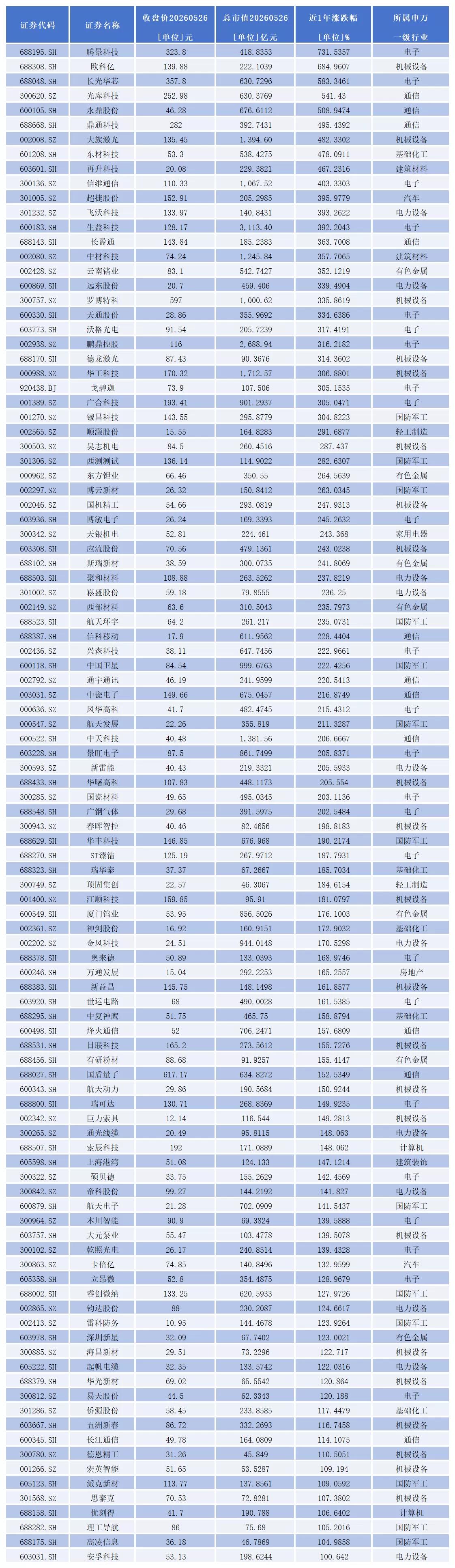
As of May 26, 2026, nearly 104 stocks in the A-share commercial space track have doubled in the past year. Since the beginning of this year alone, the stock prices of 24 stocks have doubled, indicating the popularity of the sector. Behind this is the triple resonance of technology, capital, and policy:
On the technology side, there has been a key breakthrough in reusable rockets. The Hyperbola-3 of Interstellar Glory has completed the landing shock test. The CQ-50 liquid oxygen kerosene engine of Galaxy Power has achieved dual optimization of performance and cost. Blue Arrow Aerospace and CAS Space have conducted intensive launches and verifications of multiple types of rockets;
On the capital side, SpaceX plans to go public in June, with a valuation as high as $1.75 trillion. Leading domestic companies such as Blue Arrow Aerospace and CAS Space are sprinting for IPOs. In the first quarter of 2026, domestic commercial space financing reached 8.02 billion yuan, a year-on-year surge of 4.6 times;
On the policy side, the 15th Five-Year Plan has included commercial space in new infrastructure. Many places have introduced industrial plans, and cities like Chengdu and Guangzhou are building industrial clusters, continuously releasing policy dividends.
Leading enterprises are accelerating their layout, occupying positions across the entire industrial chain from rocket manufacturing, satellite networking to space applications. The industrial inflection point of commercial space has arrived.
The Deep-seated Code of High Prosperity: Triple Factor Resonance
Policy dividends are the core driving force for the take-off of the commercial space industry. At the national level, commercial space has been clearly defined as a strategic emerging industry. The China Securities Regulatory Commission has opened a green channel on the Science and Technology Innovation Board to support the listing of unprofitable enterprises, solving the long-term capital problem.
At the local level, many places such as Sichuan, Guangdong, and Zhejiang have introduced special plans. Chengdu aims to achieve an industrial scale of 50 billion yuan by 2027, and Guangzhou is building a full-industry chain base for rockets. State-owned funds are pouring in intensively, forming a policy matrix of "national guidance and local empowerment".
The continuous strengthening of policies not only lowers the industry access threshold but also sends a strong signal of national support, strengthening the confidence of capital and enterprises in their layout.
Technological breakthroughs are the hard-core support for commercialization. The breakthrough in reusable rocket technology has directly reduced the launch cost by more than 70%, making high-frequency launches possible. The maturity of technologies such as liquid oxygen methane engines and 3D printing has shortened the rocket manufacturing cycle and reduced costs; the maturity of satellite mass production technology has significantly reduced the cost per satellite, providing conditions for the large-scale networking of low-orbit constellations.
At the same time, the iteration of technologies such as satellite Internet and remote sensing applications has expanded the downstream scenarios of commercial space, giving "space infrastructure" real commercial value. Technology has moved from the "laboratory" to the "production line", becoming the core confidence for the high prosperity of the industry.
The market demand and capital support form a two-way empowerment. On the demand side, the networking of low-orbit constellations has entered an intensive period. The Chinese GW constellation and Qianfan constellation plan to deploy tens of thousands of satellites, requiring hundreds of launches per year, bringing long-term and stable orders. The applications of satellite communication, navigation, and remote sensing in fields such as agriculture, emergency response, and the ocean are constantly expanding, and new business forms such as space computing power and space manufacturing are emerging, opening up a trillion-level market space.
On the capital side, the primary market financing is booming. Interstellar Glory received a single financing of 5.037 billion yuan. In the secondary market, there are frequent doubling stocks, and the satellite ETF has a continuous net inflow. The influx of capital provides sufficient ammunition for technology R & D and capacity expansion, and the high growth expectations of the industry further attract continuous capital investment, forming a positive cycle.
Resonance of Upstream and Downstream: Sharing the Space Dividend
The high prosperity of commercial space is spreading along the industrial chain. The upstream raw materials and core components, the midstream rocket and satellite manufacturing and launch services, and the downstream application services are all facing development opportunities.
In the upstream field, non-ferrous metals, special materials, and precision parts enterprises are the first to benefit; in the midstream field, rocket and satellite manufacturing enterprises are the core beneficiaries; in the downstream field, satellite application services open up long-term growth space, and the value of the industrial chain is continuously released.
In the past year, the commercial space-related sectors have become one of the strongest hotspots in the A-share market. 104 doubling stocks cover multiple fields such as machinery and equipment, electronics, communication, and national defense and military industry, with total market values ranging from tens of billions to hundreds of billions, fully demonstrating the popularity of the sector.
Among them, the stock prices of Ouke Yi and Tengjing Technology have risen by more than 700%, and the leading stocks such as Han's Laser and Changguang Huaxin have risen by more than 500%, becoming market benchmarks.
104 doubling stocks have emerged in the past year
Since the beginning of this year, the popularity of the sector has continued. 24 doubling stocks have erupted intensively, and the machinery and equipment, electronics, and communication industries have become the gathering places for doubling stocks. Ouke Yi leads the way with a 342.10% increase. The stock prices of Changyingtong and Changguang Huaxin have risen by more than 180%, and the core parts enterprises such as Han's Laser and Delong Laser have risen by more than 150%.
24 doubling stocks have emerged since the beginning of this year
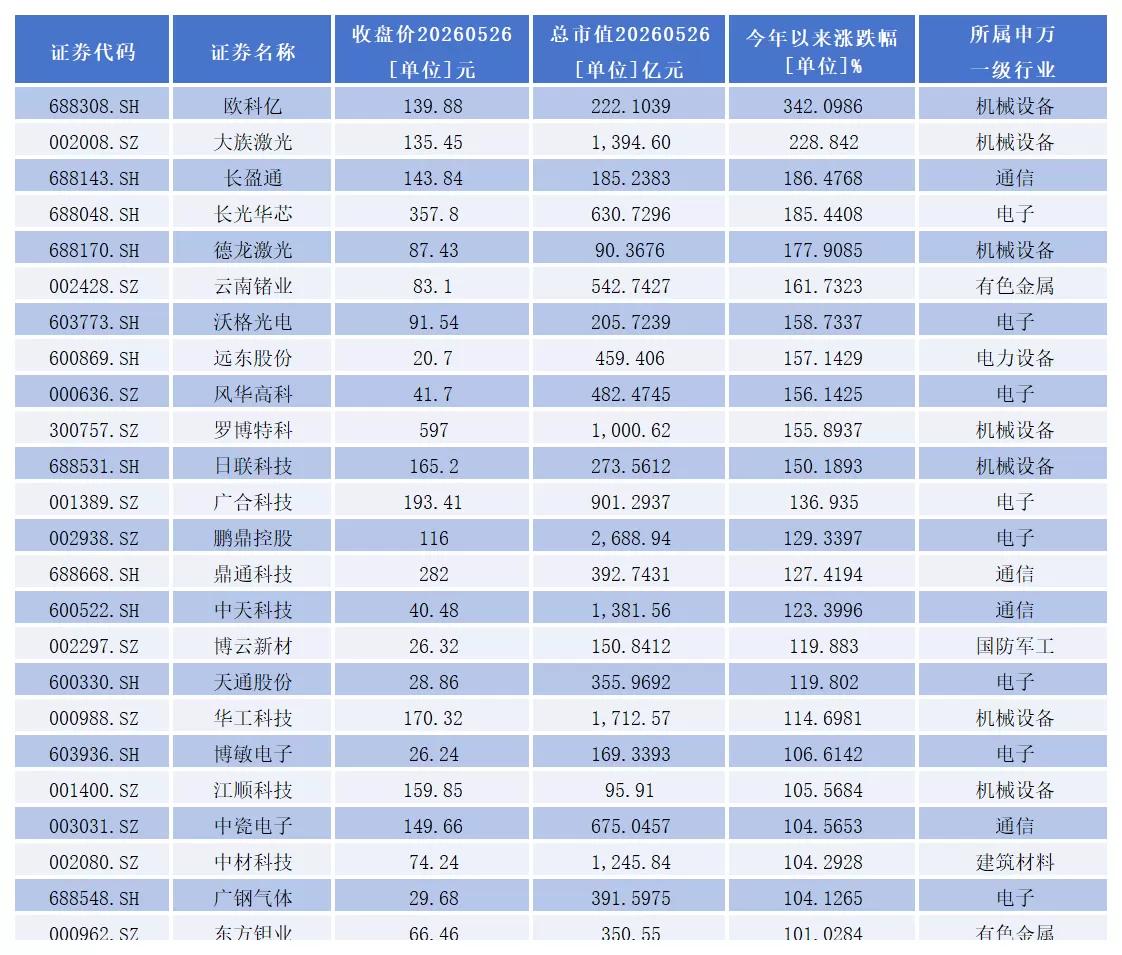
Behind these doubling stocks, there are not only technological breakthroughs in reusable rockets and satellite core components but also performance support from the implementation of industrial chain orders and capacity expansion. Capital is shifting from concept speculation to value recognition of hard-core assets.
Among the many doubling stocks, the doubling path of Wuzhou Spring (603667) is highly representative. Its stock price has risen by 116.75% in the past year. The core logic lies in the transfer of precision manufacturing capabilities + high prosperity of commercial space + the growth of high-value-added businesses. The company has been deeply involved in precision bearing manufacturing for more than 20 years and has the manufacturing capabilities of the entire industrial chain, which lays a technical foundation for entering the commercial space track.
At the same time, the company is also deploying precision bearings for robots, forming a dual-wheel drive of "commercial space + robots" and enjoying the premium of the two high-prosperity tracks. This is the core logic for the doubling of its stock price.
This article is from the WeChat official account "Lanfu Finance Network", author: Lanfu Finance Network. Republished by 36Kr with permission.