Longevity ≠ Health Preservation? Some People Have Conducted an Engineering Analysis of "Solving Aging" | muShanghai On-Site Notes
36Kr's "Workplace Bonus" (ID: ZhiChangHongLi)
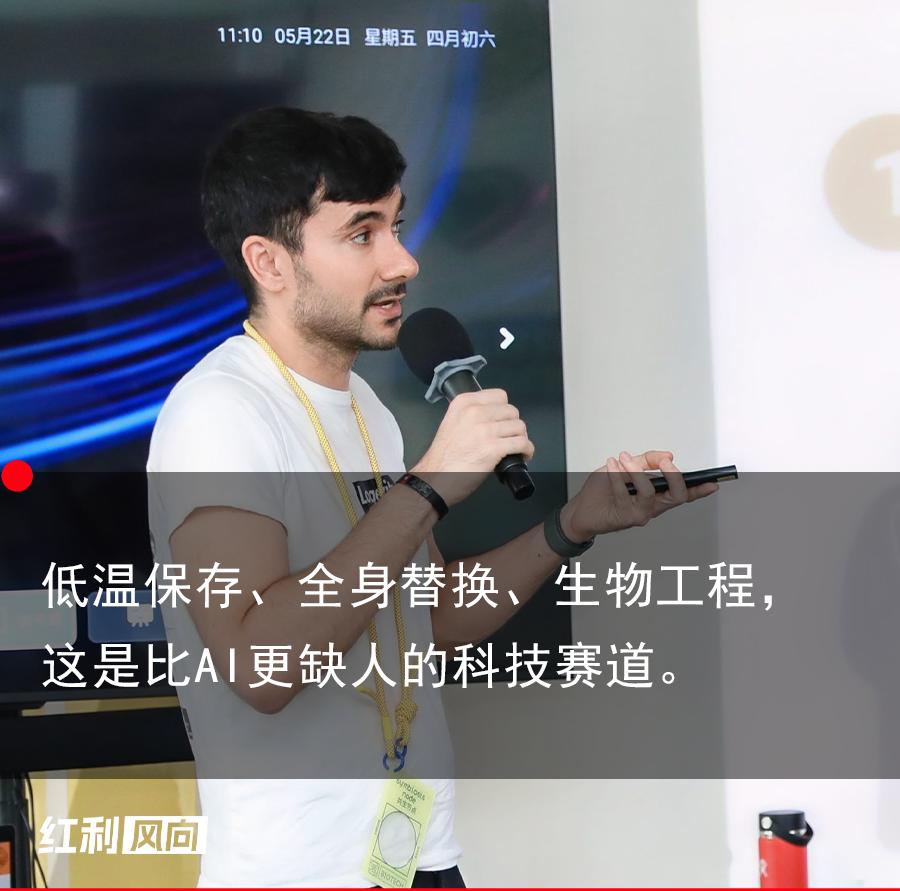
Last Friday morning, I listened to a sharing session by Eric Magro, the Head of Operations of the Longevity Biotech Fellowship (LBF). This non - profit organization, which has been established for about three years, focuses on one thing: treating "solving aging" as an engineering problem worthy of project establishment, funding, and recruitment.
Eric started the session by presenting a mortality curve. When we are young, the probability of death is almost negligible, but after a certain age, it suddenly increases exponentially. Aging is the fundamental cause of death for most people globally, yet no country or large - scale institution is systematically addressing this issue. The roadmap of LBF aims to fill this "strategic gap".
Last Friday morning I sat in on a session by Eric, Head of Operations from Longevity Biotech Fellowship (LBF). Founded roughly three years ago, this nonprofit focuses on one thing: treating "solving aging" as an engineering problem worthy of formal project launch, funding, and hiring.
Eric opened with a mortality curve. When we're young, the probability of death hovers near zero; after a certain age, it spikes exponentially. Aging is essentially the leading cause of death worldwide, yet no country or major institution is systematically dismantling the problem. LBF's roadmap aims to fill this strategic void.
[LBF systematically breaks down the problem - solving approach into three paths (with decreasing difficulty and funding requirements)]
Bioengineering: Thoroughly understand and intervene in aging biology. Eric believes this is the most difficult, most costly, and most distant direction because humanity still lacks a widely - recognized theoretical framework for aging, and we haven't fully understood the causal pathways.
Biostasis: Put people "on hold" until aging is solved. This mainly involves cryonics, as well as other immature technologies. Eric emphasizes that this is more of an engineering problem than a basic science problem, and currently, there are very few practitioners globally, and the funding is severely insufficient.
Replacement: Replace whatever is damaged, from cells, tissues, and organs to the whole body. LBF believes that the cost and time required for this path are much lower than those of bioengineering, so they are most excited about it.
[LBF breaks the solution into three paths, ranked by difficulty and capital needs]
Bioengineering — fully understanding and intervening in aging biology. Eric considers this the hardest, most expensive, and most distant route. Humanity still lacks a consensus theoretical framework for aging; we haven't even fully mapped the causal pathways.
Biostasis — putting people "on pause" until aging is solved. Primarily cryonics, plus other immature tech. Eric stresses this is more engineering than basic science, but global practitioners are scarce and funding is severely lacking.
Replacement — swapping out whatever breaks, from cells to tissues to organs to whole bodies. LBF estimates this path demands far less cost and time than bioengineering, which is why they're most excited about it.
[Some technical milestone events have already occurred]
In 2018, Chinese scientists completed the world's first somatic cell cloning of primates ("Zhong Zhong" and "Hua Hua"), and the results were published in Cell. This is a background milestone in the field of reproductive biology. When Eric was discussing LBF's long - term replacement path on - site, he used the term "bodyoid / brain - knockout", but he did not regard this 2018 study as the direct technical basis for this concept.
There are already commercial institutions operating in the field of cryopreservation. Tomorrow.Bio in Berlin was established in 2020. As of now, it has completed cryopreservation for 20 humans and 10 pets, and more than 800 people have signed contracts, with a total contract value of over 160 million euros. It cooperates with the European Biostasis Foundation in Switzerland and uses liquid nitrogen tanks for long - term storage. The well - established American institutions, Alcor Life Extension Foundation (established in 1972) and Cryonics Institute (established in 1976), also provide similar services.
The Nanowarming technology has achieved academic breakthroughs. In 2025, the John Bischof team at the University of Minnesota published a proof - of - concept in Nature Communications: using iron oxide nanoparticles in combination with radio - frequency coils, they achieved rapid and uniform rewarming of a 2 - liter vitrified volume (about 88°C/min), providing physical feasibility for the vitrification and rewarming of human organs.
The regeneration of mouse digit tips is a real research direction. Researchers such as Ken Muneoka from Tulane University and Texas A&M have long studied the regeneration mechanism of the fingertips of adult mice and found that they can completely regenerate bones, blood vessels, nerves, and nails. Related research has been published in journals such as Development and Regeneration.
Regarding Brian Johnson's Blueprint project, Eric clearly distinguished it on - site: it is a strict health optimization experiment, not an anti - aging therapy. What Brian is doing is "trying to stay healthy until AI solves aging". His project costs about 2 million US dollars per year, including extreme diet, sleep, and biomarker monitoring, but it does not claim to be able to significantly extend lifespan independently.
[Some technical milestones have already been reached]
In 2018, Chinese scientists achieved the world's first primate somatic - cell cloning ("Zhong Zhong" and "Hua Hua"), published in Cell — a relevant background milestone in reproductive biology. On - site, Eric discussed how LBF frames the longer - term replacement path using terminology like "bodyoid / brain - knockout", though he did not present the 2018 study as the direct technical basis for that concept.
Commercial cryopreservation is already operating. Berlin - based Tomorrow.Bio, founded in 2020, has completed cryopreservation for 20 humans and 10 pets, with 800+ people signed up and contracts totaling over €160 million. It partners with Switzerland's European Biostasis Foundation for long - term liquid - nitrogen storage. US veterans Alcor Life Extension Foundation (est. 1972) and Cryonics Institute (est. 1976) offer similar services.
Nanowarming has posted academic breakthroughs. The University of Minnesota's John Bischof team published a 2025 proof - of - concept in Nature Communications: using iron - oxide nanoparticles with RF coils, they achieved rapid, uniform rewarming of a 2 - liter vitrified volume at roughly 88°C/min, lending physical feasibility to organ - scale vitrification and rewarming.
Mouse digit - tip regeneration is a real research track. Teams at Tulane University and Texas A&M (Ken Muneoka et al.) have long studied adult mouse digit - tip regeneration, demonstrating full regrowth of bone, vasculature, nerves, and nails in journals such as Development and Regeneration.
Eric drew a sharp on - site distinction regarding Brian Johnson's Blueprint: it is a strict health - optimization experiment, not an anti - aging therapy. Johnson's aim is to "stay healthy until AI solves aging", spending roughly $2 million yearly on extreme diet, sleep, and biomarker protocols, without claiming it can independently deliver major lifespan extension.
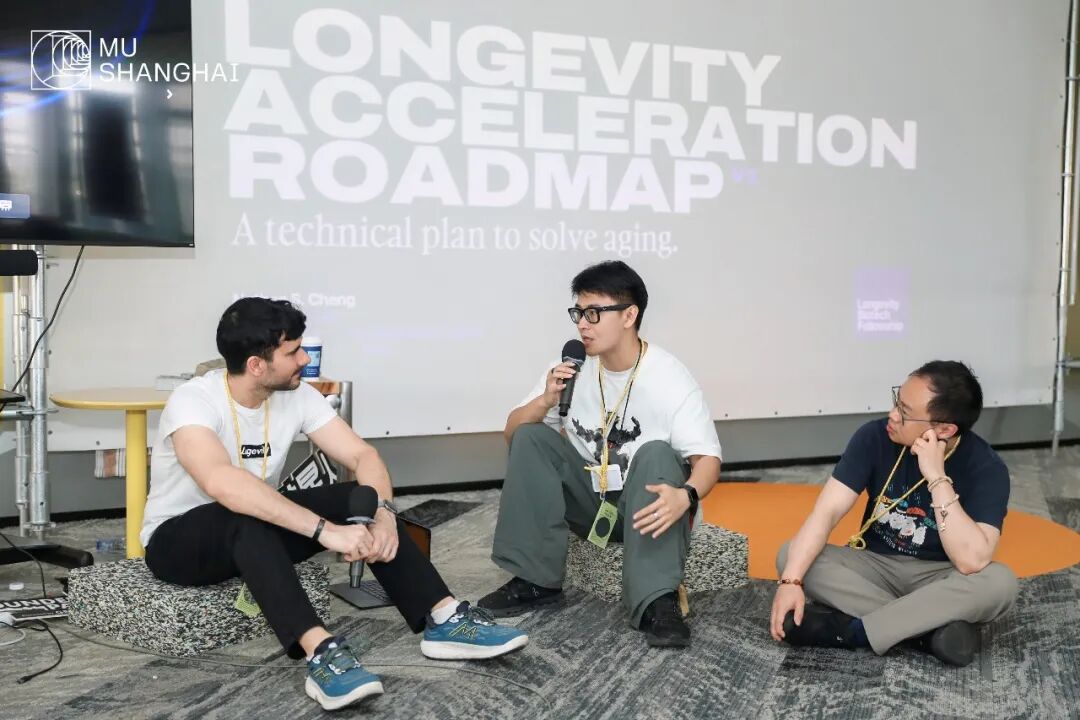
Before the official start, Frank Ji (middle), the person in charge of the second - week theme at muShanghai, asked questions to Eric Magro (left)
[Some concepts and theoretical discussions still on paper and in the laboratory]
AI - designed cryoprotectants: Currently, there are indeed teams using machine learning to find chemical combinations with lower toxicity and better effects. This is an ongoing research project.
Progressive brain replacement: Gradually replace the aging part of the brain with newly grown brain tissue. Eric admits that this is a "radical idea", and currently, very few institutions are working on it. (Researchers such as Jean Hébert have explored related concepts.)
The "two - sided coin" theory of cancer and aging: A listener at the scene proposed that if we can control and harness the infinite proliferation ability of cancer cells and understand their biology, it may provide new ideas for aging. Eric responded that this is an "interesting path", but he said he was not sure if anyone was promoting this framework.
Michael Levin (Tufts University)'s "anatomical compiler": Translate human - readable instructions into bio - electrical/chemical signals to guide cell regeneration. This is one of the research directions in Levin's laboratory. There has been some early work, but it is still far from being applied to humans.
The "negligible senescence" of crocodiles/alligators: The scientific community has indeed observed that some reptiles age extremely slowly. However, when Eric was asked on - site whether "crocodile cells stop aging after a certain age", he clearly replied, "I don't know the specific example" and reminded that such abilities are often part of the overall animal system and are difficult to isolate and transplant into humans.
[Concepts still on paper or in the lab]
AI - designed cryoprotectants: Teams are actively using machine learning to hunt for less toxic, more effective chemical combos — ongoing research.
Progressive brain replacement: Gradually swapping aging brain tissue with newly grown tissue. Eric called it a "radical idea"; very few institutions are pursuing it. Researchers such as Jean Hébert have explored related concepts.
The "two sides of a coin" theory linking cancer and aging: An audience member proposed that if we could harness cancer cells' limitless proliferation in a controlled manner, it might illuminate aging. Eric deemed it an "interesting path" but said he didn't know whether anyone was actually building on that framework.
Michael Levin (Tufts University) and the "anatomical compiler": Translating human - readable instructions into bioelectric/chemical signals that direct cell regeneration. Early work exists in Levin's lab, but human application remains distant.
Negligible senescence in crocodilians: Science has observed that some reptiles age extremely slowly. Yet when asked on - site whether "crocodile cells stop aging after a certain age", Eric replied, "I don't know the specific example", adding that such capabilities are usually embedded in an animal's total system and difficult to isolate and transplant into humans.
[How small is this circle?]
The number of people truly engaged in "hard engineering" in the longevity field may be even smaller than those in AI applications. There are only six or seven cryopreservation service institutions globally, and the number of academic teams working on organ vitrification is very small. Eric himself has signed a cryopreservation agreement. He estimates that, given the current social priorities, the probability of him seeing aging solved in his lifetime is very low (about 5% to 10%), but if there is a significant increase in talent, funding, and coordination mechanisms, this probability may increase significantly. This conditional judgment is also one of the reasons why he advocates that biostasis/cryopreservation deserves more resources in parallel.
"Death is an emergency, but we are not treating it as one." Eric repeatedly reminded us that currently, the number of "proven interventions that can significantly extend human lifespan" on the market is zero. When encountering a product that claims to allow you to live decades longer, you should ask for evidence instead of being deceived.
LBF plans to hold a two - day workshop in Shenzhen in October this year and another one in North Carolina, USA, in August. Their recruitment logic is simple. No matter whether you come from finance, law, robotics, or AI, as long as you want to participate in solving the problem of aging, you can apply.
To learn more or contact LBF: longevitybiotechfellowship.org
[How small is the circle?]
Globally, there are only six or seven commercial cryopreservation service providers. Academic teams working on organ vitrification are rare. Eric himself has signed up for cryopreservation. He estimates that, under current societal priorities, the chance of solving aging in his lifetime is low (roughly 5–10%), but that figure could rise significantly with much more talent, funding, and coordination. That conditional outlook is part of why he believes biostasis / cryopreservation deserves more resources in parallel.
"Death is an emergency, but we're not treating it like one." Eric repeatedly warned: the number of interventions proven to significantly extend human lifespan currently sits at zero. When a product claims it can add decades to your life, demand evidence — don't pay the intelligence tax.
LBF is planning a two - day workshop in Shenzhen this October, and another in North Carolina, USA, in August. Their recruitment logic is open: whether you come from finance, law, robotics, or AI, if you want to help solve aging, you can apply.
For readers who want to learn more or get in touch: longevitybiotechfellowship.org
"Workplace Bonus" will continue its on - site observation at muShanghai in the next week. This event, known as the "International Tech Burning Man", is initiated by the international open - source community The Mu and co - hosted by the Hongqiao Alibaba Center. It lasts for a full 28 days from May 10th to June 6th, bringing together developers, researchers, and startup geeks from 50 countries around the world (the atmosphere is very lively, not like a formal industry summit).
Currently, it is the third week of the four theme weeks - AI, biotechnology, robotics, and culture. We will continue to record first - hand information and judgments for readers in this convenient way. If you are also in Shanghai and happen to be interested in AI and hard technology, welcome to meet us in person ;-)
Workplace Bonus will continue its muShanghai field coverage over the next week. Billed as an "International Tech Burning Man", the event is initiated by global open - source community The Mu and co - hosted by Hongqiao Alibaba Center. Running 28 days from May 10 to June 6, it gathers developers, researchers, and startup geeks from 50 countries—the vibe is wild, not your typical buttoned - up industry summit.
We're currently in Week 3 of four themed weeks: AI, Biotech, Robotics, and Culture. We'll keep feeding readers first - hand notes and judgments in this lightweight format. If you're in Shanghai and curious about AI and hard tech, come find us ;-)

The four theme weeks of muShanghai
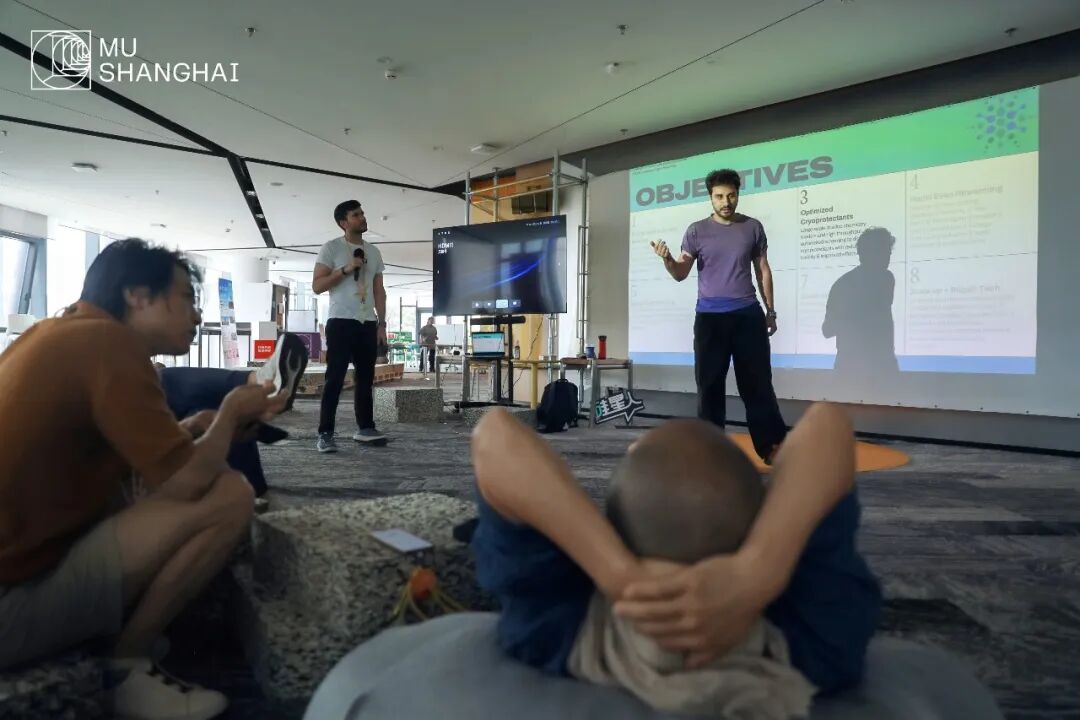
An on - site audience member (right) asked challenging questions to the speaker Eric Magro (left)
