3D printing has become extremely popular, and the "Four Little Dragons of Shenzhen" have captured 90% of the global market.
Among all types of OPC (One-Person Companies), 3D printing seems to be one of the most "beginner-friendly" entrepreneurial tracks: receiving orders online, delivering offline, and the printing equipment is inexpensive. On social media platforms, posts like "Earning over 10,000 yuan a month by setting up a 3D printing stall" and "Earning 50,000 yuan a month with just one or two 3D printers" are emerging one after another.
Data shows that since the beginning of this year, the sales of 3D printers and related accessories and consumables on the JD platform have increased by more than 100% year-on-year.
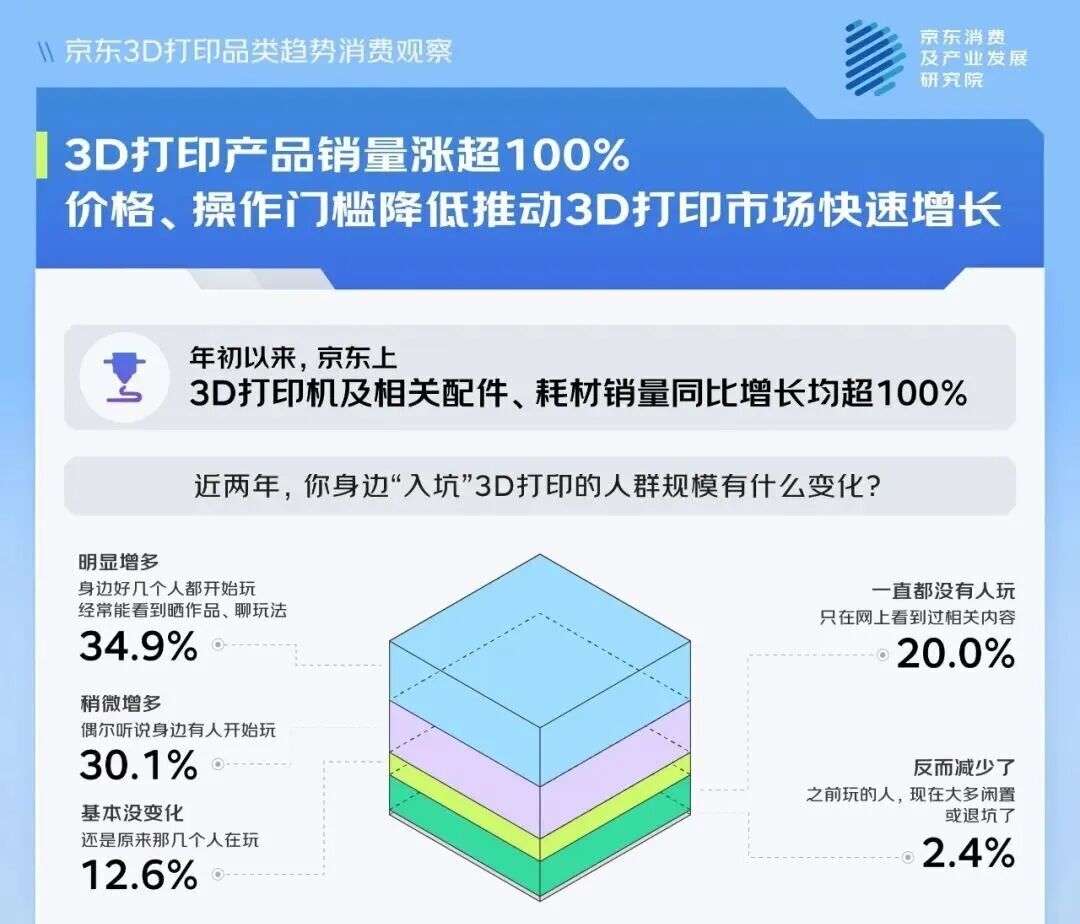
Image source: JD
Many players were initially attracted by the appearance of 3D printed products. After getting into the field, they found that a small machine can actually "print everything". Besides figurines and toys, daily necessities such as bowl racks and hooks can also be printed for personal use.
Amid the popularity, 3D printing has not only moved from the maker circle to the general public but has also further expanded to the children's group. In the offline stores of TuoZhu and Creality, they are crowded with parents bringing their children on weekends. The full-scale popularity is making more large enterprises and capital institutions eye this track.
01. 3D Printing Is "Booming"
During the May Day holiday this year, Lin Bai (pseudonym) officially opened his 3D printing studio in Shenzhen. On the opening day, Lin Bai posted a WeChat Moments message: "Now that OPC is so popular, I'll also be a studio manager."
Before opening the studio, Lin Bai didn't have much experience in 3D printing. Lin Bai's main occupation is a lawyer, and he likes playing board games in his spare time. At the end of last year, after finding that board game accessories could be upgraded, he began to have an interest in DIY. After receiving a 3D printer as a gift, Lin Bai found that 3D printing can not only make board game accessories but also many three-dimensional images. Once, after Lin Bai posted the "handmade" "Dune" figurines on social media, netizens asked if he could help "print on behalf", and thus he started his journey as a "studio manager".
All of Lin Bai's works are sold on second-hand platforms, almost all of which are board game accessories, with prices ranging from dozens to hundreds of yuan. "I spent more than 10,000 yuan on buying 3 printers, consumables, and renting an office in the early stage, and I've already recovered the cost." Lin Bai said that in the industry, his sales volume is not large. It's mainly for sharing and enjoying the production process. Although he can make money, it's still a long way from the salary level of his main occupation.
There are many people like Lin Bai who sell 3D printed products online as a side job in their spare time. An entry-level 3D printing device costs about 2,000 yuan, and the wholesale price of printing consumables (the mainstream PLA material) is only 15 - 22 yuan per kilogram. Converted, the cost per gram is about 0.015 - 0.022 yuan. Coupled with negligible electricity costs and extremely low equipment depreciation, the cost of a single item is often in single digits, while the pricing can reach 5 to 20 times the cost.
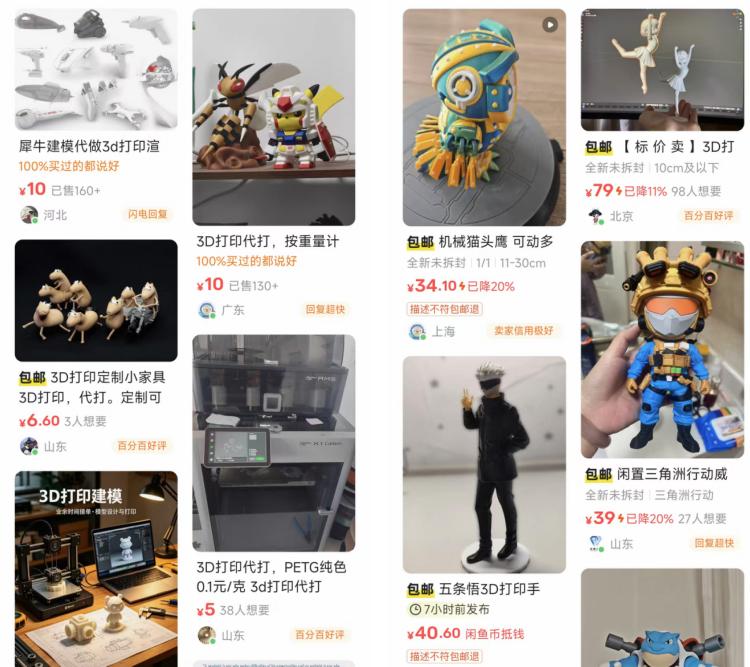
Image source: Screenshot of Xianyu
"What 3D printing sells is creativity, aesthetics, and patience." A 3D printing seller said that although the production threshold has been greatly reduced, it's still not friendly to novice beginners. Maybe the only friendly thing is one-click printing, but there are multiple links such as equipment maintenance, consumable maintenance, and post-processing of finished products outside of printing, all of which take time to explore.
"The 3D printing device just makes it easier for creators to bring their ideas to life. What's decisive is the creator's design and aesthetics." The seller said that the reason why some people can get a lot of people interested in their printed armors, handbags, and necklaces just by posting on Xiaohongshu is essentially the uniqueness of the design. If they just print and sell models like the "ankylosaurus" that are already flooding the market, it's no different from plastic toys wholesaled from Yiwu, and even with good traffic, it's not necessarily that someone will buy.
The significant improvement in the convenience of using 3D printers has made more and more non-professional players like Lin Bai the main consumers of printers.
Some industry insiders pointed out that the popularity of 3D printing is because the people sitting in front of the printers have changed. The entry of the domestic brand Creality has brought the price of consumer-grade 3D printers from over 10,000 yuan to about 1,000 yuan. TuoZhu's machines have greatly improved the printing success rate and stability, and the emergence of AI has also smoothed out the threshold of modeling.
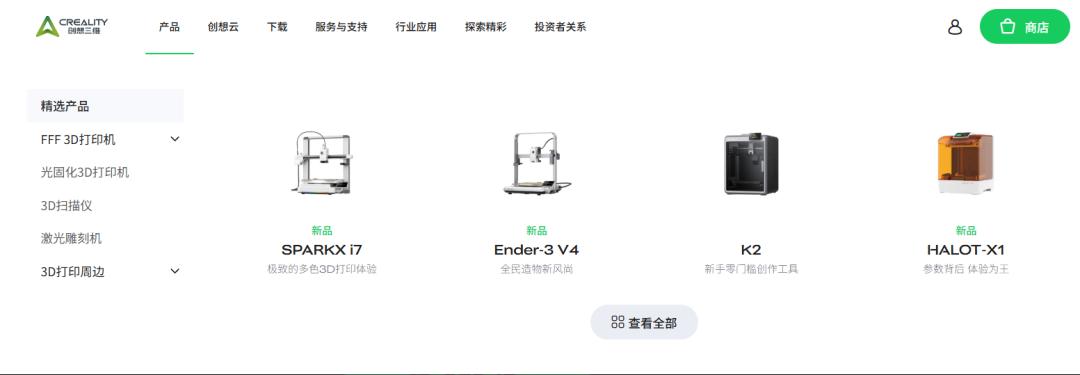
Image source: Screenshot of Creality's official website
In the past, most of the people guarding 3D printers were geeks and handicraft enthusiasts who understood parameters, could do modeling, and knew how to debug; while now, many of the people sitting in front of 3D printers are ordinary people without DIY experience, and even children.
"Fun Interpretation of Business" noticed that in the offline stores of TuoZhu and Creality, there are often many children around the display stands. They are attracted by remote-controlled racing cars and sand tables and have the desire to do it themselves. The founder of a science and technology children's training institution said that children aged 6 - 12 will be an important customer group in the 3D printing market. Many training institutions that do children's programming are also launching stage courses on 3D printing simultaneously. TuoZhu and Creality are also targeting this track.
Meanwhile, both TuoZhu and Creality are making efforts in offline channels, opening flagship experience stores in high-end shopping malls in first-tier cities like Shenzhen to reach more family customer groups.
02. "Surrounding" TuoZhu
Along with the booming consumption of 3D printing, the capital market has also exploded.
Data from CVSource shows that in 2025, a total of 81 3D printing companies received more than 100 rounds of financing, with a total amount of about 8.4 billion yuan, a 115.4% increase compared to 3.9 billion yuan in 2024. The financing scale reached a record high.
On May 11th, Creality passed the listing hearing of the Hong Kong Stock Exchange and is about to become the first consumer-grade 3D printing stock. According to the data disclosed in Creality's prospectus, the global 3D printing consumer market is occupied by four enterprises in Shenzhen. In 2024, the market shares of TuoZhu Technology, Creality, SmartPie, and Anycubic were 35.5%, 11.2%, 10.7%, and 10.0% respectively, and they are called the "Four Little Dragons of Shenzhen".
Among the four Shenzhen enterprises, TuoZhu's revenue and profit levels are the highest in the industry. A research report from Soochow Securities shows that TuoZhu's revenue is expected to reach 5.5 - 6 billion yuan last year, with a net profit close to 2 billion yuan.
Consumer-grade 3D printers are mainly divided into two types: FDM and light curing. Since FDM is easier to get started with, it is currently the most important shipping type in the 3D printing consumer market.
All the printers sold by TuoZhu are FDM. "Fun Interpretation of Business" learned that TuoZhu's advantage lies in technology and ecosystem. Configurations such as multi-color printing, automatic leveling, and silent operation, which were previously only available in products priced at 3,000 yuan, have been introduced by TuoZhu into entry-level products priced at 1,000 yuan. The TuoZhu A1 priced at 1,300 yuan is also called the "magic machine for beginners" by many people, which once triggered the follow - up of products from other brands.
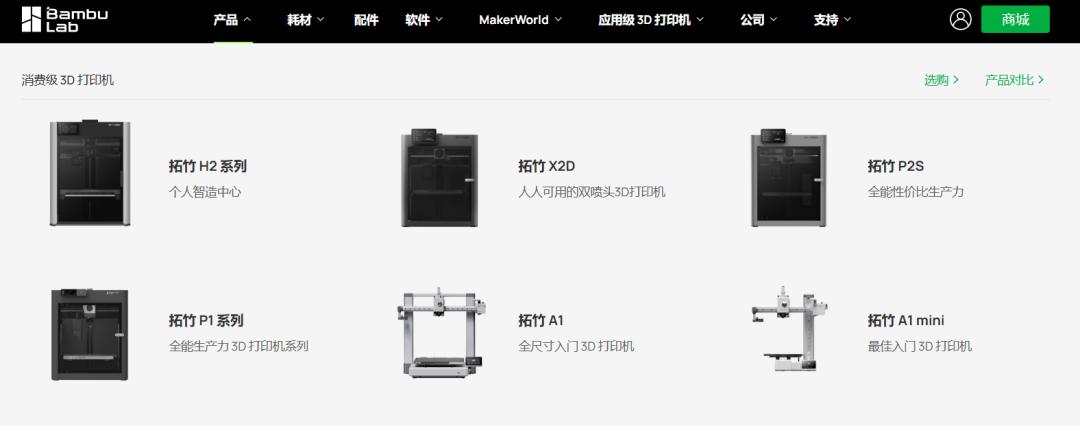
Image source: Screenshot of TuoZhu's official website
Chen Bo, the co - founder of SmartPie, said that TuoZhu's moat lies in software algorithms, which ensure the stability of printing. If other brands need to be manually leveled every half - month to continue using, TuoZhu can generally print stably for more than a month.
Creality is the earliest established among the Four Little Dragons, and it also has the most extensive product line. Its printers cover FDM and light curing, and it also has products such as 3D scanners and laser engraving machines. After TuoZhu was established, Creality lost a lot of market share in the FDM field. In order to regain the "lost ground", Creality established a sub - brand, SparkX, this year and released its first model, the "i7", which features "ready to print in 5 minutes after unpacking" and comprehensively targets the TuoZhu A1.
SmartPie and Anycubic are also accelerating their pursuit. In the past six months, SmartPie has attracted more attention from the industry due to the successive financing from star institutions such as DJI and Meituan.
Before getting the financing, SmartPie had been focusing on the light - curing field, and its light - curing printer has the No. 1 market share globally. After successive rounds of financing, SmartPie will fully enter the FDM 3D printing product line and compete directly with TuoZhu.
TuoZhu, which has been making stable profits, had its latest round of financing in April 2024. With the rapid growth of the 3D printing market, some venture capital institutions that missed TuoZhu are eagerly looking for other high - quality targets in this track.
In May this year, SmartPie just completed a round of financing of hundreds of millions of yuan, led by Shenzhen Capital Group, with institutions such as Meituan Longzhu, Meituan Strategic Investment, and Hillhouse Capital following. According to a report from "Leifeng.com", Wang Xing, the founder of Meituan, once flew to Shenzhen in person to discuss the investment in the 3D printing project. Before getting the investment from Meituan, SmartPie also received financing and support from DJI. DJI even arranged requirements to compete with TuoZhu in the agreement, which also caused Tao Ye, the founder of TuoZhu, to "complain" in his WeChat Moments.
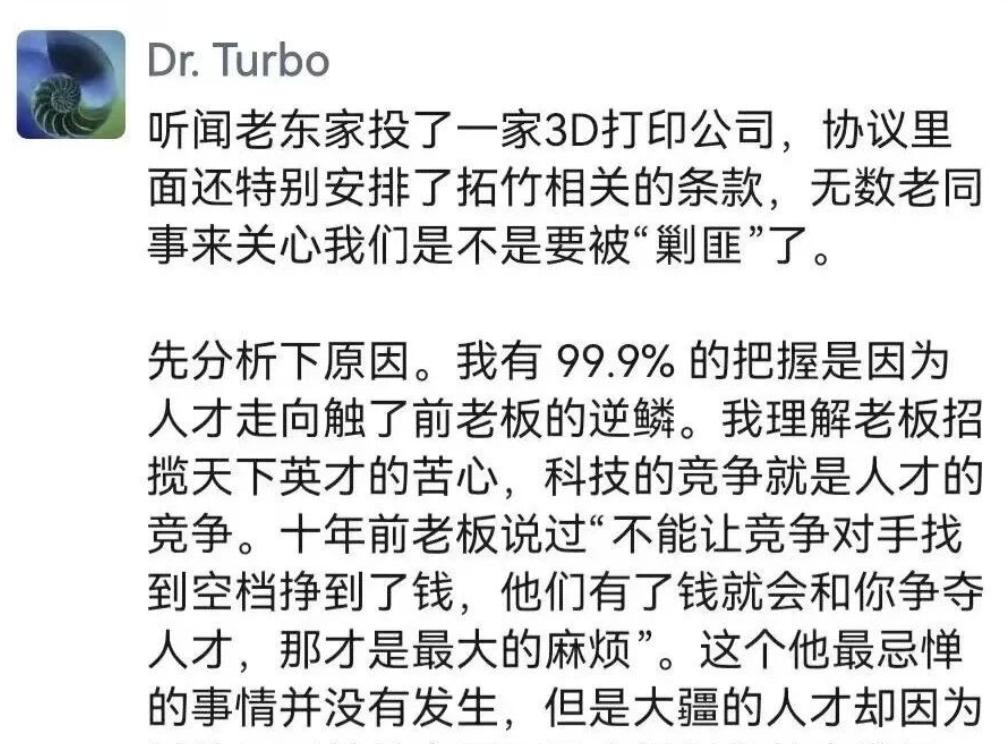
Image source: Screenshot of WeChat Moments
2026 will be a year when the "Three Little Dragons" in Shenzhen launch a fierce attack on TuoZhu. Some investors predict that there is a high possibility of a price war in the consumer - grade 3D printing industry this year, and brands will exchange price for volume to seize the market. "Fun Interpretation of Business" noticed that after the 618 promotion started this year, the price of the "i7", which is the main product of Creality this year, has dropped to 999 yuan.
03. Continuing to "Sink"
Compared with the price war, what's more important for the 3D printing industry now is how to further expand the market. Data from CIC shows that in 2025, the global shipment of consumer - grade 3D printers reached 4.1 million units.
Although the industry is booming, in the domestic market, 3D printers are far from reaching the stage of "mass consumption". The founder of a science and technology children's training institution revealed that most of the people who come to consult about 3D printing courses are white - collar workers, doctors, or university teachers, who are high - educated or high - income groups, and it's still a long way from the sinking market.
This is also the reason why leading enterprises in the industry are increasing their efforts in offline channels. Offline stores where customers can directly experience products and services are undoubtedly moving billboards. Before making 3D printing a "mass consumption", first make it "visibly available to the public".
However, offline channels require heavy investment, which poses a test to the enterprise's capital and operation ability. Creality's prospectus shows that the company's sales and marketing expenses increased from 380 million yuan in 2024 to 570 million yuan in 2025, a year - on - year increase of 48.8%. This is also one of the reasons why Creality suffered losses in 2025. The soaring marketing expenses were mainly used for online promotion. If a large number of offline stores are opened, the brand's marketing expenses will further increase.
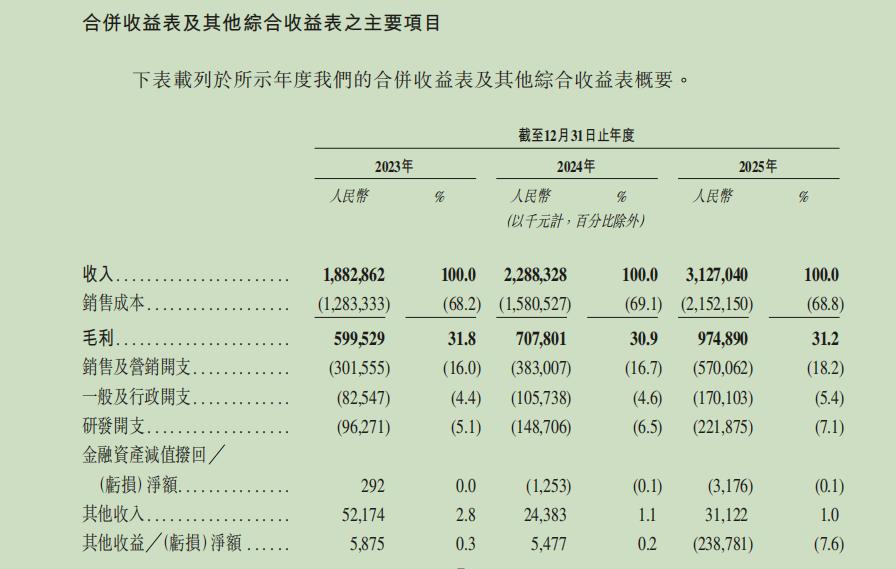
Image source: Screenshot of Creality's prospectus
In addition to channels, the construction of 3D model communities is also a "money - burning marathon".
The model community is also the core infrastructure to help 3D printing further break through the circle. Ordinary users don't know how to model or design. Whether they can continuously produce interesting, practical, and beautiful printed works after buying a machine completely depends on the existing model resources.
TuoZhu's MakerWorld once attracted a large number of trendy toy enthusiasts to get into 3D printing and buy printers because it had a large number of Pop Mart models. However, copyright disputes also followed. TuoZhu apologized to Pop Mart for the infringement. After the two sides reached a settlement, unauthorized models such as LABUBU were completely removed from MakerWorld.
