AI reshapes the decision-making chain. How can brands seize the "next super entry point"?
How many steps are needed to buy a washing machine?
In the past, a standard action for a consumer was to open Xiaohongshu and search for "washing machine recommendations" - scroll through a dozen review notes - ask her best friend on WeChat - then go to an offline store to see the actual product. After more than 20 days of hesitation and price comparison, she would finally place an order.
However, in 2026, the process will be extremely compressed.
She only needs to open her phone and say to the AI, "I have a dog at home, there are two of us, and my budget is 3,000 yuan. Recommend one for me." Then, she can directly complete the payment under the precise guidance of the AI. From "generating a need" to "completing a transaction", it may only take a few minutes.
The "AI Reconstructs the Decision - Making Chain: 2026 3C Digital & Home Appliance Social Marketing Evolution Report" points out that AI is not just a tool to improve content production efficiency. It is completely reconstructing the consumer's decision - making process, the form of the brand's content assets, and even the entire commercial transaction foundation.
For the 3C digital and home appliance industries, which are characterized by dense parameters, long decision - making cycles, and high customer unit prices, the upsurge called "AI + social marketing" has already begun. How can brands win in the new game in the next three years?
Changes in consumer behavior: From "being influenced" to "co - decision - making with AI"
Decision - making reconstruction - The linear funnel fails, and AI + social becomes the "new search entry"
The traditional "cognition - purchase" marketing funnel is being completely rewritten. In the past, the consumption touchpoints for 3C home appliances were complex, and the decision - making period lasted for dozens of days. In the AI era, Wu Yi cited data at a forum, pointing out that the decision - making cycle for 3C product categories has been compressed from 21 days to 9 days. "Social discovery + AI questions + multi - platform verification" has reconstructed the decision - making flywheel, and the conversion process has been extremely compressed. The next step in brand marketing is the parallel development of "GEO (Generative Engine Optimization) + Social SEO": Consumers seek the optimal solution for parameters and prices from AI on one hand, and are emotionally influenced by scene - based content on social platforms on the other hand. In the future, brands need to provide emotional value and ensure that the underlying information can be accurately captured and recommended by AI.
Mental evolution - From "looking at product features" to "looking at life solutions"
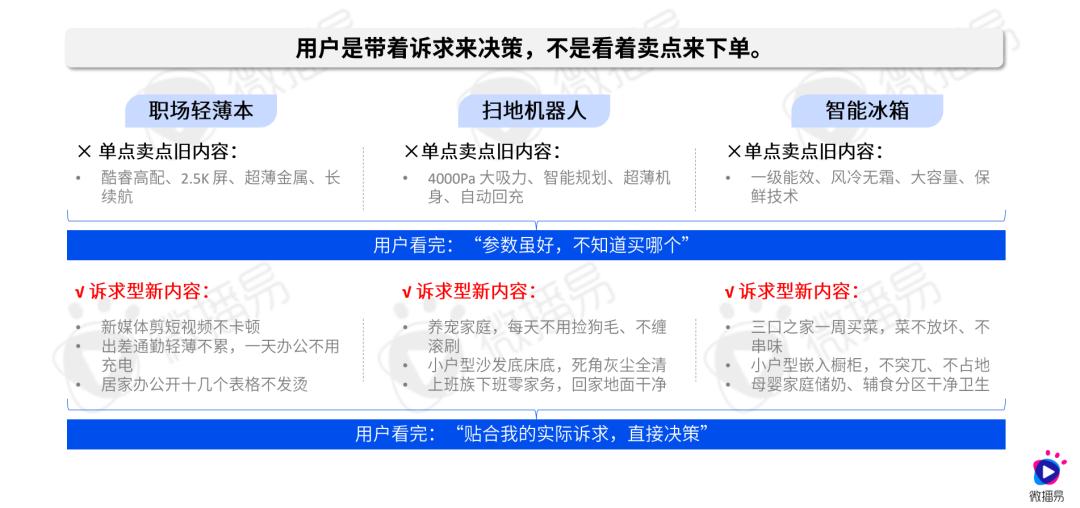
What users buy is not "4000Pa suction power", but "less housework even when having a pet". The communication context of 3C home appliances is moving from functional features to scene - based demands. When AI can instantly bridge the information gap in hardware parameters, simply "piling up indicators" will be meaningless. The brand's differential advantage lies in the accurate empathy for segmented life scenarios (such as anti - bacteria for mothers and babies, and adaptation to small - sized apartments). In the future, what will impress users is not "how powerful the product is", but "how it can solve my current life pain points".
Moat upgrade - From competing for traffic to building "AI - callable assets"
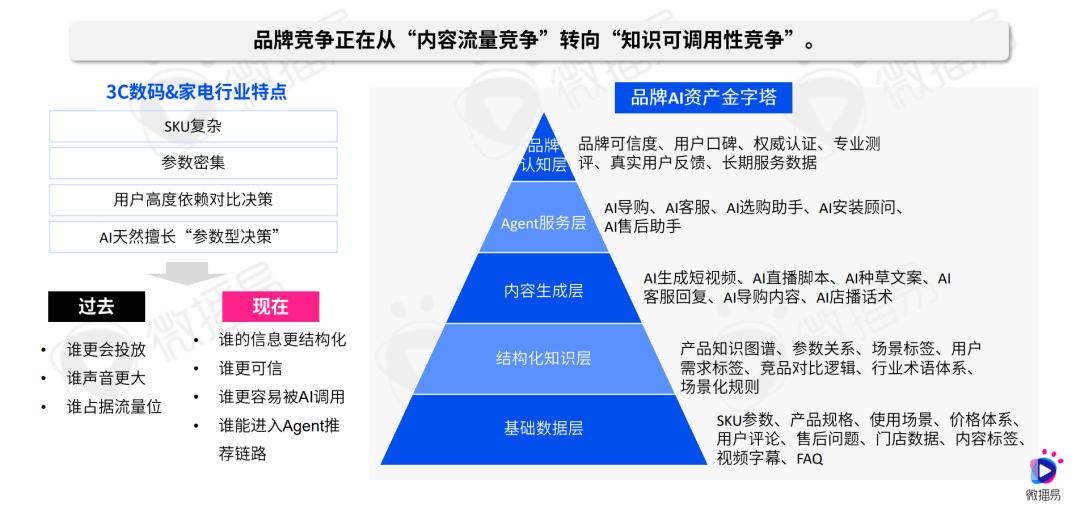
In the past decade, marketing competition was about traffic efficiency. But in the Agent (intelligent agent) era, the foundation of competition has become "knowledge callability". When consumers are used to relying on AI assistants to select and order products, brands must ensure that their information can be "understood, trusted, and preferentially recommended" by large models. This means that brand assets must be upgraded from loose content to a structured knowledge base (covering parameters, reviews, after - sales services, etc.). In the future, the most solid moat will no longer be occasional blockbusters, but the "brand knowledge graph" that can be frequently called by AI. As Wu Yi said at the forum, "The business logic of mobile phones, refrigerators, and vacuum cleaners has changed - users no longer compare parameters; AI does it for them. Brands no longer compete for exposure but need to make themselves visible, trustworthy, and recommendable to AI."
Upgrading of influencer marketing - The more popular AIGC becomes, the rarer real experiences are
When AI can generate reviews in batches in seconds, "real experiences" have become the rarest trust assets. Influencer marketing will not disappear but will be reconstructed. In the future, top - level content will evolve into a trinity of "AI - based objective data base + subjective professional interpretation by influencers + real user feedback". The brand's content strategy needs to shift from "focusing on blockbusters" to collaborative operations - influencers are responsible for trust endorsement, digital humans are used for full - scale promotion, and AI Agents are used for precise distribution. At the same time, real scene - based and comparative word - of - mouth content on social platforms will also become the highest - quality corpus for large models to capture.
Ecosystem competition - Selling not single products but smart life entrances
The AI layouts of giants such as Apple, Huawei, and Xiaomi have sent a clear signal: The competition in the 3C home appliance industry has shifted from "breaking through with single products" to "ecosystem collaboration". What consumers buy is no longer an isolated device but a smart system. Therefore, the brand's social marketing must abandon single - point display and upgrade to the overall scene expression of "whole - house smart interconnection". The interaction carrier will also evolve from two - dimensional graphics and texts to AI + AR/3D spatial experiences. In the future, whoever can seize the smart entrance of the whole - house scenario will truly master the initiative for the next round of growth.
Breaking the situation in 2026: 10 practical AI social marketing strategies
In the future of 3C home appliance marketing, AI must be fully utilized in the four core nodes of insight, influence, conversion, and operation:
Insight level: Predicting needs, from "lagging response" to "god's perspective"
Traditional consumer insight often relies on outdated questionnaires and sampling. In the AI era, brands need real - time "mind - reading skills".
· Strategy 1: AI Social Listening
Abandon the single "volume statistics" and use large models to conduct semantic understanding of the massive unstructured texts and videos on social networks. Brands can accurately capture extremely segmented scene pain points. For example, from the category of "vacuum cleaners", AI can instantly identify real demands such as "hair entanglement in pet - owning families", "embedded storage in small - sized apartments", and "silent and antibacterial functions for mother - baby families", which can directly feed back into product R & D and marketing positioning.
Influence level: Occupying algorithms, building "dual - engine - driven" content assets
When content flooding becomes the norm, how can your product be "seen" by both AI and users among the numerous competitors?
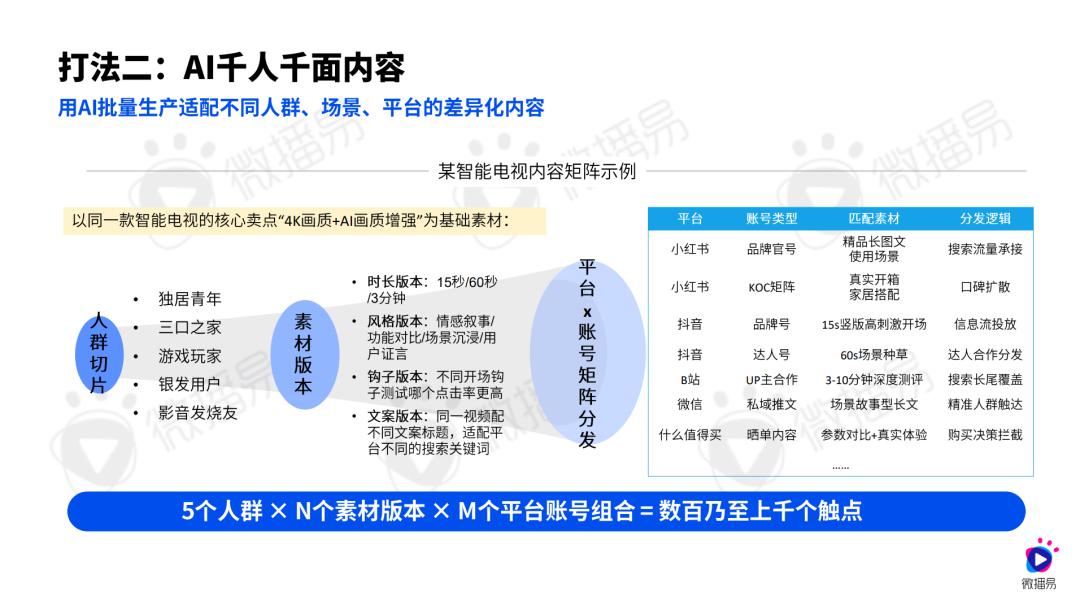
· Strategy 2: AI - generated personalized content
In the past, for the same product with the same core feature, only one set of content could be produced and promoted through large - scale advertising. After AI reconstructs the content production logic, the answer has changed - use AI to produce in batches differentiated content suitable for different people, scenarios, and platforms. One piece of material can generate hundreds or even thousands of touchpoints.
· Strategy 3: Social SEO + GEO
In addition to optimizing search rankings on traditional social platforms such as Xiaohongshu and Douyin (Social SEO), brands must immediately start GEO layout. By building a highly structured product SKU knowledge base, FAQs, and high - quality review systems, ensure that brand information can be preferentially captured by mainstream AI large models such as DeepSeek and Kimi and preferentially recommended when users ask questions, seizing the "next super search entry".
· Strategy 4: AI + AR/3D interactive content
The biggest conversion pain points for home appliances are "inappropriate size" and "mismatched style". Through AI to quickly generate 3D models and AR interactive experiences, users can "place" virtual TVs and air conditioners 1:1 into their real living rooms on their mobile phones. Truly achieve "what you see is what you get", significantly reducing decision - making costs and return rates.
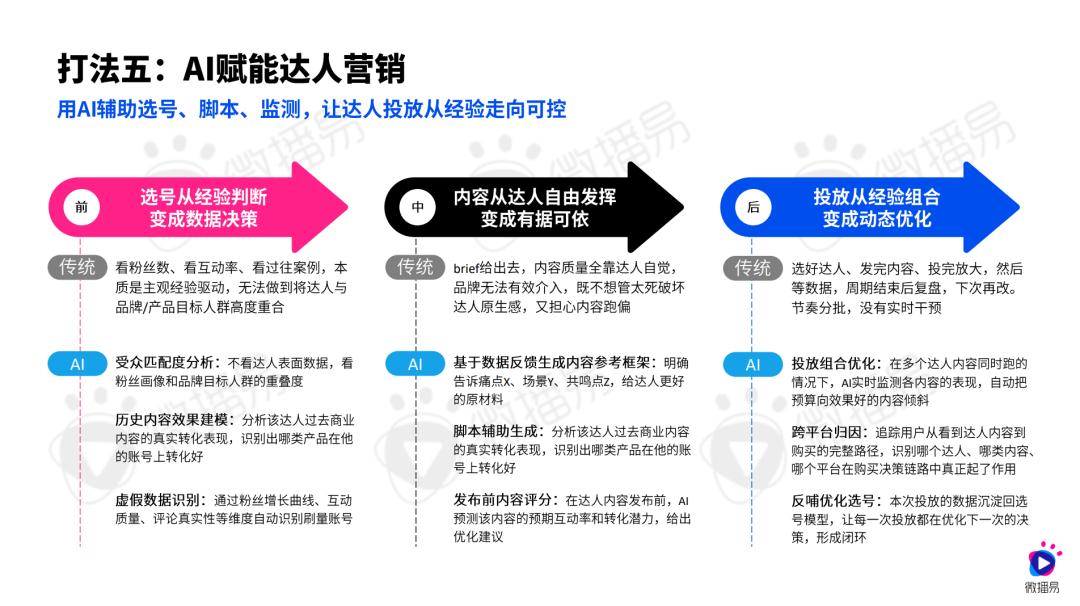
· Strategy 5: AI - empowered influencer marketing
The biggest pain point in influencer marketing has never been "not being able to find influencers", but rather relying on intuition for selecting influencers, self - awareness for content creation, and luck for performance evaluation. AI completely reconstructs these three aspects: In the influencer selection stage, instead of looking at the number of followers, look at the overlap between the follower profile and the brand's target audience, and identify fake accounts. In the content creation stage, generate a content reference framework based on data, and use AI to predict the interaction rate and conversion potential before publication. In the promotion stage, monitor the performance of multiple influencers' content in real - time, automatically allocate more budget to high - performing content, and track the complete purchase path for attribution. Make influencer promotion shift from experience - driven to data - controllable, optimizing each decision with every promotion.
Conversion level: Shortening the process, breaking the boundary between physical and virtual
3C home appliances have high unit prices and require careful decision - making. The task of AI is to extremely compress users' hesitation time.
· Strategy 6: AI digital human live - streaming
There are three limitations in real - person live - streaming: no one is on duty outside peak hours, one anchor cannot cover multiple platforms, and the depth of product knowledge varies. AI digital humans can fill these three gaps - 24/7 non - stop, multi - platform and multi - language coverage, and standardized product explanations. However, digital humans have limitations. Off - peak hours, large - scale coverage, and overseas live - streaming are their main areas. During peak hours, real - person anchors are still needed for major sales and high - value decision - making. Complementing rather than replacing is the correct way to use digital human live - streaming.
· Strategy 7: AI intelligent shopping guide
Traffic is attracted, but lost at the decision - making stage - this is the biggest black hole in current conversion. AI intelligent shopping guides plug the gaps in three scenarios: On e - commerce product detail pages, they identify users' browsing intentions, give personalized product selection suggestions, and the conversion rate is estimated to increase by 15 - 25%. In the brand's private domain, they remember users' profiles across conversations, and 90% of pre - sales consultations can be automated. Social media influence content is directly connected to the shopping guide process, with a second - level response within 24 hours, and the lead loss rate is reduced by 60%. Covering the entire decision - making process and intercepting at each node, ensuring that content investment is not in vain.
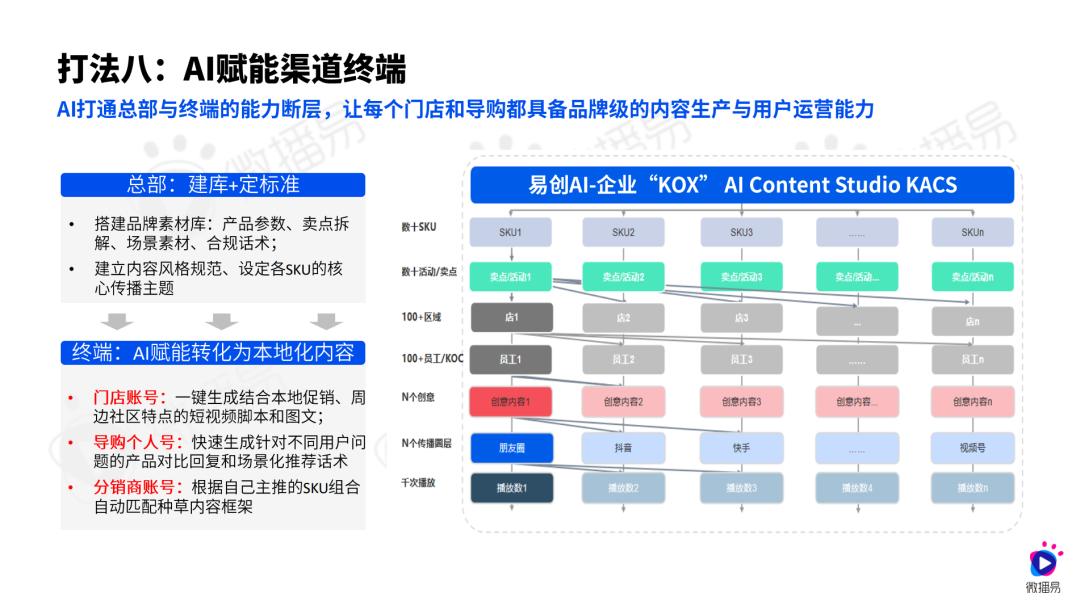
· Strategy 8: AI - empowered terminal channels
The headquarters has brand standards, while the terminals have local needs - this gap has long been filled by manual labor, resulting in uneven quality and low efficiency. The AI solution is: The headquarters builds a database and sets standards, unifying and depositing product parameters, selling point scripts, scene materials, and content style specifications. Terminals can call these resources with one click. Store accounts can generate short - video scripts combined with local promotions, shopping guides' personal accounts can quickly generate scene - based recommendation scripts, and distributor accounts can automatically match the influence framework for corresponding SKUs. Enable each store and shopping guide to have brand - level content production capabilities, making it no longer a problem to have different content for each store.
Operation level: Managing assets, locking in the full - life - cycle value (LTV)
Selling products is just the beginning. In the AI era, the core of brand operation is the "long - term data pool".
· Strategy 9: AI - powered private - domain family life - cycle operation
Combining desensitized data from device feedback and AI algorithms, accurately predict users' usage cycles. Proactively remind users before filter replacement, promote extended warranty services before the warranty period expires, and even accurately promote upgrade solutions when users' family structures change (such as getting married or having a baby), transforming single - time transactions into long - term value binding.
· Strategy 10: AI compliance and trust operation
The popularization of AI content tools has had an opposite effect: The more content there is, the harder it is for users to distinguish between true and false, and the trust threshold is actually decreasing. This makes "authenticity" a scarce resource and turns compliance from passive response into an active competitive advantage. On the defensive side, do a good job in content labeling, compliance authorization, hierarchical review, and authorization boundary management to maintain the bottom line. On the offensive side, actively disclose AI usage, make data transparent, and build a reputation moat with real content. Compliance is not a cost but a trust asset.
Facing such a surging AI wave, how should brands start?
1. Quick - win area (prioritize implementation): Immediately start using AI Social Listening to capture consumers' real pain points in real - time and feed them back into product iteration. Use AI - generated personalized content production and AI - empowered influencer marketing tools to significantly reduce trial - and - error costs and improve ROI.
2. Strategic investment area (phase - by - phase layout): Gradually promote Social SEO + GEO to ensure information occupancy in the AI era. Start deploying AI intelligent shopping guides and AI - empowered terminal channels to enable each offline store and shopping guide to have the super content production ability of the brand headquarters.
3. Long - term construction area: Start to build a sustainable trust foundation in terms of AI transparency and compliance.
Conclusion
From "content flow" to "data flow", from "broadcasting widely" to "intelligent agent recommendation", the social marketing of the 3C digital and home appliance industries is undergoing an irreversible mutation.
This article is from the WeChat official account "Weiboyi", author: Weiboyi. Republished by 36Kr with permission.