Platforms, users, and brands are all changing. The "2026 Social Media Marketing Trends Report under AI Reconstruction" breaks down five major trends.
If "marketing trends" are the waves on the water surface, then the changes of platforms and users are the undercurrents beneath it .
Without understanding the evolutionary direction of platforms and the generational changes of users, all marketing actions will become "water without a source". Guided by the China Advertising Association, the "Report on Social Media Marketing Trends under AI Reconstruction in 2026" released by Weiboyi outlines an underlying reconstruction that social media marketing is undergoing in 2026, progressing layer by layer from the macro - economy, media platforms, users and KOLs, brand investment, to marketing trends.
Platform: AI has become the underlying operating system of social media
On the macro - level, in 2025, the GDP maintained a steady medium - to - high - speed growth of around 5%. The total retail sales of consumer goods reached 50 trillion yuan, a year - on - year increase of 3.7%. The economy is improving steadily, but the consumption growth rate has declined stage by stage, and it has become the norm for brands to "spend money more cautiously". The Internet advertising market still maintains double - digit growth. It is expected to reach 836.2 billion yuan in 2026. Among them, the total of short - video, e - commerce, and social advertising exceeds 489.7 billion yuan, and AI search advertising has skyrocketed by 108% year - on - year, becoming the largest increment.
The money is still flowing in, but the direction has changed.
On the platform level, AI has penetrated from the "function" to the "operating system" level:
- Douyin × Doubao are deeply integrated —— Entries are set in the short - video interface, message list, and search bar. "Watching videos is AI, and having conversations is service", and it links up with Douyin e - commerce to form a closed - loop of "demand → recommendation → transaction".
- Xiaohongshu's three major AI product matrix —— The search assistant "Dian Dian", the private message assistant "AI Assistant", and the business marketing consultant "Mio" embed AI into the entire link of user decision - making, merchant customer acquisition, and advertising placement.
- Bilibili's Biji AI, Kuaishou's Keling 3.0, and WeChat's ClawBot —— The platform is no longer a collection of tools, but an intelligent infrastructure for the entire chain of "creation - distribution - transaction - service".
The platform is no longer just a traffic entrance, but a growth operating system driven by AI.
Users and KOLs: The differentiation intensifies, and the "gold content" is re - priced
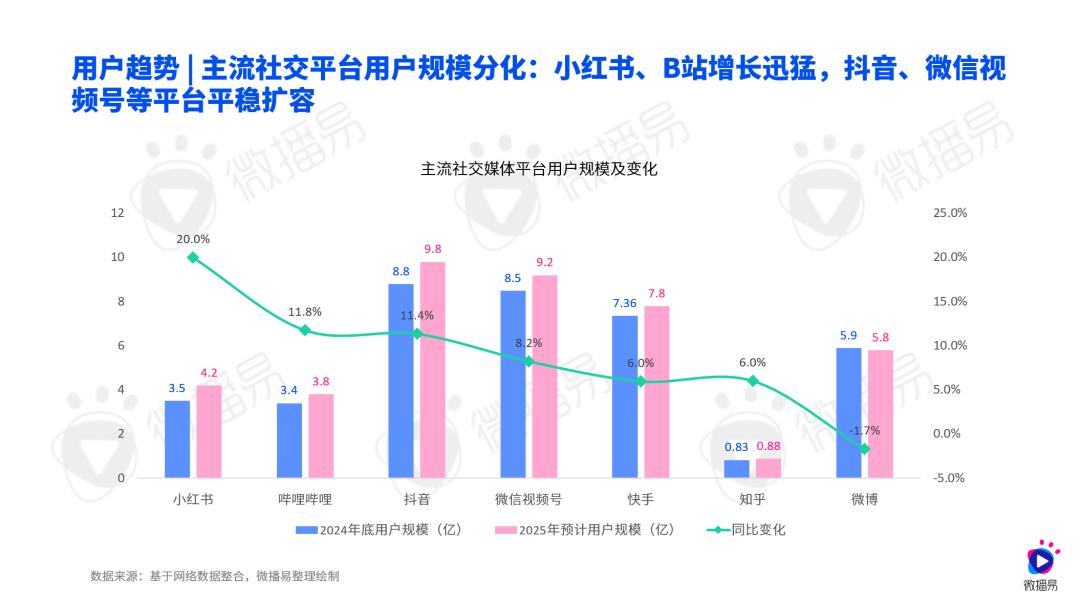
On the user level, the mainstream social media platforms are accelerating their differentiation:
- Xiaohongshu leads with a daily average duration growth rate of 23%. Bilibili and Douyin have moderate growth, while Weibo and Kuaishou are under pressure.
- The user profiles are "polarized" —— Xiaohongshu, Bilibili, and Zhihu have users from higher - tier cities with higher consumption power, while Kuaishou and Video Account have more users from lower - tier cities and are more mature.
- The interest distributions vary significantly —— Xiaohongshu has a higher TGI in lifestyle/food/beauty, Douyin is stronger in automotive/travel, and Bilibili firmly occupies the anime/technology and digital sectors.
On the KOL level, there are three major trends:
- Total quantity differentiation: The number of KOLs on Xiaohongshu has increased by 34% year - on - year, Bilibili by 12%, Douyin is steadily expanding, while Weibo and Kuaishou have stagnated.
- The rise of mid - and tail - end KOLs: The tail - end influencers on mainstream platforms continue to grow upwards, and "the middle - force" has become the main force for commercialization.
- Value re - evaluation: Xiaohongshu's KOLs significantly lead in completion rate, interaction rate, and cost per thousand followers, with the highest "gold content". Bilibili and Douyin are more cost - effective in CPE and CPM.
An influencer is no longer judged by the number of followers, but re - priced by "circle penetration + content quality + business suitability".
Brand investment: Budgets return from effectiveness to brand and shift from traffic to content
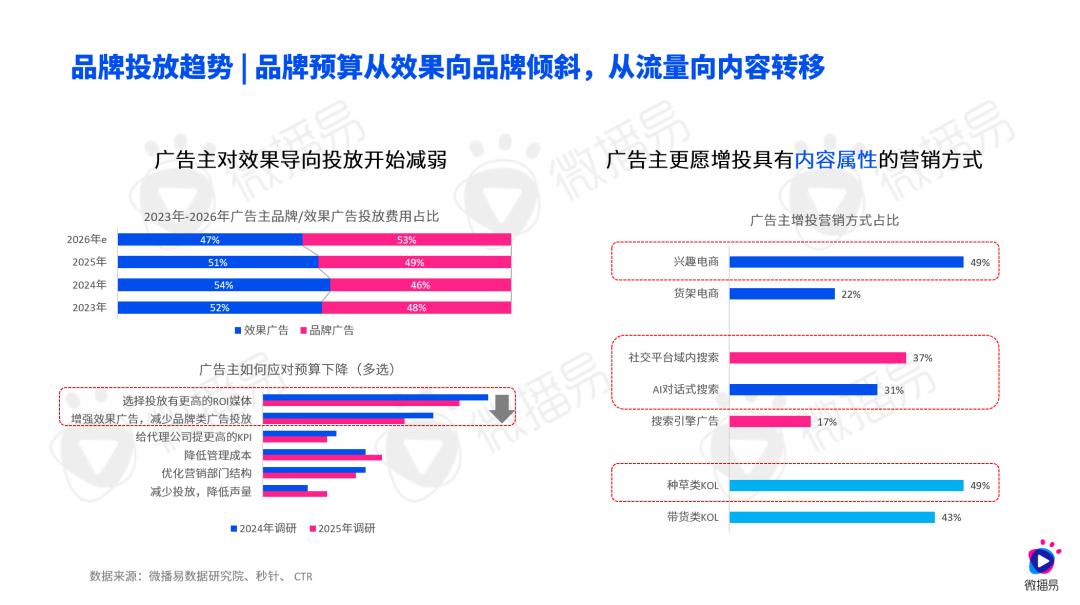
The report shows that in 2026, the expected growth rate of advertisers has rebounded slightly, but more importantly, there are structural changes:
- The proportion of brand advertising has risen to 53%, and performance advertising has dropped to 47% —— Budgets are returning from "effectiveness" to "brand".
- 49% of advertisers are increasing investment in "grass - planting KOLs", 43% in "sales - driving KOLs", and 49% in "AI conversational search" —— Budgets are flowing from "traffic" to "content" and "AI search".
- Nearly 80% of brands choose to invest across multiple platforms, and Douyin and Xiaohongshu have become the main battlefields for the vast majority of brands.
- Typical industries have their own paths —— The beauty and personal care industry has a significant decline on Xiaohongshu but still ranks first. The 3C digital and IT Internet industries have increased on both Xiaohongshu and Bilibili year - on - year. The automotive industry is increasing "content - based" efforts on WeChat and Weibo.
The logic of brand spending has changed: It's not about buying more traffic, but building thicker content assets.
Marketing trends: Five core trends in social media marketing in 2026
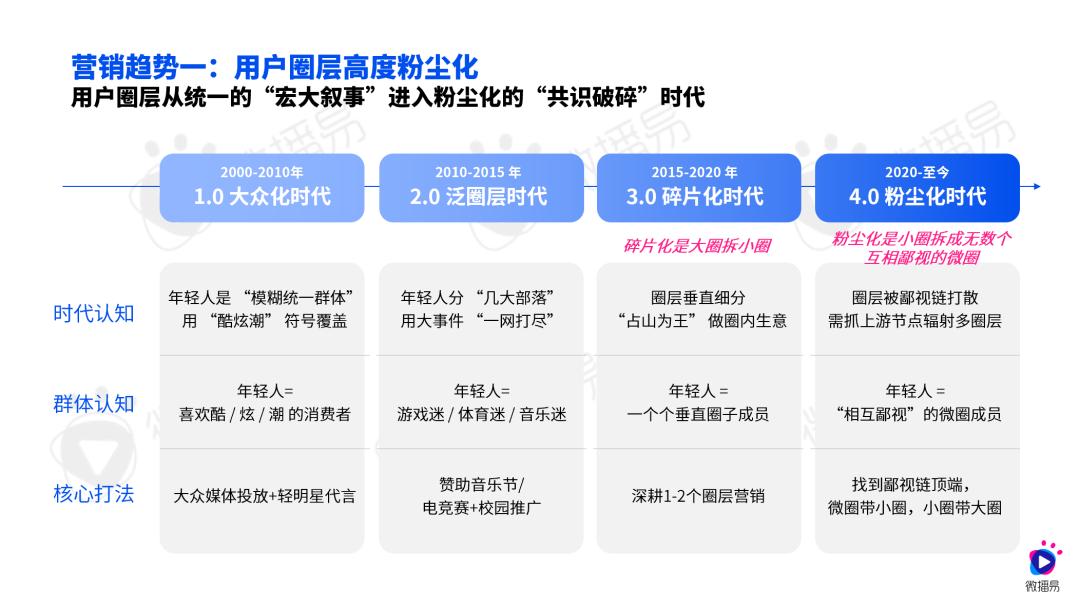
Trend 1: User circles are highly atomized, moving from a unified "grand narrative" to fragmented "micro - circles"
Population tags are completely ineffective. The report quotes platform data and points out that Xiaohongshu has precipitated over 7,000 segmented cultural circles, Bilibili over 2,500 segmented interest tags, and Douyin over 800 segmented creation styles —— Users are no longer "a unified group of young people", but are fragmented into countless isolated micro - circles with their own aesthetic standards.
The report proposes a clear evolutionary path:
1.0 Mass - oriented (2000 - 2010) → 2.0 General circle - oriented (2010 - 2015) → 3.0 Fragmented (2015 - 2020) → 4.0 Atomized (2020 - present).
Fragmentation is about "breaking large circles into small ones", and atomization is about "breaking small circles into countless non - mutually - recognized micro - circles". Each micro - circle has its own aesthetic coordinates: "Authentic > Exquisite", "Film grain > AI skin - smoothing", "Handmade > Branded goods", "Underground > Mainstream"...... Between circles, high walls have been built in four dimensions: aesthetics, consumption, identity, and content, making it extremely difficult for external perspectives to intervene.
Trend 2: AI changes the content production method. In the RGC era, content changes from a "work" to a "response"
The report points out that KOL marketing has entered an era of dual engines of "real - person trust assets + AI productivity". Real people provide trust —— KOLs capture emotions, resonances, and implicit needs with their real personalities; AI provides efficiency —— AI tools complete parameter - to - scenario conversion, material optimization, and multi - circle adaptation.
More importantly, the report innovatively and systematically proposes the concept of RGC (Real - time Generated Content):
UGC (User - Generated Content) → PGC (Professional - Generated Content) → AIGC (AI - Generated Content) → RGC (Real - time Generated Content).
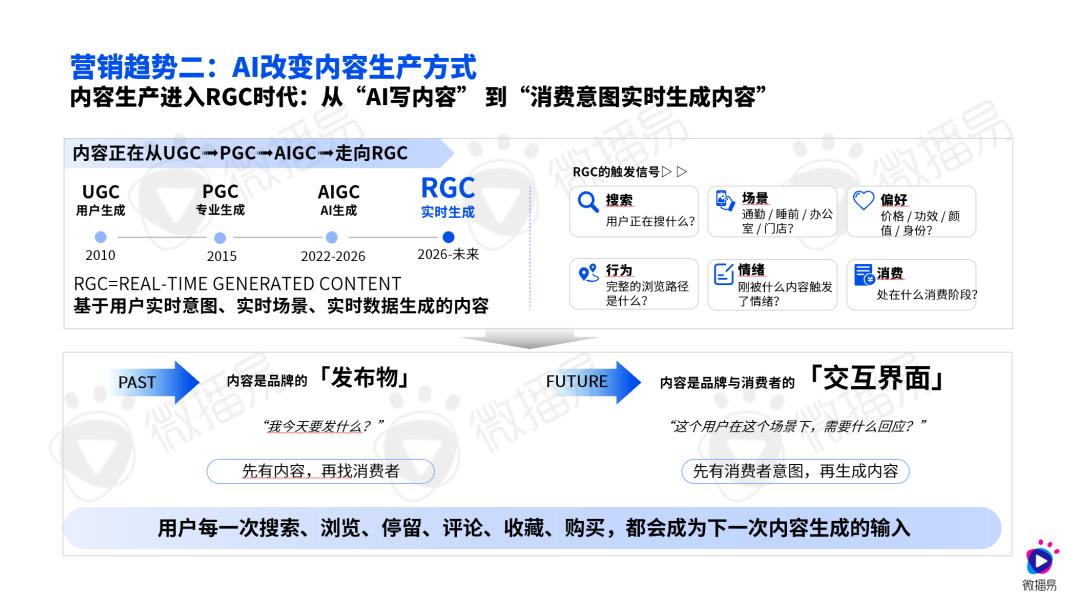
In the past: Content was the "publication" of a brand: "What should I post today?" First, there was content, and then consumers were sought.
In the future: Content is the "interaction interface" between a brand and consumers: "What response does this user need in this scenario?" First, there is an intention, and then content is generated.
Every search, stay, comment, collection, and purchase by users becomes the input for the next content generation. Search intention, preference, scenario, consumption stage, emotional state, and behavior path —— These six trigger signals enable content to truly achieve "personalized and instant generation for each individual".
In the RGC era, content is no longer a "work", but a "response" —— a real - time response to each user and each scenario.
The production method of content has changed, and the mission of content itself has also changed.
Trend 3: The attribute of content assets is upgraded. It should not only touch people but also "feed AI"
When users start asking Doubao, Wenxin, and Tongyi "which product is better", social content no longer only serves "people", but also needs to serve "AI".
The report provides a sharp insight: Doubao captures data from Douyin, Wenxin captures data from Baidu Hao and Xiaohongshu, Tongyi captures data from Taobao and Weibo, and Claude/ChatGPT captures public data across the entire network. Social content is becoming the "training corpus" for AI models. The brand's right to speak in the AI era essentially depends on its ability to be "captured, understood, and cited by AI".
Then it proposes a framework of "two sides of content" —— For people: clear information structure, strong emotional connection, real interaction precipitation, and consistency across platforms; For AI: easy to extract core information, able to identify emotional tendencies, and form a knowledge graph.
It also lists four types of content most suitable for being precipitated as AI corpus: scenario - based, question - based, comparison - based, and trust - based, which respectively help AI judge "in which scenarios it is mentioned", "what kind of question - answering methods it matches", "what kind of recommendation ranking it forms", and "whether it has user consensus".
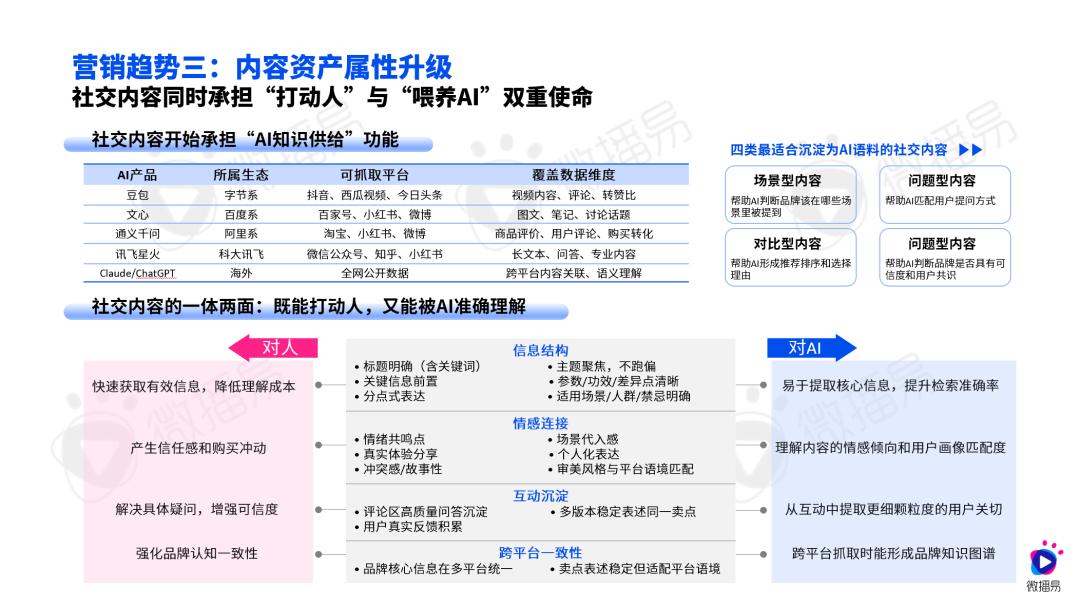
Those who have the AI corpus will have the brand's right to speak in the AI era.
If content needs to serve both people and AI, then the competition between brands has also quietly changed tracks.
Trend 4: The focus of brand competition has shifted from "being able to use AI tools" to "owning data assets that can feed AI"
In the past, it was about competing in tool capabilities. Now, it's about competing in data assets. In the future, it will be about competing in data - driven aesthetics.
What is "data - driven aesthetics"? It is to transform the brand's "feeling", "experience", and "aesthetic judgment" into structured data that AI can learn and reuse:

The report further points out that a general model + general industry data = 30 - point AI; a general model + brand - specific data = 60 - point AI; a general model + full - chain closed - loop data = 100 - point AI.
Every user search, browsing, comment, and purchase should be precipitated as the brand's own data assets, rather than being fed to the platform. This is exactly the underlying logic of Weiboyi's "Yichuang AI" —— to make AI understand the brand, model the aesthetic standards, and apply them in all scenarios, and to make every frame of content a precise expression of the brand's DNA.
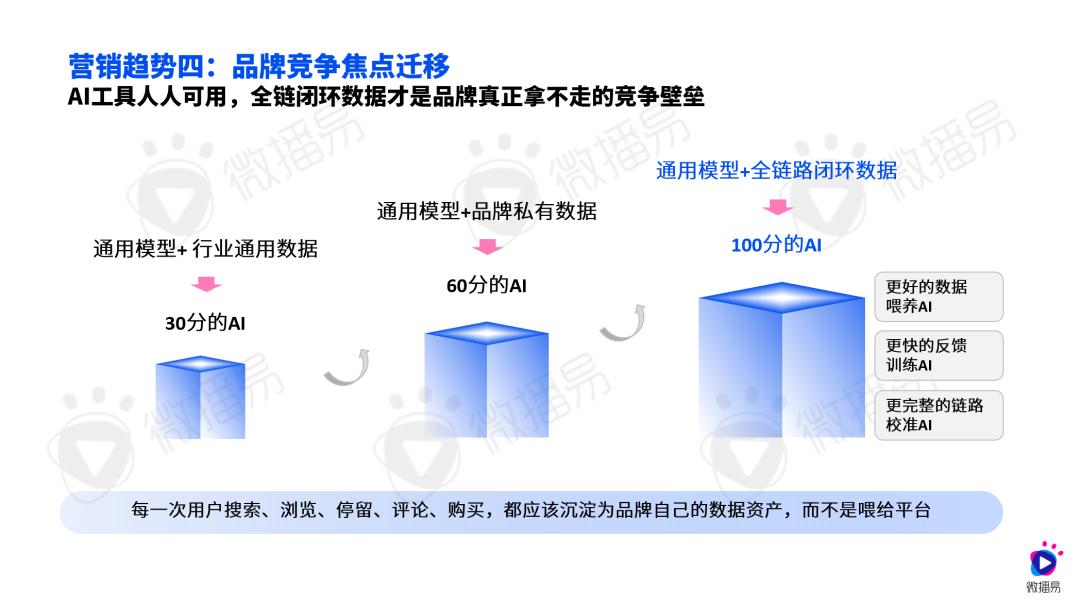
AI tools can be used by everyone, but full - chain closed - loop data is the real unshakable competitive barrier for brands.
Once the barrier is established, the methodology also needs to be upgraded.
Trend 5: The marketing methodology is iteratively upgraded: Stylized replication + Scenario - based integration
Based on RGC and data - aesthetic barriers, the report presents a new marketing paradigm for the future: Upgrading from "large - scale investment" to "stylized replication + scenario - based integration" —— Future content should meet the different intentions of one million people and generate one million different responses.
