17 A-share semiconductor companies flock to the south.
In 2026, as the demand for AI computing power grew exponentially and the global semiconductor supply chain was rapidly restructured, there was a significant and concentrated "wave of listings on the Hong Kong Stock Exchange" in the A-share semiconductor industry.
After OmniVision Technologies, GigaDevice Semiconductor, Montage Technology, and National Technology Co., Ltd. listed on the Hong Kong Stock Exchange at the beginning of the year, and Source Photonics, CMIC Semiconductor, and VeriSilicon Holdings Co., Ltd. submitted their listing applications in quick succession, another company listed on the STAR Market is aiming for a Hong Kong listing. Recently, Dongxin Semiconductor Co., Ltd. announced that it plans to issue overseas-listed shares (H shares) and be listed on the Main Board of the Hong Kong Exchanges and Clearing Limited.
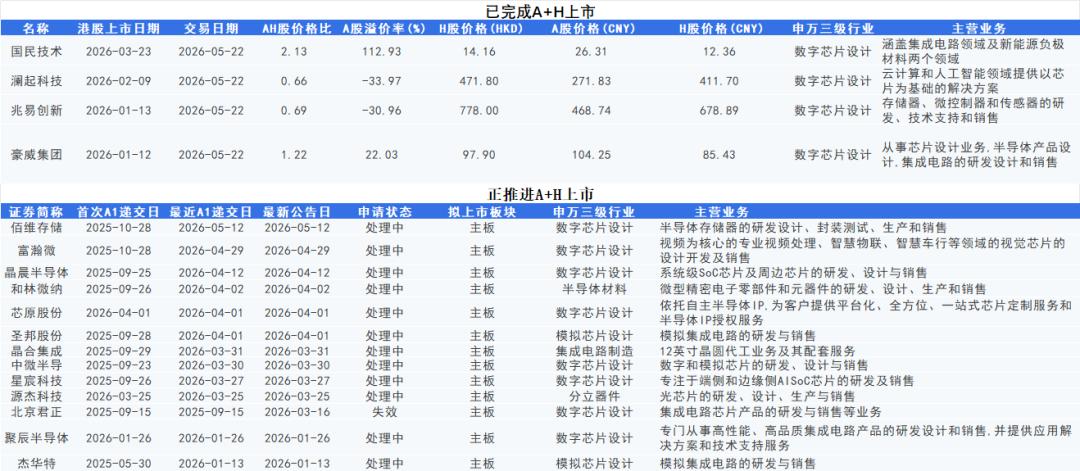
According to statistics from a reporter of STAR Market Daily, including Dongxin Semiconductor, 17 A-share semiconductor companies have announced their plans to list in Hong Kong since 2026. Four of them have successfully listed on the Hong Kong Stock Exchange, and the other 13 are in the process of submitting applications or have passed board resolutions. The companies going public in Hong Kong almost cover the core tracks in the integrated circuit design field. Many industry insiders said that the listing of A-share semiconductor companies in Hong Kong is the result of the synergy between industrial policies, corporate needs, and new policies of the Hong Kong Stock Exchange.
The Expansion of the Queue of A-share Semiconductor Companies Listing in Hong Kong
The multiple proposals regarding the issuance of H shares and listing on the Main Board of the Hong Kong Stock Exchange, which were reviewed and approved at the 12th meeting of the 3rd Board of Directors of Dongxin Semiconductor, show that the company plans to issue no more than 10% of its total share capital as H shares and grant an over-allotment option of no more than 15%.
In response, a person from the securities department of Dongxin Semiconductor told a reporter of STAR Market Daily that the company's decision to list in Hong Kong this time is to further enhance its capital strength and comprehensive competitiveness, deepen its global strategic layout, expand financing channels in the international capital market, and build a diversified capital operation platform.
According to its announcement, after deducting the issuance expenses, the funds raised by Dongxin Semiconductor will be used for strengthening core technology R & D, expanding production capacity and product portfolio, improving overseas layout, strategic investment and acquisition, replenishing working capital, and other general corporate purposes.
Regarding the impact of this Hong Kong listing on Dongxin Semiconductor's storage business and the GPU business of its subsidiary, Lisuan Technology, the person from the securities department said that the specific impact needs to be observed from the subsequent application documents.
With the addition of Dongxin Semiconductor, the queue of A-share semiconductor companies listing in Hong Kong since 2026 has further expanded. According to statistics by a reporter of STAR Market Daily, as of May 25 this year, four A-share semiconductor companies have successfully listed on the Hong Kong Stock Exchange. Thirteen others have submitted their prospectuses or passed board resolutions, and 12 are in the process of being reviewed. The review status of Beijing Junzheng was updated to invalid on March 15, 2026, due to the expiration of its prospectus.
"The listing of A-share semiconductor companies in Hong Kong is an inevitable result of the synergy between industrial policies, corporate needs, and new policies of the Hong Kong Stock Exchange." Li Jing, an investment manager at Yifeng Fund, analyzed and told a reporter of STAR Market Daily. From the policy perspective, from the end of 2024 to 2025, the China Securities Regulatory Commission clearly supported leading companies in the industry to list in Hong Kong. Subsequently, the Hong Kong Stock Exchange launched the "Technology Company Path" and provided a "fast-track approval channel" for eligible A-share companies. The approval process has been shortened from the traditional multiple rounds of inquiries to "one round of inquiry + 30-day approval."
From the industrial perspective, the semiconductor industry is experiencing a new round of capital expenditure cycle triggered by AI large models, and there is an extremely strong demand for funds for technological iteration and production capacity expansion. At the corporate level, leading companies urgently need to build a dual-capital platform of "A shares + H shares."
The Enthusiasm for Secondary Listings in Hong Kong among Chip Design Companies
From memory chips to optical chips, from interconnect chips to MCUs, from IP services to CIS, a reporter of STAR Market Daily noticed that the companies going public in Hong Kong this time almost cover the core tracks in the chip design field, while the equipment, materials, and manufacturing sectors account for a very small proportion. Meanwhile, words such as "global strategy," "overseas layout," and "international capital market" appear frequently in their prospectuses or announcements.
Lu Kelin, an internationally registered innovation management expert and the founder and CEO of Luke Island Technology, told a reporter of STAR Market Daily that "the extreme skew in the industry distribution is not unexpected. Design companies have light assets, fast iteration, and high valuation elasticity, which naturally match the Hong Kong stock market's preference for 'technology narratives.' In contrast, equipment and materials companies have heavy fixed assets, long customer certification cycles, and slow profit realization. The valuation discount given by the Hong Kong stock market will eat into the safety cushion of the A-share premium. More importantly, the 'internationalization' of design companies is about expanding into overseas markets, while that of equipment and materials companies is about seizing positions in the supply chain. In the current geopolitical environment, the latter needs to be low-key and is not suitable for a high-profile listing on the offshore market."
Guo Tao, an angel investor and a senior artificial intelligence expert, believes that the explosion of AI large models has led to a significant increase in the demand for related semiconductor chips, bringing broad market space and development opportunities for chip design companies. These companies need more funds for R & D and production expansion, and listing in Hong Kong can provide financial support. At the same time, the capital market has also recognized the driving effect of AI development on the semiconductor industry, increasing its attention and investment enthusiasm for related companies, which has prompted more semiconductor design companies to choose to list in Hong Kong at this time.
In this wave of A-share semiconductor companies listing in Hong Kong, the phenomenon of the valuation inversion between A shares and H shares of Montage Technology has attracted wide attention in the industry. As of the close on May 25, the A-share price of Montage Technology was 284.08 yuan, and the H-share price was HK$471.8. Calculated at the exchange rate of HK$1 = 0.8659 yuan, the H shares had a premium of up to 43.8% over the A shares. In addition, there was also a valuation inversion between A shares and H shares of GigaDevice Semiconductor.
Li Jing, the investment manager at Yifeng Fund, said that A-share investors usually use "localization rate," "production capacity cycle," and even "theme rotation" to price semiconductor stocks. Under this framework, chip stocks are easily labeled as cyclical stocks and are greatly affected by market sentiment and short-term performance fluctuations, making it difficult to give a stable high premium. International capital uses "global AI track" and "scarcity and monopoly" to price China's core technology assets. "When they find that Montage Technology's interconnect chips are standard components for high-end AI servers and have strong scarcity and monopoly power globally, they will directly benchmark against the hundred-fold valuation system of global interconnect leaders such as Broadcom and Marvell in the US stock market."
In addition, there are differences in the liquidity structure between A shares and H shares. The tradable shares of H shares of some technology leaders are extremely small. For example, the tradable shares of Montage Technology's H shares are only 6.6% of its A shares. A small amount of incremental funds can push up the price, resulting in a unique liquidity premium.
Fundraising for R & D Focuses on AI and Automotive Electronics
A reporter of STAR Market Daily noticed that from the fundraising purposes of the semiconductor companies that have already listed or are queuing up for secondary listings in Hong Kong, technology R & D has become the top priority. Among the 17 companies mentioned above, the vast majority of them will use the raised funds for R & D investment. For example, the relevant proportion of Amlogic is as high as 70%, which is used to promote the tape-out of products with 6nm and more advanced processes. Companies such as SGMICRO, ZJET, and Fudan Microelectronics have also maintained a high level of R & D investment in recent years.
From the perspective of R & D directions, artificial intelligence and automotive electronics have become the two key directions, and most companies have identified these two directions as their future R & D focuses.
As the global leader in memory interface chips, Montage Technology will use the raised funds for R & D in the field of interconnect chips, with a focus on CXL (Compute Express Link) technology. Source Photonics, the leading company in high-speed optical chips, stated in its board resolution that after deducting the issuance expenses, the raised funds will be mainly used to strengthen R & D and testing capabilities and increase the production capacity of high-speed and high-power optical chips. VeriSilicon Holdings, the world's fourth-largest full-stack chip customization solution provider, will use the raised funds for R & D in AI chip design services and IP.
In addition, companies such as Amlogic, Xingchen Technology, and Beijing Junzheng have identified edge AI chips as their key R & D directions. Among them, Amlogic plans to develop high-end intelligent edge AI SoC chips based on the 6nm process for applications in smart TVs, smart set-top boxes, AIoT, and other fields. Xingchen Technology disclosed that the raised funds will be used for the development of visual AI SoC and 3D perception SoC. Beijing Junzheng disclosed in its prospectus that the raised funds will be used for technological innovation and product development in three core product lines: computing chips, memory chips, and analog and interconnect chips.
Automotive electronics has become another high-growth track in the semiconductor industry. With the rapid development of new energy vehicles and intelligent connected vehicles, the demand for semiconductors in the automotive industry has increased rapidly. A report released by the China Research and Intelligence Industry Research Institute shows that in 2025, the global market scale exceeded US$97 billion, with a compound annual growth rate of 12.4%. The Chinese market, with a scale of 250 billion yuan, accounted for 30% of the global market, becoming the largest incremental market in the world.
CMIC Semiconductor, a leading domestic MCU company, will use the funds raised from its Hong Kong listing for R & D in high-end fields such as high-computing power automotive-grade MCUs, industrial control motor drive chips, and AI and robot-specific chips. The company plans to further increase its market share in the automotive-grade MCU market through the Hong Kong listing.
Juchuang Microelectronics Co., Ltd., the core supplier of EEPROM, will use the raised funds for R & D of automotive-grade EEPROM and automotive electronics-specific mixed-signal chips. It is reported that the company's automotive-grade EEPROM products have entered the supply chains of global mainstream automotive manufacturers and are expected to further increase their market share in the future.
In addition, companies such as ZJET, SGMICRO, and Fudan Microelectronics have also identified automotive-grade power management chips, automotive-grade analog chips, and automotive-grade camera chips as their key R & D directions.
Relevant Policies Encourage Companies to List in Hong Kong
In terms of progress, the first three months of this year became the peak period for listings. OmniVision Technologies, GigaDevice Semiconductor, Montage Technology, and National Technology Co., Ltd. completed their Hong Kong listings between January and March this year. From the end of March to the beginning of April, there was a peak period for submitting listing applications. Source Photonics, CMIC Semiconductor, and VeriSilicon Holdings Co., Ltd. submitted their prospectuses in a concentrated manner within just one week. Dongxin Semiconductor is the first A-share semiconductor company to announce its Hong Kong listing plan since May this year.
Zhi Peiyuan, the vice president of the Listed Company Investment Special Committee of the China Investment Association, said in an interview with STAR Market Daily that "the Hong Kong stock market has flexible systems, a relatively fast listing rhythm, and a short overall time-consuming. It can provide companies with diversified financing tools to precisely meet the development needs at different stages."
Statistics show that international institutional investors account for nearly 70% of the Hong Kong stock market. This is not only conducive to enhancing the global exposure of companies and attracting overseas high-end talents but also creates favorable conditions for future cross-border mergers and acquisitions. For semiconductor leading companies already listed on the A-share market, such as GigaDevice Semiconductor, Montage Technology, and Hefei Jinghe Integrated Circuit Co., Ltd., listing in Hong Kong is an important measure to broaden the source of funds, reduce dependence on a single market, and enhance international industry influence.
"The concentrated layout of A-share companies in the Hong Kong stock market is not only a strategic choice made by companies themselves but also cannot be separated from the continuous support at the policy level," a private equity fund manager told STAR Market Daily.
On April 12, 2024, the new "Nine National Policies" proposed to improve the cross-border interconnection mechanism, smooth the channels for companies to list overseas, and improve the efficiency of filing management, sending out multiple positive signals. On October 18 of the same year, the Hong Kong Securities and Futures Commission and the Hong Kong Stock Exchange jointly announced that they would shorten the approval cycle for new listing applications.
It is worth mentioning that in addition to the STAR Market companies listing in Hong Kong one after another, since 2025, a number of innovative companies from popular fields such as AI and embodied intelligence have chosen to list in Hong Kong as their first choice, which is also closely related to the encouragement and support of relevant policies in the Hong Kong stock market.
Specifically, different from the previous rhythm, since 2026, the listing of semiconductor companies in Hong Kong has expanded explosively and has become the backbone and focus of attention in the Hong Kong IPO market. The private equity fund manager analyzed and believed that "this wave of enthusiasm has largely benefited from the opening of Chapter 18C of the Hong Kong Stock Exchange to unprofitable hard technology companies, which is highly consistent with the fifth set of standards of the STAR Market and the concept of establishing the science and technology growth layer."
Chapter 18C of the Hong Kong Stock Exchange, officially known as Chapter 18C of the Main Board Listing Rules (hereinafter referred to as "Chapter 18C"), that is, the "Specialized Technology Company Listing Regime," came into effect on March 31, 2023. Its core purpose is to open up a dedicated listing and financing channel for "hard technology" companies engaged in cutting-edge technology R & D, with high growth potential but not yet meeting the profit or revenue requirements of the traditional main board.
Chapter 18C allows "specialized technology companies" that are not yet profitable and have no revenue to list, which perfectly matches the characteristics of the semiconductor industry with high R & D investment and long return cycles. At the same time, the liquidity of the Hong Kong stock market rebounded from 2025 to 2026, and the premium between A shares and H shares narrowed. Some high-quality semiconductor companies have obtained more attractive valuation pricing in the Hong Kong stock market.
Since 2026, among the many technology companies listed in the Hong Kong stock market, including Unisound Technology, Zhipu AI, MiniMax, Lightelligence, Fourier Intelligence, and GigaAI Technology, have listed in Hong Kong under Chapter 18C. In 2025, companies such as Biren Technology and TianShu Zhixin also listed under Chapter 18C.
It is worth mentioning that the official data released by the Hong Kong Stock Exchange on May 20 this year showed that in the first quarter of 2026, the total fundraising amount in the Hong Kong equity capital market reached US$30.6 billion, a year-on-year increase of 45%. The fundraising amount from initial public offerings reached US$13.3 billion, a year-on-year surge of 454%. Nearly one-fifth of it came from specialized technology companies under Chapter 18C.
The Hong Kong Stock Exchange further disclosed that in the first quarter of 2026, a total of six companies listed under Chapter 18C, raising a total of US$2.5 billion, more than twice the total fundraising amount in 2024 and 2025. The relevant issuers cover fields such as robotics, autonomous driving, AI, and aerospace.
In addition, since the Hong Kong Stock Exchange has a "Technology Company Path" that allows companies under Chapter 18C to submit applications