Two-year comeback: How have short dramas become a must-have for brands?
In the past two years, one of the most unexpected variables in China's internet content industry has been the explosion of short dramas.
This explosion is not a single - dimensional growth but the simultaneous advancement of two main lines:
Firstly, the rapid expansion of the user base and market output value. The speed is so fast that it can be regarded as a new miracle in the mobile internet field.
Secondly, the systematic improvement of the content quality itself. From the production level to the narrative depth, short dramas are undergoing a self - upgrade.
The users have changed, the content has changed, and the nature of the traffic has also changed.
The audience profile of short dramas has undergone a brand - new change, covering a wide range of groups in high - tier cities with high purchasing power.
The themes of short dramas have long broken through the single routine. Multiple types such as family, judicial, realistic, and period dramas are emerging in an endless stream, and the production cost and professional level are comparable to those of traditional film and television.
The traffic of short dramas has also opened up a new content channel for brands, which combines the distribution efficiency of short - videos and the immersive viewing time of long - videos.
These changes together point to a new judgment: short dramas are no longer an option for brands to "give it a try" but are growing into a highly certain marketing position.
Looking back at the development process of the mobile internet, an interesting rule appears repeatedly. Whenever a new content form emerges, brands' attitudes are surprisingly similar: initially, they generally wait and see, worried about inconsistent tonality, unclear effects, and difficult - to - control risks; then, as a few early adopters reap the benefits, the industry's perception begins to change. Finally, when both the user base and scale cross the critical point, this content form becomes an inevitable path that all brand companies cannot avoid.
And short dramas are just like this.
This article will start from the qualitative changes in users, content, and traffic, analyze the core driving forces for brands to heavily invest in short dramas, and combine some real cases of brands to answer a question that brand owners are most concerned about: how to enter the short - drama market?
Short dramas have changed
If we were to summarize the current situation of short dramas in one sentence, it would be: it is no longer the short drama it was two years ago.
From the audience composition to the content form, from the production ecosystem to the traffic attributes, short dramas have completed a earth - shattering evolution.
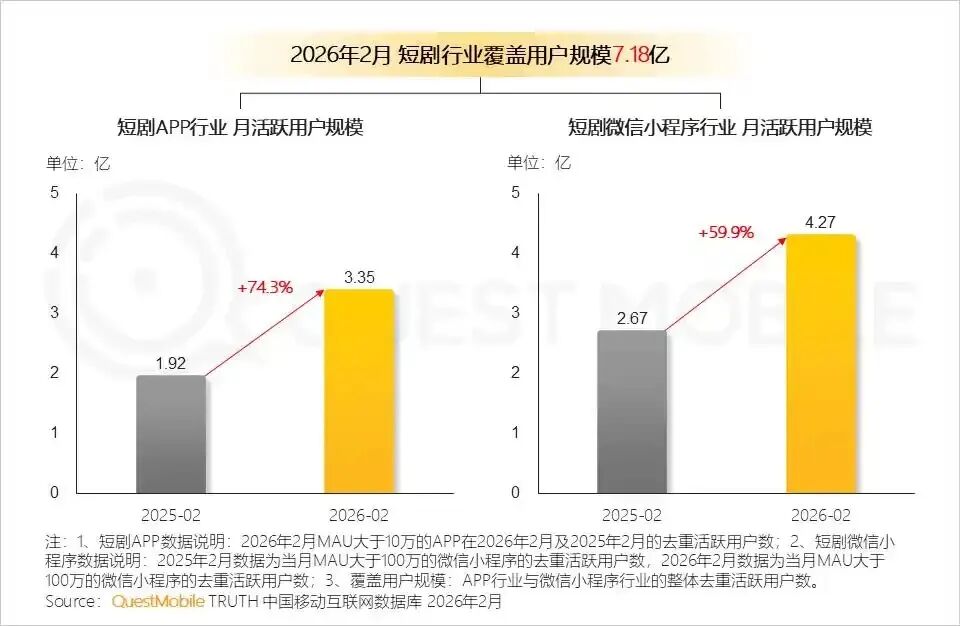
According to the "2026 Short - drama Industry Insight Report" released by QuestMobile, as of February 2026, the monthly active user scale of the domestic short - drama industry has reached 718 million. This means that 7 out of every 10 Chinese netizens are watching short dramas.
What is more worthy of attention than the scale growth is the qualitative change in the user structure. WETRUE data shows that young audiences aged 18 to 30 account for more than half, and the young group has become the core driving force for the industry's growth. The proportion of audiences in first - tier and new first - tier cities continues to increase, with first - tier cities accounting for 21.73%, new first - tier cities accounting for 19.47%, and second - tier cities accounting for 22%.
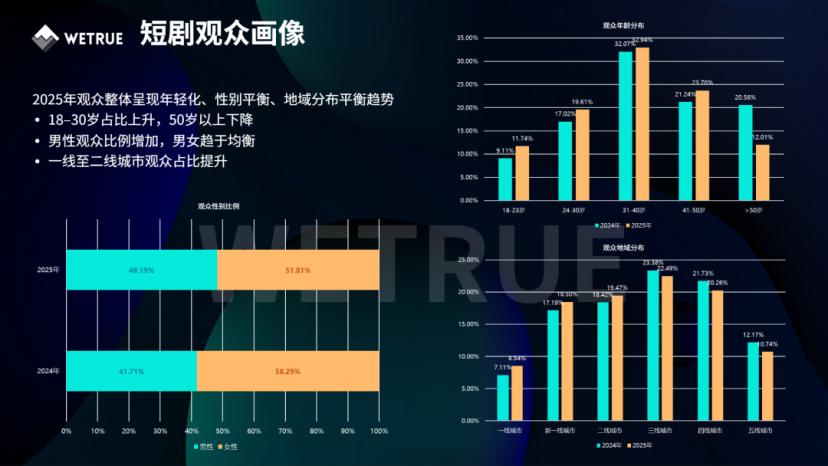
Behind the numbers are real content consumption behaviors. Today, young people watch short dramas not because they are "bored and killing time", but because there is really content they like in short dramas.
Take the dark - horse short drama "A Family of Three in the Same Class" during this year's Spring Festival season as an example. Relying on the high - concept setting of "parents returning to 18 years old and becoming classmates with their son", which seems absurd but touches the heart, it successfully opened up a market gap.
The fantasy time - travel is just the shell, and the core is actually that parents truly enter their children's world: when they become their son's deskmates, they witness the son's daily life of being isolated, slandered, and bullied on campus. This "companion - style growth from the perspective of peers" precisely touches the longing of countless young audiences for "being understood by parents", and at the same time makes the group of parents resonate strongly in the sense of substitution of "if I could go back to adolescence". The love line and the family line run in parallel, covering multiple circles of audiences from students to parents.
The solid data also proves its popularity: the playback volume exceeded 1 billion in 7 days after its launch, and as of the end of March, the whole - network playback volume exceeded 1.2 billion. It set a new historical record for the campus drama with a popularity value of 93.59 million on the Hongguo short - drama platform. The whole - network related topic reading volume exceeded 300 million, and it frequently appeared on the hot searches of Douyin and Weibo. It was called "the most wonderful ensemble drama during the Spring Festival season" by the audience, and also triggered an offline out - of - circle effect of spontaneous remakes by college student associations.
Short dramas with high stickiness, high discussion degree, and strong emotional resonance naturally carry emotional values such as inter - generational communication, campus youth, and family warmth. Whether it is product placement in the plot or topic co - creation, they all contain great commercial potential to accurately reach young and family users.
Behind the user upgrade is the content upgrade. In 2025, a profound qualitative change took place in the short - drama industry. According to the "Research Report on the High - quality Development of Chinese Micro - short Dramas (2025)", the past rough routines relying on high - frequency reversals and emotional stimulation can no longer meet the increasingly high requirements of the audience. Instead, works with complete stories, three - dimensional characters, and distinct themes have emerged.
What is more worthy of attention is the diversification of themes. Today, on platforms such as Hongguo, the following types of works can be seen:
The period family drama "Inside and Outside the Family" reflects inter - generational conflicts through daily - life narratives and quickly refreshed the 1 - billion playback volume with its good reputation;
Judicial theme dramas such as "The Glory of the Judge" and "The Blade of Justice" combine fast - paced narratives with logical closure and social issue expression;
Realistic theme dramas such as "Walking Towards the Sun in the Worldly Life" and "No Small Matters in the Western City" show the struggles and warmth of ordinary people;
And works like "Summer Fendra" that form obvious differences in lighting, composition, and overall aesthetics. On the first day of its launch, both the popularity and playback volume exceeded 100 million, and the cumulative viewing volume exceeded 3 billion.
Serial development is also injecting lasting vitality into short dramas. The "Grandma at Eighteen Comes to Restore the Family Glory" series has been updated to the fourth part, and the popularity of each part has reached new highs. Among them, the first - day playback volume of the fourth part reached 1.28 billion, and the cumulative playback volume of the four parts was 20 billion; the "Yunmiao" series has multiple parts launched in succession; after the launch of "Inside and Outside the Family 2", the popularity value remained above 100 million for 7 consecutive days and exceeded 1 billion in four days, becoming the short drama that broke through the 1 - billion playback volume the fastest in the history of Yunhe Data.
Nearly 60% of users will watch their favorite dramas repeatedly, and short dramas are changing from "one - time consumer goods" to content IPs that can be operated in the long term.
Platforms like Hongguo have also significantly improved their review standards several times, strictly controlling aspects such as plot logic, character fullness, and story connotation, promoting the industry to shift from simply pursuing traffic to emphasizing content quality.
For brand owners, this means that they can now naturally integrate brands into the narrative in high - quality, diverse - themed content with real fan stickiness. The safety and expressiveness of the content are no longer comparable to the past.
The third change lies in the transformation of traffic attributes. Short dramas have both the reach efficiency and distribution ability, as well as the narrative depth and immersive viewing time. Users regard short dramas as "heavy - content" like traditional dramas for consumption. This deep retention of user attention is an extremely scarce resource in today's internet environment.
In summary, the users of short dramas have expanded to high - value and diverse groups, and the content has moved towards high - quality, diversification, and serialization. These three changes together constitute the starting point for brands to re - evaluate the marketing value of short dramas.
The driving forces for brands to heavily invest in short dramas
The fact that short dramas have changed is a factual judgment, but the change itself does not automatically mean that brands should invest heavily. We need to further ask: what is the real motivation for brand decision - making? Why is the current a time window worth grasping?
By sorting out multiple brand placement cases and platform ecosystems, four core driving forces can be summarized.
Driving force 1: The leap in user quality eliminates brand tonality concerns
In the past, the biggest concern of brands about short dramas was not so much the effect as the brand image: if I invest my budget in short dramas, will it be considered that the brand is moving towards low - end? The direct source of this concern is the old user portrait.
When the proportion of users in first - tier cities exceeds 20% and young people become the main growth force, investing in short dramas is becoming a positive move for brands to "become younger" and "embrace new content forms". Especially for mass consumer brands that hope to reach Generation Z and expand their influence in first - and second - tier cities, short dramas have become a cost - effective choice. The user quality of short dramas is sufficient to support considerable return expectations.
Driving force 2: Abundant content supply gives brands the space for active selection
In the past, in addition to the problem of user portraits, there was another practical obstacle for brands not to invest in short dramas: there were no suitable dramas to invest in. The themes of short dramas were highly homogeneous, and brand placement often seemed very awkward.
Now the industry pattern has changed greatly. Not only are themes such as family, judicial, realistic, workplace, period, and female growth becoming more and more abundant, but high - quality brands and professional production teams are also working together to promote short dramas towards high - quality. The abundant content supply allows brands with different tonality and categories to find suitable cooperation themes.
More importantly, brands have changed from "having no choice" to "being able to choose". Brands can pre - screen dramas with excellent production, good data performance, and suitable themes. They can even, like Liangpinpuzi, pre - lock dramas with the potential to become blockbusters and intervene in customization at the script stage. This change from passive placement to active selection is the key premise for brands to be willing to increase investment.
Driving force 3: Short dramas become a new traffic growth point
The emergence of short dramas has broadened the choices for brand marketing and brought a new incremental path for brand content marketing.
Although the duration is short, its content - carrying capacity is not weak, which is enough to tell a brand story; there is also enough space to fully express the brand connotation; its ecosystem is relatively new, and the competition has not reached a white - hot stage. For brands, this is a precious incremental market. Both users and content are growing rapidly, and brands that enter the market early can obtain benefits at a relatively low cost.
Driving force 4: Mature and diverse commercialization methods
Today, the methods that brands can use on short - drama platforms such as Hongguo are quite rich.
Mid - roll ads can directly jump to e - commerce or lead - collection pages; clickable ads in dramas can pop up clickable brand floating windows during playback; the dual - platform promotion by actors enables a piece of content to be published on both the short - drama platform and Douyin simultaneously, reaching users on both platforms; the Xingtu platform supports brands to cooperate with short - drama actors in content promotion and live - broadcast pre - heating; actors can directly enter the live - broadcast room and interact with the brand; the highlight clips in the live - broadcast can also be edited into effective advertising materials for secondary placement with authorization.
These combined make it possible for brands to design a complete marketing link from exposure, promotion to conversion and repurchase.
Short dramas are no longer an isolated placement channel but a content center that can form a combined punch with live - broadcasts, short - videos, and effective ads.
More importantly, these methods have been verified by leading brands, and the successful experience is replicable.
The "four propositions" of short - drama marketing
After brands decide to invest in short dramas, the four most common propositions they encounter are: First, with a large number of dramas, how to select the blockbusters suitable for their own brands? Second, after finding the blockbusters suitable for the brand, are short dramas suitable for brand image building or node marketing? Third, can short dramas help brands accurately acquire customers, especially for categories that need sales leads? Fourth, do short - drama actors have the same product - selling ability as internet celebrities, and how to connect the whole link from exposure to conversion?
Proposition 1: Find the blockbusters suitable for the brand
Tens of thousands of new dramas are launched on short - drama platforms such as Hongguo every year, and the most headache for brand owners is drama selection.
If they choose the wrong drama, the budget will be wasted; if they choose the right one, they also have to worry about whether the placement method is awkward and whether it can really drive sales. The traditional approach is to "cast a wide net and bet on probability", but this is too risky for brands.
From passive gambling to active selection, the core logic of drama selection lies in two points: data prediction and actor binding. Use the platform's data capabilities to identify dramas with the potential to become blockbusters in advance, and lock in actors with fan appeal at brand marketing nodes to establish cooperation - actors themselves are the key signal for a drama to become popular.
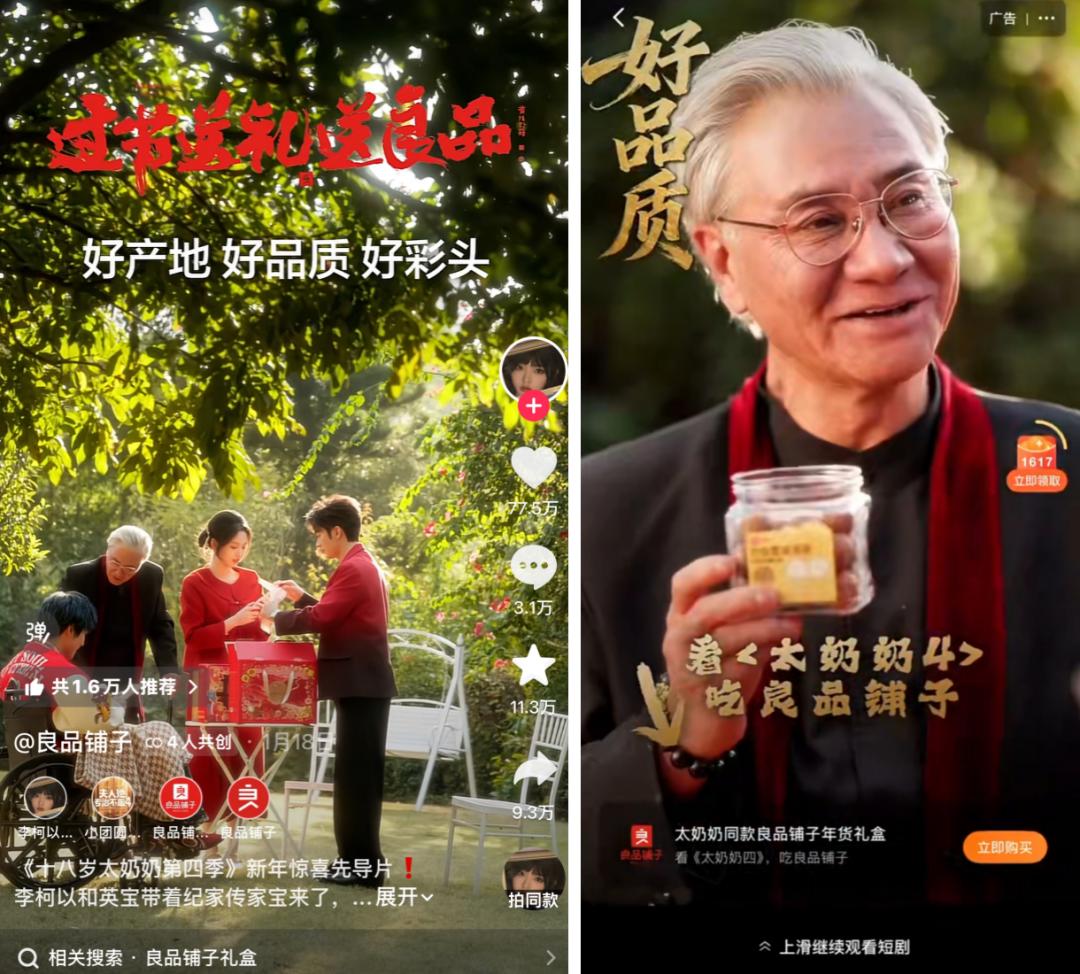
The cooperation between Liangpinpuzi and "Grandma at Eighteen Comes to Restore the Family Glory 4" during the Spring Festival season in 2025 is a typical successful drama - selection case. Before the Chinese New Year goods festival, Liangpinpuzi found through data insights on the Hongguo platform that the popularity index and user interaction data of this drama far exceeded those of other dramas in the same period, and decisively locked it in. The most core action after the selection was to co - create an extra episode with the drama production side, naturally integrating the concept of "giving Liangpinpuzi as New Year gifts" into the plot. As a result, the total exposure of the project was 143 million, the playback volume of a single extra episode exceeded 100 million, and it drove the brand to add more than 6 million deeply - interested people, effectively helping Liangpinpuzi attract new customers and break into new markets during the Spring Festival.
It is not difficult to see that blockbuster short dramas are not gambled on but selected. Data is like a telescope, helping brands see blockbusters in advance; co - creation is like an amplifier, helping brands quickly gather popularity. Selecting the right drama is better than thousands of blind placements. This is the starting line for short - drama marketing.
Proposition 2: Short dramas can also be used for "node marketing"
Another case of Liangpinpuzi shows another effective path for drama selection and further verifies that short dramas can fully meet the requirements of node marketing.
During the launch period of Liangpinpuzi's new prune product this spring, it chose to cooperate with the short drama "Second Marriage, a Good Omen". It locked in the cooperation with the two leading