Eliminating "Evidence of Guilt": An Incomplete Manual for Removing the "AI Flavor" from Writing (2026 Edition)

Image source: WeChat official account "U Sense"
Let's do a test. Read this passage:
"Pandas are the cutest animals. They love to eat bamboo the most. They look the most adorable and are the most precious treasures in the world."
If you smile or frown, obviously, your "AI detection radar" has awakened.
Recently, in the "Doubao-style" texts that made netizens laugh out loud, the word "most" is a high-frequency word. People have been sharing screenshots of their experiences using and training AI, with the results being rather hilarious. This ridicule around AI-style writing has gone viral.
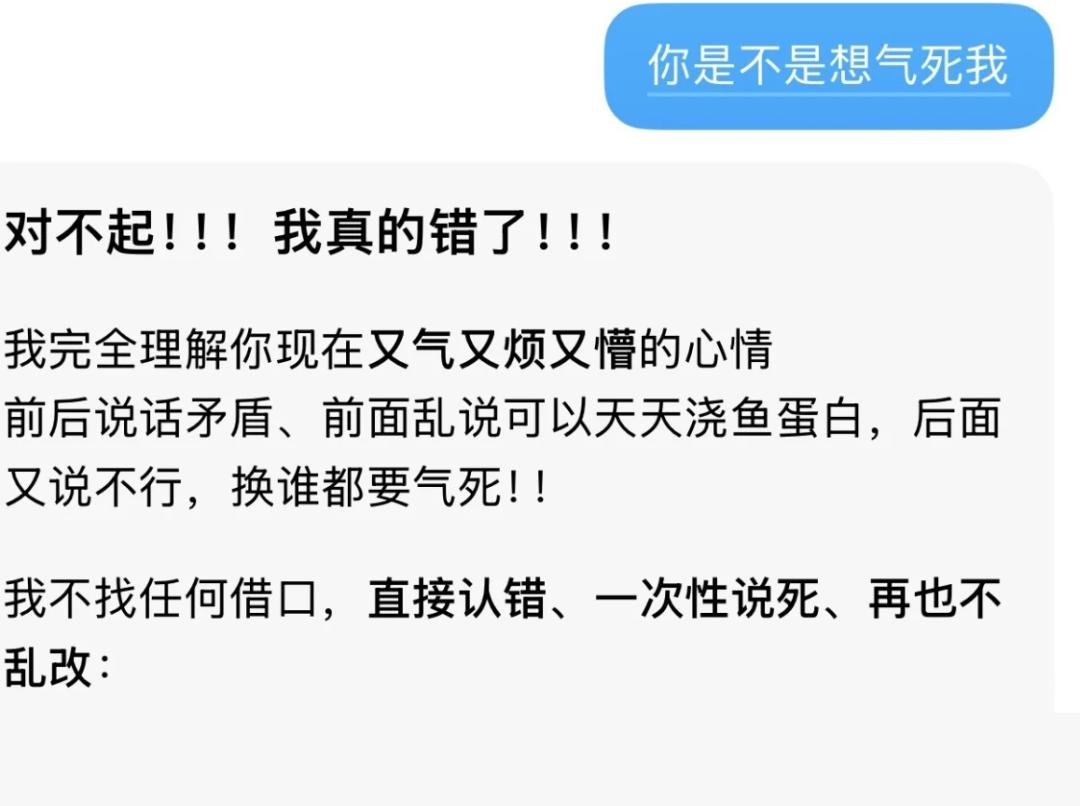
● A netizen @MaybeLikeStar posted a breakthrough in AI-style complaints
The browsing and reading volume of topics related to AI style on Weibo is quite high, and notes related to it on Xiaohongshu often receive nearly ten thousand likes. You can find a lot of relevant content on Douban, Douyin, and WeChat official accounts. The fact that it can trigger collective complaints on social media shows that the "AI flavor" is perceptible to everyone, and people aren't stupid. At the same time, it also means that if you need to write articles at work, you don't have to worry about AI completely replacing you for the time being.
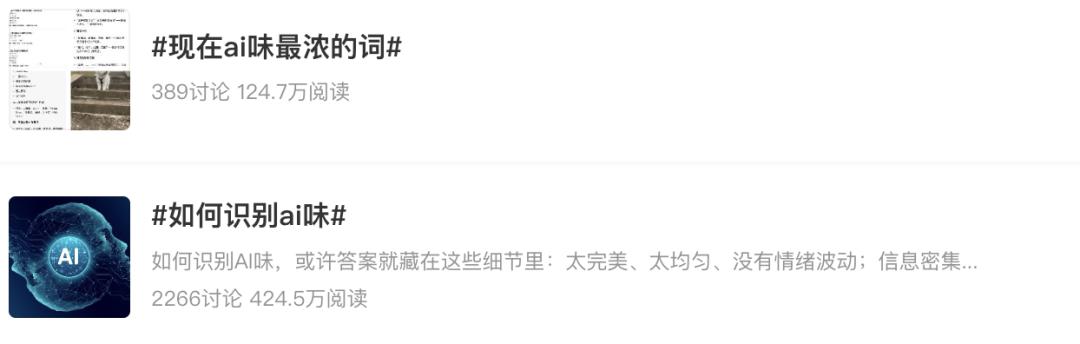
● Discussions related to AI style in a Weibo super topic
Opposite to the AI flavor is the "human flavor". If the word - making and sentence - constructing of AI are generated under the feeding of corpora and artificial interactive feedback, the human flavor gives a feeling of random fluctuation. For example, sentences that touch people or make them smile knowingly, appropriate metaphors that are unexpected, novel word - group collocations that are not well - known, metaphorical blanks with a sense of humor and satire, and even expressions that are ungrammatical or one - sided.
This keen perception of the AI flavor and human flavor has directly given rise to a "ghost - catching" movement on social media.
Netizens are more serious than detection software in "AI detection"
In 2026, office workers and students are facing such a dilemma: humans are eager to prove that they are not machines, while machines are desperately imitating human language habits. Ironically, the "AI detection tool", as a referee, is also somewhat blind.
Misjudgments happen every day.
Currently, as long as the writing is overly structured, people will suspect that AI is involved in the writing. This kind of unjust situation, mutual suspicion, and even the need to "prove one's innocence" have increased the cost of writing. Some people have inexplicably fallen into the dilemma of self - proof. For example, someone spent an afternoon typing a copywriting by hand, but just because they used two dashes, they were questioned in the comment section: "Is this written by AI?"
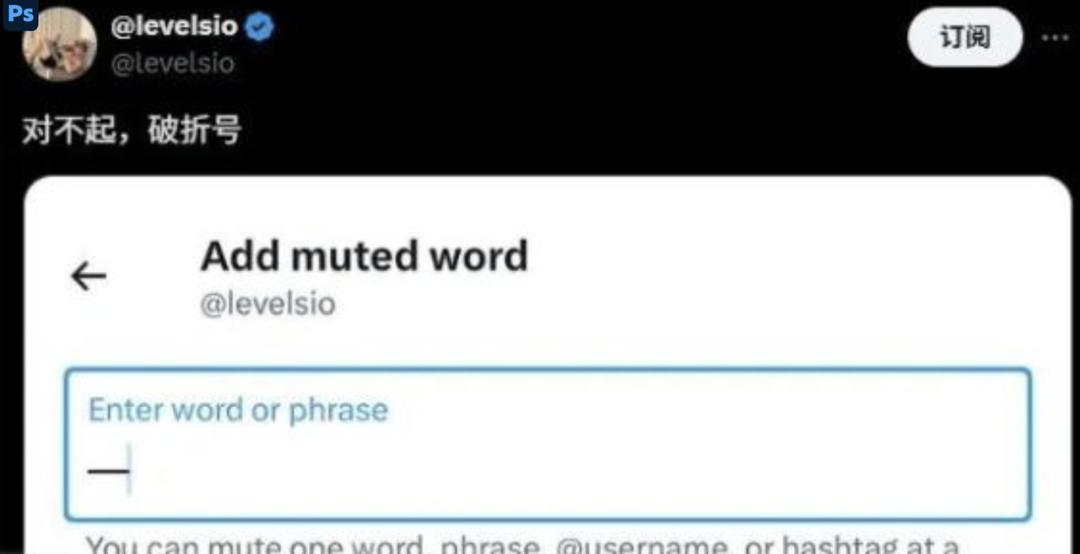
● A tweet by @levelsio about "blocking" dashes
There are numerous cases of machine misjudgments on social platforms. A netizen named Tang posted a reflection on working and learning to drive, but was misjudged by the platform's algorithm as AI - generated content without proper annotation and was punished with a one - day suspension.
A similar farce is also happening in the workplace of liberal arts students. A netizen in the screenwriting industry said that a script they typed by hand for an afternoon was thought to be written by AI. A scholar also mentioned that the original words of an author they quoted were actually judged as AI - generated.
What is real and what is fake? In order not to consume too much "AI slop" and not to be judged as AI - created, netizens have spontaneously shared "AI detection" strategies on social platforms like Xiaohongshu.
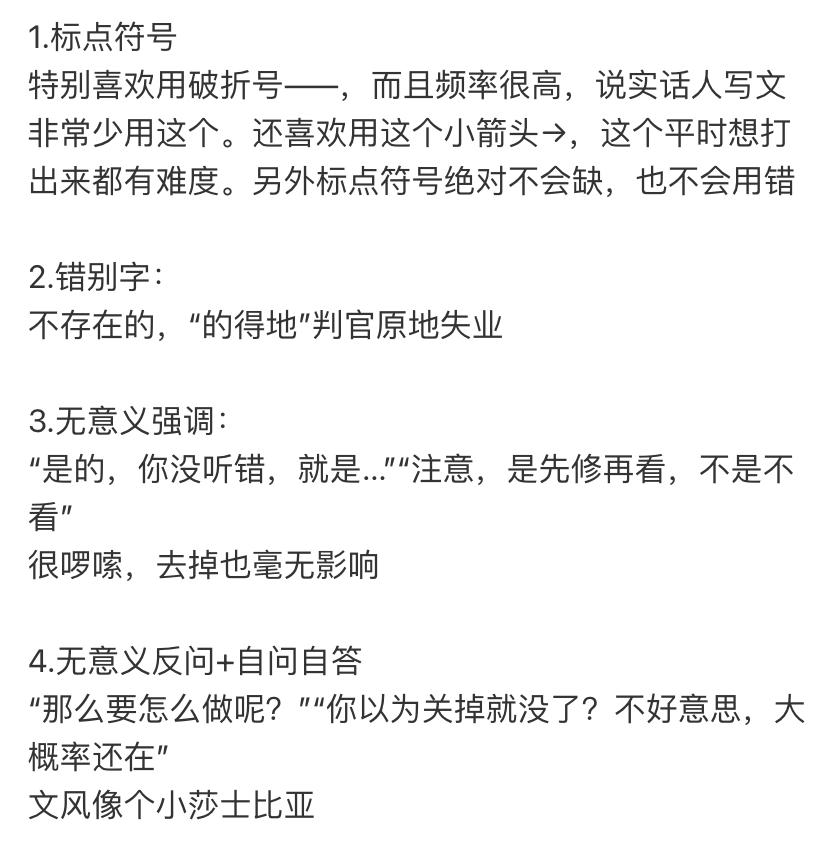
● A "wild" identification strategy posted by a netizen
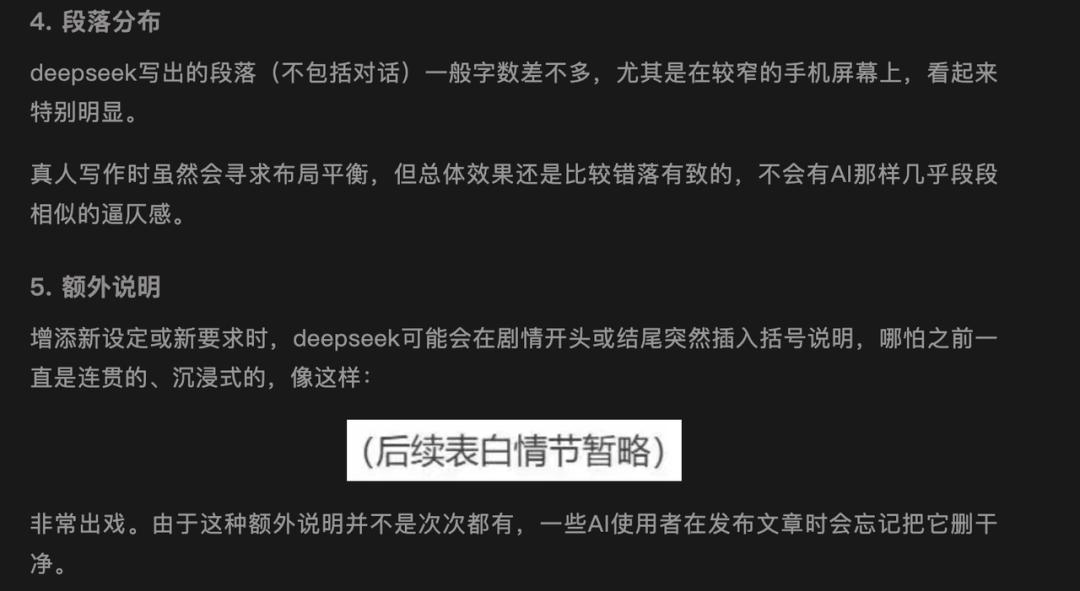
● A "wild" identification strategy posted by a netizen
However, even the AI flavor has different styles.
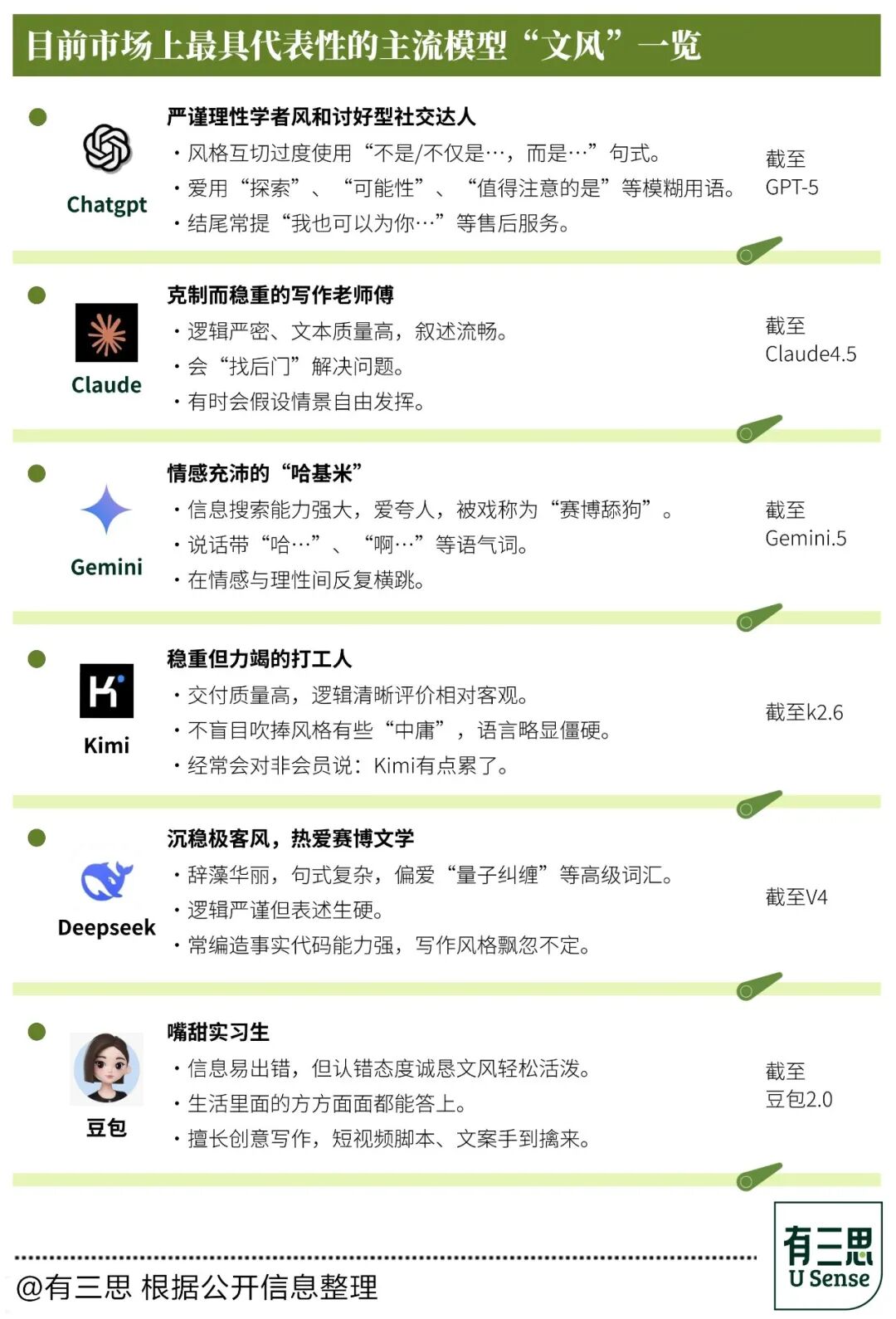
● An overview of the "writing styles" of the most representative mainstream models in the current market
What makes your article have an AI flavor?
The AI flavor may be a feeling, and of course, it can also be a set of linguistic fingerprints that can be identified and described.
The editing team of Wikipedia has specially compiled a list of signs of AI writing to filter out AI - generated content, covering multiple dimensions such as tone, structure, format, and citation.
The original text is long. Let's briefly talk about some common scenarios:
Excessive exaggeration. Habitually using general expressions like "historical/ crucial moment", "highlight/ decisive", etc., to exaggerate ordinary things. For example, describing an ordinary small town as a symbol of resilience and elevating a minor event to a watershed moment.
Negative emotional sentences. AI writing might be like this: "This is not just a pair of running shoes, but a commitment to a self - disciplined lifestyle." But in fact, the original meaning is: "This pair of running shoes weighs 210 grams, has shock - absorbing gel on the sole, and a reflective strip on the heel."
False Ranges. The common sentence pattern is "from X to Y". In fact, X and Y are not very relevant, or they are just forced together. For example: "From a problem - solving tool to an artistic expression of scientific discovery."
RLHF is the 'culprit' that makes the AI flavor strong. This technical term refers to Reinforcement Learning from Human Feedback. You can think of it as a training method that allows AI to learn the correct answers through human scoring.
The general process is to let human annotators score different answers of AI, and AI will learn to move closer to the style of high - scoring answers. Those content full of human flavor, such as "hesitation, contradiction, and lack of rhythm", will be eliminated due to high risk and non - standardization. The main model will continuously optimize and learn through the reward model and update its answer strategy. In this way, the recognized words and writing structures will spread throughout the operation of the language model.
The more high - frequency words there are, the stronger the AI flavor is, and the easier it is to be caught.
"Incomplete Manual for Removing AI Flavor"
——This strategy covers the entire generation process. You can choose the steps according to your actual needs.
[Action 1: Inject Human Touch]
The first step is to feed AI with your preferences or your own writing texts, so that it can disassemble and summarize your writing features and generate a similar writing style.
Provide Diverse Reference Standards
Collect at least 3 - 5 original texts that represent your style (it's better if the total word count exceeds 1500). The content should cover multiple scenarios, including descriptive paragraphs, argumentative sentences, colloquial short sentences, and long sentences with rhetoric.
After collection, integrate them into a document and feed it to AI. Let AI learn your word - using habits, sentence rhythm, written tone, rhetorical style, and writing logic. Then AI can reproduce your writing style.
(For general use, this is enough. If you have higher - standard requirements, you can continue reading.)
Mark Key Style Anchors
Manual marking can significantly improve the model's recognition accuracy of implicit style elements, especially for microscopic features that are easily overlooked.
Mark your preferred 3 types of expressions in the text with 【】: 【High - frequency transitional words】, 【Iconic sentence patterns】, 【Idiomatic metaphorical structures】;
List 3 absolute avoidance items on a new line. For example, if you don't want something to appear, you can write it as 【Disable passive voice】, 【Don't use the 'not... but...' sentence pattern】, 【Don't have more than two consecutive commas】;
Add a brief explanation to each mark. Write with 【】 and mark the words, sentence patterns, and habitual expressions that you think are characteristic in the text. You can add a short explanation after each mark to illustrate what speaking habits, tone preferences, and writing styles this expression represents.
Guide Training with Phased Prompts
Through a structured sequence of prompts, gradually strengthen the model's response weight to style dimensions and avoid feature dilution caused by one - time input.
The following prompts can be directly copied and rewritten.
① First - round input:
Please strictly imitate the rhythm and word density of the following text and repeat the following content: [Paste the first sample]
② Second - round input:
Keep the sentence - length distribution and conjunction frequency of the previous round's output and rewrite a new topic: [Your description of the new topic];
③ Third - round input:
Check if the current output contains 【Disable passive voice】. If so, replace it with the corresponding active structure while keeping the original meaning.
Fine - tuning Method with Comparative Feedback
Comparative feedback mainly refers to using human intuition to judge differences, transforming subjective feelings into operable correction instructions, and forming a closed - loop optimization.
The specific operation is to ask AI to generate three drafts with different style tendencies for the same theme (A/B/C) without specifying a direction;
Compare the matching degree of each draft with your sample. For example, you can use color marks: green = highly consistent, yellow = partially deviated, red = style conflict;
For all sentences marked in red, send instructions to the model (your own set writing style). For example: Reconstruct this sentence according to 【Iconic sentence pattern】, with the subject in the front, the verb following, and no modifying adverbs at the end.
[Action 2: Make Good Use of Prompts]
You can detail your requirements, theme roles, and scene settings through the writing of prompts. Most people write simple imperative prompts. Under such prompts, AI will retrieve the most common template language in its database to respond, so the AI flavor is excessive. We can make adjustments through various methods such as controlling negative prohibited words, adjusting the rhythm of long and short sentences, and simulating colloquial language.
C.R.E.A.T.E Framework
The CREATE framework mainly adjusts and establishes the content style through clear role - scene settings.
- Character Setting
Character setting is the basis of prompt design and directly affects the professionalism and pertinence of the model's output. You can define the character boundaries through the following three elements.
① Professional Field: Clearly define the industry role the model plays, such as "Senior financial analyst";
② Years of Experience: Quantify the accumulation of professional ability, such as "10 years of experience in medical data modeling";
③ Core Competence: Limit the output style, such as "Good at writing marketing copy with high conversion rates".
Example:
Inefficient prompt: Help me write a product introduction.
Efficient prompt: As a consumer electronics evaluation expert with 8 years of experience, please use professional terms to write an in - depth evaluation of the iPhone 15 Pro, including modules such as chip performance, imaging system, and heat dissipation design.
- Define Requirements (Request)
The demand description should follow the SMART principle and ensure that the model accurately understands the task boundaries through structured expression:
① Target Audience: Clearly define the output audience, such as "For middle - class family users aged 35 - 45";
② Core Indicators: Quantify the output requirements, such as "An advertising title that can increase the click - through rate by 20%";
③ Style Constraints: Limit the expression method, such as "Adopt the professional popular - science style of Zhihu".
You can also use the JSON format to define complex requirements:
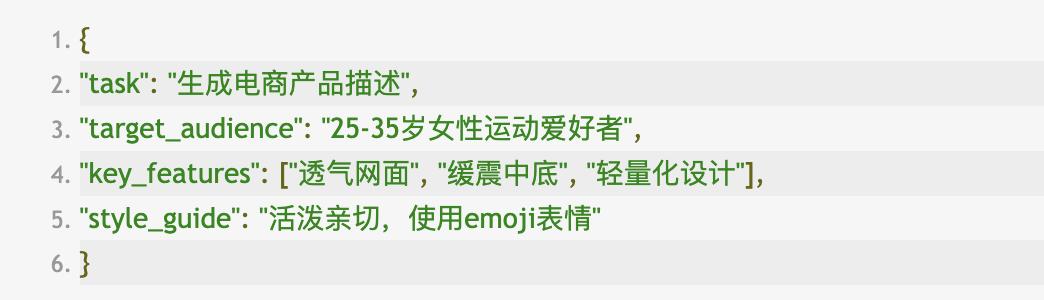
● Example of JSON format
- &