Spend $118 on an AI pet collar just to hear your cat say "I miss you."
People who have owned cats probably have all experienced such moments.
The cat jumps onto your lap and meows at you, but you have no idea what it's thinking.
You wish so much that it could just say a word, even if it's just to tell you that it had a good day.
The Hangzhou startup PettiChat came up with this idea.
This company has developed an AI pet collar priced at $118, which is connected to Alibaba's Qwen large - model. It claims to be able to translate the sounds and emotions of cats and dogs in real - time with an accuracy rate of 94.6%.
Currently, 10,000 units of this product have been pre - ordered.
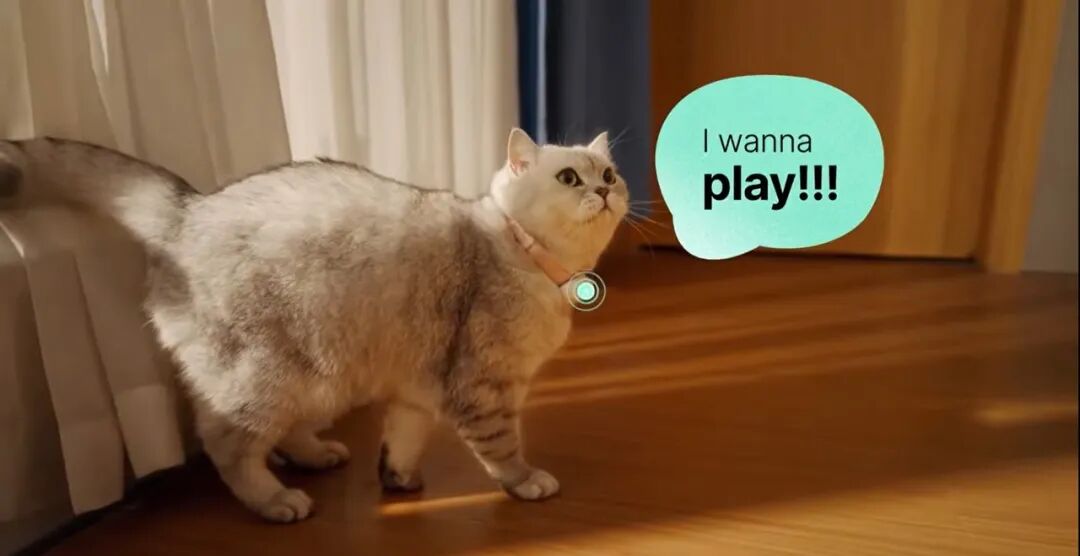
AI Pet Translator
The experience of PettiChat is probably like this:
You hang a small round piece weighing about 27 grams on your cat or dog's collar. It listens to the sounds, monitors the movement, and tracks the position, then sends the results to Qwen. A few seconds later, a human - like sentence pops up on your phone.
The dog barks twice at the door, and the APP translates it as: "I want to go out and play."
The cat meows at you at three o'clock in the morning, and the APP translates it as: "I'm a little hungry and I miss you a bit."
The owner is deeply touched on the spot. It turns out that the naughty pet isn't just causing chaos but is lonely; the fussy pet isn't just acting crazy but needs companionship.
Then the pet owner is so moved that they take a photo and post it on Xiaohongshu with the caption: "It's really talking to me."
But the most amazing thing about this device isn't that it can really understand cats and dogs, but that it understands pet owners so well.
Dog owners are constantly guessing every day: Is it bored? Is it scared? Does it miss me?
Cat owners are even more miserable. When a cat gives them a glance, humans automatically start to reflect: Did I do something to offend it?
PettiChat turns this kind of imagination into a product experience.
Animal Behavior World Model
There are already many "pet translation" APP products on the market. Why did PettiChat sell like hotcakes right after it started taking pre - orders in early May?
According to the official statement, what they launched is not a joking product, but a real pet language recognition system based on AI technology.
Li Jingyuan, the founder of PettiChat, said: "What we want to do is not just a translator, but a world model of animal behavior."
What PettiChat hopes to build is a world model that includes animal vision, sound, biochemical signals, and behavior signals. By collecting high - quality animal behavior data, a more reasonable physical modeling architecture can be used to predict the health and behavior of pets.
To this end, PettiChat is continuously building a huge animal behavior database. Currently, there are about 890,000 cat - related data and about 650,000 dog - related data that have been reviewed by experts.
With the feeding of data from the physical world, the model can make the leap from recognition to prediction.
According to the data provided by PettiChat, the accuracy rate of the acoustic pattern test for cats in different situations reaches 94.6%, and that for dogs reaches 92.3%.
At the same time, the system has also strengthened the ability of action recognition and the understanding of the context of animal behavior based on AI Agent, which can better combine recent interactions to predict abnormal behavior and anxiety in pets.
However, the problem is that PettiChat has not publicly released any research reports to confirm the accuracy rate. After all, cats and dogs can't click "Translation is correct" in the App.
So the real value of PettiChat may not lie in making pets speak.
Real Business Model
PettiChat's official once said: "The collected data may also provide possibilities for subsequent cross - border cooperation. Pet insurance companies have already expressed their intention to cooperate."
This sentence is actually the real business plan of this company.
You put this small clip on your cat every day and think you're listening to your cat talk.
But PettiChat is actually recording: What time it meowed today, how many times, the frequency and intensity of the meows, how much it moved, where it was, and whether there were any abnormal vital signs...
These data are continuously sent back to the cloud, forming an increasingly complete pet health record.
Then pet insurance companies can use this database for accurate pricing and claim risk control.
And all of this is labeled by you every day.
So in essence, PettiChat is a pet health data collector with the label of "pet translation".
People who buy this device are working for PettiChat for free every day, using the real - life data of their pets to continuously feed, optimize, and improve this database.
The model becomes more and more accurate, the data becomes more and more valuable, and users become more and more immersed because it understands their pets better and better.
Once this flywheel starts spinning, collaborating with insurance companies, veterinary platforms, and providing targeted pet food promotions will all be natural.
If you see it as a translator, you'll think it's a waste of money.
If you see it as a data collection entry, you'll think these people are geniuses.
The founding team of PettiChat is indeed not an amateur group.
The core members of the team all come from the School of Computer Science and the School of Artificial Intelligence at Zhejiang University.
Li Jingyuan, the founder, is a 90s - born serial entrepreneur with a Ph.D. in artificial intelligence from Zhejiang University.
Du Jiachun, the CTO, holds a bachelor's degree from Zhejiang University and a master's degree from Eindhoven University of Technology in the Netherlands. He has 8 years of work experience in the fields of the Internet of Things and large - models at Alibaba Cloud.
PettiChat recently completed a $1 million seed - round financing, jointly invested by the Zhejiang University Alumni Fund Oufang Angel and Huadan Angel.
Paying for Emotional Value
We can conclude the technical discussion here.
The 94.6% accuracy rate cannot be independently verified. The ground truth is labeled by humans, Qwen is responsible for polishing the emotional labels into natural language, the edge - side hardware runs a lightweight classification model, and the real large - model is in the cloud.
Is PettiChat a revolutionary breakthrough? Of course not. Its technical level is probably just equivalent to a junior - year course project in the computer department.
But the 10,000 pre - orders are there, which shows that people don't really care about the technology.
People who have owned cats and dogs understand this feeling.
You come home from work and open the door. The cat looks up at you from the sofa and then goes back to sleep. You don't know if it's welcoming you or annoyed by the noise.
You feed it, and it walks away after eating. You don't know if it's satisfied or if it thinks today's cat food isn't good enough.
It's sick and curled up in the corner. You're in a panic, but it can't say a word.
But what PettiChat sells is this sense of certainty.
Even if this certainty is fabricated by Qwen, and even if the cat never said that sentence, when "I'm very happy today, thank you for accompanying me" pops up on the phone screen, you really feel comforted at that moment.
To some extent, this is in the same category as electronic wooden fish, sleep - inducing podcasts, and AI companion apps.
Modern urbanites don't need information; they need an emotional outlet.
Users who pay for PettiChat are just expressing that they need this kind of feeling.
This article is from the WeChat official account "World Model Workshop". The author is World Model Workshop. It is published by 36Kr with authorization.