If the US-Iran agreement is reached, will the oil price collapse?
On May 25th, the international crude oil market suffered a "severe setback" at the opening. As of press time, both WTI crude oil futures and Brent crude oil futures have fallen by more than 4%.
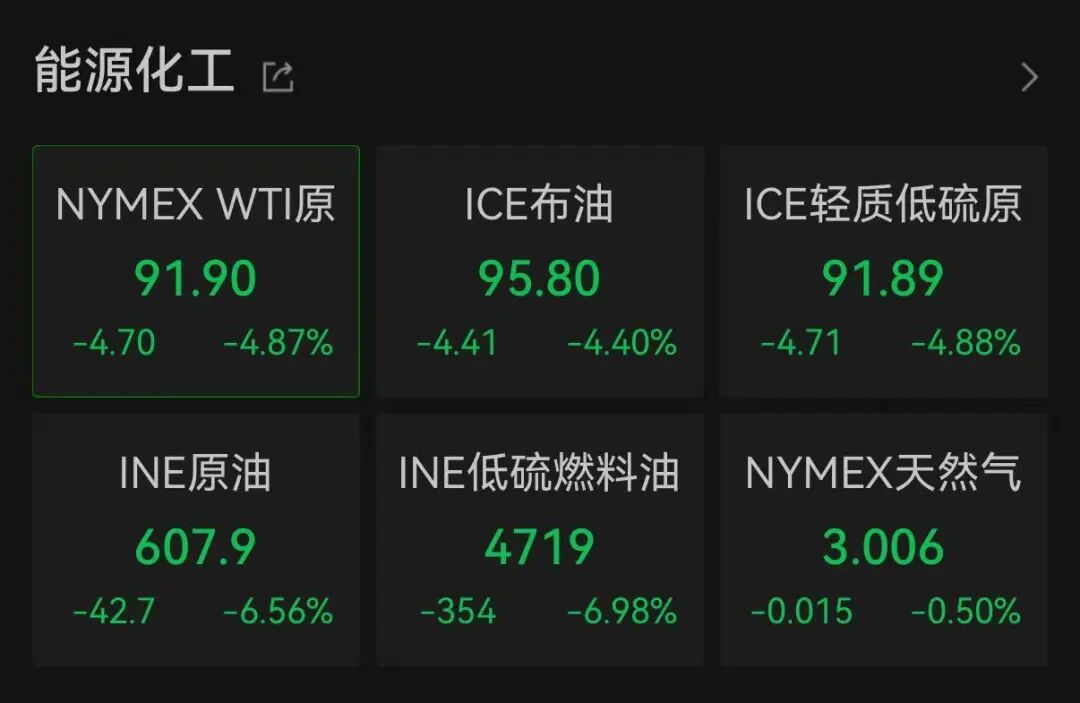
According to the news, US President Trump said on the 23rd that the negotiations between the United States and Iran are "getting closer" to reaching an agreement. But on the 24th, Trump further emphasized that the agreement between the United States and Iran "has not been fully finalized."
However, Trump's latest statement obviously did not stop the decline of international oil prices.
With the agreement not yet truly in place, international oil prices have already dropped significantly. It seems that the market is pricing in advance for the US-Iran peace agreement.
"The approaching of the US-Iran peace agreement and the plan to reopen the Strait of Hormuz are the main reasons for the decline of international oil prices," Wu Yan, a crude oil analyst at Longzhong Information, told China News Service. Although there are still differences on some key issues between the two sides, after multiple rounds of negotiations, the initial reaching of the peace agreement has released long-awaited positive expectations to the market.
In reality, the news that some ships have passed through the Strait of Hormuz smoothly has further injected confidence into the market.
According to the public relations department of the Islamic Revolutionary Guard Corps Navy of Iran on the 24th, a total of 33 ships, including oil tankers, container ships and other merchant ships, passed through the Strait of Hormuz in the past 24 hours.
In Wu Yan's view, this shows that the Strait of Hormuz has ended the one-size-fits-all situation, and the passage situation is much better than the previous large-scale blockage, which has become another factor driving the decline of oil prices.
So, once the peace agreement is finally and truly in place, will international oil prices collapse?
Han Zhengji, a crude oil analyst at Jinlian Chuang, believes that if the United States and Iran finally reach an agreement, international crude oil prices will further decline as the geopolitical premium fades. However, if the situation between the United States and Iran intensifies again, oil prices will resume their upward trend.
In addition, due to this conflict, a large number of oil fields in Gulf countries have reduced production due to force majeure. Han Zhengji believes that even if the geopolitical situation eases, it is difficult to restore crude oil production overnight.
He expects that before the oil production of major oil-producing countries returns to normal levels, the supply and demand fundamentals of the crude oil market will still be the focus of the market. And under the current situation where the crude oil market is still in a situation of supply falling short of demand, crude oil prices may remain at a relatively high level in the short term.
Wu Yan expects that from June to August, Brent crude oil futures will probably trade in the range of $87 to $110 per barrel.
"Currently, there is a supply gap of about 6.8 million barrels per day globally. The crude oil production of Iraq, Kuwait and the United Arab Emirates is basically halved. In addition, the Northern Hemisphere will enter the peak season for fuel consumption in summer, and commercial crude oil inventories will decline rapidly," Wu Yan believes that this will support fuel demand and international oil prices.
This article is from the WeChat official account “China News Service” (ID: jwview), author: Song Yafen, published by 36Kr with authorization.