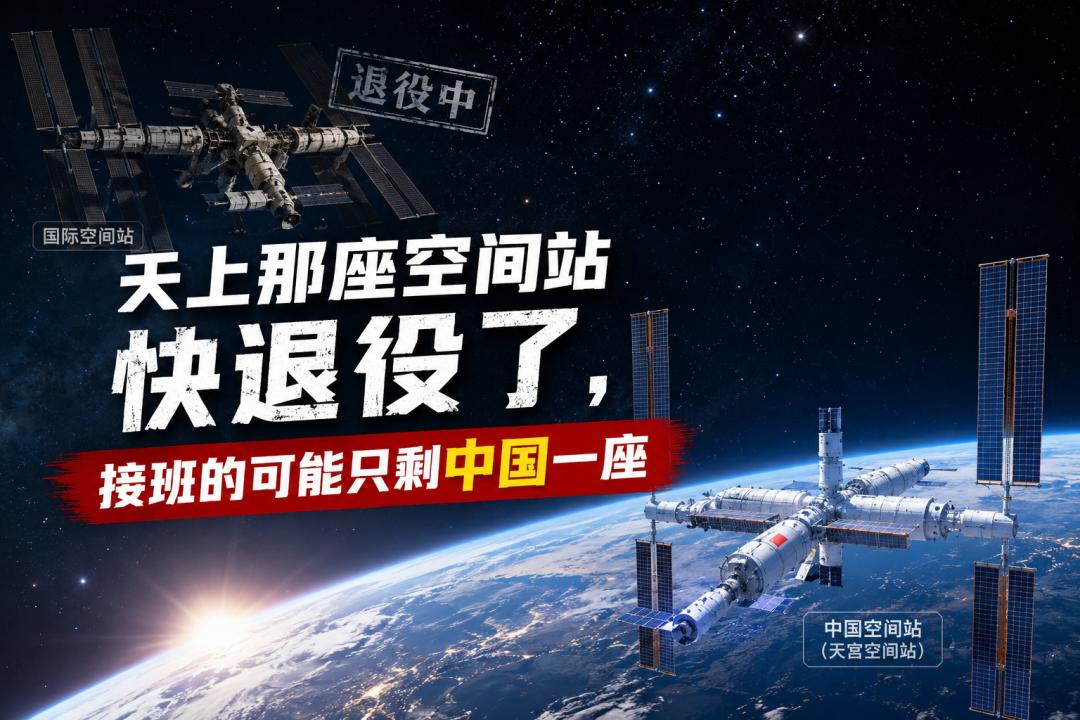
The space station up in the sky is about to be decommissioned, and it's likely that China's will be the only one left to take over.
Let's start with a timeline that many people haven't paid much attention to.
The International Space Station in the sky is already an over - serviced "old man". According to the plans of multiple countries, it will be decommissioned around 2030 and eventually burn up in the atmosphere. This means that after a certain day in 2030, there may be only one long - term manned space station in low - Earth orbit, and it will be China's.
The reason I start from this time point is that only when the recent event is put into this countdown table can we understand its significance: In the late night of May 24th, while Shenzhou-23 was taking off, two Pakistani astronauts were training with Chinese astronauts at the Jiuquan training ground. One of them will fly to the Chinese space station by the end of 2026 and become its first foreign visitor (Source: China Manned Space Engineering Office, China News Service, May 23, 2026).
Many people regard this as a beautiful story of China - Pakistan friendship. That's right. But what I want to say is that it's not a coincidence that China issued the first foreign ticket during this specific time window.
Why exactly these years?
Put the two things side by side, and you'll understand: On one hand, the old platform in the sky is entering the countdown to its end; on the other hand, China's new platform has just been completed and is welcoming guests.
There is a subtle handover window in between. During this window, the country that takes the "open - door" stance first can plant a message in the minds of all countries: When the old one is gone, there will be a place here if you want to go to space.
What China wants is this first - mover advantage. When to issue the first foreign ticket and to whom is essentially answering a strategic question: How to attract "future space partners" to its side before the decommissioning of the International Space Station and the re - alignment of countries. Sending out the invitation earlier means occupying a place in others' minds earlier.
Why would a country queue up for this ticket?
Let's talk about how rare this event is.
So far in human history, only three countries have been able to send people into space: Russia, the United States, and China. And being able to systematically select, train, and send people from other countries into one's own space station is an even higher threshold.
In February 2025, witnessed by the Prime Minister of Pakistan, China and Pakistan officially signed a cooperation agreement on the selection and training of astronauts. This is the first time the Chinese government has selected and trained astronauts for a foreign country (Source: China Manned Space Engineering Office). In the past few decades, this ability was only in the hands of Russia and the United States. If a country wanted to send people into space, it either had to build its own rockets or buy tickets from these two countries, queue up, and be at their mercy. Now, China has been added to the list, and it's at the critical moment when one of the two old - fashioned platforms is about to exit.
What China is selling is a whole system
So, what exactly is China offering? It's not just a ticket for a few - day trip, but a package of a whole set of capabilities.
If you want to send people to the Chinese space station, you have to pass several tests: Astronauts are selected and trained in China, they have to learn Chinese (in - orbit cooperation relies on Chinese for communication), the experimental payloads must meet Chinese standards, and the entire system including the spacecraft, docking, and life - support is the Chinese system. In other words, what the other country is buying is not just a single flight, but an acceptance of the "whole Chinese space system". Once this system is used and recognized by one country, other countries that follow will have a reference.
This is actually a long - term plan that China has been laying. As early as 2018, China, together with the United Nations, issued an invitation to all member states, welcoming them to conduct experiments on the Chinese space station. The first batch of selected projects came from 17 countries such as Switzerland, Germany, Japan, Saudi Arabia, and Kenya, with 9 projects selected from 42 applications (Source: United Nations Office for Outer Space Affairs, China Manned Space Engineering Office). By the end of 2023, China had signed more than 150 inter - governmental space cooperation agreements with more than 50 countries and international organizations (Source: China National Space Administration). All these preparations are waiting for the gap after the decommissioning of the old platform.
Why is Pakistan the first?
After talking about the time point, let's talk about the choice of the country. Pakistan being the first one selected is also well - calculated.
China and Pakistan have been all - weather partners for decades. Starting with Pakistan has the lowest political risk and the most stable demonstration effect. Moreover, the fact that an astronaut from a developing country can go to the Chinese space station is more convincing to all countries that don't have space capabilities yet. This is an advertisement more effective than any other: If Pakistan can do it, can we? This is exactly the signal that China wants to send during the countdown window.
What does this have to do with you and me?
By now, you may think that this is a national - level event far from ordinary people. In fact, it's not. The dividends of this business will seep down through three levels.
The closest level is the Chinese companies in the space industry chain. For rockets, satellites, ground - based monitoring and control, and space experimental equipment, each additional country for cooperation means more orders. The customer list of Chinese space industry is changing from "for self - use" to "for sale to others".
The next level is the broader Chinese high - end manufacturing. The ability to send people safely into space and bring them back is a certification of a country's top - level industrial capabilities. Once this brand is established, it will benefit the overall bargaining power of "Made in China" in the global high - end market.
The outermost level is you, who may seem completely unrelated. Whether a country has a long - term seat in space determines whether it can participate in setting rules, allocating resources, and establishing standards in the next few decades. This ticket sent out before the decommissioning of the old platform is China's way of reserving a seat at the negotiation table for the next generation.
Written in the countdown
Let's go back to the two Pakistani astronauts still training in Jiuquan. By the end of 2026, one of them will fly to the Chinese space station, stay for about a week, complete the experiments, and then return on Shenzhou. One week is very short, as short as a business trip.
But when put into the 2030 countdown table, this one - week stay is more than just a business trip. It means that before the old platform bids farewell, there is already a new and stable option in the answer to the question "Can we go to space?", which is China. What we are witnessing is not just a visit by a guest, but a country officially putting up a "open for business" sign for its most cutting - edge capabilities during the handover window.
This is probably one of the most inspiring things in the past two years, and few people have explained it thoroughly from the perspective of "time". If it also touches your heart, share it with friends who also care about how far China can go.
This article is only for information sharing and industry analysis, and does not constitute any investment advice, investment analysis, or trading invitation. The market is risky, and investment should be made with caution. Any investment decision made based on the content of this article, the risks and profits or losses shall be borne by the individual, and the author and the publishing platform shall not bear any legal liability.
This article is from the WeChat official account "BT Finance" (ID: btcjv1), written by Jiang Xu, and is published by 36Kr with authorization.