Burned through 60 trillion in 30 days, Zuckerberg didn't make the top 250: Big tech's AI has become a KPI game
Is it becoming popular for big Silicon Valley companies to slack off using tokens?
Recently, the UK's Financial Times reported that some Amazon employees are sitting at their desks, having an internal AI tool called MeshClaw run tasks that are completely unnecessary.
They are not conducting experiments or rushing to complete projects. Instead, they are racking up tokens.
MeshClaw can send emails, handle Slack messages, and deploy code. It is a true AI agent that can "take over" tasks. According to reports, Amazon has also set up an internal leaderboard to track each employee's token consumption in real - time, with the goal of having over 80% of developers use AI every week.
Three informed sources revealed that some employees have since found a new survival strategy: using MeshClaw to run unnecessary tasks specifically to boost their numbers on the leaderboard.
In Silicon Valley, this behavior has a specific term: tokenmaxxing (going crazy over AI usage).
Amazon says that token data is not used for performance evaluations. However, according to reports, many employees don't believe it. Some have directly stated that they feel "a lot of pressure," and it's not just about using AI, but using it "the most."
Amazon is not the only one. Meta's internal leaderboard, "Claudeonomics," burned through 60 trillion tokens in the past month, and even Mark Zuckerberg himself didn't make it into the top 250.
In May 2026, several of the world's wealthiest companies have entered a new work state. AI in big companies has started to turn into a KPI game.
Jassy's Memo
Employees Read a Hidden Meaning
MeshClaw is Amazon's AI gateway for employees, and it is connected to Claude.
Amazon's push for AI is obvious. According to reports, the company has set an internal goal: over 80% of developers must use AI tools every week, and an internal leaderboard has been launched to track each person's token consumption.
The original intention is of course good, but it has taken a wrong turn in the hands of employees. The problem doesn't entirely lie with the employees. The root cause of token anxiety actually lies at the top of the company.
In June 2025, Amazon CEO Andy Jassy sent an open memo to all employees, directly suggesting that employees "use and experiment with AI whenever possible." He also wrote that those who embrace the AI transformation will "be in a more advantageous position and have a high - impact."
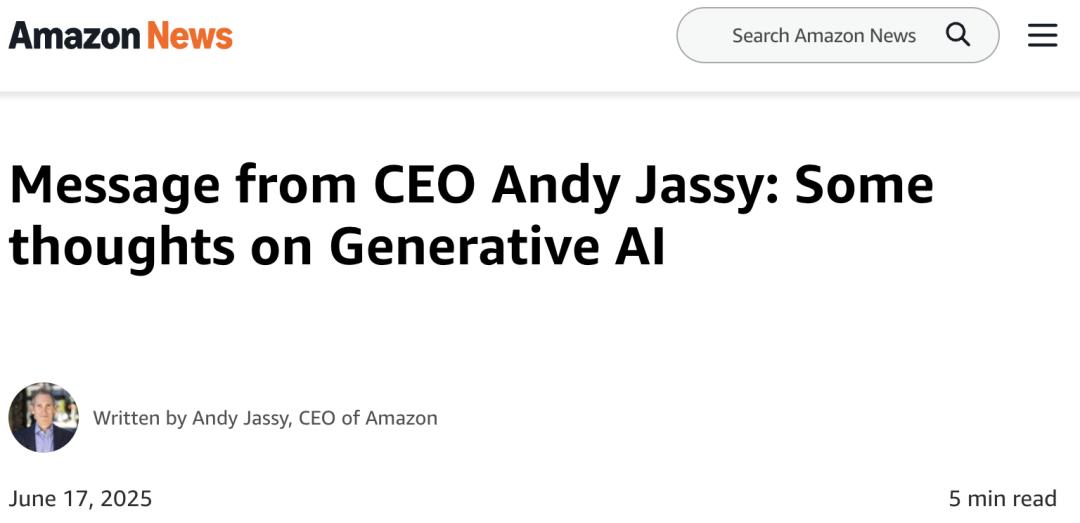
https://www.aboutamazon.com/news/company-news/amazon-ceo-andy-jassy-on-generative-ai
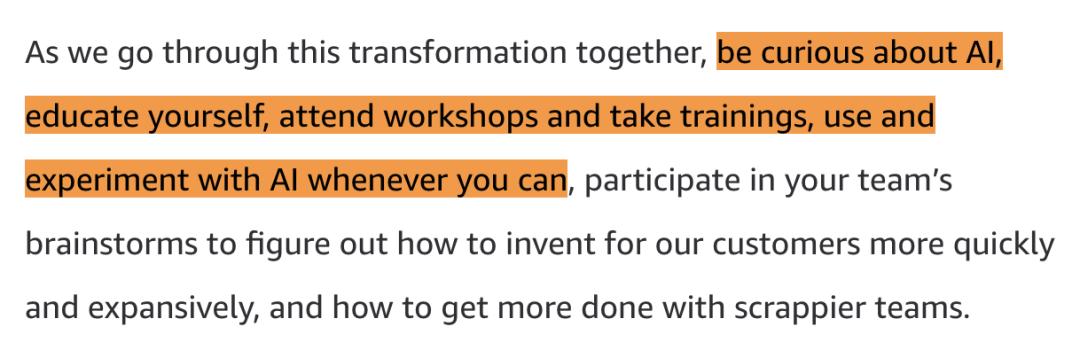
In Jassy's memo, the sentence "Stay curious about AI... use and test AI whenever possible" was read by employees as having another meaning: tokenmaxxing.
Jassy directly linked "embracing AI" with "having a high - impact" in the memo, putting every ordinary employee into a state of token anxiety: Is my current AI usage enough?
More importantly, Jassy also wrote in the same memo that in the next few years, as AI is widely used across the company, Amazon expects the size of its corporate workforce to decline.
Amazon officially states that token data will not be used for performance evaluations, but according to employees, managers are still keeping an eye on the leaderboard. The message in this atmosphere is clear: the more tokens you use, the safer you are.
So, tasks that don't actually need AI are still being handed over to AI just to make the numbers on the leaderboard look good.
This is a classic example of reverse clock - in under the Internet OKR system, where employees are playing a game against a quantitative indicator.
Meta Is Even More Absurd: The CTO Encourages 'Racking Up Tokens' Himself
Meta was also exposed by The Information for its internal AI leaderboard in the same week.
An employee named Ash Bhat independently created a tool called "Claudeonomics." This dashboard tracks the token usage of about 85,000 employees and displays it in the form of a leaderboard. In 30 days, a total of 60 trillion tokens were consumed, and a single top - user burned through 281 billion tokens.
Interestingly, Mark Zuckerberg himself didn't make it into the top 250, nor did CTO Andrew Bosworth.
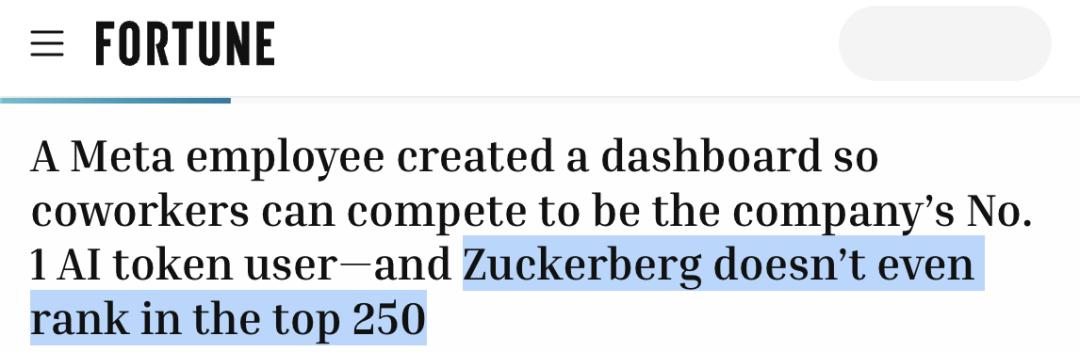
After the leaderboard was reported by the media, the author took it offline. But Bosworth immediately publicly supported it on Forbes, saying that the company's best engineers spend an amount of tokens equivalent to their annual salary, but their efficiency has increased by 5 to 10 times. "It's like getting free money. Keep racking up tokens with no upper limit."
Whether it's employees being forced or the CTO genuinely encouraging it, both Amazon and Meta, two of the world's wealthiest companies, have turned tokenmaxxing into a corporate culture.
It's not just these well - known big companies. May Habib, the CEO of the enterprise AI platform company Writer, frankly admitted three things in an interview with The Wall Street Journal: tokens are an indicator that can be "racked up," employees use the company's platform for personal projects, and not every token is creating commercial value.
She knows all this, but her attitude is still to promote it:
Once you start calculating the return on investment for the actions of a single AI agent, you'll never really start using it.
The monthly champion on Writer's internal leaderboard consumed nearly 11 billion tokens, and the runner - up exceeded 6 billion. Habib publicly said that she is keeping an eye on this leaderboard.
Sonya Huang, a partner at Sequoia Capital, even said bluntly: "We should all be tokenmaxxing."
Huang said that the leaderboard is an imperfect indicator. She admits, "But the really important question for your company is: Have my employees completely transformed into AI natives? To achieve this, you need to get them into this tokenmaxxing state."
So the essence of the debate is not "whether the leaderboard is good or not," but at what scale and stage, and for whom it is effective.
For a startup like Writer with dozens of employees, when the CEO personally monitors the leaderboard and publicly praises employees, it's a cultural signal with direct effects.
For the 12,000 developers tracked by Jellyfish, the token leaderboard has become a game that everyone knows they're playing but no one wants to talk about openly.
And with hundreds of thousands of employees at Amazon, the scale of the game is completely different, and so are the side effects.
10 Times the Tokens
Only Yields 2 Times the Output
Soon, there is data to refute this token - racking behavior on the leaderboard.
Engineering intelligence company Jellyfish analyzed the Q1 2026 data of 12,000 developers from 200 companies.
They came up with a harsh statistic:
Developers in the highest usage tier consume about 10 times the tokens per PR compared to the median, but their PR throughput is only about 2 times that of the median.
They burn 10 times the fuel but only travel 2 times the distance.
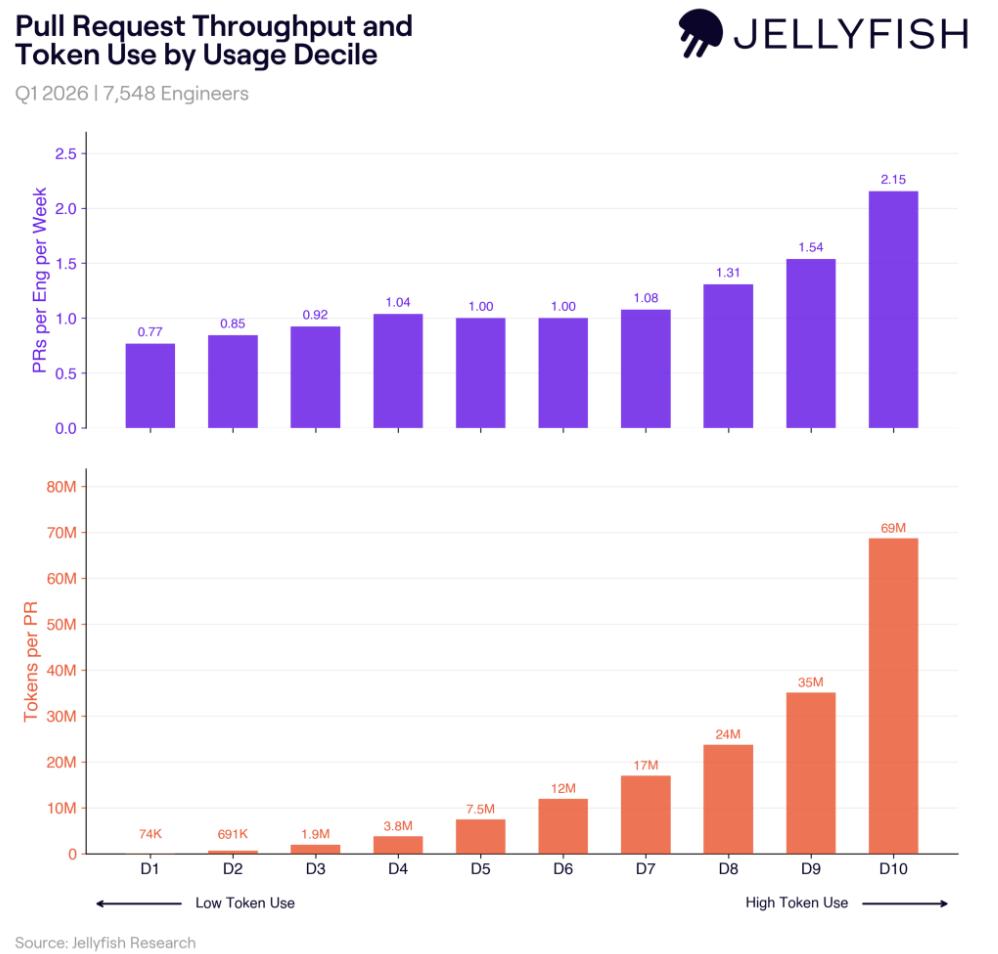
Jellyfish data: The output of the group with the highest token usage is 2.8 times that of the lowest - usage group, but the token consumption per PR differs by nearly a thousand times. Burning more tokens results in a disproportionately low increase in output.
The cost figures are even more eye - catching.
Jellyfish estimated using the public pricing of the Claude API: the median developer spends about $52 per month on AI programming; for high - usage users in the 90th percentile, this figure jumps to $691.
The token cost per PR soars from $0.28 in the lowest - usage tier to $89.32 in the highest - usage tier.
For the same task, some people spend $0.28 to complete it, while others spend $89, and the latter's work isn't much better.
Nicholas Arcolano, the head of AI research at Jellyfish, said bluntly: "The CFO has started to hold people accountable. Customers are willing to spend money on AI, but they need proof of responsible spending."
He also gave an example that seems efficient but is actually absurd:
I have five AI agents each create a version and then pick the best one. A lot of work is discarded. It may still be cheaper than having a human do it overall, but it's much more expensive than just doing it once.
Data on 22,000 developers from the engineering analysis platform Faros.ai fills in the other half of the story.
AI tools have indeed accelerated code output: the number of completed tasks has increased by 34%, and the delivery of complete functional modules (epics) has increased by 66%. However, during the same period, the number of bugs per developer has increased by 54%, the code review time has increased to about 5 times, and the code churn rate (the ratio of deleted lines to new lines) has increased by a staggering 861% in a high - AI - adoption environment.
The indicators are soaring, but the efficiency hasn't kept up.
This is a real - world example of the famous Goodhart's Law in economics: when a measurement indicator becomes a target, it is no longer a reliable measurement indicator.
The moment token consumption becomes a KPI, it loses its meaning as a proxy indicator for efficiency.
Gil Luria, the head of technology research at D.A. Davidson, told Fortune: "You get the behavior you incentivize. If you tell people they can succeed by using more of a certain resource, of course they'll use more... This doesn't seem very healthy."
Every Racked - Up Token
Endorses Capital Expenditure
Looking beyond the perspective of token users, there is another layer of logic worth noting.
The combined capital expenditure of the four ultra - large - scale cloud providers, Amazon, Microsoft, Google, and Meta, is approaching $700 billion in 2026, and some Wall Street institutions predict that it will exceed $1 trillion in 2027.
This is the largest collective bet on a single technology direction in human history.
There has to be an explanation for this money, and it's also the first question investors will ask: where is the money going, and is the demand real?
In April this year, Anthropic announced an expansion of its partnership with Amazon, promising to invest over $100 billion in AWS technology over the next decade to train and run Claude.
Currently, over 100,000 enterprise customers are running Claude through Amazon Bedrock. Anthropic's annualized revenue has exceeded $30 billion, up from about $9 billion at the end of 2025.
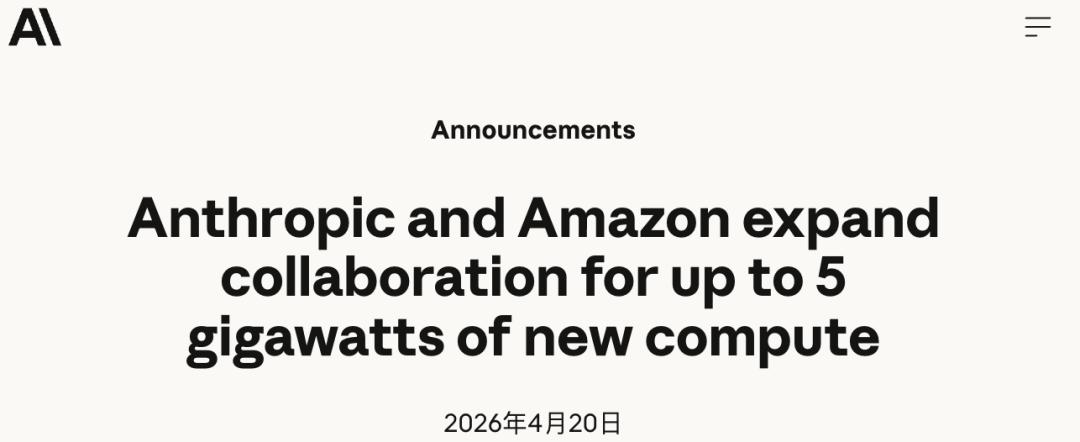
In April 2026, Anthropic announced an expansion of its partnership with Amazon, promising to invest over $100 billion in AWS over ten years.
In this structure, Amazon is not only Anthropic's largest investor, but also its most important cloud infrastructure provider and one of the largest enterprise distribution channels for Claude.
Luria calls this relationship "circular activity."
The same group of large companies has invested in upstream AI suppliers, sold computing power to external customers, and is also consuming their own computing power internally like crazy. The growth in internal token usage is not only the result of employees being pushed to use AI but also objectively serves as evidence that "AI infrastructure investment is worthwhile."
From this perspective, every token racked up by employees endorses the rationality of capital expenditure.
Arcolano proposed what he believes is the right path: don't pursue the extreme usage of a few people, but push more people to the middle of the curve.
Widespread, moderate, and continuous AI adoption is more cost - effective and sustainable than the extreme consumption of a few people. He suggests that managers use a different indicator: look at how many tokens are consumed per PR.
Arcolano is referring to a more refined perspective, but the capital narrative is often more crude.
We are at a peculiar moment: AI tools are indeed improving productivity, as the data has proven; but the incentive system built around AI usage is distorting everything in an imperceptible way.
Goodhart's Law was proposed last century, but with every technological change, it finds a new form of manifestation every once in a while, and this time, the protagonist is tokens.
References:
https://fortune.com/2026/05/12/amazon-tokenmaxxing-claude-ai-capex-meta-gil-luria/%20
https://www.ft.com/content/8ee0d3ef-9548-422d-8ff1-ebd48ad4b2ca%20
https://www.businessinsider.com/ai-tokenmaxxing-fails-as-productivity-strategy-jellyfish-2026-5%20
https://jellyfish.co/blog/is-tokenmaxxing-cost-effective-new-data-from-jellyfish-explains/%20
https://www.faros.ai/blog/tokenmaxxing
This article is from the WeChat official account "New Intelligence Yuan", author: ASI Revelation, editor: Yuanyu. Republished by 36Kr with authorization.