The number of articles generated by AI has far exceeded that of humans. AI has written everything for you. What's left in your brain?
In November 2024, the number of online articles generated by AI officially exceeded that written by humans. Merriam-Webster chose "slop" as the word of the year 2025. When machines start speaking on behalf of humans, will humans forget how to think? What's more troublesome is that when humans stop writing, the fuel for AI to learn will also be exhausted. A serial crisis about language and thinking is unfolding at a speed that most people haven't noticed.
In May 2026, the digital marketing agency Graphite released a tracking study. The conclusion was eye - catching: the number of English articles generated by AI on the Internet has officially exceeded that written by humans since November 2024.
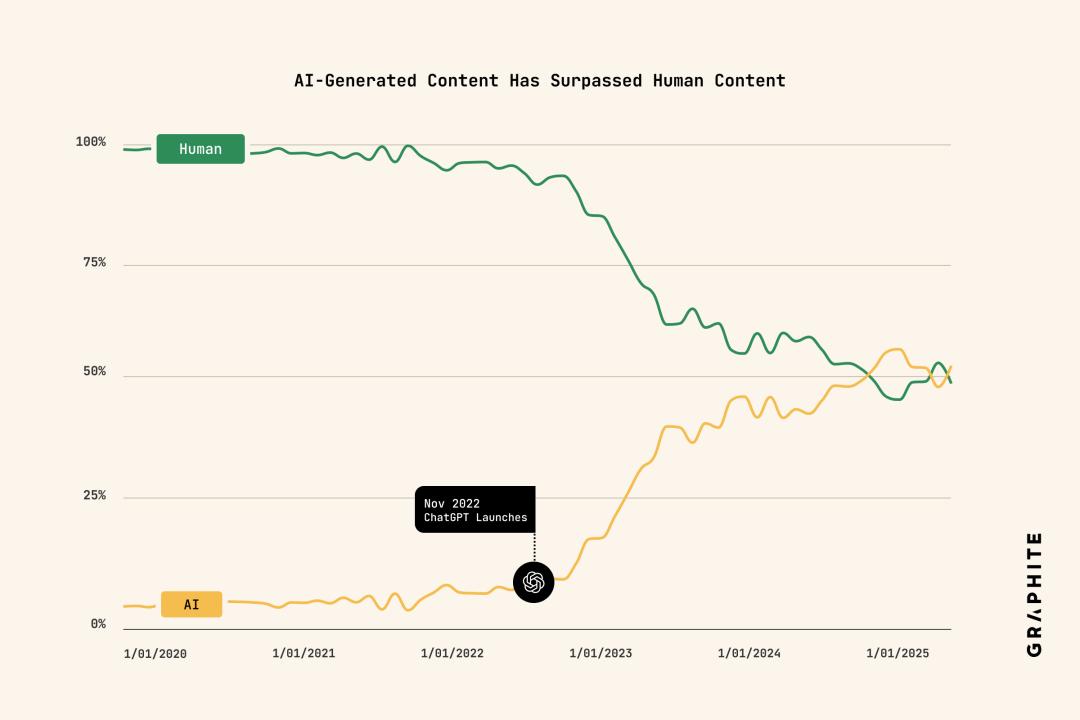
Just 12 months after ChatGPT was launched, AI - written articles accounted for 39% of the total online publications.
By 2025, this proportion has stabilized above 50% and shows no sign of decline so far.
Graphite randomly selected 43,000 articles from the CommonCrawl database and scanned each article with an AI detection algorithm. The false - positive rate was about 4.2%, and the false - negative rate was only 0.6%.
This is only in the context of "pure AI - generated" content.
Those "semi - finished products" drafted by AI and polished by humans are not even counted. Graphite admitted in the report that this kind of content may be even more common.
A word called Slop became the word of the year
This wave has a precise name.
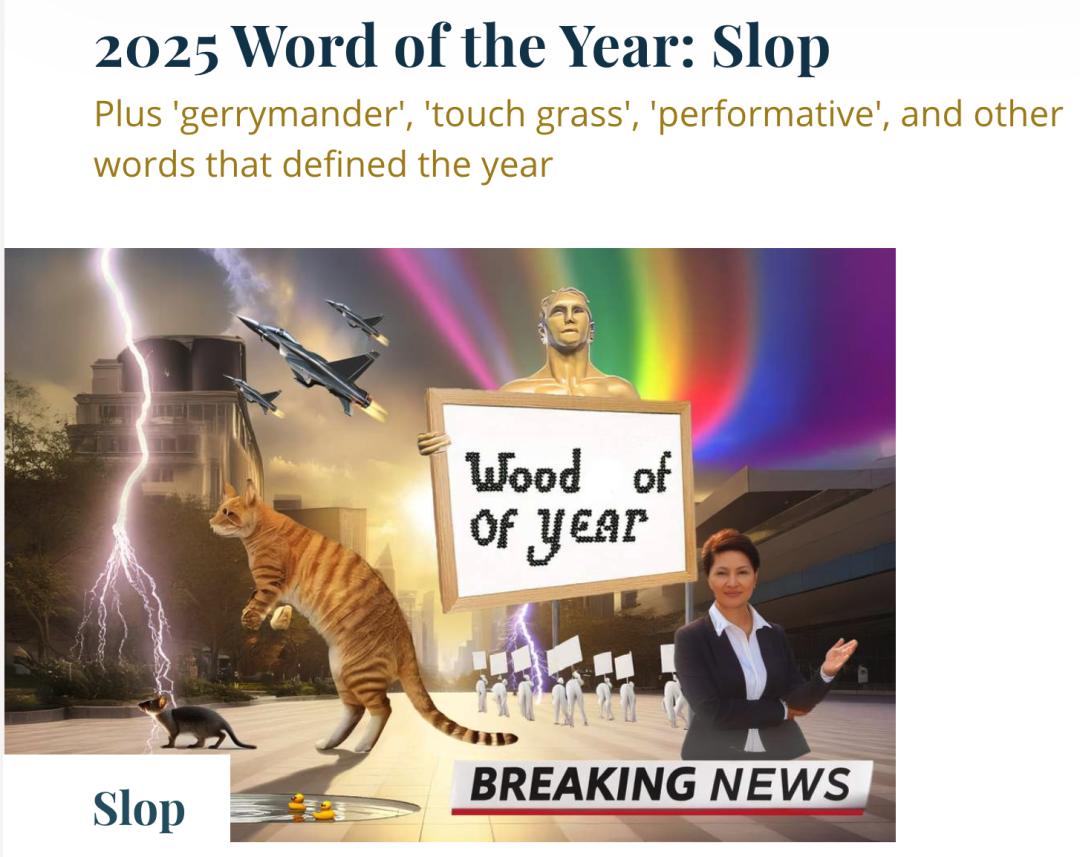
Merriam-Webster chose "slop" as the word of the year 2025, specifically referring to the low - quality content mass - produced by AI.
The New Yorker compared AI slop to the Great Molasses Flood in Boston in 1919. The storage tank burst, and more than two million gallons of molasses flooded the neighborhood. It took weeks to clean up, and the subway stations were still sticky months later.
The stickiness of AI slop is just like that of molasses.
On YouTube, Reddit, and Facebook, there are machine - generated fillers everywhere.
Literary critic Matthew Kirschenbaum warned that a "textpocalypse" is coming. In the future, the words written by humans may become rare treasures hanging on the wall, as rare as daguerreotypes.
Interestingly, machine writing is much older than we thought.
As early as 1953, mathematician Christopher Strachey used a computer at the University of Manchester to generate love letters, which was no different from the Mad Libs word - filling game.
In the same year, Roald Dahl published the short story "The Great Automatic Grammatizator". In the story, an engineer built a machine for writing stories, and it produced half of the novels and stories in the English - speaking world within a year.
Dahl wrote at the end, "Does this surprise you? I doubt it. Worse is yet to come."
Seventy years later, the "worse" has indeed come.
The boundaries of language are collapsing
The real danger of AI slop goes beyond the scope of content quality.
It is quietly changing the relationship between humans and language.
Wittgenstein wrote a much - quoted sentence in "Tractatus Logico - Philosophicus": "The limits of my language mean the limits of my world."

This sentence has a new interpretation in the AI era.
When a person stops writing by hand and outsources expression to machines, what shrinks is not only the skill but also the boundary of his thinking.
Writing has never been as simple as typing out what you have in mind. The process of writing itself is thinking.
The wording of a sentence, the progression of an argument, and the choice of a metaphor all force the writer to clarify what he really wants to say. When the fingers stop, this clarification also stops.
Leif Weatherby, the director of the NYU Center for Digital Humanities, put forward a sharp observation in his book "Language Machines". Machines can now generate language without the participation of reason, and language and reason have been completely decoupled.
He believes that since the Cold War, "the humanities have ceded language to cognitive science and computer science."
This passage sounds very academic, but for each individual, it is a very specific thing. When ChatGPT writes your weekly report, replies to your emails, and composes your WeChat Moments copy for you, do people really "think" in the time saved?
Or is it the thinking itself that is saved?
Italian writer Italo Calvino anticipated a "real literary machine" in 1967, a machine that can spontaneously create chaos and creativity.
But to this day, no matter how elaborate and fluent the text generated by large language models is, its underlying nature is still derivative, average, and predictable. In the words of German philosopher Max Bense, this is "poetry without a poet."
The nutrients are drying up
The atrophy of thinking is only half of the problem.
The other half is more hidden and more deadly.
The ability of large language models comes from a vast amount of human text.
The articles, papers, novels, forum posts, and code comments accumulated on the Internet over the decades constitute the core nutrients for training these models.
As more and more new content is produced by AI rather than humans, these nutrients are being diluted.
This problem already has a name in the academic community, called "model collapse".
In 2024, a paper published in the journal "Nature" pointed out that when an AI model is repeatedly trained on the data it has generated, the diversity and quality of its output will degenerate from generation to generation and eventually collapse into meaningless noise.
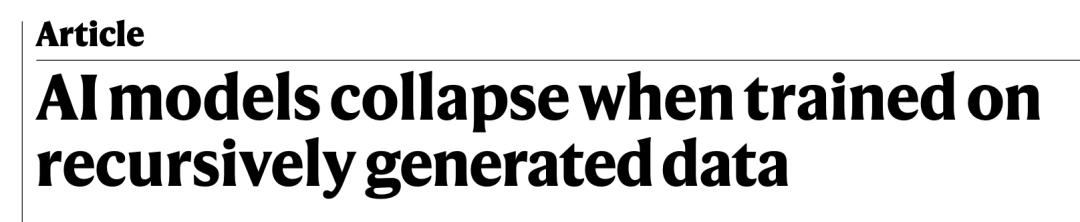
https://www.nature.com/articles/s41586-024-07566-y
This is almost the same logic as inbreeding leading to genetic degradation.
What's more, these two problems will accelerate each other, forming a flywheel.
The more AI writes, the less humans write. The less humans write, the less fresh nutrients AI can learn.
The drying - up of nutrients makes AI output more homogeneous, and the homogeneous output further reduces humans' motivation to write by themselves.
Once it starts spinning, it's hard to stop.
Graphite's data also confirms this.
Although the proportion of AI - written articles has remained basically the same since May 2024 and has not continued to soar, this may precisely indicate that the ecological niches easily filled by AI have been filled, and the remaining gaps are also being gradually infiltrated.
The endgame
If we look further into the future, what will be the endgame of AGI or even ASI?
Optimists will say that once super - intelligence appears, it will have the ability to learn and create autonomously and will not need human text as training material at all. The above - mentioned flywheel will automatically collapse.
Pessimists, on the other hand, believe that before that day comes, humans may have severely degenerated in thinking and become a species highly dependent on AI output. By then, even if super - intelligence is willing to communicate, humans will not have enough understanding to receive what it says.
Both scenarios may be too extreme.
What is more worthy of vigilance is a frog - in - boiling - water - style intermediate state. AI is not powerful enough to replace all human thinking, but it is powerful enough to make most people give up the habit of active thinking.
The language in this world has not died out, but it has become more and more homogeneous, more and more mediocre, and more and more lacking in the surprises and insights that only emerge when humans struggle to organize sentences.
Jill Lepore quoted Leif Weatherby: "Something remarkable is happening. We can talk to machines. But we haven't found the language to describe this turning point. The real problem is that this plot is supposed to be written by humans, but so far, the plot itself is slop."
Wittgenstein said that the boundaries of language are the boundaries of the world.
So, when the producers of a language switch from carbon - based to silicon - based, is the boundary of this world expanding or contracting?
Dahl said in 1953 that half of the novels in the English - speaking world were already written by machines.
"Does this surprise you?" he asked.
In 2026, this question itself has lost all rhetorical color.
References:
https://www.newyorker.com/magazine/2026/05/25/the - prehistory - of - ai - slop
https://graphite.io/five - percent/more - articles - are - now - created - by - ai - than - humans
This article is from the WeChat official account "New Intelligence Yuan". The author is "ASI Revelation", and the editor is Marco. It is published by 36Kr with permission.