Two AI TV series have made their way into Cannes. Jellyfish Intelligence aims to be the disruptor in AI content industrialization | Project Report
On May 8th, the Fantastic Pavilion section of the 79th Cannes International Film Festival announced the list of vertical-screen drama showcases.
The vertical-screen drama "The Golden Tomb Seeker" produced by Jellyfish Pictures, a Chinese AI film and television company under Jellyfish Intelligence, and "Series Tower" produced by Jellyfish Interstellar stood out from over 1,000 vertical-screen works from 120 countries around the world and became one of the 21 officially screened works.
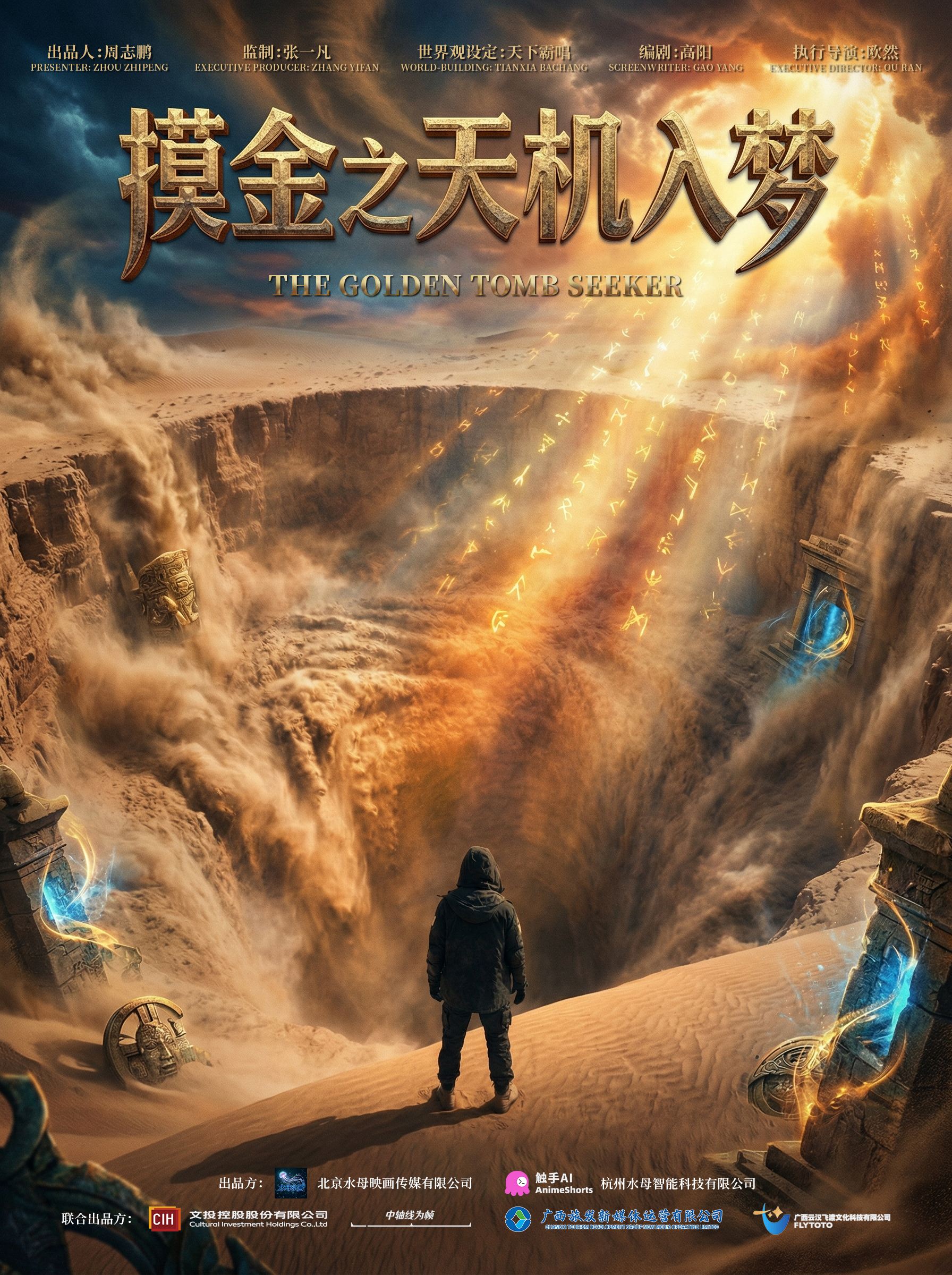
The vertical-screen drama "The Golden Tomb Seeker"
When two pure AI-produced vertical-screen short dramas appeared in the screening hall of the Cannes Film Festival, probably many people didn't expect that the AI comic dramas, once regarded as "electronic snacks", could actually stand on the stage of the global film industry.
This is not a gilding game for traffic short dramas, but a coming-of-age ceremony for an industry.
In 2025, AI comic dramas were still growing wildly with low-cost popular novels. In just one year, they completed the five-year evolution path of traditional short dramas - from shoddy production and edgy traffic to high-quality, industrialized, and IP-based, and even began to tell serious stories and go global.

"Series Tower"
"People's impression of AI comic dramas still stays at popular novels, fast consumption, and tacky style," said Zhou Zhipeng, the co-founder of Jellyfish Intelligence. "But we want to prove that AI can produce content with core, aesthetics, and international language."
In the past, AI content was ridiculed for "only creating exciting points"; now, it begins to carry heavier themes such as science fiction, suspense, and the Eastern universe. This step is a key leap for the industry from "traffic supply" to "content creation".
The craze of AI comic dramas came unexpectedly.
In 2025, the industry produced over 50,000 works in a year, but only one or two hundred of them really made money. Most companies relied on taking orders, increasing production volume, and following trends. The pictures were distorted, the plots were absurd, and the characters were deformed. Finally, they were taken off the platform in batches.
By 2026, the trend completely changed.
After the integration of Douyin and Hongguo, the platform policy directly "bet on high-quality products": the revenue-sharing coefficient of simulated human AI comic dramas was raised to 60 times, far exceeding that of live-action dramas; low-quality content was not given traffic, and edgy content was directly removed. Companies that used to survive by "increasing volume" lost their living space overnight.
Technology is also a pair of scissors. The emergence of Seedance 2.0 pushed AI videos from "single-shot splicing" to "multi-shot continuous narration", with the picture quality reaching 1080P, and the character expressions, camera movement rhythm, and scene accuracy were comprehensively upgraded. Leading content companies signed annual contracts worth tens of millions of yuan to lock in computing power, concurrency, and portrait whitelists, and the industry officially entered the era of "technological arms race".
"In the past, anyone could make AI short dramas. Now, only teams that understand content, technology, and industrialization can survive," Zhou Zhipeng said bluntly.
Different from most "order-based production" companies in the market, Jellyfish Intelligence has taken a more arduous but stable path from the beginning: a trinity of tools, production, and talent cultivation.
They not only create content but also develop tools. The domestic Touch AI and the overseas Animeshorts.ai platforms have fully AI-ized the entire process from topic selection, IP screening, and script generation to storyboarding, picture, video, and post-production. After its overseas launch, it won the Product Hunt Star of the Day, and has accumulated nearly 100,000 paying creators in Japan alone.
They not only do outsourcing but also control IPs. They have joined hands with top writers such as Tianxia Bachang, Gao Yang, and Pan Haitian, and signed contracts with major IP platforms for novels and TV dramas, holding 350 IP authorizations.
They not only focus on production capacity but also build a talent system. They are deeply involved in the AIGC job standards of the Ministry of Industry and Information Technology, took the lead in establishing the first national AI design industry-education integration community, and introduced courses into hundreds of colleges and universities. While others are short of people, production capacity, and standards, Jellyfish Intelligence stabilizes the supply side from the source.
This model allows it to run faster in the industry reshuffle.
The endgame of AI comic dramas is no longer "quick money". Jellyfish Intelligence is betting on three things in the next step: IP universe building, high-quality globalization, and serious content.
They are building an "Eastern Grand Jianghu Universe Worldview" centered around Tianxia Bachang and Gao Yang, and will successively develop a series of 30 works with content linkage and cross-drama character interactions, similar to a huge story world like the Chinese version of Marvel; at the same time, they have signed contracts with top science fiction IPs such as Pan Haitian, Wu Shuang, and Han Song, and use AI to bring to life the science fiction stories that "couldn't be made with a lot of money" in the past.
The high-quality development of AI came faster than everyone expected. The content data and audience feedback data at the smallest granularity, as well as the self-evolution of agents driven by a powerful knowledge base, can help producers, screenwriters, production companies, and investors achieve better commercial results.
The overseas market is also a long-term focus. As the earliest Chinese AI comic/comic drama team to enter the Japanese market with the best data, Jellyfish Intelligence uses Animeshorts.ai to simultaneously export AI creation tools and content to Japan, South Korea, Europe, and the United States, allowing Chinese AI capabilities and Chinese stories to go global.
"AI lowers the production threshold, not the creation threshold," Zhou Zhipeng said. "What really determines the outcome is still the story, aesthetics, and values."
From the Rococo design gene to the industrialization of AI content; from domestic blockbusters to the Cannes screening; from tacky popular dramas to the Eastern universe and hardcore science fiction, Jellyfish Intelligence has caught up with the most certain trend of the times: AI is not a substitute for content but a new infrastructure for content.
When AI starts to tell stories seriously, short dramas are no longer just fast food for killing time. And the player who first turns fast food into a feast has already stood at the door of the next round of growth.