Roundtable Discussion: When AI Enters the Industrial Frontline: Who Will Be the Most Scarce AI Talents in the Future? | 2026 AI Partner · Beijing Yizhuang AI + Industry Conference
Is it those who understand AI or those who understand business that are truly scarce?
An counter - intuitive judgment: The value of understanding AI is depreciating rapidly, while those who can make judgments in critical low - frequency decision - making are the real scarce resources in the future. High - frequency repetitive jobs are most likely to be replaced by AI. However, in low - frequency and high - impact decisions such as creating blockbuster products and building brands, human judgment remains irreplaceable. The biggest bottleneck in enterprises' AI transformation is not technology or data, but the "inability to think of application scenarios". Currently, the majority of AI profits still lie in the infrastructure layer, and the ROI of the application end has not been fully released, but the inflection point will come faster than expected.
The following is the content of the round - table dialogue, edited by 36Kr:
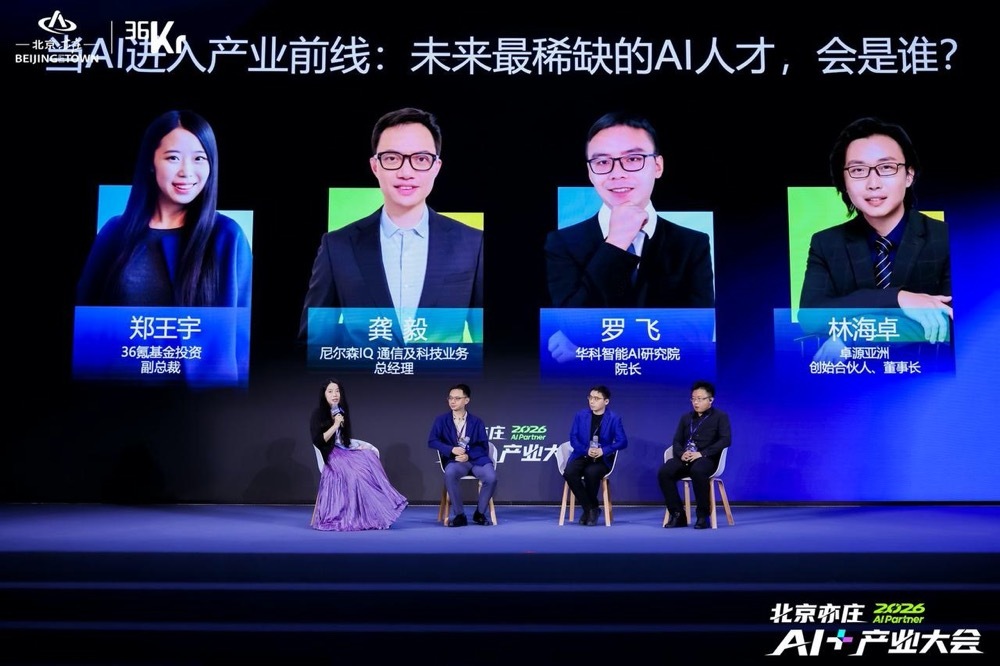
Zheng Wangyu | Vice President of Investment at 36Kr Fund (Host)
Gong Yi | General Manager of Communication and Technology Business at Nielsen IQ
Luo Fei | Dean of the AI Research Institute of Huake Intelligence
Lin Haizhuo | Founding Partner and Chairman of Zhuoyuan Asia
Zheng Wangyu: Hello, dear guests. Today, we are here to discuss "When AI enters the front line of the industry: Who will be the most scarce AI talents in the future?" and who will become the new stars in the industry. It's a rare opportunity to gather industry elites here. Please introduce yourselves in one sentence and share your perspectives in the following discussion.
Gong Yi: Hello, everyone. I'm Gong Yi from Nielsen IQ. Our industry is the data - insight industry, and I'll start my discussion from this perspective today.
Luo Fei: Hello, everyone. I'm Luo Fei from Huake Intelligence, a company listed on the Hong Kong Stock Exchange, mainly engaged in investment. The research institute I'm in is mainly focused on enabling the AI transformation of traditional industries, providing training, consulting, and support. We've encountered many pain points of traditional business owners in the process of upgrading, and I'd like to share them with you today.
Lin Haizhuo: Hello, everyone. I'm Lin Haizhuo from Zhuoyuan Asia. We are an investment institution focusing on artificial intelligence, semiconductors, and robotics, concentrating on the venture - capital market. We've invested in representative hard - tech projects such as Qingzhou Intelligence, Jianghang Intelligence, Muxi Integrated Circuit, and Pony.ai.
Zheng Wangyu: The three experts have different perspectives. In the past year, AI has shifted from a competition of model capabilities to the implementation of industrial scenarios. Now, in various industries such as consumer retail, enterprise management, manufacturing, finance, and healthcare, as well as in venture capital, the value of AI depends not only on model parameters and technical indicators but also on whether it can be integrated into real business processes. To put it simply, AI is now entering the front line of the entire industry, influencing decision - making, execution, and even business implementation results. In this process, new problems have become more urgent. As AI tools become more and more popular, what kind of talents are truly scarce? In this last round - table session, we hope to discuss the overall division of labor and changes between humans and machines, experts and tools, and organizations and individuals after AI reaches the front line of the industry from the perspectives of enterprise competition and talent.
Let's start with the first question. In this process, it's not just about giving employees an additional tool, but also about influencing decision - making processes such as consumer insight, product innovation, supply chain, channel operation, and customer management. From your perspectives, which jobs are most likely to be restructured by AI? And which aspects are suitable for AI but most difficult to implement in practice? Mr. Lin, please.
Lin Haizhuo: We currently have a view that in the investment process, those who can raise good questions still have a competitive edge. Currently, knowledge - intensive fields naturally have a characteristic that their knowledge systems can be easily described in a structured way, and the technical structure can be expressed in code, with relatively clear boundaries and right - or - wrong judgments. Under this logic, it is more in line with the current paradigm of artificial intelligence to solve problems. Occupations like accountants, lawyers, and programmers are more likely to be replaced by new technologies at present. However, raising good questions still requires human guidance. What we see now, whether it's robots, various Agents, or even lobster - feeding, still needs that step from scratch to make it better at doing something within a defined scope. Raising questions in each industry or combining one's past experience in the industry to come up with cross - disciplinary and cutting - edge ideas, and guiding a model to accumulate in that direction, is something that can more easily build individual barriers in the future.
It's easier to understand that in fields related to experience, emotions, or the perceptual level, such as psychologists and counselors, it's still a long way for AI to replace them. The combination of travel experience designers, tour guides, and embodied intelligence scenarios, which offer rich personalized and contextual experiences, is also far from being replaced by AI. From an employment perspective, AI is better at empowering rather than immediately replacing jobs. These are roughly the two dimensions.
Zheng Wangyu: The perspective of an investor is relatively macroscopic and comprehensive. Dr. Luo, in your actual observation of the industrial implementation process, which industries are more likely to be replaced by AI, and which aspects are more difficult?
Luo Fei: Now in the AI 2.0 era, we are leveraging the capabilities of large AI models. A large AI model is essentially an inference engine. We believe that wherever humans used to perform inferences, there are many application scenarios to be explored, and we need to see if the inference process can be done by AI. We've summarized three characteristics. Repetition makes it worthwhile to use AI; Standardization means that there are standards for each inference, thinking, and action process; Proficiency refers to having skilled people in the enterprise who can clearly describe the work. We need to extract the experience of these skilled people and equip the large AI model with tools to replace the work. This is one dimension.
Another dimension is the work environment. Jobs that are mainly done in front of a computer are more likely to be replaced, while jobs that involve more human interaction are less likely to be replaced. Jobs such as repeatedly searching for information, formulating plans in front of a computer, whether writing in Word, PPT, or Excel, are becoming more and more likely to be replaced as the capabilities of AI continue to grow and it can control the computer to do these tasks. Jobs closer to people and the market are less likely to be replaced. We can see that human capabilities need to shift to the left, where the left represents the market and customers, and the right represents the back - end processes. After integrating AI, human capabilities need to continuously shift to the left.
Zheng Wangyu: This means that communication, collaboration, and insight are becoming more important. I've extracted three keywords from what you said: repetition, proficiency, and standardization. Jobs with these characteristics are more likely to be replaced. Mr. Gong.
Gong Yi: My view is consistent with the previous guests. Our clients are Fortune 500 companies, and our service areas are mainly in brand marketing, product innovation, retail, and customer service. We've divided the situation into a matrix: One axis is frequency, and both guests have mentioned high - frequency and low - frequency.
The other axis is the strategic importance of decision - making. Jobs with higher frequencies and a large amount of feedback and data are easier for AI to learn from and perform reinforcement learning, so they are more likely to be replaced. For low - frequency and high - importance tasks, it's very difficult to be replaced. Why do we see a large number of replicated advertising campaigns and a high degree of automation in the brand - marketing field? From the initial creativity to production, KOL placement, and evaluation, it has become very operational. Even today, when it comes to creating high - end brands with premium value, brands targeting young people, or brands that resonate with local consumers when going global in cross - cultural markets such as Western Europe and India, these are low - frequency and high - impact tasks, and we still find it very difficult for AI to handle them. This is a scarce ability in society.
Zheng Wangyu: The next question is, where does the resistance to the implementation of AI capabilities in enterprises come from? Is it from technology, data accumulation, or organizational inertia? Mr. Gong, could you answer this question from the perspective of serving clients?
Gong Yi: Data is definitely the foundation. Even today, AI can perform searches and execute many workflows, reaching a level of 70 - 80 points in terms of skills, but there are still many hallucinations. Hallucinations are based on how we provide effective data to AI so that it doesn't generate hallucinations in the correct workflow. In the industry, a common view is that we don't need to conduct market research anymore. We just ask AI ten thousand times, and it represents ten thousand consumers. Can we then determine whether a mobile phone or a refrigerator will perform well in the market based on these "ten - thousand - consumer" responses? After a lot of verification, we find that it's not that simple.
Firstly, we need to ask if the data obtained from AI is representative enough. Secondly, each time we ask AI, whether it embeds specific data to answer the question. For example, if you are from a DINK family or a four - generation family, when answering questions, does AI represent the needs of these people? Finally, when it comes to consumer satisfaction, does a score of 9 out of 10 mean market success, or does it have to be 10? If we don't integrate these professional aspects, we'll find that the answers we get from AI are ambiguous. When the frequency is not high enough, it's difficult for enterprises to decide whether to trust AI. To sum up, there are many professional aspects in an enterprise's process that need to be resolved, either by AI or other means. AI has many requirements to empower the entire process.
Zheng Wangyu: Dr. Luo, where do you think the resistance to the implementation of AI in a company comes from? Technology, data, or organizational inertia?
Luo Fei: It mainly comes from the organization. We can see that AI technology is developing by leaps and bounds every year. People in the AI industry feel that AGI is just around the corner, and the capabilities of AI are getting stronger year by year. However, the implementation in enterprises is not as fast. There are still many resistances, mainly due to the organization's perception of AI. In the past two or three years, we've served leading enterprises in more than a dozen industries, which are mostly traditional industries such as real estate, finance, healthcare, and catering. We've investigated a question and found that there are two bottlenecks in the implementation of AI in enterprises: the primary bottleneck and the advanced bottleneck. The primary bottleneck is that enterprises can't think of more application scenarios. Everyone says that AI is very powerful, but when I ask employees or bosses of these enterprises how many application scenarios they can think of, they can't come up with many. We call this the primary bottleneck. The advanced bottleneck is that although enterprises can implement application scenarios, they don't see results after implementation. The investment doesn't yield results, and neither internal employees nor external customers are willing to use it.
I've found through research that although AI technology is developing rapidly, most enterprises are still stuck at the primary bottleneck. Even though AI has such strong capabilities and practitioners are aware of it, most enterprises still can't find application scenarios, which is the biggest bottleneck. The main reason for not being able to find application scenarios is that enterprises haven't raised their awareness of AI, haven't conducted in - depth business analysis, or have inertial thinking. Currently, AI is in the 2.0 era, but most enterprises still have a 1.0 mindset, believing that implementing AI requires a lot of pre - conditions, such as digitization, good data, and advanced technology. These pre - conditions are hindering enterprises from expanding their understanding of application scenarios. This is a huge bottleneck that I've experienced firsthand.
Zheng Wangyu: The larger the company, the more the resistance comes from the organization. I wonder how innovative companies are. What have you observed?
Lin Haizhuo: From an industry perspective, the return on investment is not that high yet. An important reason can be found in history. Before the Internet bubble in 2000, Cisco was once the world's most valuable company. In the early days of the Internet, before the birth of many companies like Google, when building the Internet highway, the core switch was once the most valuable enterprise. NVIDIA and Broadcom also occupied a major position in the market value. This shows that the main source of profits in artificial intelligence still lies in building infrastructure. When enterprises or super - individuals invest in artificial intelligence, a significant portion of the ROI cost is actually spent on infrastructure. At least currently, the infrastructure is taking a large share of the investment and profits, which is in line with what Deutsche Bank said at the beginning of this year: There is a short - term shortage of computing power, a medium - term shortage of energy, and a perpetual shortage of storage. This reflects that at the current stage of artificial intelligence development, the infrastructure is taking most of the investment and profit, and the application is still catching up.
For the majority of netizens, the large models or artificial intelligence they come into contact with are mostly substitutes for search engines. Now, when they have a question in mind, they may directly ask DeepSeek, Yuanbao, Qianwen, or Doubao instead of using a traditional search engine. People still regard AI as an alternative entry for retrieval and search engines. Truly integrating AI into the business process, such as in steelmaking, iron - smelting, heavy industry, semiconductors, and advanced design, to help in very niche fields, whether on the business - process side or in building in - depth and high - end knowledge know - how and feeding back to the work, is still a long way off, at least a two - to three - year time frame. Because in the field of large models, practitioners need to feed the large model with the questions they are interested in. In this process, people joke that they even need to "PUA" their large model to make it understand the questions. After the intelligent agent comes into contact with the data, it will continuously accumulate a specific knowledge - base structure or industry common - sense structure in that niche field, which requires a long time of feeding. However, the inflection point will come faster than expected.
Overall, there are two aspects: One is that the intelligent agent is still in the process of being fed and trained with high - end value knowledge graphs and corresponding information in vertical industries; The infrastructure is the main focus in the next few years. The large - scale infrastructure is not redundant, and a large part of the cost has to be borne by the early adopters, which comprehensively affects the ROI.
Zheng Wangyu: Mr. Lin has given us a very important reminder that we need to see the stage of development of any industry and distinguish between the current stage and future potential. Will AI make the industry more concentrated? Some people say that AI lowers the threshold for innovation. Will AI make leading enterprises stronger, or will it give more opportunities to new entrants?
Lin Haizhuo: I'm a bit worried about the topic you just mentioned. Recently, a book called The Technological Republic has become very popular, which describes a scenario where super - tech giants, in terms of data capabilities and other aspects, will reach a monopoly situation that we can't even imagine now. Most practitioners are currently thinking about what they will do if most of their job capabilities can be replaced by AI. This is a new direction that needs to be explored from a philosophical and sociological perspective. In the past, optimistic people would say that unemployed people can always find new jobs. In the era of textile machines, people could repair the machines instead of doing textile work on the front line, and they could be liberated to engage in more creative industries or apply the machines in other fields, with various innovative ways to solve the problem.
However, the number of jobs that can be replaced by artificial intelligence, whether for white - collar or blue - collar workers, may be exponential. In the short term, when these jobs are replaced, what will happen to a large number of workers in the corresponding positions? For example, there are six or seven million customer - service employees in China, and there is an obvious trend of replacement for ride - hailing drivers and taxi drivers. How can these workers be resettled? From a national perspective, we can see several signs: The country is still vigorously promoting the popularization of higher education. To solve this problem, we can't just let workers do a different type of manual work but need to integrate them into the advanced service industry, which requires a higher level of education. Therefore, the number of college - educated workers needs to be increased.
2033 will be the peak of the college - entrance examination in China. From 2033 to 2038, within five years, the number of college - entrance - examination candidates will drop by about 40%. In the long - term future, how to adjust the subject ratio and deal with the possible disappearance of some majors in universities is an important way to guide the employment direction of future practitioners. From a national perspective, we are still significantly increasing the proportion of science and engineering majors. We must have a sufficient number of the new generation