A Conversation with WANG Xiaochuan: After Stepping Off the Main Path of General Artificial Intelligence
"If you don't transform and continue on the mainstream path, you'll also have the same level of anxiety," said Wang Xiaochuan. This transformation allowed him to truly return to what he most wanted to do since the first day of his entrepreneurship: creating an AI doctor.
Interview | Deng Yongyi, Yang Xuan
Text | Deng Yongyi
Editor | Zhang Yuxin
A year ago, Wang Xiaochuan led Baichuan Intelligence to make a sharp "big brake": significantly reducing the general model team, closing multiple industry lines such as finance, and going all-in on the medical large model. However, at the same time, the entire large model industry was extremely bustling, with big companies and startups taking turns in "bombardment-style updates" - in the past six months, a new version of the general large model was released on average every three days.
So what was the seemingly quiet Baichuan doing? On May 22nd, Wang Xiaochuan quietly presented the answers: the new medical large model M4 and the Agent product "Baixiaoyi".
In the past three years, Baichuan gradually shifted from "aiming to build the best basic large model in China" to "betting on multiple implementation scenarios simultaneously", "creating a super C-end entrance", and now to "focusing only on healthcare". The team size has been continuously shrinking, some partners have left, and the original listing schedule has been postponed.
Was this seemingly bumpy path the right one? When we met Wang Xiaochuan on the eve of the new product launch, we found that he was in a more composed state: "Continuing to compete in the general model and following the mainstream path is one option. Even if the company goes public and has a glorious moment, the anxiety won't be reduced by half." He told "Intelligent Emergence", compared to the great misunderstanding inside and outside the company at that time and the sense of loneliness of choosing a non-consensus path, what he found even harder to accept was: "The company was almost two years old, but we didn't know what we were really doing and what value we were creating."
In the Internet era for a decade, healthcare has not been a lucrative business - the commercialization path is long, and the feedback cycle is measured in years. From big companies to startups, even with investments as high as billions of yuan, there are very few products that have successfully achieved Product-Market Fit, let alone achieved great commercial success.
Against this background, many companies chose to improve the efficiency of doctors or connect the links of registration, medicine, and insurance to complete the commercial closed-loop. However, Wang Xiaochuan said that these are not the most important things at present. He realized that Baichuan's C-end products must be patient-centered and increase the supply of doctors. "We need to create more doctors."
With this idea in mind, Baichuan has made more progress in the B-end healthcare scenarios: at Beijing Children's Hospital, two of Baichuan's AI pediatric doctors have officially "taken up their posts" in multi-disciplinary consultations within the hospital. In many diagnosis and treatment plans, the coincidence rate between the AI pediatric doctors and the expert consultation results reaches 95%, and they have started to be introduced to more than 150 county-level hospitals in Hebei Province.
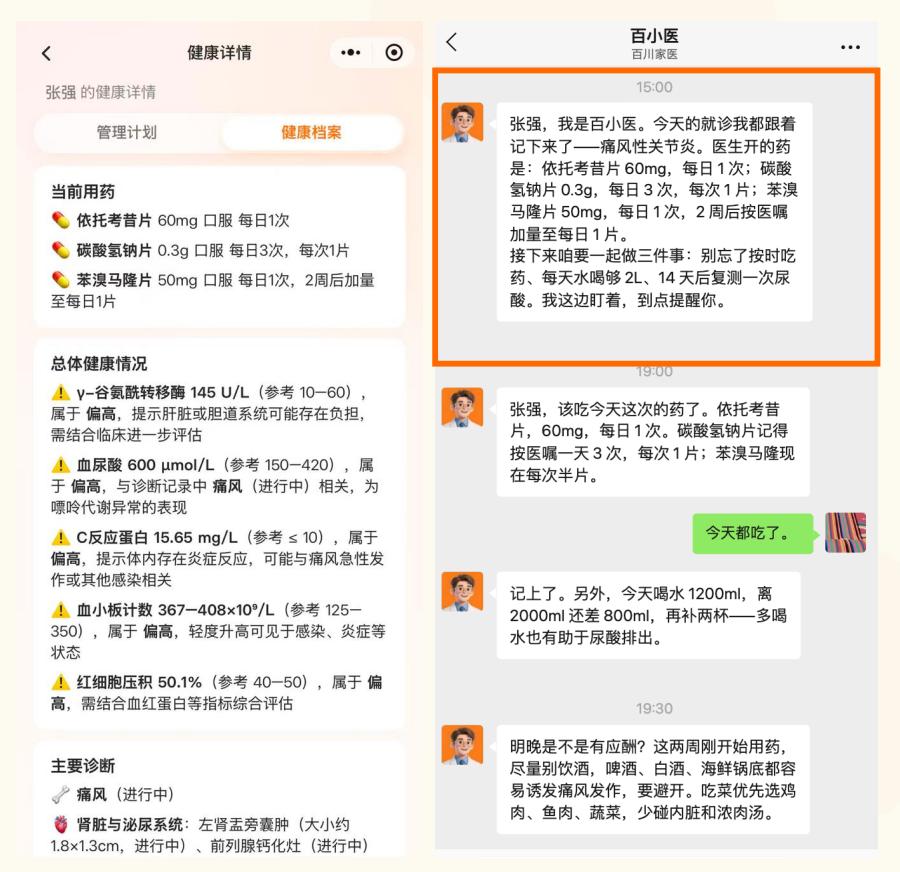
Meanwhile, on the C-end, Baichuan's newly launched Agent product "Baixiaoyi" provides services in both the App and WeChat ecosystems. "Baixiaoyi" is like an "AI family doctor". It not only provides Q&A services but also prepares a summary of the patient's condition for the doctor before the patient sees a doctor, conducts prescription analysis, manages medical records, and regularly reminds you to take medicine, have check-ups, etc.
△ Image source: Baichuan Intelligence
Wang Xiaochuan doesn't accept the view that "healthcare is a longer and slower path". "This idea itself is a kind of inertia of the era." His logic is that if the Coding Agent can become the fastest-growing application scenario in history within a few months, it means that many old boundaries have been broken.
Withdrawing from the fierce competition in the general large model and going all-in on healthcare - regarding this choice, Wang Xiaochuan candidly said, "My choice may not be right, nor may it be wrong. But I think that in the AI era, as long as we deliver enough important value to users, commercialization will come naturally."
For those AI companies still in the homogenized competition, Wang Xiaochuan's choice is at least a path worthy of serious consideration: find a problem you truly believe in and then spend enough time to answer it.
Here is the dialogue between Wang Xiaochuan and "Intelligent Emergence":
Going all-in on healthcare comes with a price
"Intelligent Emergence": At the beginning of this year, you released the medical large model M3. Today, you're releasing the new-generation medical large model M4 and the new Agent product Baixiaoyi. What are the core improvements?
Wang Xiaochuan: M4 is our closed-source medical large model, which provides services through API. A core highlight is that it adopts the Agent architecture, moving from simple conversations to clinical applications, with the ability to remember the patient's entire life cycle.
There are also several other breakthroughs: a reduction in hallucinations and an enhancement in evidence-based capabilities - we have atomized the guidelines and even incorporated expert consensus; there is also a significant improvement in the questioning ability - this is crucial for the healthcare scenario. For every two percentage points increase in the questioning ability, the diagnostic accuracy increases by one percentage point.
Currently, in complex scenarios such as oncology, M4 can complete the entire Agent workflow on its own - collecting data, checking for conflicts, accessing the gene mutation database, and providing diagnostic suggestions. M4 can make autonomous decisions. For different sub-types of tumors, it can even search the gene database. Like a lobster, it can actively ask questions and manage actively.
"Baixiaoyi" is Baichuan's new To C product, in the form of a bot on the App and WeChat. It can actively provide prescriptions, analyze medical records, and manage health data throughout the life cycle.
"Intelligent Emergence": How do you define that the M4 model is "well - done"?
Wang Xiaochuan: On the HealthBench test set released by OpenAI, our model is the best in both the Hard and Professional subsets. We didn't conduct special training for the benchmark, so a good performance of the model is truly good. This test set contains 5000 multi - round doctor - patient conversation scenarios, and nearly 50,000 evaluation rules were written by 262 human doctors. It's not something that can be achieved by gaming the rankings.
"Intelligent Emergence": Currently, the biggest industry consensus is on Coding, but Baichuan chose not to follow the general model route a year ago and went all - in on healthcare. What was your thinking at that time?
Wang Xiaochuan: The grand narrative of AGI is fine, but there must be bubbles in it. After the bubbles fade away, the pearls will remain. How to find these pearls? Everyone will bet on their own ecological niches. Since the establishment of Baichuan, what I want to do hasn't really changed - my original intention was to build a life model and create doctors. The emergence of ChatGPT has facilitated this goal.
I thought too early and too far ahead. In 2023, if you talked to people about creating doctors and building a life model, you'd find that not many people understood.
"Intelligent Emergence": But at that time, not competing in the general model was a choice that deviated from the mainstream track. Did you have any concerns?
Wang Xiaochuan: If you follow the mainstream, you'll have other fears. I'm not saying that what I'm doing now is particularly good. It's just that the mainstream also has its own problems, and different choices come with their own costs.
We started to focus on healthcare after a major adjustment in April 2025 because it was approaching the second anniversary of Baichuan's establishment, and I felt a great sense of urgency. At that time, the company was over - burdened, involved in everything from models, doctors, life models to commercialization. We just didn't know what we were doing and what value we were creating.
"Intelligent Emergence": What was the cost of this decision?
Wang Xiaochuan: Many people left at that time. Some colleagues thought that focusing on the general model was the right path, and the investors also had objections. There were all kinds of misinterpretations at that time. For example, some people spread the word that Xiaochuan might not be interested in going public and didn't care because he was already financially free.
"Intelligent Emergence": Some startups might choose not to think too far ahead and make money first to support their dreams. Going public is also an option.
Wang Xiaochuan: We weren't short of money at that time. So what if we went public?
"Intelligent Emergence": Some former senior executives of Baichuan and some of your investors had a hard time understanding your sudden change of direction.
Wang Xiaochuan: We could have found ways to increase ARR and revenue, but that wasn't what I wanted the most at that time.
First, you'd have no energy to focus on the business. Earning revenue is not on the same level as actually delivering a good product or service. Second, when the business hasn't made a breakthrough in a single area, implementing matrix management is extremely dangerous. At that time, sales, product, and technology personnel were taking on multiple roles and serving multiple products.
This state didn't match my judgment of the value the company wanted to achieve. If I didn't truly believe in something from the bottom of my heart, it would be difficult to do it well.
"Intelligent Emergence": Then how did you explain it to the investors?
Wang Xiaochuan: It was hard to explain. Investors definitely wanted the company to go public. I could only continue to do a good job in what we're currently doing.
"Intelligent Emergence": After the adjustment in April, how did the team size, structure, and Baichuan's overall working methods change?
Wang Xiaochuan: We reduced the number of employees to no more than 300, with a flat organizational structure. Now, only about a dozen people report directly to me.
We're currently divided into several major areas: one is to develop the medical model itself; the second is to create AI doctor products in the form of Agents; the third is to cooperate with the hospital system. Through AI doctors, we connect the hospital, the Health Commission, and other systems. Our goal is to use AI for four - level diagnosis and treatment.
"Intelligent Emergence": So, what's your reflection on this exploration process?
Wang Xiaochuan: The biggest reflection is that we shouldn't have launched so many business lines. You either focus on the general model or on healthcare. You can't do both at the same time. Trying to handle business, technology, and healthcare simultaneously was too much to bear at the beginning.
We don't want to replace doctors
"Intelligent Emergence": Why did you create an AI doctor bot in WeChat for "Baixiaoyi"?
Wang Xiaochuan: The bot is like a friend on your WeChat. When you ask it "Should I go to the hospital?", it might say no and suggest you observe first. A few days later, it will actively ask you "Has your condition worsened?" and also remind you to take medicine. It can actively and individually manage personal and family health.
Daily health management can't be solved by just one or two consultations. It requires long - term companionship, and assistant - type apps are hard to support this kind of continuity.
"Intelligent Emergence": Many people might ask, what's the difference in the experience between seeing a doctor with Baichuan's assistant and with Doubao?
Wang Xiaochuan: We have more extensive citations and traceability of professional literature compared to general AI assistants. But to be honest, in any field, it's hard to create a significant gap in the experience of the Q&A scenario.
In terms of product form and experience, the newly released "Baixiaoyi" adopts a dual - terminal architecture: the App terminal is responsible for providing serious medical decision - making - analyzing and comparing medical records and prescriptions; the WeChat bot terminal is responsible for daily reminders and follow - up. It's an AI doctor that will actively follow up on your health condition.
Additionally, we've built a permanent memory storage system at the bottom, which doesn't follow the context - based model. It's a storage system with a database structure - the user's uploaded medical examination reports, symptoms and conditions mentioned in the conversation, blood pressure, and medication information can all be recorded for full - life - cycle health data management. Memory ability is particularly important in the healthcare scenario, and general models often don't know what data of the user to store.
"Intelligent Emergence": How does it compare with Afu, which also focuses on healthcare?
Wang Xiaochuan: Our entry point is different. We focus on active management. After you ask a question, a few days later, it will actively ask you on WeChat "Has your condition worsened?", remind you to take medicine, and that it's time for a follow - up visit. This continuous follow - up ability is hard for apps to support, and users can feel the difference as soon as they use it.
"Intelligent Emergence": The leading company in the US AI healthcare track, OpenEvidence, has a valuation of $12 billion. They develop AI clinical decision - support tools for doctors, using top - journal papers to assist doctors in making diagnosis and treatment decisions. Can we follow this path in China?
Wang Xiaochuan: The healthcare markets in China and the US are very different. In the US, improving doctor efficiency directly leads to more income - a doctor can see 15 patients a day instead of 10, and the insurance company pays by the number of patients, so the income increases by 50% directly. However, Chinese doctors see an average of 50 - 80 patients a day and are already very busy, so there's almost no room for efficiency improvement.
"Intelligent Emergence": Then what's the motivation for developing AI - assisted diagnosis and treatment in China?
Wang Xiaochuan: Currently, the supply of high - quality healthcare in China is severely insufficient. Directly using general AI assistants to provide AI consultations for patients is difficult to integrate into the healthcare system and may easily lead to new doctor - patient conflicts. This year, some doctors from top - tier hospitals have told me that 25 out of 30 patients come to the hospital with Doubao's advice and question the doctors.
Currently, the country is advocating for active health management and strengthening grass - roots healthcare. If AI can be integrated into the healthcare system and serve as a pre - step for hierarchical diagnosis and treatment, it's a direction recognized by policies and an opportunity for new species.
"Intelligent Emergence": Then how does Baichuan improve the intelligence of the medical model?
Wang Xiaochuan: We don't focus on traditional training data. Instead, we mainly build an evaluation system for reinforcement learning.
Doctors' annotations are not about providing the correct answers but helping us establish a reward function for the test set - what kind of questioning path can ultimately lead to a good diagnosis result.
"Intelligent Emergence": We've heard that you've hired many doctors for data annotation, which is quite costly.
Wang Xiaochuan: Working with doctors for data annotation is really difficult, but it's not about the money. It's about persuading them, establishing an evaluation system, and getting the team to cooperate with them. All these need to be explored, and no one has done it before.