36Kr Exclusive | A domestic pioneer in native robot "brain chips", incubated from a Peking University project, secures hundreds of millions in financing.
Author | Qiao Yujie
Editor | Yuan Silai
Yingke learned that Beijing Weifan Intelligent Technology Co., Ltd. (hereinafter referred to as "Weifan Intelligent") recently completed a seed - round financing of hundreds of millions of yuan. The financing was jointly led by Zhongguancun Capital and its subsidiary Qihang Investment, and co - invested by Shanghai Future Industry Fund, Shixi Capital, BAW Storage, Yanchuang Group, Haiyi Investment, and Tanyuan Venture Capital.
Weifan Intelligent was founded in May 2025 and was incubated from the Peking University Brain - like Chip Laboratory (PAICORE Lab). It focuses on the R & D of the "big and small brain" integrated chips for embodied intelligence and is committed to creating a fully domestic robot core computing solution.
Yin Jilei, the co - founder, graduated from Peking University and has more than 20 years of experience in the semiconductor industry. He served as the COO and R & D vice - president of Zhicun Technology, as well as the chip R & D director of IBM and GlobalFoundries, and has also been engaged in chip R & D work in enterprises such as MTK and VIA. The core members of the team all come from leading enterprises in the industry such as IBM, Huawei, and Tencent.
With the rapid development of embodied intelligence and the continuous evolution of the robot "brain" algorithm, higher requirements are put forward for the general - purpose chip platform. The robot "brain" chip not only needs to carry multi - modal perception and AI reasoning but also needs to take into account core computing tasks such as motion control. It is the "central nerve" for the robot to complete interaction, decision - making, and execution.
Currently, the market for embodied intelligence "brain" chips is highly dependent on NVIDIA's Jetson series, but there are problems such as high prices, limited local support, and high thresholds for commercial deployment.
On the other hand, there is currently no mature domestic chip product that can truly meet the "brain" needs of the robot end - side.
In response to the difficult problem of balancing "computing power - energy efficiency - cost" in robot chips, Weifan Intelligent fully utilizes the team's long - term technical accumulation in brain - like chips and independently developed a brain - inspired GPU architecture (Brain - Inspired GPU, BiGPU). It integrates brain - like computing and general - purpose GPU computing capabilities and is originally designed for the SOTA large models of embodied intelligence. By introducing the brain - like computing mechanism, the power consumption is reduced, while the general adaptability of the GPU to various algorithm frameworks is retained, thus taking into account low power consumption, high energy efficiency, and algorithm flexibility.
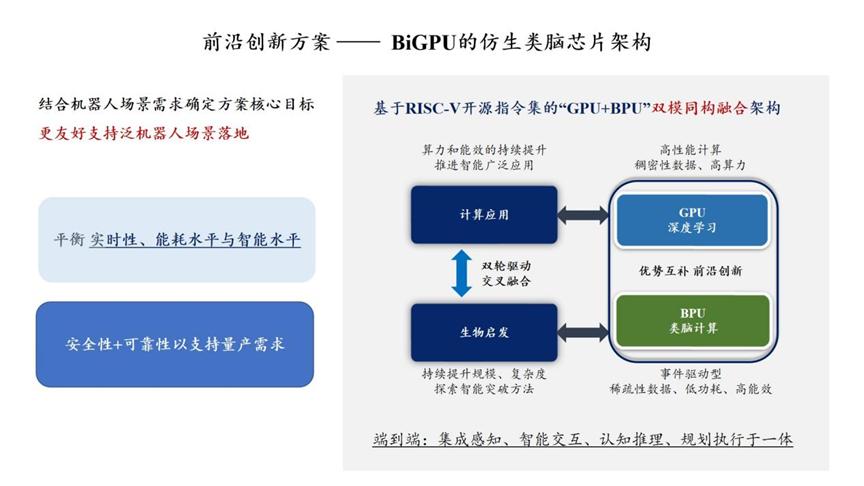
(Image source/Enterprise)
Yin Jilei introduced that more than 80% of the computing volume in the neural network is concentrated in the matrix multiplication and accumulation (GEMM) operation. In order to reduce the data volume and bandwidth requirements while ensuring the computing power effect, Weifan Intelligent converts the traditional neural network computing (ANN) into the accumulation computing in the form of a spiking neural network (SNN) through encoding conversion, significantly reducing the power consumption and bandwidth pressure while retaining the functions.
Previously, Weifan Intelligent has applied for a patent for a unified software - hardware method and related devices supporting the ANN and SNN network structures, achieving the unification of the SNN and ANN instruction formats and address addressing. Compared with the traditional heterogeneous scheme that needs to maintain two sets of systems and toolchains, this scheme can share a unified instruction set and software toolchain and is deeply compatible with the mainstream software ecosystem, thus reducing the development complexity and ecological access cost.
It is understood that the company's overall R & D cycle is planned for two years. Currently, more than half of the project progress has been completed, and it is expected that the chip will be put into production in the second quarter of 2027.
This round of financing will be mainly used to expand the R & D team, complete the development of the instruction set architecture, and promote the product definition and implementation plan.
The following is an excerpt from an interview between Yingke and Yin Jilei, the founder of Weifan Intelligent (slightly edited):
Yingke: Why choose the brain - like computing route to develop the robot brain chip?
Yin Jilei: Brain - like computing is essentially an important direction for the next - generation artificial intelligence. In fact, we are using next - generation technology to solve current problems and reserve a computing platform in advance for future algorithm evolution.
Currently, we can support mainstream architectures such as Attention Transformer, VLA, and world models, as well as run brain - like neural networks and new models after their integration. In the long run, brain - like computing is considered one of the important paths to AGI. It has the potential for extremely low power consumption and multi - function integration. For example, the human brain only consumes about 20 watts of power but can complete highly complex perception and decision - making tasks. We hope that BiGPU can not only serve the current robot algorithms but also carry future new intelligent computing paradigms.
Yingke: Have there been any previous attempts by enterprises to apply brain - like computing to the design of robot brain chips? What are the main difficulties?
Yin Jilei: There have indeed been some commercialization attempts of brain - like computing in the industry before, but most of them adopted pure SNN computing or heterogeneous schemes. The so - called heterogeneous means splicing the SNN (spiking neural network) computing module and the traditional NPU module together, which is essentially still two sets of systems. Our approach is homogeneous integration, which is equivalent to integrating the general - purpose GPU computing ability and the brain - like computing core into the same architecture. The biggest advantage of this is that it can share the same set of instruction sets and software toolchains and further achieve compatibility with the mainstream ecosystem.
The real difficulty lies in that the team needs to understand both brain - like computing and general - purpose computing architectures to complete the integration of the two technical routes at the underlying level.
Yingke: Has the company cooperated with robot manufacturers at present?
Yin Jilei: Yes. Currently, we are in communication and cooperation with some leading robot companies, and some of the projects have entered the actual cooperation stage.
Views of the investors
Sun Cisuo, Chairman of Zhongguancun Capital: The integration of multi - field technologies is a new feature of current hard - technology investment. Zhongguancun Capital always maintains a high sensitivity to cutting - edge technologies. Weifan Intelligent's brain - like chip is a typical cross - disciplinary application. By deeply splitting tasks, it can efficiently improve the execution ability at the device level. This technical ability is inseparable from Peking University's years of accumulation in the field of brain - like chips. Zhongguancun Capital hopes to combine its integrated service ability with the Weifan Intelligent team to present an inference AI chip that takes into account both performance and power consumption in the end - side scenario.
Li Lei, Managing Director of Qihang Investment: Qihang Investment focuses on national strategic hard - technology tracks such as the new - generation artificial intelligence and high - end core chips. It focuses on investing in high - quality science and technology innovation enterprises with underlying original innovation, breaking through industrial bottlenecks, and capable of achieving independent control and large - scale industrial empowerment. By investing in Weifan Intelligent, we mainly value the company's differentiated technical barriers in the field of embodied intelligence brain - like chips, which are expected to solve the industry pain points of "high energy consumption, low real - time performance, and weak adaptability" of end - side embodied intelligence. Qihang Investment will empower the enterprise in all aspects in terms of technology iteration, product mass production, and benchmark scenario implementation, helping the company continuously strengthen its technical moat and accelerate the process of domestic substitution.
Li Ran, Shanghai Future Industry Fund: Weifan Intelligent focuses on the "big and small brain" integrated chips for embodied intelligence, which belongs to the cross - cutting hard track of brain - like intelligence + embodied intelligence that Shanghai focuses on. The company independently developed the BiGPU brain - inspired GPU architecture, achieving the homogeneous integration of ANN and SNN. The technical route has original innovation and substitution value. The core of this investment in Weifan Intelligent is based on the strategic layout of Shanghai's brain - like intelligence future industry agglomeration area, aiming at the independent control of the core chips for embodied intelligence, and promoting the coordinated implementation of cutting - edge technologies and the industrial ecosystem.
Han Nan, Partner of Shixi Capital: There are three main reasons for investing in Weifan Intelligent, a brain - like chip enterprise. First is the track trend. Global AI is shifting from high - power - consumption and large - computing - power to end - side ultra - low - power - consumption intelligence, and brain - like computing is an inevitable direction for industrial development. Second is the team and technology. The company has mature full - stack R & D capabilities and has formed independent core technologies in spiking neural networks and neuromorphic architectures, getting rid of the limitations of traditional computing power. Third is the implementation prospect. The products precisely match the needs of physical industries such as humanoid robot brains, edge intelligence, and industrial intelligence, with a clear commercialization path. In the future, with the full - scale explosion of downstream applications, the enterprise is expected to achieve large - scale production quickly, and its growth space is worthy of long - term expectation.
Qin Xianglong, Partner of Haiyi Investment: Relying on the original brain - like + general - purpose computing chip architecture, Weifan Intelligent focuses on creating a "big and small brain" integrated chip that is suitable for multiple scenarios and cost - effective at the end - side. The company's founding team has in - depth experience in the entire chain of embodied scenario understanding, chip architecture design, toolchains, algorithm R & D, and engineering implementation, with profound technical accumulation and sufficient practical experience. At the same time, the successful entrepreneurial resume of the founder of Weifan Intelligent has also established very good understanding and trust with the Haiyi team in the past. Haiyi Investment is optimistic about Weifan Intelligent's close alignment with the national science and technology development strategy and its focus on domestic independent and controllable chips. It has broad development prospects in the future.