Roundtable Discussion: Seeing Real Results: From Technology to Prescription, the Scenario Implementation and Value Closed-loop of AI + Healthcare | 2026 AI Partner · Beijing Yizhuang AI + Industry Conference
From the technological showmanship five years ago to the current clinical necessity, AI + healthcare has finally passed through the hype of "proving what it can do" and entered the deep - water zone of "solving pain points". Instead of having the utopian idea of replacing doctors, it only serves as an assistant to relieve the burden. This dialogue tells us that the first step in the implementation of AI healthcare is not to convince the hospital dean, but to win the trust of department directors; the key is not a single - point breakthrough, but the linkage of multiple data to form a closed - loop.
The round - table dialogue directly addresses the real bottlenecks for AI to enter hospitals: difficult system integration, doctors' aversion to trouble, and unclear responsibility demarcation. Starting from the nine - year in - depth practice of Zuoyi Technology, from Peking Union Medical College Hospital to Zhongwei, Ningxia, it reveals the differentiated logic of hierarchical implementation - improving efficiency in tertiary hospitals and supplementing human resources at the grassroots level. Using the common pain point of medical record generation as the center, it connects with triage in the front and follow - up in the back, turning the "black technology" into a tool that doctors are willing to open every day.
The following is the content of the round - table speech, compiled and edited by 36Kr:
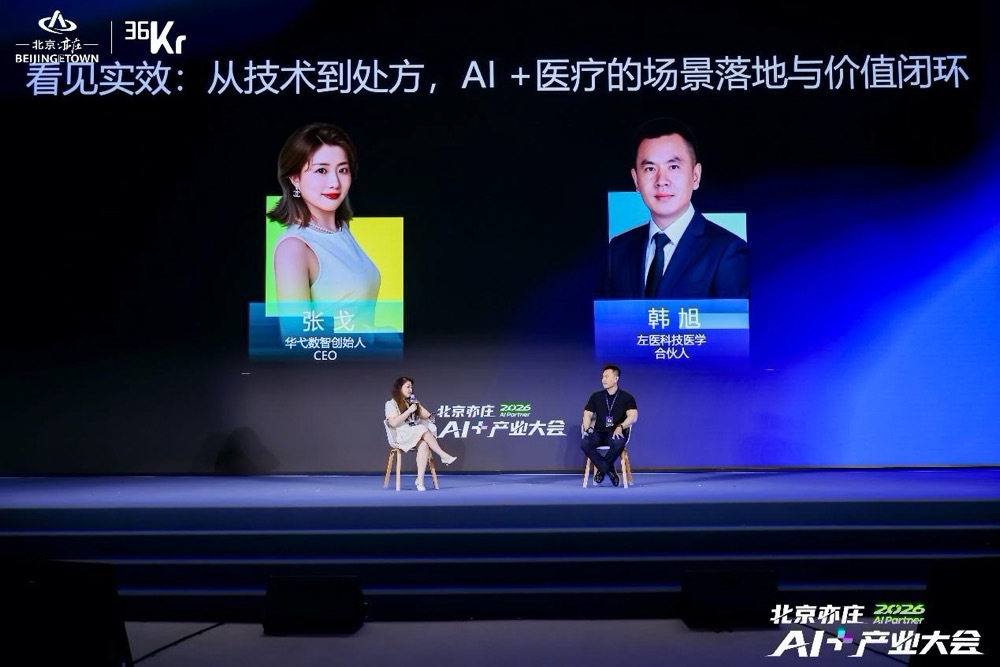
Zhang Ge | Founder & CEO of Huayi Digital Intelligence (Host)
Han Xu | Medical Partner of Zuoyi Technology
Zhang Ge: Hello, dear guests and friends watching the live broadcast. I'm Zhang Ge from Huayi Digital Intelligence, the host of this round of dialogue. I'm very glad to welcome Mr. Han. Today, we'll talk about a very practical topic: how AI healthcare is actually implemented. First, please let Mr. Han say hello to everyone and tell us in 30 seconds what the essential difference is between what Zuoyi is doing now and the wave of AI - assisted healthcare enthusiasm five years ago?
Han Xu: Thank you, Mr. Zhang, and thank you for the invitation from the organizer. I'm glad to have this opportunity to communicate and share with you here. Zuoyi Technology has been deeply involved in the AI + healthcare industry since 2016. We've also experienced different stages of the development of AI healthcare in China. In our understanding, five years ago, AI healthcare was more driven by technology and capital. People were thinking about how to use AI technology to transform healthcare or even replace doctors. The things done were more from a technical perspective and didn't solve the real clinical problems, so it was difficult to implement. Now, we start from the real clinical needs, focusing on what really troubles doctors in their daily work, and thinking about using AI technology to reduce doctors' work pressure, improve quality and efficiency, and at the same time, make it more convenient for patients to seek medical treatment.
Zhang Ge: From Mr. Han's summary, we can feel that medical AI is going deeper and more practical. First, we're very concerned about the issue of scenario implementation. When AI healthcare enters the hospital, which link do you think should be opened up first or where should we start? For example, should we persuade the leaders from top to bottom, train doctors, or connect with the medical information system? Which link is the bottleneck?
Han Xu: From our experience, when AI healthcare enters the hospital, the first step is definitely not to persuade the dean, nor to connect with the HIS, EMR systems or conduct full - staff training. The first step should be to go deep into the clinical front - line and departments, and win the support of department directors and key doctors, so that they are willing to conduct pilot projects. After seeing real results in this process, then we can proceed with subsequent promotion. As for connecting with the EMR and HIS systems, there are certain technical difficulties, and at the same time, multi - party coordination is required, with high costs and long time cycles. Starting with system connection is very likely to become a bottleneck.
Doctor training without real things and real effects is just a form and has no practical meaning. As for hospital - wide promotion, after conducting department pilot projects and achieving certain results, communicating with hospital leaders with real data and promoting it across the whole hospital will be more convincing.
The second bottleneck: 1. System connection. There are many systems in the hospital, with many brands and manufacturers, and there are no standard interfaces. The data formats, including fields and permission management, are all different. Now, hospitals also attach great importance to data security. If we want to make a connection, we need to coordinate multiple departments such as the information department and the medical department repeatedly, which is a very long process and a major bottleneck.
2. Problems encountered in the implementation process: doctors' acceptance. Doctors are a relatively conservative group with a strong sense of risk aversion. When a new tool is introduced, they are reluctant to change their inherent work habits, fearing that using the tool will increase their learning and usage burden and even increase their workload. Moreover, they also have certain concerns about the accuracy and risks of AI products. In the actual project implementation process, it's very difficult to make doctors accept and be willing to use it.
Zhang Ge: You've mentioned very practical pain points in the implementation process, such as information system connection and permission management. These are very important bottleneck - type problems to be solved in information - related projects. You've not only connected with top - tier tertiary hospitals like Peking Union Medical College Hospital, but also implemented the cloud - based healthcare project in Zhongwei, Ningxia. What are the differences between the implementation logic of grassroots medical care and that of tertiary hospitals? Are there greater difficulties, or are there different entry points due to different levels of informatization construction in different hospitals?
Han Xu: For top - tier tertiary hospitals like Peking Union Medical College Hospital and grassroots medical institutions, the demand points for introducing AI healthcare systems and using AI healthcare products are different, and the implementation paths and entry points are also different. For example, tertiary hospitals focus more on in - hospital operations. The main problems they need to solve are that expert resources are precious and doctors' time is very limited. They are more concerned about how to improve in - hospital efficiency and refine the efficiency of each process link. These are the demands of tertiary hospitals. Grassroots medical institutions face the problem of a shortage of doctors and heavy daily work. Although they deal with common diseases and have a lot of trivial matters, they also have the pressure of family doctor contract services. Each doctor has to sign contracts with one or two thousand residents, which is beyond their service capacity. And residents also have certain demands or requirements for family doctor contract services, but the service capacity is not up to par.
For grassroots medical institutions, the characteristics of using AI healthcare products are as follows. On the one hand, through AI products such as medical record generation, intelligent follow - up, and intelligent health records, they can help with daily trivial and procedural work, and also hope to use AI products to serve patients. For tertiary hospitals like Peking Union Medical College Hospital, the demand for out - of - hospital patient service is not very high. They focus more on solving in - hospital efficiency problems.
Zhang Ge: Different doctor groups have different demands. By solving their needs and improving their work efficiency, we can make them more receptive to AI products. Have you ever encountered scenarios where doctors are resistant to using AI products? Do you have any experience in making front - line medical staff more receptive?
Han Xu: This is also an important bottleneck. Medical staff are initially resistant and wait - and - see about many new tools for several reasons. First, they worry that it will increase their burden as they need to learn and operate. There are many systems in the doctor workstation, such as HIS and EMR systems. Switching between systems is very troublesome. Second, there is a risk that if the generated content has problems, it will cause certain risks to them. We can start from several aspects to solve this problem. First, our products should be as close as possible to their daily work, not forcefully bind them, and try not to disturb them. It means integrating with their original systems instead of requiring them to learn and operate separately, reducing the psychological burden of learning a new system.
Second, in terms of responsibility demarcation, all content generated by AI must be confirmed by doctors before it can be sent out. Doctors can also modify it at any time. The final decision - making power is in the hands of doctors, and they can control the risks, which will be much better.
Zhang Ge: AI - assisted diagnosis and treatment can improve the work efficiency of real doctors.
Going back to the opening question, AI healthcare was also popular five years ago. At that time, it was about AI - assisted diagnosis and AI image reading. What is the core difference between what Zuoyi Technology is doing now and that time? Is it the change in technological capabilities? AI technology is advancing rapidly, and application scenarios have changed over time. Or is it the change in people's understanding of healthcare itself?
Han Xu: First, there has been a great change in the understanding and perception of the healthcare industry in the AI healthcare field. Five years ago, the focus was on assisted diagnosis and treatment, mainly trying to directly enter the diagnosis and treatment link, which is the core part of healthcare. Through technology, people wanted to directly solve the most difficult problems, such as the assisted diagnosis of difficult and complicated diseases and the recommendation of tumor treatment plans. In the scenarios with the highest professional barriers, people wanted to make efforts, but in fact, they faced many problems. First, the implementation difficulty was very high, doctors were not very willing to use it, and the effect was not particularly good. Now, people have gradually realized that in terms of doctors' daily work, diagnosis and treatment only take up a small part of their time. Most of their time in the hospital is spent on handling documentary medical records, medical history organization, follow - up, communicating with patients, doing procedural work, and submitting reports, which take up a lot of their time. Now, we have changed our thinking from trying to solve the most core diagnosis and treatment problems to helping doctors handle daily procedural, repetitive, and transactional work, serving as their assistants and helping them spend more time on the real diagnosis and treatment link. The scenarios have also changed. Previously, people were mainly doing assisted diagnosis and image recognition of lesions. Now, different links before, during, and after diagnosis are being used for triage, pre - consultation, medical record generation, disease management, etc.
The development of technology is very important and helps to achieve the above - mentioned two points. With the maturity of large - model technology and the ability of multi - modality, from initially only being able to process text to now being able to handle pictures, images, voices, etc., the entire AI can assist doctors in more and more comprehensive service work.
Zhang Ge: From the evolution of technology itself to the data integration of our business over the years, it is indeed a complex evolutionary process, a process of qualitative change triggered by quantitative change. You have a product called multi - data linkage, which integrates multiple data such as pre - consultation, dialogue transcription, electronic medical records, and out - of - hospital OCR to generate medical records. Did this ability exist before? If there is no multi - linkage, can our AI medical record generation still achieve the 90% accuracy mentioned earlier?
Han Xu: The abilities of pre - consultation, OCR, voice - generated medical records, and in - hospital data processing are single - point capabilities that we have gradually developed. We previously had a separate pre - consultation product and also did medical record structuring processing for in - hospital data in hospitals, OCR extraction, and voice - generated electronic medical records. Each single - point tool has certain defects for the final medical record generation. If we only generate electronic medical records based on the single - time dialogue between doctors and patients during the consultation, since the doctor's consultation time is very short, they may habitually not ask some things, which will lead to the omission of some key points. If we only rely on what the patient fills in by themselves, due to the patient's lack of medical professional knowledge, they may exaggerate their condition or omit important information. If there is no OCR ability for in - hospital data, many patients will bring a large number of out - of - hospital examination reports and test sheets for consultation. Without this ability, doctors can only manually enter the information or repeat the results by voice, which also wastes a lot of time.
By connecting these four single - point abilities together, first of all, they can complement each other, and the missing information in a single link can be supplemented by another link. Different links, such as the pre - consultation link before diagnosis, the voice link during diagnosis, and the link of past medical records and in - hospital data, can verify each other. For example, we may find some contradictory points. The AI large model may have the problem of hallucination, and through mutual verification, we can try to avoid such problems. First, this is the supplement of multi - dimensional data, and second, it is also a guarantee for the quality of medical record generation. Without the supplement of multi - dimensional data, the quality of medical record generation definitely cannot reach the current level.
Zhang Ge: This is the cross - correlation verification of multiple dimensions and the iterative update of technology, which ultimately leads to the result.
Speaking of technological updates, from Peking Union Medical College Hospital to Ditan Hospital's infectious disease diagnosis and treatment intelligent agent, to Chongqing Medical University Children's Hospital's Chong'er Xiaoyi, and then to the AI family doctor project in Zhongwei, Ningxia, in which of these scenarios is AI involved the most deeply, and in which is it involved the least? What do you think determines the depth of AI involvement?
Han Xu: In our view, for specialized intelligent agents, such as the infectious disease intelligent agent in Ditan Hospital and the specialized intelligent agent in the Affiliated Traditional Chinese Medicine Hospital of Chongqing Medical University, the requirements for AI are relatively higher. For specialized or specific diseases, it is necessary to match the special logic of consultation, diagnosis, treatment plans, and medical record writing, and it is necessary to establish a knowledge base for specialized diseases and make adaptations. AI will be involved more deeply.
Secondly, for Peking Union Medical College Hospital, it mainly focuses on improving the efficiency of the entire outpatient process, such as accurate appointment, medical record generation, triage, and pre - consultation. It does not involve the core link of diagnosis and treatment and is more about peripheral clinical matters, so the requirements for medical professionalism are slightly lower.
The AI family doctor project in Zhongwei, Ningxia, mainly focuses on providing inclusive health services to regional residents, such as patient education, popular science, and regular follow - up, and the involvement of AI is the least.
Zhang Ge: This is a very great project. From the technological equalization and empowerment in the AI era to bringing high - quality resources into thousands of households, it is a remarkable cause. From the hospital's perspective, in terms of ROI, how do we talk about the conversion rate with hospital deans?
Han Xu: When communicating the project's benefits with hospital managers, first of all, we should try to avoid using professional terms such as models, parameters, and technical routes for communication.
We should more focus on the aspects that managers care about, that is, short - term benefits. For the project in Peking Union Medical College Hospital, the most obvious short - term benefit is the saving of labor costs. In the pilot department, previously, one or two people were needed to handle the organization of medical records, medical history, follow - up, and daily transactional work. The AI system can help save one or two labor costs, and it is easy to calculate how much labor cost it can save for the hospital.
Second, from the perspective of hospital operation, through the improvement of the efficiency of consulting rooms and the increase in doctors' reception efficiency, without expanding the number of consulting rooms, the hospital can receive more patients in unit time, thus improving the revenue efficiency. Through the standardized generation of medical records, it can also reduce points deductions and fines in medical insurance inspections and evaluations, which is also an obvious benefit. In the long run, the construction of specialized intelligent agents can help the hospital establish a specialized benchmark in the region, which is conducive to building its characteristic departments. In terms of risk management and control, it leaves a full record, and all dialogue data are stored. In case of doctor - patient disputes or the demarcation of medical responsibilities, there is a data source, which can try to avoid disputes. We can communicate from these aspects. The principle is to conduct hospital - wide promotion after having certain data from department pilot projects and calculate the accounts clearly.
Zhang Ge: In the retrospective mechanism, from the perspective of risk management and control, there is indeed an unavoidable problem: who is responsible for AI errors? We know that generative artificial intelligence has the characteristic of uncertainty in the generated content, which is its technical feature. If the AI - generated medical record has an error and the doctor fails to notice the error details and directly adopts it, how should the responsibility be demarcated? Zuoyi has a lot of business - level experience when signing contracts with hospitals. Please also explain this part to us.
Han Xu: Under the current laws and regulations, the ultimate responsible subjects for medical behavior are doctors and medical institutions. In the contract signed with the hospital, it is clearly stipulated that doctors must review all content generated by AI, such as medical records. If problems arise due to the doctor's failure to review, the doctor and the hospital shall bear the main responsibility. Our responsibility is for the defects of the product and service. For example, if problems arise due to model problems, data problems, or some inherent limitations of the AI product that are not clearly defined, the manufacturer needs to bear