South Korean funds are snapping up Science and Technology Innovation 50, robotics, and chip ETFs.
Yesterday, the A-share market experienced a significant correction, but South Korean investors went against the trend and bought multiple high-quality targets, initiating a bottom-fishing mode.
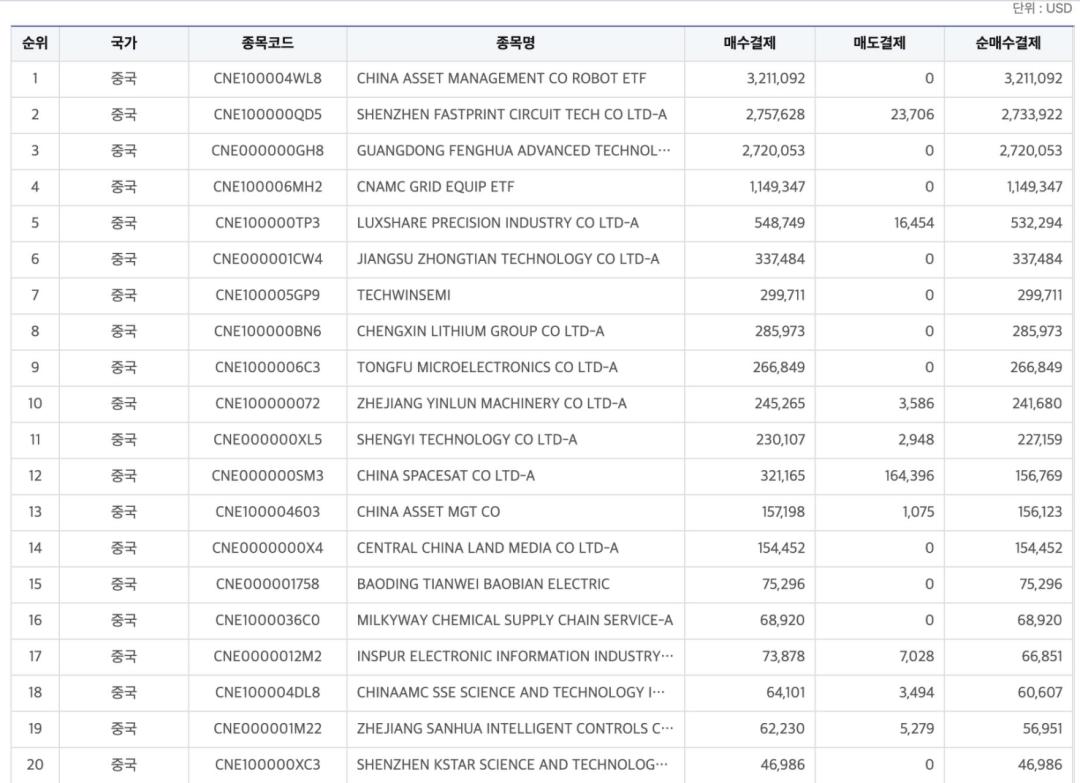
Data from the Korea Securities Depository shows that during the decline of the A-share market on May 21st, the target with the highest net purchase amount by South Korean investors was the Huaxia CSI Robotics ETF, with a net purchase amount of $3.2111 million. In addition, products such as the Huatai-PineBridge CSI 300 ETF, Huaxia Semiconductor Chip ETF, and Huaxia STAR 50 ETF also saw additional purchases by South Korean investors.
In terms of individual stocks, XingSen Technology, the leading PCB company, received a net purchase of $2.7339 million from South Korean investors yesterday. Fenghua Hi-Tech, the leading company in the electronic components sub-sector, received a net purchase of $2.7201 million. In addition, Tongfu Microelectronics, a semiconductor packaging and testing enterprise, Shengyi Technology, the leading copper-clad laminate company, and Luxshare Precision, the leading consumer electronics company, also saw additional purchases by South Korean investors.
From the overall layout of South Korean investors, this counter-trend additional purchase focuses on multiple technology stocks in China's high-end manufacturing industry chain. Industry insiders analyzed that China's sub-sectors such as robotics, semiconductors, and consumer electronics have a complete industrial supporting system and possess scarcity and competitive advantages globally. Even though the South Korean domestic technology stock market has shown strong performance, South Korean investors still went against the trend and increased their positions in high-quality A-share technology stocks, fully demonstrating the unique attractiveness of China's technology assets.
Industry institutions emphasized that although the A-share technology sector has experienced volatile adjustments in the short term due to market sentiment, the long-term positive development trend has not changed. In the future, the accumulation of market profit-making effects driven by the technology industry trend may promote the positive cycle of incremental funds to transform from "quantitative change" to "qualitative change", which is expected to provide support in terms of both funds and sentiment for the subsequent market.
South Korean investors made net purchases of ETFs such as Robotics, Chip, and STAR 50
The latest data from the Korea Securities Depository shows that when the A-share market declined on May 21st, South Korean investors went against the trend and bought multiple high-quality targets.
The security with the highest net purchase amount by South Korean investors yesterday was the Huaxia CSI Robotics ETF, with a purchase amount of $3.2111 million, a selling amount of $0, and a net purchase amount of $3.2111 million. Industry insiders analyzed that relying on a complete supply chain and core technologies, China's robotics industry has built strong barriers at the industrial chain and application levels. The investment targets in relevant sub-industries possess scarcity globally, thus attracting the layout of overseas investors.
In addition, the Huaxia Power Grid Equipment ETF and the Huaxia China Securities Semiconductor Chip ETF also received net purchases from South Korean investors yesterday, with net purchase amounts of $1.1493 million and $0.1561 million respectively.
Industry insiders pointed out that recently, South Korean domestic chip stocks have strengthened, and stocks such as Samsung Electronics and SK Hynix have repeatedly hit new highs. However, even when there are sufficient investment opportunities in the domestic market, South Korean investors still went against the trend and increased their positions in Chinese semiconductor ETFs during this A-share market adjustment, which fully demonstrates the investment attractiveness of China's semiconductor industry.
It is also worth noting that South Korean investors also made net purchases of products such as the E Fund CSI Robotics Industry ETF, Huaxia STAR 50 ETF, Harvest CSI 300 Dividend Low Volatility ETF, and Huatai-PineBridge CSI 300 ETF yesterday.
South Korean investors not only made large-scale purchases of technology-themed ETFs such as robotics and chips but also bottom-fished broad-based products tracking the CSI 300 and STAR 50 indexes, indicating that South Korean investors not only are optimistic about the development of the A-share technology sector but also recognize the overall investment opportunities in the A-share market.
Leading semiconductor and consumer electronics companies also received net purchases
In addition to ETFs, South Korean investors also bought multiple high-quality individual stocks yesterday.
The individual stock with the highest net purchase amount by South Korean investors yesterday was XingSen Technology, with a purchase amount of $2.7576 million, a selling amount of $0.0237 million, and a net purchase amount of $2.7339 million. XingSen Technology is a leading enterprise in domestic sub-sectors such as PCB printed circuit boards and IC semiconductor packaging substrates, and it has deeply benefited from the AI wave.
The second-highest net purchase amount was for Fenghua Hi-Tech, with a purchase amount of $2.7201 million, a selling amount of $0, and a net purchase amount of $2.7201 million. Fenghua Hi-Tech is a leading company in the domestic electronic components sub-sector, mainly engaged in passive components such as chip resistors, capacitors, and inductors, and it has deeply benefited from the development of AI and new energy.
In addition, South Korean investors also increased their positions in high-quality targets in sub-sectors such as semiconductors, power equipment, consumer electronics, and auto parts.
In the semiconductor sector, South Korean investors made net purchases of Tongfu Microelectronics, an integrated circuit packaging and testing enterprise, and Shengyi Technology, the leading copper-clad laminate company, with net purchase amounts of $0.2668 million and $0.2272 million respectively.
Luxshare Precision, a popular target in the consumer electronics field, also received significant purchases from South Korean investors yesterday, with a net purchase amount of $0.5323 million.
ZTT, a communication and power equipment enterprise, and Yinlun Machinery, an auto parts enterprise, also received net purchases from South Korean investors yesterday, with net purchase amounts of $0.3375 million and $0.2417 million respectively.
From the overall layout of South Korean investors, this counter-trend additional purchase highly focuses on multiple technology stocks in China's high-end manufacturing industry chain, covering multiple technology sub-sectors such as PCB, semiconductor packaging and testing, consumer electronics, new energy power equipment, and auto parts.
Industry insiders analyzed and pointed out that China's high-end manufacturing industry chain has a complete supply chain system and possesses significant scarcity and competitive advantages globally. Even if the relevant targets experience short-term fluctuations, the short-term adjustment at the sentiment level will not change the long-term positive trend.
Looking forward to the future market, Huaxia Fund believes that the market may enter a volatile period, mainly characterized by phased volatile adjustments, but the long-term positive trend will not change. The institution analyzed that currently, AI technology is the main contradiction in the market. The short-term adjustment is mainly due to investors' concerns about overcrowding and high valuations, as well as the accelerated realization of profit-making funds. The medium-term trend will still return to the fundamentals of the sector, and the direction is still in the expansion stage. The rise of the technology sector has strong fundamental support.
Huitianfu Fund believes that the current overall market risk may be relatively controllable. Driven by the technology market, the stock markets in Japan and South Korea are still rising significantly. The correction in the domestic market may be more due to its own game nature. Since April, the accumulation of market profit-making effects driven by the technology industry trend may promote the positive cycle of incremental funds to transform from "quantitative change" to "qualitative change", which is expected to provide support in terms of both funds and sentiment for the subsequent market.
This article is from the WeChat official account "Science and Technology Innovation Board Daily", author: Li Di. It is published by 36Kr with authorization.