Roundtable Dialogue: Cost Reduction and Efficiency Improvement, Risk Control and Intelligence Enhancement: A Practical Sample of Digital Employees Driving the Digital and Intelligent Transformation of the Financial Industry | 2026 AI Partner · Beijing Yizhuang AI + Industry Conference
Over the seven - year cooperation between Kingdee ZVee and Galaxy Futures, from RPA projects worth hundreds of thousands to intelligent process reconstruction worth millions, one thing has been proven: the value of enterprise - level AI lies not in answering questions, but in getting things done.
From RPA to Agentic Flow, Kingdee ZVee and Galaxy Futures have established a complete path for enterprise process intelligence in seven years. Now, digital employees have been implemented in over 50 scenarios at Galaxy Futures, executing over 3,000 business processes daily with an accuracy rate of 99.97%. In 2025, the two parties joined hands again to explore a new paradigm of "intelligent processes", aiming to endow processes with the capabilities of self - construction, self - optimization, and self - evolution.
The following is the content of the round - table dialogue, edited by 36Kr:
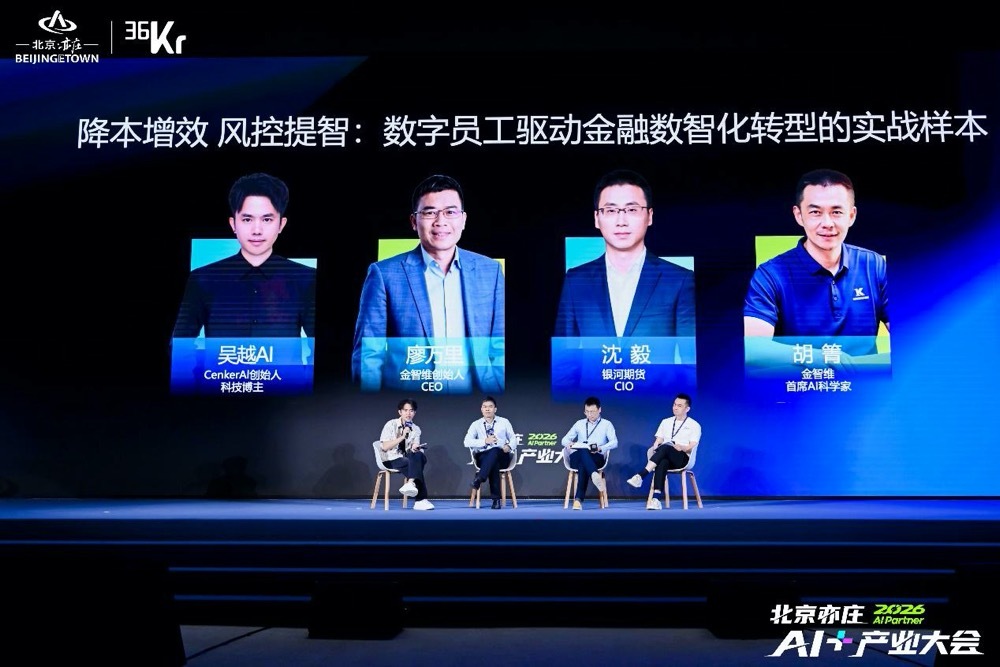
Wu Yue | Founder of AI - CenkerAl and technology blogger (Host)
Liao Wanli | Founder & Chairman of Zhuhai Kingdee ZVee Artificial Intelligence Co., Ltd.
Shen Yi | Senior Technical Director of Galaxy Futures
Hu Qing | Chief AI Scientist of Kingdee ZVee
Wu Yue: Good afternoon, everyone. Welcome back to the round - table forum of the 36Kr AI Industry Conference. I'm Wu Yue, the host today. This morning, we listened to highly informative speeches, and each guest mentioned what AI can do and how it can bring about changes. In this afternoon session, let's discuss how to implement AI in practice, not just on PPTs or at press conferences, but how to truly integrate it into the core processes of enterprises to generate value. For today's round - table, we've invited three guests:
Mr. Liao, the CEO of Kingdee ZVee. Kingdee ZVee is a company deeply involved in enterprise process intelligence, and they've been in this field for ten years. Last year, they launched the enterprise - level platform Ki - AgentS and explored the new concept of Agentic Flow with Galaxy Futures. We'll elaborate on this later.
Shen Yi, the CIO of Galaxy Futures. Galaxy Futures is one of the pioneers in digital transformation in the financial industry, and it's the protagonist of the case we're going to discuss today.
On the right is Hu Qing, the Chief AI Scientist of Kingdee ZVee, who is the technical mastermind behind the system we'll introduce next.
Today's round - table topic is quite straightforward. We'll discuss their seven - year cooperation to understand how the process intelligence has been established and what inspiration it brings to us. Mr. Liao, Kingdee ZVee and Galaxy Futures have been collaborating for seven years. In the B2B industry, a seven - year cooperation is quite remarkable. Could you first talk about how this cooperation started and what has led to the current situation?
Liao Wanli: We've been collaborating with Galaxy Futures for six or seven years. The contract value has increased from over one hundred thousand to millions. Our product line is quite diverse, ranging from early automation, RPA, intelligent agents to the entire application. After years of cooperation, we've established a relationship of mutual trust. Galaxy Futures is also one of our representative financial clients. Currently, the digital employee product has been implemented in Galaxy Futures, with over 50 application scenarios. More than 3,000 business processes are executed daily, and the most crucial indicator, the execution accuracy rate, is 99.97%. Digital employees have taken over repetitive and cumbersome tasks, and the answer is quite clear.
In 2023, we held a seminar on digital transformation in the industry with Galaxy Futures and published a white paper on digital transformation in the futures industry. Since then, we've realized that after the emergence of large - scale models and intelligent agents, the transformation of enterprises is not a single - point operation but about how to integrate into enterprise processes and achieve business reconstruction of enterprise processes. Thus, we launched the latest project cooperation in September 2025, and two scenarios have been implemented so far. This is a very valuable case.
Wu Yue: Mr. Liao, from the perspective of a supplier, the cooperation has grown from hundreds of thousands to millions in seven years. Mr. Shen, as the client, why did you choose Kingdee ZVee? There's no shortage of large - scale partners in the futures industry.
Shen Yi: To briefly respond to what Mr. Liao said, in the early days, suppliers providing solutions for the financial industry based on RPA scenarios were quite representative. In 2023, DeepSeek was not well - known in China, while the products of OpenAI had already achieved some results, specifically the versions before 3.5. With so many enterprise - level processes to execute, how could we transform based on the still - early large - scale models at that time? We explored various solutions in the industry. After reviewing so many solutions, we reached the conclusion that operational processes require a highly centralized platform.
Many of Galaxy Futures' innovative cooperation projects follow the ODA model. The futures company provides some design concepts and looks for partners to conduct innovative practices. Kingdee ZVee showed great willingness to undertake this, and thus a new - generation cooperation was born.
Wu Yue: You've established a great co - creation relationship over the seven - year period. Galaxy Futures has implemented many RPA processes, with a large number running daily and a high accuracy rate. Last year, you decided to implement Agentic Flow. This must be more than just a step forward. What kind of scenarios made you realize that the previous RPA was no longer sufficient? Let's discuss it in detail.
Shen Yi: The financial industry solves problems in a very practical way. The futures industry serves the real economy and has many industrial clients, especially those engaged in real - world businesses. The risk of opening accounts for these industrial clients is relatively high, and offline account opening is required. For offline account opening, either the company has to visit the client or the client has to come to the company to collect information. The information provided according to the requirements of the China Securities Regulatory Commission is quite complex. A single communication is not enough to provide the required list, and many times it involves repeated communication. To solve this problem, we learned from the solutions of the securities industry and implemented so - called pre - customer information collection using an iPad to pre - collect information. This model worked well in the early days. However, with the diversification of business, changes in crude oil prices in Iran and the Strait of Hormuz, as well as regulatory changes, the agility of our previous software - based agile development model was no longer sufficient. When the concept of model agents emerged, we started to think about whether there was a more agile and responsive way than the current microservice approach to meet the immediate needs of operational and service personnel.
Wu Yue: It's like using a new approach to solve the problem. From Mr. Liao's perspective, currently, popular things like large - scale models and chat windows require a conversational element. Why do you still focus on processes and bet on them? Has anyone questioned your direction?
Liao Wanli: It's not a bet; it's following the trend. For over a decade, we've been committed to helping enterprises truly integrate intelligent agents into business processes. We've never deviated from the concept of "processes". Over the past decade, from automated operation and maintenance, RPA to today's intelligent agents, the technology has changed, but our mission has always been to help enterprises in the industry solve problems, making processes run faster, more accurately, and more reliably. When large - scale models emerged in 2023 and 2024, they mainly solved the problem of question - answering. At the beginning of this year, with the emergence of certain technologies, people suddenly realized that intelligent agents could do what you asked them to do, which brought greater value to enterprises. It's not just about answering questions but about getting things done. From then on, the value gradually emerged. For example, if an intelligent agent helps you receive an email, it only improves personal productivity. What we aim to do is to build intelligent agents around the overall enterprise processes, from the account - opening process in the securities and futures industry to the entire clearing business process. We're focusing on organizational productivity, which is the direction we're pursuing. Organizational productivity creates the greatest value for enterprises. Mr. Hu can add more to this.
Hu Qing: As Mr. Liao said, processes are the real carriers of enterprise business. The operational efficiency of an enterprise is reflected through processes. Enterprises are more concerned about process efficiency improvement, which is why Kingdee ZVee focused on the RPA track from the beginning. Mr. Liao mentioned following the trend, which is a natural development. From the ability of large - scale models to recognize things to the ability to execute tasks, there were technological breakthroughs last year. The breakthroughs were more prominent in the consumer (to C) field. In the business (to B) field, the focus is not just on consumer - oriented chat tools or information provision but on helping enterprises perform more professional, accurate, and for the financial industry, safer tasks. This is our exploration goal. We're very honored to jointly recognize with Galaxy Futures that the enterprise scenario has reached a stage where we need to explore new things that enterprises haven't done before, and we should pay more attention to how to achieve intelligence in the process track. We're very fortunate to conduct a pioneering attempt with Galaxy Futures.
Wu Yue: Talking about the cooperation with Mr. Shen, from Mr. Shen's perspective, before deciding to implement Agentic Flow, had the industry tried some solutions? Why weren't they successful? You should have systematically tried some solutions. Could you explain how BPMN, RPA, and large - scale models were used and where the bottlenecks were?
Shen Yi: RPA has been around for a long time. In the early days, we used RPA to solve the most complex problem, which was operation and maintenance. Operation and maintenance is crucial for production safety, and daily operations require a high degree of repetition, large workload, and high precision. RPA is very good at handling this part. However, when there are changes, whether in policies or real - world situations, we find that it's difficult to make adjustments. Then we entered the second stage, where we used microservices, modern agile front - ends like 2.5 and 3.0, and the BPMN drag - and - drop framework to create similar agile solutions. Especially in the past two or three years, with the rapid changes in the industry and the numerous ideas in front - line operational scenarios, this solution was viable. Nowadays, everyone talks about "intense competition". If you have an idea, you find a developer to develop the process using this microservice architecture, but often it still doesn't work. As OpenAI became more mature, people started to wonder if large - scale models could be incorporated into the work or business processes. However, in essence, it's still a traditional standardized process logic and doesn't bring about a revolutionary change. This is the real situation in previous engineering practices, and I think it's similar in the enterprise side, especially in the financial industry, including securities, futures, and funds.
Wu Yue: Mr. Shen, you've talked about many technical aspects. Putting aside the technology, after implementing Agentic Flow, what are the most direct feelings of your operation team? Can you give two or three specific examples to show how process intelligence is manifested, comparing the situation before and after the implementation?
Shen Yi: We often say that people don't easily notice the difference between process intelligence and intelligent processes. In the process of "process + intelligence", we find that many processes are still quite rigid, and it's difficult to improve efficiency. Nodes in the process that need to be statistically analyzed, optimized, or improved are still determined manually. It's a bit like converting a traditional car to an electric one, where the traditional way is simply combined with AI capabilities, and there's no fundamental change. In my opinion, this can be defined as "process intelligence". Later, with the idea of using large - scale models, I hope it can be the other way around, "intelligent processes", which is also a point that I'm quite interested in when talking with Mr. Hu. There are a large number of uncertainties, temporary tasks, and degrees of freedom in business operations. In traditional software development, we follow the logic of requirement collection, product design, architecture design, coding, testing, and delivery. During the 924 market fluctuation last year, the market change was very rapid, and the entire period, including the National Day holiday, was only three weeks. If you wanted to launch an operational activity or adjust policies using the traditional software development method, it would take two months to come up with the corresponding solution, which would be meaningless. We hope to improve the timeliness. Internet companies can achieve this, but it's more difficult for the financial industry. The reason is that Internet companies are naturally sensitive, and their support teams are very agile, while other industries, especially the financial industry, are more rigorous, compliant, and safety - conscious. It's not reasonable to launch new things too quickly. In reality, business opportunities are very limited. So, the question is whether to reform or not. Regarding this question, we simply put forward an idea. Mr. Hu can help me add some technical details later. We hope that the entire process can be intelligent from the very beginning of its construction, which is what we call "intelligent processes".
Wu Yue: Mr. Hu, you can continue to talk about the technical aspects. Only by overcoming the technical challenges can we solve many problems.
Hu Qing: At the beginning of product and technology design, we had the idea of AI - native. The reason for putting intelligence before processes is that we hope to design processes with an AI - based mindset. As Mr. Shen mentioned, in the first stage, the most direct way to achieve process intelligence is to add some AI elements to the processes and let AI handle some tasks in the process. This is still an early - stage idea of using AI as a tool. The relationship between humans and intelligence has started to become more equal. Intelligence plays an actual role in the overall work process, taking over some mental work. As Mr. Shen said, in the original process lifecycle, the system was only responsible for the operational aspects. In the future, we hope it can not only handle operations but also process management, process creation, and process optimization. The knowledge and skills that were originally required from humans can now be handled by intelligence.
We're approaching this in three stages. In the first stage, we believe that AI technology should be introduced into the process execution. We'll identify which parts of the process can be AI - enabled. In the second stage, we hope that the process construction itself can be intelligent. As Mr. Shen mentioned, when a new process emerges or the process changes, intelligent agents or large - scale models can help build business processes more quickly to adapt to last year's market situation. As artificial intelligence evolves, it starts to have the ability of self - evolution and self - optimization, and the later stages of the process will be similar. We expect that in this year or next year, intelligent processes will be able to self - evolve, collect data during the process execution, and optimize the potential self - evolution direction of the process.
Shen Yi: We can simply summarize two points that are easy to remember and understand the relationship between these two concepts. First, we believe that the construction paradigm of intelligent processes is the intelligent agent paradigm, which is the same as the current intelligent agent paradigm. Second, the intelligent agent paradigm is the constructor. Processes have the ability of self - evolution, self - learning, and in the future, many processes can be generated automatically, which was not possible in the era of process intelligence. This is the underlying logic.
Wu Yue: Mr. Hu and Mr. Shen have talked about this. Let's expand the topic. The boundary between humans and intelligent agents is a question that more and more people are concerned about, especially in the AI era. How do you design the boundary of human - agent interaction in process intelligence? What tasks should be done by humans, and what tasks should be done by intelligent agents? Mr. Hu.
Hu Qing: As we've mentioned before, the boundary between humans and intelligent agents has changed. Intelligent agents have evolved from tools to collaborators, and this is more evident this year. We can see the emergence of intelligent agent communities, intelligent agent teams, and even the concept of OPC. With the enhancement of large - scale model capabilities, intelligent agents can handle more and more tasks from a work - ability perspective. In the B2B field, especially in the financial industry, there are stronger requirements for supervision, safety, and controllability. Whether from the perspective of responsibility and authority or the final execution and review, humans need to collaborate with intelligent agents at key nodes.
As intelligent agents become more capable, you'll delegate execution - level tasks to them, and the nature of human work will also change. Humans will focus more on defining problems, setting goals, checking the correctness of intelligent agent execution, and defining the boundaries and frameworks of intelligent agent execution. This is not just a technical issue but also a matter of adjusting the enterprise organizational structure and changing interpersonal relationships.
Wu Yue: Humans should define goals, and intelligent agents should define the implementation path. For all technologies, the key is whether they have functions and values. Mr. Shen, after this transformation, has your operation team noticed any changes?
Shen Yi: It's definitely a difficult process. The financial industry has strict requirements for safety, compliance, and auditability. Although innovation is possible, the practical cost of an innovation is relatively high. Similar to the "sandbox" concept, we