Roundtable Dialogue: The Ultimate Thinking on Evolution: When Introducing AI, Should We Change the Process First or the Mindset First? | 2026 AI Partner · Beijing Yizhuang AI + Industry Conference
When a company introduces AI, should it change the processes first or the mindset first? There is no standard answer, only practical experience. The perspectives of scholars, manufacturers, and industrial enablers collide to reach a consensus: Don't expect to unify the entire company's understanding before taking action, and don't aim for perfection in one step. Using small - scale process changes to achieve results and using results to gain consensus is the most stable path for AI transformation.
The round - table dialogue directly addressed the real - world pitfalls in AI implementation, such as the "hot - top, cold - bottom" situation, excessive pursuit of full - intelligence, and deficits in data governance. It also offered a piece of advice: Identify the right scenarios and start working. Use 1% success to drive 100% change.
The following is the content of the round - table speech, edited by 36Kr:
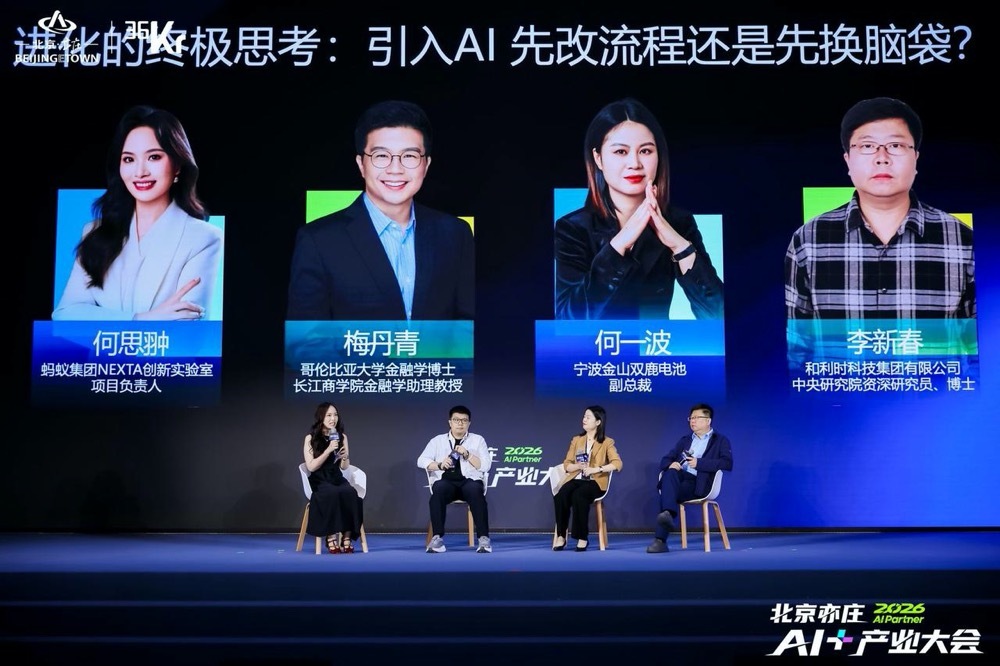
He Sichong | Project Leader of NEXTA Innovation Lab at Ant Group (Host)
Mei Danqing | Doctor of Finance from Columbia University, Assistant Professor of Finance at Cheung Kong Graduate School of Business
He Yibo | Vice President of Ningbo Jinshan Shuanglu Battery
Li Xinchun | Senior Researcher at the Central Research Institute of Hollysys Technology Group Co., Ltd.
He Sichong: Good morning, dear friends. I'm very glad to be on the stage of AI Partner. I'm He Sichong, the host of this round - table. On behalf of the organizer, I welcome the guests on the stage to participate in this round - table. As the concluding round - table this morning, I only want to discuss one question and solve one thing: What should a company do first when introducing AI? Let me set the principle for this round - table discussion. We won't talk about concepts but practical experiences. Share your previous AI practices with us, including what to do first, what to do later, the possible pitfalls you've encountered, and the final results.
Let me introduce the three guests on the stage first. Mr. Mei Danqing, Assistant Professor of Finance at Cheung Kong Graduate School of Business and Doctor of Finance from Columbia University.
Mei Danqing: I'm very glad to communicate with you all. Thank you.
He Sichong: Ms. He Yibo, Vice President of Shuanglu Battery.
He Yibo: Hello, everyone. I'm He Yibo. I'm very glad to meet you here today. I hope we'll have more opportunities for cooperation in the future. Thank you.
He Sichong: Dr. Li Xinchun, Senior Researcher at the Central Research Institute of Hollysys Technology Group Co., Ltd.
Li Xinchun: Hello, everyone. I'm very glad to share my AI experience in the process industry here.
He Sichong: Once again, welcome the three guests to our round - table. Let's get straight to the point. First, please let the three guests quickly state your positions. From your respective corporate and research perspectives, when a company wants to embark on AI transformation, should it change the processes first or the mindset first? Professor Mei, please.
Mei Danqing: The mindset and processes must be modified simultaneously. But if we have to choose one, I suggest changing the mindset of the top decision - maker first. Because if the top decision - maker's mindset isn't changed, changing the processes will only bring minor improvements in the old system. In 2026, we should shift from "introducing AI" to "AI - native". Simply put, instead of adding AI to the existing processes, we should change to "AI +" and build an AI - native architecture. This requires companies, especially the decision - making layer and the top decision - maker, to change their mindsets first. The processes should also follow up, and small - scale processes can be used to verify the new mindset. This is my basic view.
He Sichong: The core of AI lies not in process optimization but in the intelligent improvement at the cognitive and decision - making levels, mainly the cognitive improvement of the top decision - maker. Ms. He, how did Shuanglu Battery embrace AI? What did you do at that time and what problems did you want to solve?
He Yibo: Your question is quite interesting. It's similar to the question of whether to pick up the chopsticks or open your mouth first when eating. For a company, it's a matter of going with the trend. Many people don't know much about Shuanglu Battery. Our company was established in 1954, just a few years younger than the founding of New China. This year, it's been 72 years. Our company has experienced the Chinese industrial revolution, from a weak foundation to continuous catch - up and partial technological leadership. My biggest insight is that a company isn't isolated. It must resonate with national policies and the times. We've gone through the journey from a small workshop to automation, intelligence, and now the era of AI. Our company started as a small workshop with seven people, then introduced foreign production lines. After being subject to technological sanctions, we independently developed and designed automated production lines. Now we're actively embracing AI. The data and process optimization we've accumulated over the years are excellent foundations for us to embrace and apply AI. It's a natural and inevitable process.
He Sichong: What was the trigger at that time? Did you think it was time to introduce AI?
He Yibo: When it comes to mindset, I believe that the top leaders of many companies already have an understanding. We can feel that the development of Chinese companies over the years is due to the iterative application of new technologies, which has rapidly improved our productivity. We must embrace AI technology. Ultimately, the problems a company needs to solve are efficiency, quality, and cost.
He Sichong: Dr. Li, having served so many industrial customers on the front line, what advice would you give to a company? What should it do first?
Li Xinchun: Hollysys has been in the industrial automation field for more than 30 years, serving tens of thousands of industrial customers and implementing a large number of industrial intelligent applications. From the perspective of industrial AI empowerment, we suggest starting with the processes to drive the change in mindset. The industrial field has its own characteristics. There are many industries in the industrial field, with diverse scenarios and a high degree of fragmentation. There are high requirements for safety, stability, and model interpretability. In this situation, many general AI technologies are difficult to directly apply in industrial scenarios, and there are significant differences from the technical route to the value realization. Currently, both the industry and academia lack a unified understanding of the value realization of industrial AI, the functional boundaries of industrial AI, and the future development path of AI. My view is that since it's difficult to reach a unified understanding at present, can we start with the processes? Through the actual results of AI implementation, we can promote the upgrade of mindset and the formation of consensus from the perspective of data and actual value realization.
He Sichong: From this question, the positions of the three guests are clear. Professor Mei's view is from the decision - making and cognitive levels. Ms. He's view is based on the specific experience of Shuanglu Battery and the company's 72 - year development. Dr. Li's view is from the front - line experience of serving customers. Although the answers may be different, they all point to one thing: it depends on the stage of your company and the problems you're facing to make the right choice and approach. Now we'd like to talk about specific scenarios. Shuanglu is an established manufacturing brand with 72 years of history. It's natural for it to fully embrace AI on the production line. For example, how did you choose the first AI scenario?
He Yibo: Our company is building a "lights - out factory". Let me give you a vivid example. In the past, there was electrolytic manganese dioxide and graphite in the positive electrode material of our batteries. People who have been to industrial enterprises may know that everyone coming out of the raw material workshop was black, except for their teeth. At that time, when people took the bus, the bus driver would refuse to carry them because they were really dirty. Now, our company is a lights - out factory, fully automated and intelligent from start to finish.
The first AI application was for appearance quality inspection. The production line and logistics warehousing are all intelligent. There was also a pain point for us. We used to store the produced batteries in the warehouse for 10 - 15 days, and then conduct a full appearance inspection on the batteries. The appearance of the batteries is very small. We need to ensure that there is no leakage, no damage, no defects, and no metal wires. As far as I know, in our industry, for decades, people have relied on the naked eye for inspection. But the batteries are very small, only 0.001 square meters. There are more than 600 AA batteries or more than 1000 AAA batteries on a board. After a day of inspection, people's eyes would be tired and their waists would ache. In 2021, when we were building a new factory, it was a good opportunity. The traditional appearance visual inspection couldn't detect defective points and flaws well. We collaborated with the technical staff of Huawei Cloud. With the data we had accumulated, their AI algorithms, and industrial cameras, we could at least theoretically solve this problem well. The naked eye has the possibility of missing some defects, but AI can solve this problem. Everyone quickly reached a consensus.
This process wasn't easy. The foundation of AI is data. The defect rate of our batteries is relatively low. We require that no defective battery can be released. AI learning starts from scratch. We need to accumulate a large number of defective products for it to learn and accumulate data. We had a lot of data before, but most of it was in people's minds. It took us two or three years to accumulate samples and feed them to the AI. So far, this work has been successful. One reason is the support from the National Ministry of Industry and Information Technology. Another reason is that Huawei Cloud has promoted it as a classic case. With the joint efforts of several parties, we've achieved success and set a benchmark in the industry.
He Sichong: Mr. Zhu once said that the core problem lies in people. I'd like to know that in the process of our AI application, you mainly talked about the changes in data and technical capabilities. How can we make the employees change and fully embrace AI?
He Yibo: When it comes to people, several teachers have mentioned anxiety. People are worried that AI will replace them and they'll lose their jobs. When our company undertakes AI projects, we always hold hearings. The purpose of the hearings is to put all the employees' ideas, concerns, and suggestions on the table, discuss what value this project can bring, how much it will cost, and whether it's worth investing. After unifying our thinking, we'll start to work.
After the success of the AI appearance quality inspection scenario, we didn't fire these employees. Instead, we transferred them to easier positions. People felt that AI really helped them a lot, and AI solved the most difficult and tiring work. At this time, everyone will actively embrace AI.
He Sichong: We don't use AI to replace people, but to let people find more suitable jobs.
He Yibo: We have other application scenarios. Now we're using generative AI in the R & D department. In the past, old researchers and technicians had to conduct various experiments. Now with AI, it can provide us with ideas and directions, and then our work will be more efficient. We need to know what benefits AI can bring to us. After tasting the dividends, everyone is willing to actively promote this matter.
He Sichong: Thank you, Ms. He. Next, let's invite Dr. Li to share from the perspective of an enabler. If a new customer comes to you and says they want to implement AI, what are your standard procedures?
Li Xinchun: We've had a lot of exchanges with customers in the industry about AI applications. First, we conduct value anchoring. We analyze the business scenarios, sort out the scenarios that have a greater impact on the business, have a good data foundation, and can be quantitatively analyzed and compared. We call these scenarios value anchor points. First, we need to determine the goals. Second, we won't make drastic changes to the existing business scenarios. We'll first create a minimum MVP (Minimum Viable Product) closed - loop. In the pilot operation scenario of the closed - loop, we'll verify the feasibility of the technology, the actual value of implementation, and then see the users' feedback. On the basis of the MVP closed - loop, we'll discuss how to expand from 10% of the scenarios to 20% or 30% of the scenarios. We'll use data and results to speak. If we say at the beginning that there's a problem with the processes and need to change them, users will definitely be hard to accept at the initial stage. With the support of data and value, we'll then guide customers to restructure the processes, such as modifying the operation manuals and management processes. Only then will front - line operators and managers be willing to cooperate with us in this change, and then promote the improvement of the enterprise's employees' understanding of AI.
He Sichong: What are the speed requirements in the promotion process? Many companies are very anxious. If they don't see measurable results in a long time, their confidence will soon disappear. What's our speed?
Li Xinchun: Hollysys released the XMagital industrial intelligent platform on June 18 last year. The main purpose is to support the rapid development and deployment of industrial intelligent applications through this platform. This platform solves two main problems. One is the data problem, which solves the problem of the native integration of industrial production control and industrial production management data. In the past, these two layers were separated. On the basis of the native data integration, we've also built a semantic base and organized and managed the data through the ontology model. Above the data layer is the model layer. We've packaged the models, algorithms, and industrial knowledge accumulated by Hollysys over more than 30 years into the concept of the industrial world model, which is also the theme of our release on June 16 this year. We've also provided an intelligent orchestration tool. Through natural language, business personnel can put forward business requirements, and the orchestration tool can deploy the industrial world model to configure intelligent applications. For example, based on the xmagital platform, the development of prediction - type applications has changed from being measured in months and weeks to being measured in days, which has greatly promoted the development and deployment of industrial intelligent applications.
He Sichong: Let's go back to the issue of people. You just said to start with the processes. When the boss comes to Hollysys for AI transformation and the management meetings and strategic meetings have reached a consensus that they must implement AI, when the enterprise really starts to implement it, there will still be hesitation and waiting - and - seeing among the middle - level management, and the front - line employees won't act immediately. How do we deal with the situation of "hot - top, cold - bottom"?
Li Xinchun: The interest demands of different levels are different. We need to empower each level to let them see the value of AI. For the boss, we should show him not only the macro - economic reports but also some major problems in production. Through digital twin technology, we can show him the specific situation of on - site production, losses, energy consumption, quality fluctuations, etc. in a visual form, so that he can promote the management to solve these problems. For the management, we should provide appropriate tools. Once the problems are exposed and the superiors assign tasks, what are the corresponding AI tools? Through anchor point analysis, we've conducted in - depth research on the chemical industry and sorted out several major scenario clusters, such as process intelligent control, optimization, intelligent equipment maintenance, equipment quality management, safety and environmental protection intelligent control, etc. We've sorted out the anchor points and provided corresponding intelligent tools to help them complete the tasks assigned by the boss.
For front - line employees, we'll distribute a certain proportion of the benefits generated after the intelligent optimization is put into operation, so that they can see real benefits, and they'll change from a resistant attitude to a more active one in using these tools.
He Sichong: Professor Mei, for different companies, such as a small company with 20 people, a medium - sized manufacturing company with 500 people, and a large - scale group with more than 5,000 people, the ways to integrate AI are different. How should they start?
Mei Danqing:
For small companies, there is less internal friction, so it's actually easier to build an AI - native system from scratch at present, that is, to re - structure the entire workflow and business logic with AI at the center. With the support of AI capabilities, this is relatively easy to achieve.
It's more difficult for medium - sized manufacturing companies or large enterprises. As Dr. Li said, there are many key factors in the manufacturing industry, such as materials and factory processes, which are difficult to transform all at once. It needs to be done step by step, taking the processes as the clue