Roundtable Discussion: The "National Promotion Plan" of AI+ and the "Survival Roadmap" for Enterprises | 2026 AI Partner · Beijing Yizhuang AI+ Industry Conference
The combination of AI and other industries is shifting from technological guidance to industrial practice. How can policy dividends be realized? How can investments turn into outputs? How can enterprises survive and win in this wave? The first round - table discussion at the 2026 Beijing Yizhuang AI + Industry Conference will put these questions on the table, focusing on practical solutions rather than empty talk.
The first round - table discussion at the 2026 Beijing Yizhuang AI + Industry Conference focuses on "The National Promotion Plan for AI + and the Survival Roadmap for Enterprises". Cheng Xin, a global partner at Bain & Company, serves as the host. Four guests, including Zhou Han, the minister of the Shanghai Artificial Intelligence Industry Association, Xu Yi, the dean of the AI Research Institute at Midea Group, Gao Chao, the founding partner and CEO of Yunxiu Capital, and Zhang Liang, the person - in - charge of JD.com's AI intelligent hardware project, will discuss from four dimensions: policy implementation, industrial practice, capital perspective, and platform empowerment, and extract a "survival formula" for enterprises from 2026 to 2027.
The following is the content of the round - table discussion, compiled and edited by 36Kr:
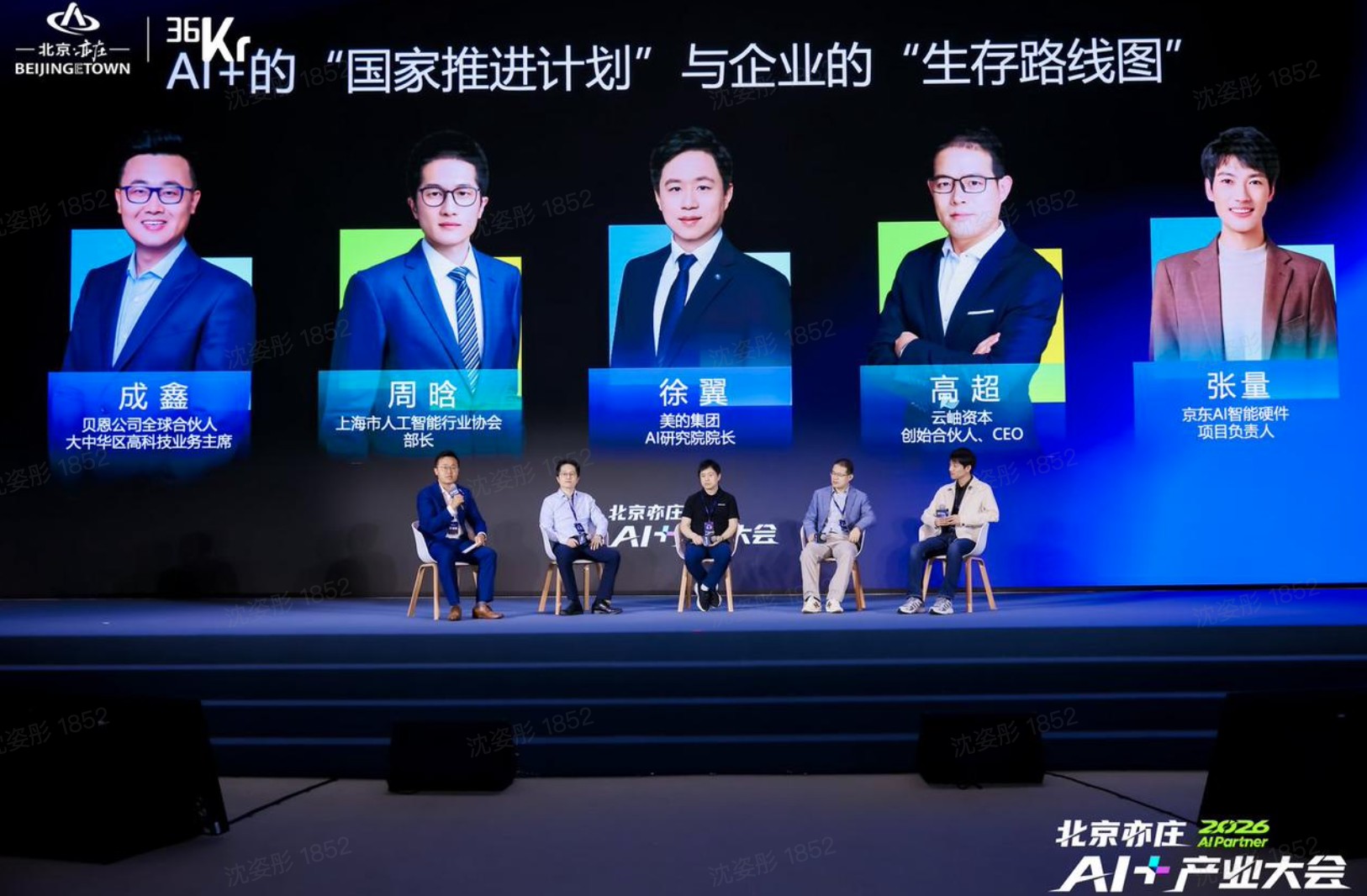
Cheng Xin | Global Partner at Bain & Company, Chairman of the High - tech Business in Greater China (Host)
Zhou Han | Minister of the Shanghai Artificial Intelligence Industry Association
Xu Yi | Dean of the AI Research Institute at Midea Group
Gao Chao | Founding Partner and CEO of Yunxiu Capital
Zhang Liang | Person - in - charge of JD.com's AI intelligent hardware project
Cheng Xin: Good morning, dear guests and friends. I'm very honored to be the host of this first round - table discussion. I'm Cheng Xin from Bain & Company. On behalf of the organizer, I'd like to welcome the guests of this first round - table discussion again - Minister Zhou, Dean Xu, Mr. Gao, and Mr. Zhang. Under today's theme, we'll discuss three practical topics.
First, what are the real dividends and constraints brought by the "National AI + Promotion Plan" to enterprises?
Second, how can large enterprises, industrial players, and capital providers turn AI investments into outputs?
Third, how can enterprises draw a "survival roadmap" to survive and win from 2026 to 2027?
We hope to use more than 40 minutes today to speak with scenarios, data, and real enterprise pain points, and provide the on - site enterprises and guests with an actionable list that they can take away directly. This is also the goal of our first round - table discussion today.
The first group of questions starts from the policy and industry perspectives. The first question is for Minister Zhou. The State Council's "Artificial Intelligence +" action has clearly defined six major directions and the goal of a 70% penetration rate by 2027. For real - economy enterprises in manufacturing, retail, and supply chain, which are the must - implement demand scenarios this year? Which policies are real subsidies and real green channels?
Zhou Han: Since the issuance of Document No. 11 by the State Council, the Ministry of Industry and Information Technology and the Cyberspace Administration of China have successively introduced many policies, including the implementation opinions on the development and compliance of artificial intelligence + intelligent manufacturing and intelligent agent industries, as well as the development opinions on AI + e - commerce. All these policies clearly point to a direction, from past pilot exploration to focusing on results and real implementation. At present, for the fields you mentioned, the following implementation directions can be considered:
In the manufacturing field, intelligent production scheduling, maintenance prediction, process optimization, and production dispatching are areas that various industries are currently concerned about, with high - yielding dividends and intensive policy support.
In the retail industry, personalized intelligent marketing, order optimization, and corresponding logistics distribution, as well as intelligent sorting, embodied intelligence, and intelligent delivery in the supply chain and logistics distribution, all correspond to scenarios with good implementation results.
There are many policies. Leaders in the Beijing area have also mentioned that at the national and local levels, the "three - voucher" policy has become very popular. Each city has invested hundreds of millions or even billions of yuan. At the national level, there is support for computing power infrastructure, including computing power vouchers, model vouchers, and corpus vouchers. These vouchers have high specifications and can be applied for and supported on a quarterly basis. These are real support and subsidies for enterprises.
As for green channels, many green channels for talents, household registration policies, and support channels for talent expert sequences have shortened the application cycle. For the top talents of enterprises, there are channels for participating in political discussions and formulating standards, which are very helpful for the subsequent development of enterprises.
Cheng Xin: Minister Zhou has given several specific application scenarios with clear input - output ratios and also mentioned relevant support policies. When local governments are promoting AI +, enterprises often fall into three pitfalls: waste of computing power, data compliance issues, and no returns after investment. How can these pitfalls be avoided? What is the shortest implementation list you can give to enterprises from the perspective of the association?
Zhou Han: Regarding these three pitfalls, there are barriers in different industries. For example, in the case of computing power, enterprises often blindly build large - scale computing power. The key to avoiding this problem is to start from the business and clearly define the problems based on actual business scenarios. Secondly, in different industries, some problems can be solved through industry models instead of large - scale models. The understanding of business scenarios should be more targeted. Don't start with large - scale scenarios at the beginning, as it's easy to encounter many pitfalls that enterprises may not be able to overcome. Shorten the pilot period, iterate repeatedly, and quickly evaluate your computing power needs in the computing power investment.
The state also knows that model applications are very helpful to small and medium - sized enterprises and has established centralized computing power centers. Public computing power resources can provide good support for enterprises in the early stage. When the business model is determined, some enterprises can lease public computing power for training, and edge inference computing power can support scenario - based applications. The cost of building edge inference resources for enterprises is much lower than that of building training computing power resources.
The issue of data compliance is indeed sensitive. From the enterprise perspective, sensitive data should be classified. Determine what data can be used for internal training, desensitize sensitive data, and use public data for model feeding. For some sensitive industries, consider private deployment to avoid subsequent data compliance issues. In the past, from a technical perspective, we focused on training to achieve model effects. Now, as the industry becomes more standardized, the Cyberspace Administration of China and the Data Administration have been evaluating and standardizing data compliance issues. Enterprises should conduct certain evaluations of compliance issues in the early stage of business.
Cheng Xin: Thank you, Minister Zhou, for your practical suggestions. From the policy perspective, which scenarios do you hope leading enterprises like Midea and JD.com will open up first as demonstrations to drive small and medium - sized enterprises to keep up?
Zhou Han: From the policy perspective, we focus on several dimensions: universality, demonstration, and the ability to drive the industrial ecosystem. Let me briefly talk about the possible directions for Midea and JD.com, two leading enterprises.
In terms of supply chain production scheduling, both Midea and JD.com have their unique advantages. Opening up scenarios such as production scheduling, intelligent dispatching, and inventory management for small and medium - sized enterprises in the ecosystem, as well as data sharing and upstream - downstream collaboration, will have a good demonstration effect on downstream enterprises. For example, JD.com has an advantage in the e - commerce industry. Opening up marketing data and empowering AI marketing data capabilities to small and medium - sized retailers that settle on its platform will be a very good tool - based empowerment for enterprises without technical capabilities, and it is a good example of upstream - downstream collaboration in the industrial chain and the leading demonstration effect.
Cheng Xin: Thank you, Minister Zhou! Now, from the perspective of the industrial group, let's welcome Dean Xu to share. Midea's AI transformation has penetrated into various fields, including manufacturing, supply chain, and marketing. Please give three quantifiable scenarios to illustrate the real ROI (return on investment) of AI in cost reduction, quality improvement, and efficiency enhancement, and what is the input - output cycle?
Xu Yi: Thank you for the question, host. I'll give three examples to illustrate the ROI of AI in cost reduction, quality improvement, and revenue increase.
Cost reduction: Since last year, Midea has looked at the entire end - to - end pipeline to find opportunities. We have a large project - AIGC. For example, from intelligent production scheduling to the production process, quality inspection, predictive equipment maintenance, product sales, and subsequent customer service, the cost reduction last year was calculated to be 700 million yuan. This is the internal efficiency improvement brought by the large AIGC project.
Quality improvement: This year, after the release of Midea's MevoX intelligent agent for consumer - end smart home products, there has been a significant improvement in user interaction and response accuracy, which has greatly enhanced the user experience of smart home products.
Revenue increase: Midea has a large industrial portfolio. As we know, Midea is mainly engaged in household appliances. Our Kuka is in the industrial robot business, and Wandong Medical is in the intelligent imaging business. In terms of revenue increase, AI will help Kuka achieve intelligent upgrading. For example, in the past, it took several days to deploy a Kuka industrial robot from unpacking to operation. We hope to reduce this time to one day or even a few hours.
Wandong released a large medical diagnosis and treatment model in Beijing last December, which has helped Wandong Medical increase its sales.
Overall, AI has greatly improved Midea Group from internal R & D, production, and sales to empowering each product division.
Many projects can yield short - term benefits quickly. For example, within 1 - 3 months after implementation, as I mentioned before, in after - sales service and customer service, when customers have many questions about household appliances, we are now using intelligent voice customer service, and customers can hardly tell whether it is a real person or an intelligent voice. We can see initial results about three months after the project is launched. The same is true for internal R & D and production efficiency. For large - scale changes, it may take about a year. Generally speaking, many things are accelerating in the AI era.
Cheng Xin: Thank you, Dean Xu from Midea, for sharing these practical investment - output cases. AI transformation is not just about technology deployment but also about re - engineering the operation logic of enterprises. From Midea's perspective, when moving from early - stage pilots to large - scale implementation, did you change the process first or the organization first? What is the biggest resistance to cross - departmental collaboration, and what mechanism is used to ensure the realization of AI effects?
Xu Yi: Whether to change the process or the organization first, we need to look at the end - to - end process. Midea has a long value chain, from internal R & D to production, manufacturing, sales, to the hands of customers, and then to feedback. When we look at the end - to - end value chain, we will identify the single points that can generate value and make breakthroughs. For example, in intelligent customer service, intelligent production scheduling, and intelligent replenishment, we first look at the process rather than the organization. We first analyze the process and then see how the organization should be changed to adapt to the new process.
Now, AI has a strong generalization and unity. Traditional processes are often not suitable for the changes in the AI era. What should we do next? For example, in intelligent production scheduling, predictive equipment repair, online sales agents, and after - sales agents, after establishing single - point agents, it will be very easy to establish end - to - end process changes. Internally, we say that things can be done without face - to - face communication, with agents communicating with each other. So, we first make process changes and then consider organizational changes.
The biggest resistance in the transformation process is not the resistance from people, as we can foresee. The biggest resistance lies in the data itself. How well is your data governance? For any process in the production line or production process, what data is needed to build a new agent process, and the relationship between data is also very crucial and difficult to handle.
To solve this problem, unified planning is required. Data governance is almost endless. There are many departmental and information barriers within the enterprise, which need to be unified. The most crucial thing is the determination of the leadership or the top management for the transformation, and all barriers need to be broken through.
Cheng Xin: Facing the national goal of AI penetration by 2027, what are the must - do things and lists for Midea in the future? And as a leading enterprise, which capabilities and aspects may Midea open up to which ecosystems?
Xu Yi: We need to pull out the end - to - end process and re - engineer the internal processes of the company, as well as the 2B and 2C business processes. We should actively embrace the corresponding changes brought about by technological advancements. In terms of data, data algorithms and computing power are generally available resources. The degree of internal governance of each enterprise is where real barriers can be formed. Midea will focus on this aspect.
In the ecosystem, Midea will contribute to the industry at three levels: algorithm, protocol, and scenario. At the algorithm level, Midea's AI Research Institute has open - sourced a lot, such as the VLA large model for embodied intelligence and the coding agent. The medical large model we released last year is also open - sourced, contributing to the industry at the algorithm level.
At the protocol level, in the smart home industry, Midea is actively leading the promotion of interconnection. Consumers need this. How can household appliances of different brands in thousands of households achieve interconnection to realize smart home? Midea is actively collaborating with national departments to promote this.
At the scenario level, in line with what Minister Zhou mentioned, we will cooperate with the government to open up scenarios and expand the scale of development.
Cheng Xin: Thank you, Dean Xu. Next, let's hear about JD.com's advanced experience. JD.com has a large number of implementations in the smart supply chain and retail. Please talk about how AI helps enterprises in the supply chain and retail fields.
Zhang Liang: Today's theme is "AI on the Frontline". I'm also a front - line retail worker. As a retail company, we face a lot of user needs every day, which can be divided into three aspects.
First, in the entire supply chain, although technology is evolving, the underlying logic of retail remains the same, which is the pursuit of experience, price, and service. This is JD.com's long - term moat. JD.com continuously uses AI to improve the user experience, reduce operating costs, and improve operating efficiency. For example, the intelligent procurement and sales workbench for procurement and sales staff, digital humans in technology, and wolf - type robots in logistics are applied at the user end, operation end, and fulfillment end. In a rich AI application scenario, there is an opportunity and ability to improve experience and efficiency and optimize profits.
In the retail end, when merchants operate retail business on the platform, they need to form a team, including operation personnel, advertising personnel, content personnel, and their own customer service. As mentioned before, in the future, an OPC (One - Person Company) can solve this problem. Currently, JD.com has developed a large number of AI - related tools and systems in the background and empowered merchants. JD.com offers free digital human live - streaming services to merchants, helping them quickly set up 24/7 live - streaming rooms.
Third, internally, as front - line business personnel, we are also using our own intelligent office systems. The company is also empowering every operation and business personnel with large - model capabilities and developing our own agents according to our business scenarios. In the past, we had many industry - experienced experts. In the future, all these experiences will become general capabilities that can be empowered to all employees' skills.
In addition, we also serve many B - end hardware customers. We combine software capabilities with hardware. JD.com also provides its own capabilities to hardware manufacturers of household appliances, 3C digital products, etc., greatly improving the experience and intelligence of hardware products.
Cheng Xin: Thank you, Mr. Zhang. In the past decade, JD.com has driven the growth of many ecological enterprises. In the AI era, more innovative companies are emerging. How can JD.com help companies in the AI + consumer innovation field with your ideas and experience?
Zhang Liang: We believe that helping enterprises grow and accelerating their incubation is our important responsibility. Recently, we have contacted many hardware enterprises, including many startups in the industrial field. We are also in contact with many incubators and investors and communicating with hardware manufacturers. Different - stage manufacturers have different needs.
In the first stage, many domestic startup companies and OPC companies have certain technical capabilities and innovative ideas. However, they lack a mature platform to help them conduct preliminary verification of market demand in the early product stage. At the end of April this year, we launched the "Aidol Creation Camp". As the name implies, it aims to create