The landscape of AI server power supplies is changing, and ADI is betting $1.5 billion.
In the past two days, a major piece of news has gone viral on WeChat Moments: ADI and Empower Semiconductor have announced that they have reached a definitive agreement, and ADI will acquire Empower in an all-cash transaction worth $1.5 billion.
Elon Musk once said that in the data-intensive era, the ever-increasing power demand poses unprecedented challenges to power supply design. (Anyway, they're running out of transformers to run transformers.)
From the completion of Empower's Series D financing of over $140 million in September 2025 to its acquisition by ADI, only eight months have passed. This clearly reminds us that power semiconductors have now become as important as GPUs and HBMs.
So, what technologies is ADI targeting, and what progress have power supply manufacturers made in AI data centers? Today, EEWorld will conduct a review of these issues.
Who is Empower?
You may not be familiar with Empower. It is a power chip company that has received investment from Google. The company was co-founded in 2014 by three senior analog design experts. They regarded the integrated voltage regulator (IVR) as the "low-hanging fruit" in data centers. This chip alleviates the long-standing balance between power density and energy efficiency by eliminating or integrating discrete components.
The company's solutions are highly favored by Marvell. In June last year, Empower Semiconductor announced a deep cooperation with Marvell to jointly develop an integrated voltage regulator (IVR) and a vertical power delivery (VPD) architecture. The core goal is to upgrade the traditional board-level voltage regulation design to a silicon-based integrated or near-chip power supply solution to address various power supply challenges in the era of kilowatt-level chips.
There are four technologies of this company that are well worth paying attention to:
First, IVR Voltage Regulator
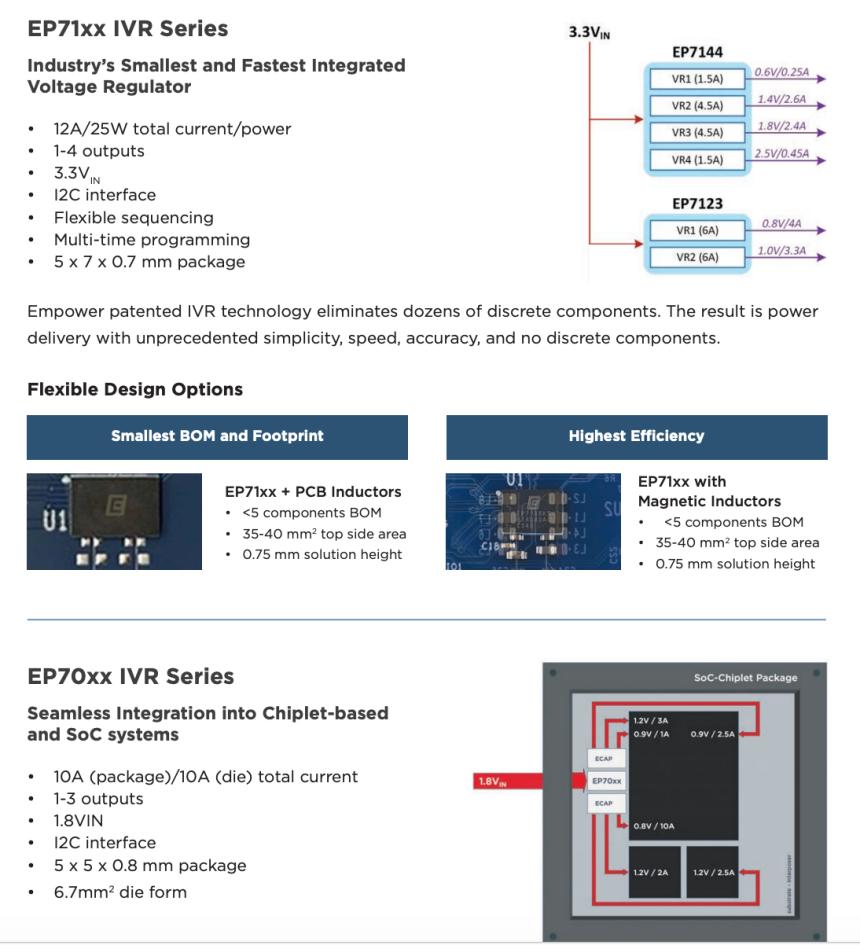
In the data-intensive era, IVR is regarded as the future of data centers. Its core values lie in: firstly, it solves two major problems in the AI era, namely large path loss and blocked transient response; secondly, it achieves high power supply integration with its high-frequency characteristics. All functional modules of the power supply are integrated within a single-chip package, which can be used immediately after being attached. The power supply design is simpler, and the size is extremely small.
Empower's patented IVR technology is the key technology for realizing Chiplet (small chips) and system power supplies. In traditional PMICs, multiple discrete components have the problems of slow speed, high cost, and large volume. Current data centers are approaching the energy consumption limit. IVR was born to replace the discrete and bulky PMICs, while significantly reducing power loss and improving transient response.
IVR eliminates all independent components and achieves high-frequency switching in the hundreds of MHz level through the FinFET process. It integrates dozens of discrete components into a single IC, reducing the PCB area and achieving nanosecond-level transient response. It enables the chip to be configured and programmed, with an extremely small volume and can be placed anywhere in the system. IVR achieves this goal by eliminating magnetic components and multilayer ceramic capacitors (MLCCs). Therefore, the entire package volume is 3 - 5 times smaller than the inductors used in typical power delivery systems.
Second, ECAP Silicon Capacitors
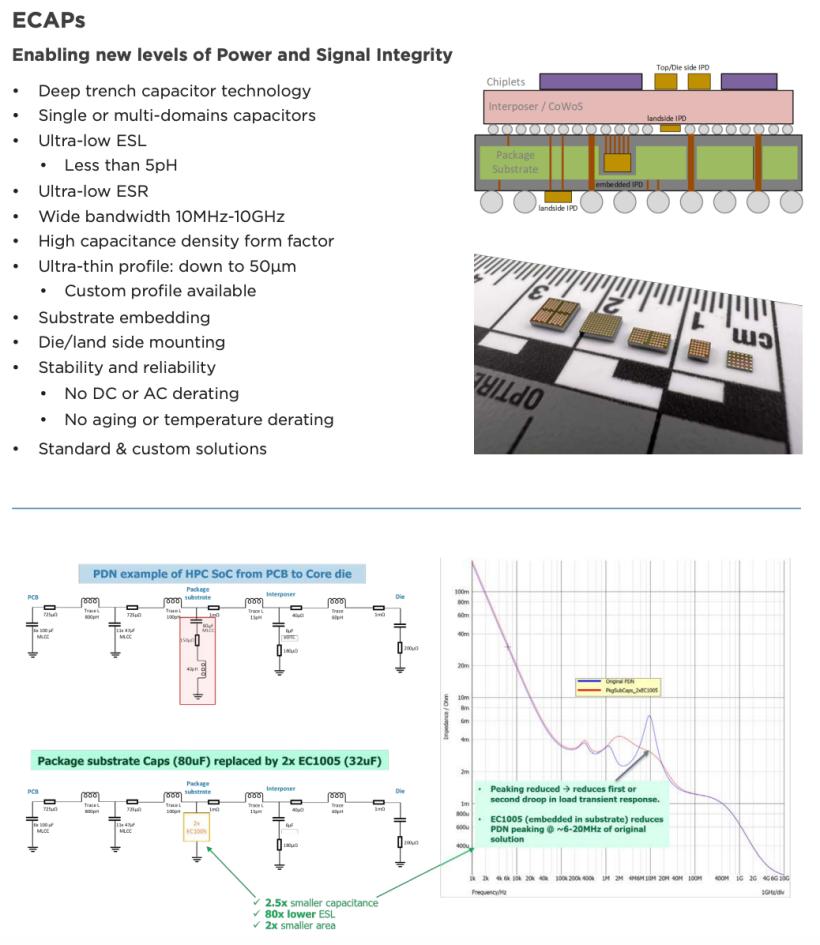
The silicon capacitor ECAP developed by Empower is used in conjunction with IVR or VPD. The principle of the silicon capacitor is the same as that of MLCCs, but the ESL of the silicon capacitor is only one-hundredth or even lower than that of MLCCs. It is particularly suitable for high-frequency filtering, which can optimize the high-frequency impedance of the PDN and make the chip power supply more stable and cleaner. The dielectric material of the silicon capacitor is different from that of MLCCs, and its capacitance value is more stable and not affected by voltage and temperature.
ECAP is manufactured using semiconductor lithography technology. With its pH-level equivalent inductance and zero-bias attenuation characteristics, it provides pure filtering protection in the hundreds of MHz frequency band. They feature ultra-low equivalent series inductance (ESL) and equivalent series resistance (ESR), and can provide broadband performance up to 10 GHz. The high capacitance density and ultra-thin profile enable chip-side, land-side, or embedded substrate integration in single-domain or multi-domain configurations. These capacitors offer excellent stability and reliability, with no DC, AC, aging, or temperature degradation, supporting stable performance under all operating conditions. They have both standard product portfolios and fully customized designs.
Third, VPD Vertical Power Delivery
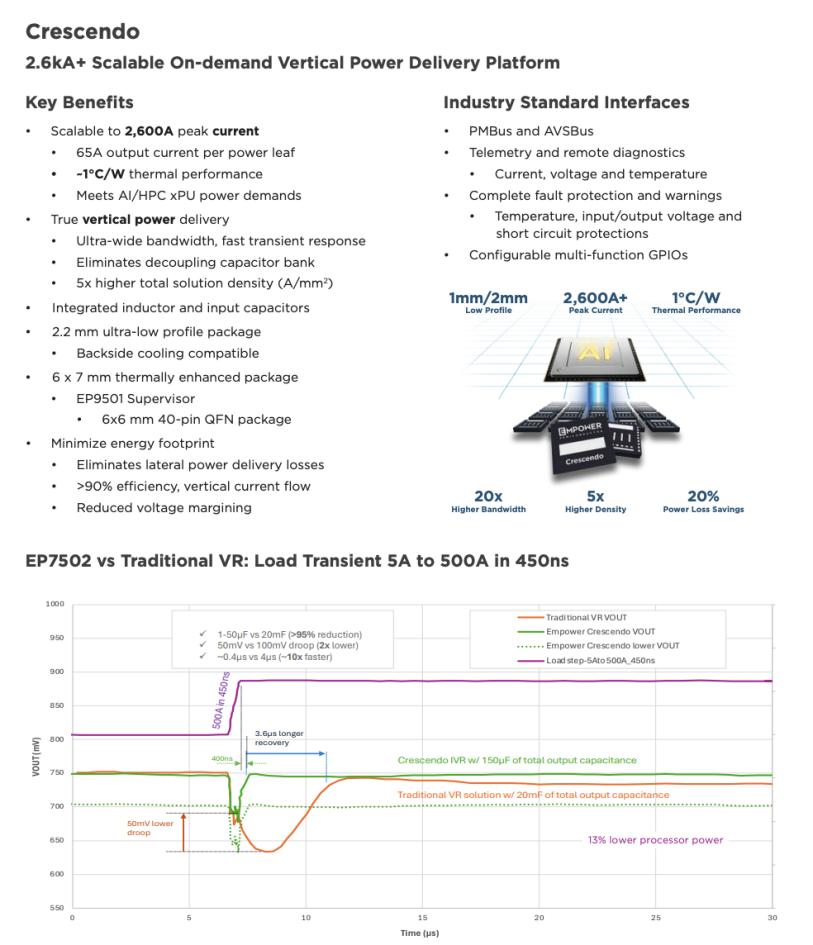
The lateral power delivery (LPD) technology is mature and well-tested. However, limited by the basic laws of physics, as the operating current of the processor continues to increase, the power loss caused by the resistance and inductance effects in the power delivery network (PDN) begins to intensify. The vertical power delivery architecture (VPD) delivers power vertically upwards through the PCB layer, directly powering the processor above. This effectively shortens the power transmission distance from the VRM to the SoC, resulting in lower resistance loss, better transient response, better signal integrity, more space on the front side of the motherboard, and enhanced scalability.
Empower's vertical power delivery technology, Crescendo, achieves fast transient response, precise voltage control, and excellent power integrity by directly moving the high-density regulator below the load. Its scalable and digitally configurable architecture reduces losses, maximizes power density, and eliminates the need for bulky external components or decoupling capacitor banks. Crescendo is designed for demanding xPU and accelerator platforms, achieving higher performance per watt while simplifying system design and supporting the rapid evolution of next-generation computing.
Fourth, FINFAST Technology
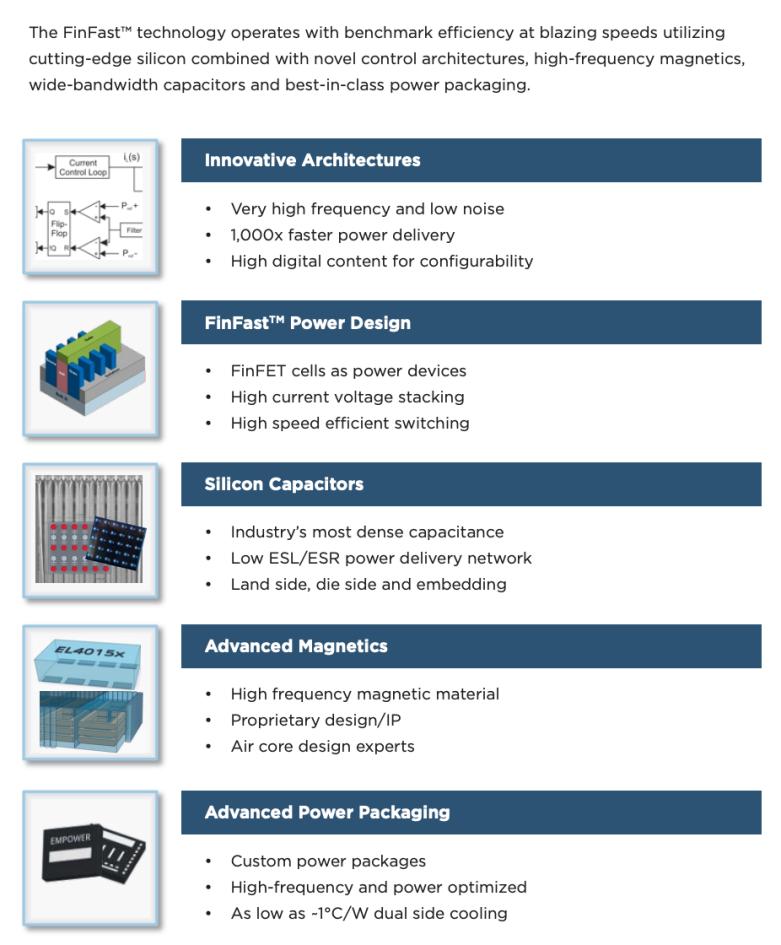
FinFast is Empower's breakthrough power technology platform, based on five fundamental pillars: innovative power architecture, FinFET-based power design, advanced power packaging, advanced magnetics, and silicon capacitors. These technologies together achieve ultra-high power density, excellent efficiency, and industry-leading dynamic performance. FinFast is designed for artificial intelligence, data centers, networks, and chipset systems, enabling products to redefine the possibilities of modern power delivery.
What's the Significance of ADI's Acquisition?
According to the analysis of "Third-Generation Semiconductor Canteen", ADI has a well-established layout in 48V/800V cabinets and board-level power supplies. However, there is still a blank area from the outside of the chip to the one-millimeter area directly below the die. Empower's IVR + ECAP just fills this gap. At the same time, the vertical power delivery Crescendo platform can achieve a current of over 3000A and a transient response 20 times faster. With the rapid development of large models, Agents, and embodied intelligence, the power consumption of AI accelerator cards and whole machines has risen rapidly. The power supply pressure for single machines/boards has entered the kilowatt level. There is no time to start research and development from scratch. Spending $1.5 billion to buy an "in-package" entry ticket is very cost-effective for the analog giant with a market value of nearly $200 billion.
According to the review, in the past 18 months, ADI has been making steady progress in the field of AI data centers: in April 2024, it established the µModule as the main product line in data centers, solving the board-level integration problem; in August 2025, it joined the NVIDIA 800V ecosystem, and its data center power supply business increased by 50% year-on-year; at the 2025 APEC, it launched the SiC intelligent switch, laying out the 800V primary side (PFC/LLC); in February 2026, it set the "Physical Intelligence" strategy; on March 4, 2026, it developed a new type of coupled inductor with a Notch CL (NCL) structure, foreshadowing vertical power delivery (VPD); on March 27, 2026, it released an 800V white paper, judging that 800V HVDC is the endgame; on May 19, 2026, it acquired Empower for $1.5 billion, filling the last one-millimeter gap in the package.
Currently, there are only a handful of companies globally that can produce mass-producible IVR platforms. Vertical power delivery (VPD) and in-package integration are recognized as the future of the industry. It can be said that Empower's acquisition was almost inevitable.
Development Trends of Power Supplies in AI Data Centers
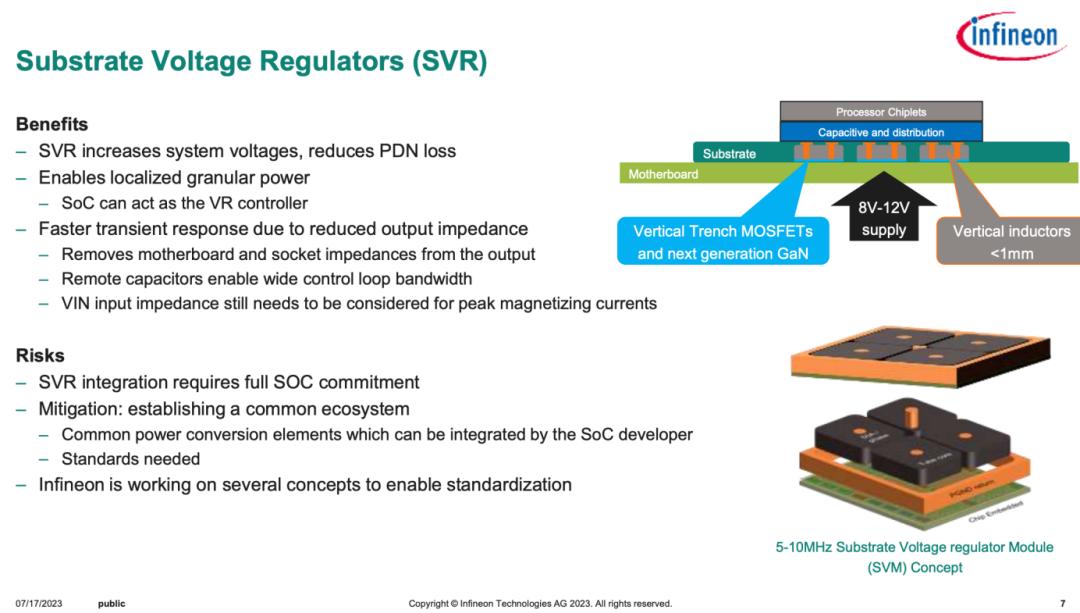
Higher integration and vertical power delivery are the development directions of AI power supplies. Infineon once shared that the future of AI power supplies will be divided into three stages:
The first stage is discrete/lateral power delivery. The power stage, inductors, and capacitors are directly placed next to the processor (GPU). The cost is the lowest, and the ecosystem and quality system are mature. However, when the GPU current exceeds 850 - 1000A, the loss will exceed 100W, and the total resistance of the PDN is about 90 - 140μΩ.
The second stage is backside vertical power delivery (BVM). It adopts a vertical layout. As the name suggests, the power supply module uses a vertically penetrating layout, vertically connecting to the processor from the backside of the substrate/motherboard, shortening the transmission path. By eliminating the spacing between multiple small modules and removing the power/control signal wiring below the processor, it improves power density, simplifies the motherboard design, and significantly reduces the total resistance of the PDN to 10 - 15μΩ (89% lower than that of the lateral layout).
The third stage is substrate-integrated voltage regulator power delivery (SIVR). The voltage regulator is directly integrated on the substrate, further streamlining the vertical transmission path. It is the optimal solution for loss control. It can additionally reduce the substrate PDN loss by 10 - 15%, and the total resistance of the PDN reaches 7 - 10μΩ (93% lower than that of the lateral layout).
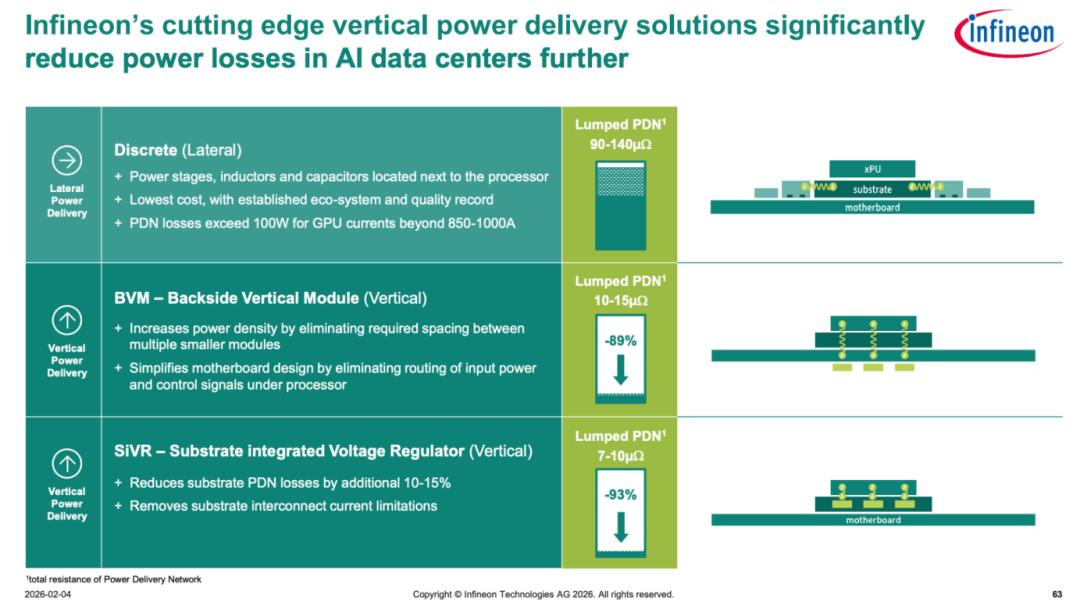
In this regard, IVR is a further optimized solution for VPD power supplies, and VPD technology is the entry ticket to the third stage.
Progress of Other Manufacturers in IVR
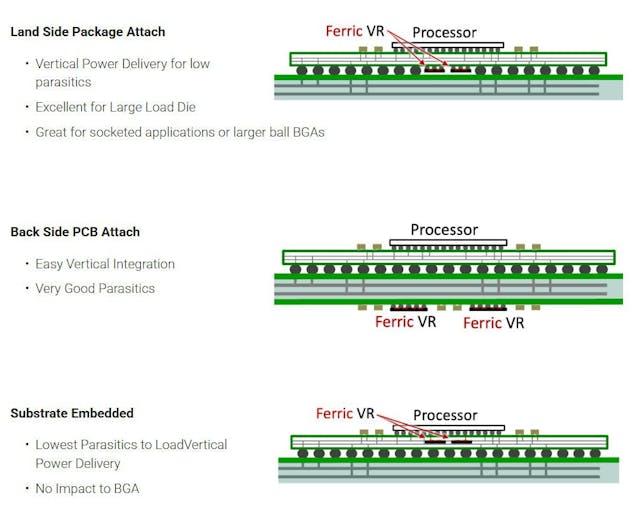
Currently, there are three IVR solutions: the first is to install the IVR on the backside of the motherboard PCB, similar to the "standard" vertical power transmission. The process is relatively simple, but the PDN is the largest; the second is to install it near the xPU die. For systems with lower power consumption, the chip is packaged in the package on the side of the xPU, and the installation is easier than on the pad side; the third is to embed the IVR in the substrate, reducing the thickness of the IVR so that it can be directly embedded in the substrate directly below the xPU die. The PDN is small, and it can carry a large current.
In the field of IVR, Empower is not alone. Ferric and Intel have launched IVR solutions, and Infineon is also closely following this technology.
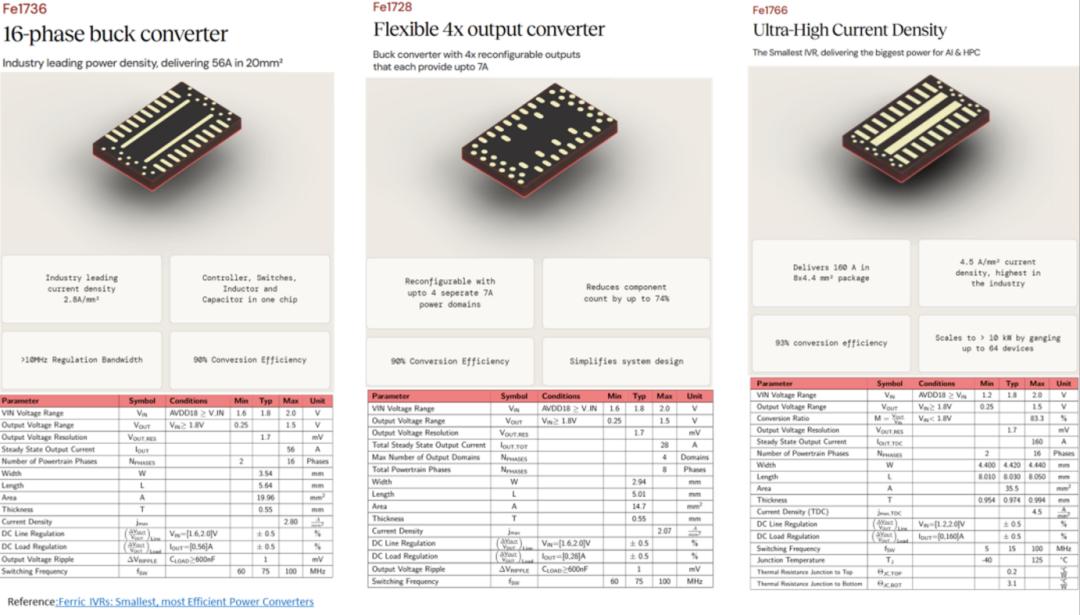
The American manufacturer Ferric is also one of Marvell's collaborators. Its IVR can be used in the "substrate-embedded" configuration, with an input of 1.2 - 2V, an output of 0.25 - 1.5V, a frequency of 60 - 100MHz, a thickness of 0.55 - 1mm, and a current density of up to 4.5A/mm².
In a previous interview, Ferric said, "With the support of Intel and the US government, we are developing some key underlying technologies for realizing IVR. We were developing thin-film ferromagnetic materials that can be integrated with semiconductors to miniaturize the entire power converter system, thereby achieving high-density IVR and solving this bottleneck - this is our current progress."
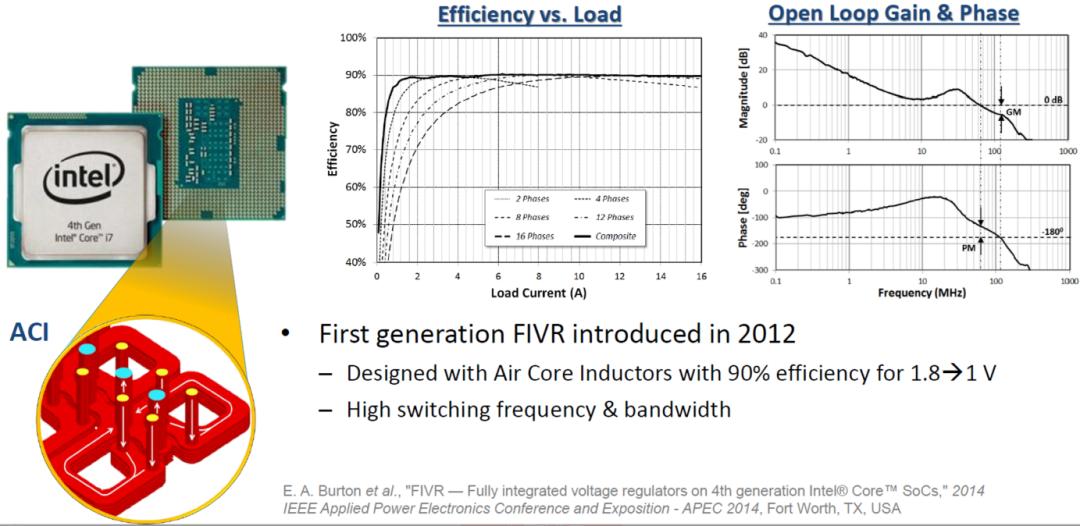
Intel introduced the FIVR technology a few years ago. Intel's FIVR directly integrates the IVR into the CPU. After adoption, the system design is greatly simplified, and the power supply solution becomes extremely simple. Intel used the IVR technology in its fourth-generation CPUs. The IVR is directly integrated into the CPU, using an air inductor (ACI). However, magnetic inductors (CoaxMIL) are also used in subsequent designs. With an input of 1.8V and an output of 1V, the maximum efficiency can reach 90%, and the loop bandwidth can reach 60MHz. However, Intel later postponed this technology. The specific reason is unknown, and heat dissipation may be one of the reasons.
Infineon has been paying attention to the substrate voltage regulator (SVR/SIVR) technology for a long time. It is researching multiple concepts to achieve standardization and has also proposed the concept of hybrid control.