Behind the rumors of traffic restrictions on "The Protagonist" and traffic investment in "Grandma", is algorithmic marketing creating anger?
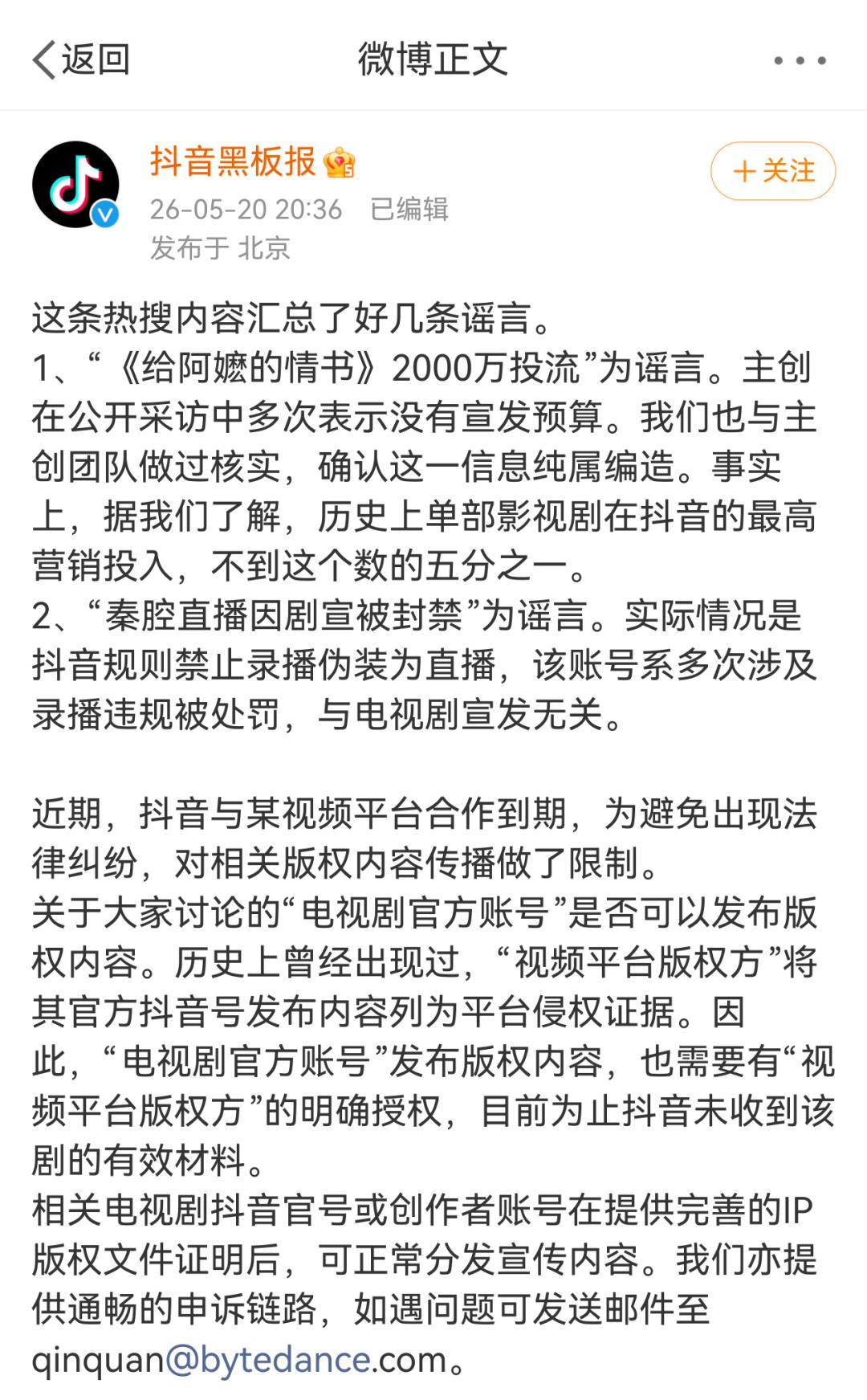
Douyin's public relations department has been quite busy recently. Last night, they continuously clarified two rumors.
One is about the movie "Love Letter to Grandma". It was rumored that the movie invested 20 million yuan in Douyin for promotion, but only got one video with millions of likes in return. Douyin responded that this information was purely fabricated. The highest marketing investment for a single movie or TV series on the platform in history was less than one-fifth of 20 million yuan.
The other is about a Qin opera live broadcast. There was a rumor that a Qin opera live broadcast was banned by Douyin for promoting the TV series "The Leading Role". Douyin explained that the reason for the ban was that the live broadcast room used pre-recorded content to pretend to be a live broadcast, which violated the platform's rules and had nothing to do with the TV series' promotion.
Regarding these two rumors, Douyin's clarifications seem to have no disputes at the factual level.
But what's worth exploring is: why can these false statements be widely believed and even make it to the hot search?
The answer may not lie in the facts themselves, but in emotions. The reason why the rumor of "20 million yuan for promotion" has a market is that it hits the long - standing dissatisfaction of many people with Douyin's marketing. Audiences are already tired of the routine and homogeneous marketing bombardment, and producers are also overwhelmed by the rising promotion costs. When "not promoting on Douyin" has become the most resounding word - of - mouth label for "The Leading Role" and "Love Letter to Grandma", the industry's true attitude towards Douyin's marketing is actually self - evident.
A rumor can stir up waves not because it is well - fabricated, but because it hits a nerve that has been tense for a long time. Behind these two rumors is actually the various angers that Douyin's marketing is arousing - from producers, from audiences, and the subtle changes happening in the entire industry.
When "Not Promoting on Douyin" Becomes the Most Resounding Word - of - Mouth
In the hot search topic of "The First Shot Against Douyin's Marketing", the most thought - provoking detail is that "The Leading Role" didn't actively choose to "resist". To a large extent, its non - promotion on Douyin is a passive choice.
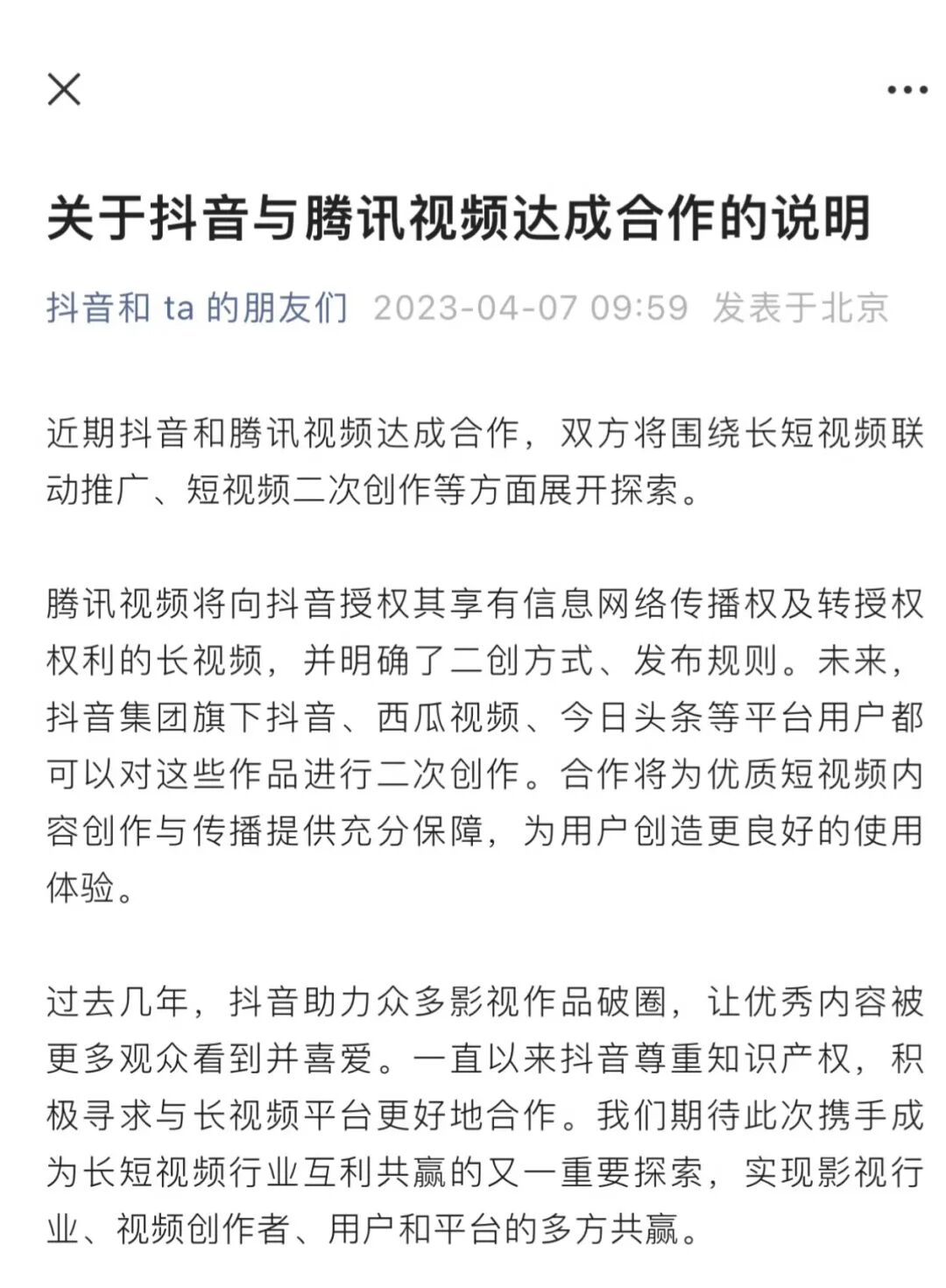
Since the three - year copyright cooperation on second - creation of film and TV between Tencent and Douyin expired at the end of April 2026 and was not renewed, Douyin carried out a large - scale cleanup of Tencent - related content to avoid legal disputes. The popular TV series "The Leading Role" was the first to be affected - a large number of short videos under the official account of the production company were deleted as soon as they were posted, and there were only about 20 left at one point. They even dared not use the normal topic tags of the TV series and finally had to open a "supporting role" account to divert traffic. That is to say, it was forced to take the path of not relying on Douyin because it wanted to promote but couldn't.
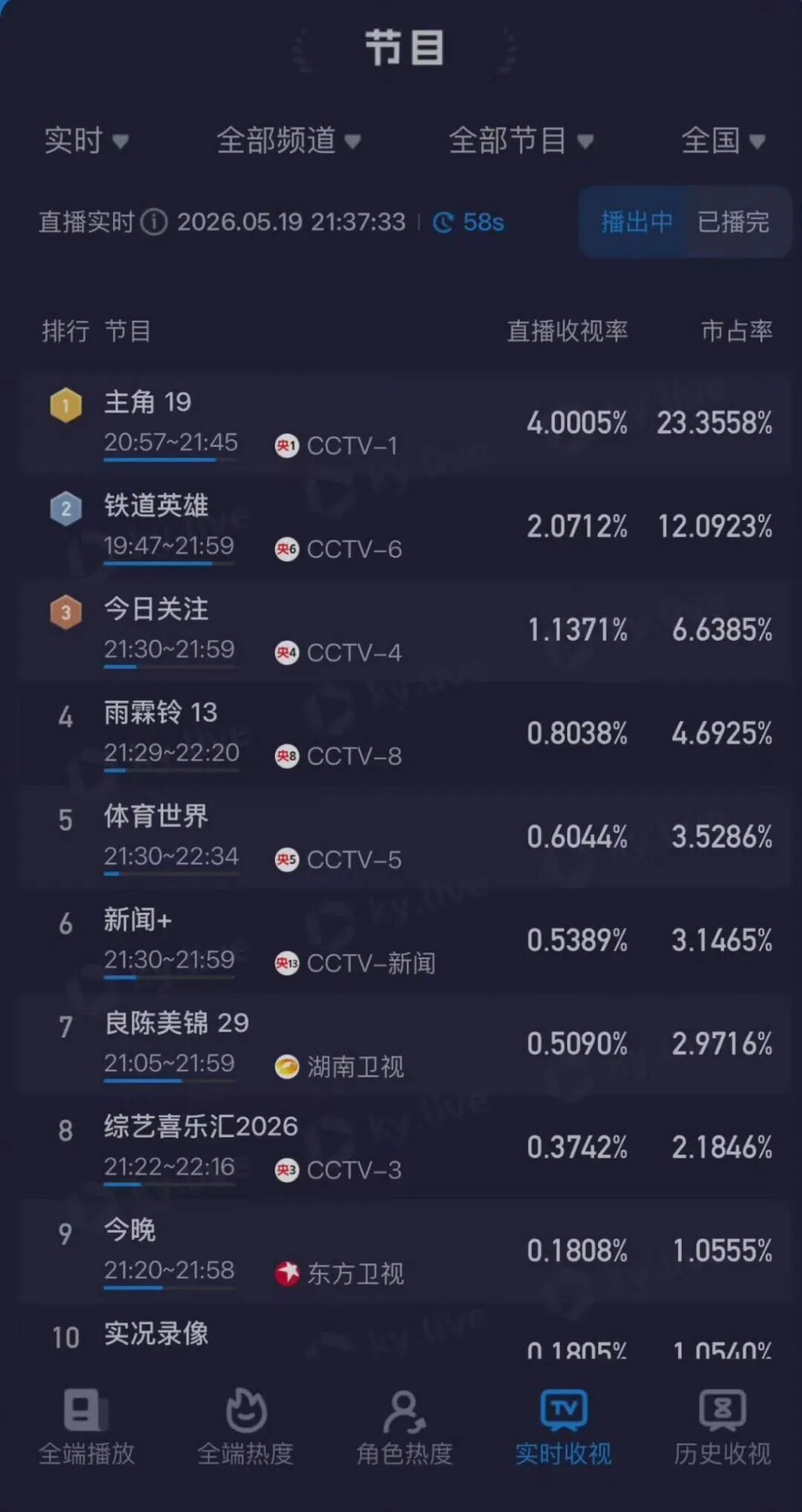
But the result is quite dramatic: it topped the CCTV ratings, and the popularity on Tencent's platform continued to rise. At the same time, topics such as "#The Leading Role's Popularity #The First Shot Against Douyin's Marketing" successively made it to the hot search on Weibo, turning the dilemma of being forced out into a word - of - mouth counter - attack. This challenges a near - superstitious consensus in the industry in recent years: no Douyin, no hit.
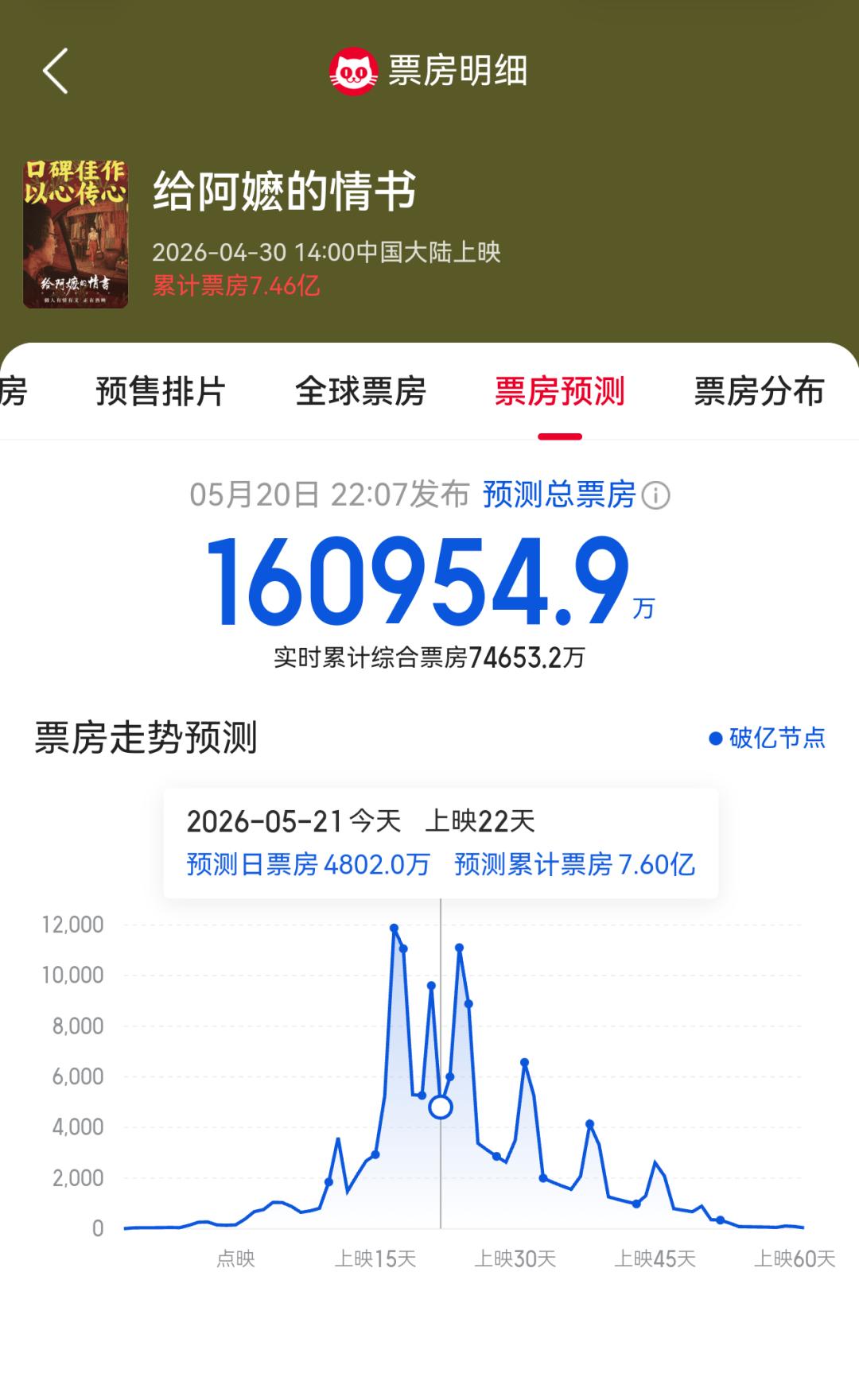
Almost at the same time, the movie "Love Letter to Grandma" also ran a curve that completely went against the market logic in an almost "anti - Douyin" attitude. With a production cost of only 14 million yuan, no popular stars, and all amateur actors, the creative team repeatedly emphasized in public interviews that "there is no promotion budget". On the first day of its release, the screening rate was only 1.6%, and the box office on the first day was 3.77 million yuan. Initially, the industry predicted that the total box office would be just over 50 million yuan. But it got a score of 9.0 on Douban, which later rose to 9.1, becoming the highest - rated domestic drama in the past decade. The word - of - mouth among audiences spread on its own.
Douyin's official rumor - refuting statement mentioned that the highest marketing investment for a single movie or TV series on the platform in history was less than one - fifth of 20 million yuan. And "Love Letter to Grandma" achieved a box office far higher than most commercial movies with "zero promotion on Douyin". This contrast itself is enough to illustrate the problem.
These two cases jointly point to a conclusion that has been repeatedly verified: truly good content can form topics through other channels and finally reach its audience even if it "loses its voice" on Douyin.
Then, if a work can succeed without promotion on Douyin, why do so many people still choose to promote?
The refuted rumor can explain some problems to some extent. Although 20 million yuan is false, the reason why it can be widely believed is that there is a real premise: In the past few years, a large number of mediocre or even shoddily - made movies and TV series have indeed created a false illusion of hits through Douyin's "second - creation of topics + emotional catchphrases + viral video clips". For example, countless romance movies with failing scores on Douban have achieved hundreds of millions in box office through dozens of tear - jerking video clips with captions like "I'm heartbroken after watching". After being deceived by the marketing into the cinema or clicking on the full movie, audiences find that the best parts are only in those 15 - second clips on Douyin.
Over time, producers have become accustomed to actively catering to the "pleasure points" and "pain points" of the sinking market, breaking the script into high - energy segments suitable for short - video dissemination, and the creation has become increasingly fragmented. The wave of "anti - Douyin marketing" this time may ring an alarm for the industry: when "not promoting on Douyin" has become the most resounding word - of - mouth label, producers may re - realize that the content itself is the most valuable currency.
Is Douyin's Dominance in Promotion Causing Anger?
The relationship between Douyin and long - video platforms has not always been as tense as it is today.
A few years ago, the film and TV commentaries and second - creation of video clips on Douyin were almost in a state of wild growth. A large number of accounts compressed a movie or TV series into a "watch in X minutes" video of three to five minutes, with captions and emotional voice - overs, and often received millions of likes. Long - video platforms were naturally dissatisfied because these contents used their copyrights without paying a single cent. Around 2021, Youku, iQiyi, and Tencent Video jointly spoke out, accusing short - video platforms of infringement and even taking them to court.
But the problem is that Douyin's traffic - driving effect is really too strong. After a TV series becomes popular on Douyin, the playback volume of the full movie or TV series rises visibly. Long - video platforms did the math: instead of fighting hard, it's better to cooperate. So in 2023, Tencent Video took the lead in reaching a second - creation copyright cooperation with Douyin, and iQiyi and Youku followed suit. "If you can't beat them, join them" became the standard script in the industry for those two years.
As a result of the compromise, Douyin officially got the "admission ticket" for film and TV promotion, and it was free. Since then, Douyin's marketing has changed from an optional option to a necessary one, and then from a necessary one to an increasingly expensive necessary one.
The most typical example is short dramas. Douyin uses its traffic advantage to strongly support short dramas, and producers flocked to it. But soon they found that the business model of short dramas is essentially "promotion in exchange for recharge" - after a short drama is launched, producers have to spend 80% - 90% of the recharge income on buying traffic on Douyin to maintain exposure. Once they stop promoting, the drama will disappear without a trace, just like a stone sinking into the sea. For a short drama with a recharge of 100 million yuan, the promotion cost is often more than 80 million yuan, and what really goes into the producers' pockets is very little.
The situation of long - form TV series and movies is not much better. Producers are becoming more and more dependent on Douyin for promotion, but the price of promotion is rising, and the effect is becoming more and more unpredictable. The bigger problem is that Douyin's algorithm is a black box. Producers spend hundreds of thousands or even millions of yuan on promotion, and they can see the playback volume and the number of likes, but it's difficult to know how much of these data has been converted into real viewership. This state is like throwing money into a black hole. You hear a sound, but you don't know where it goes after that.
As the promotion cost rises and the conversion rate drops, the grievances of all parties are naturally accumulating. When this emotion accumulates to a certain extent, it will find an outlet to vent. The reason why the rumor of "20 million yuan for promotion" can spread is ultimately not because it is well - fabricated, but because it is in line with everyone's imagination of Douyin. Promotion is like a bottomless pit. Douyin makes a lot of money in the middle, while producers are kept in the dark. Even if the fact is not like this, people are willing to believe that it is close to the truth.
The anger of producers is one side of the coin, and the other side comes from audiences.
The attitude of ordinary users towards Douyin - style promotion has also been quietly changing in recent years. At first, people found it fresh and wanted to watch the full movie after seeing movie clips. Later, the promotion became more and more frequent, and homogeneous "catchphrases", "heart - breaking moments", and "crying scenes" filled the information stream, and people gradually got annoyed. Later, when audiences found that the movies they were attracted to by the marketing were often not as good as the 15 - second clips on Douyin, a feeling of being deceived gradually accumulated. Audiences began to instinctively be vigilant and even rebellious towards the content pushed by Douyin.
This emotion is very obvious in this rumor - refuting event: although Douyin refuted the rumor, there was more resonance like "Finally, someone is talking about the promotion issue" in the comment section rather than a sense of relief.
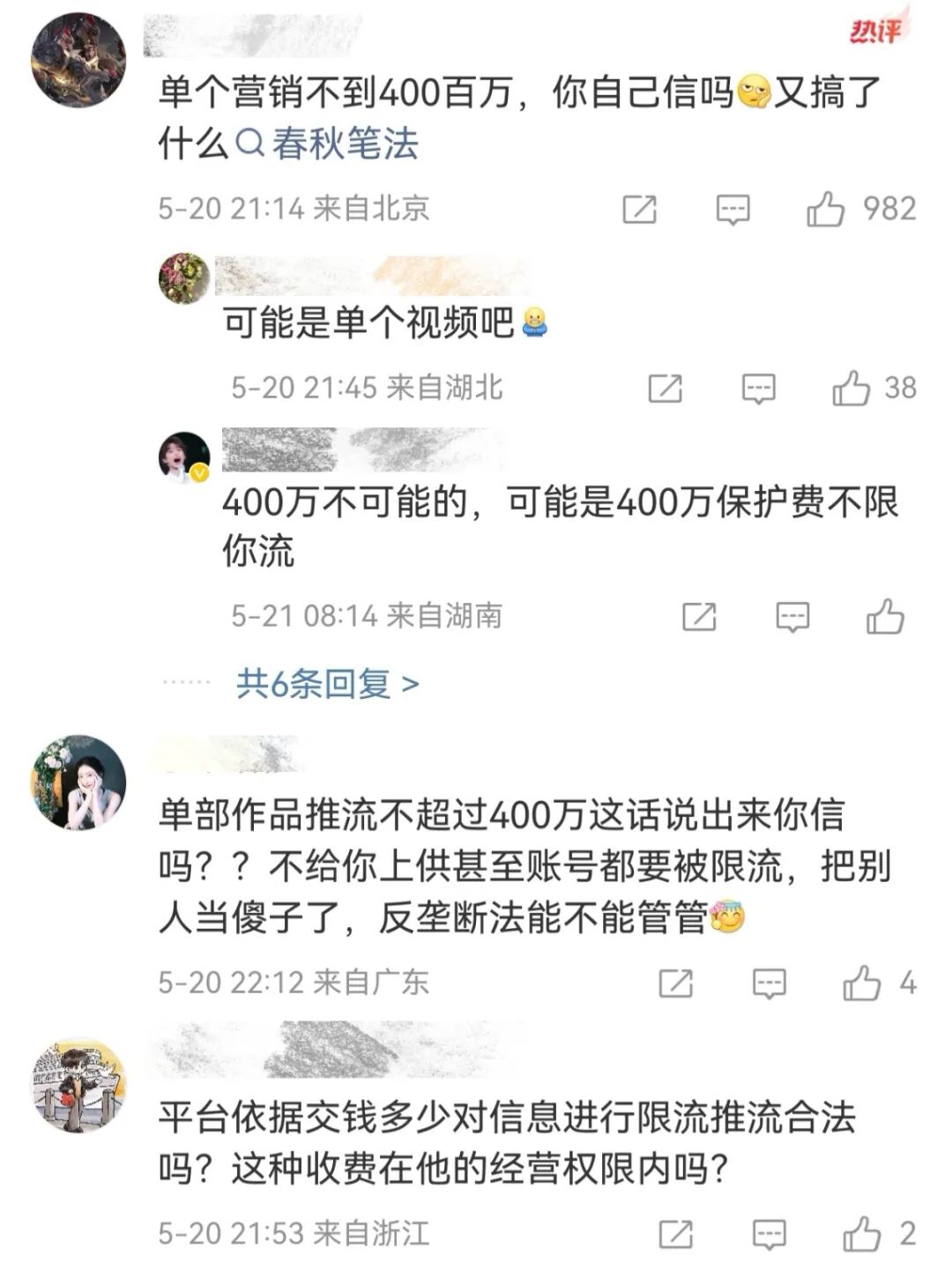
In other words, what audiences dislike is not the truth or falsehood of a certain rumor, but the promotion itself. The algorithm is like an invisible hand, pushing homogeneous marketing content in front of users again and again, but now, they are no longer easily convinced.
Producers have suffered from promotion for a long time, and audiences have also been tired of marketing for a long time.
The New "Three - Kingdoms Struggle" in the Marketing Landscape
Douyin's dominance in the film and TV promotion field is being quietly challenged by multiple forces.
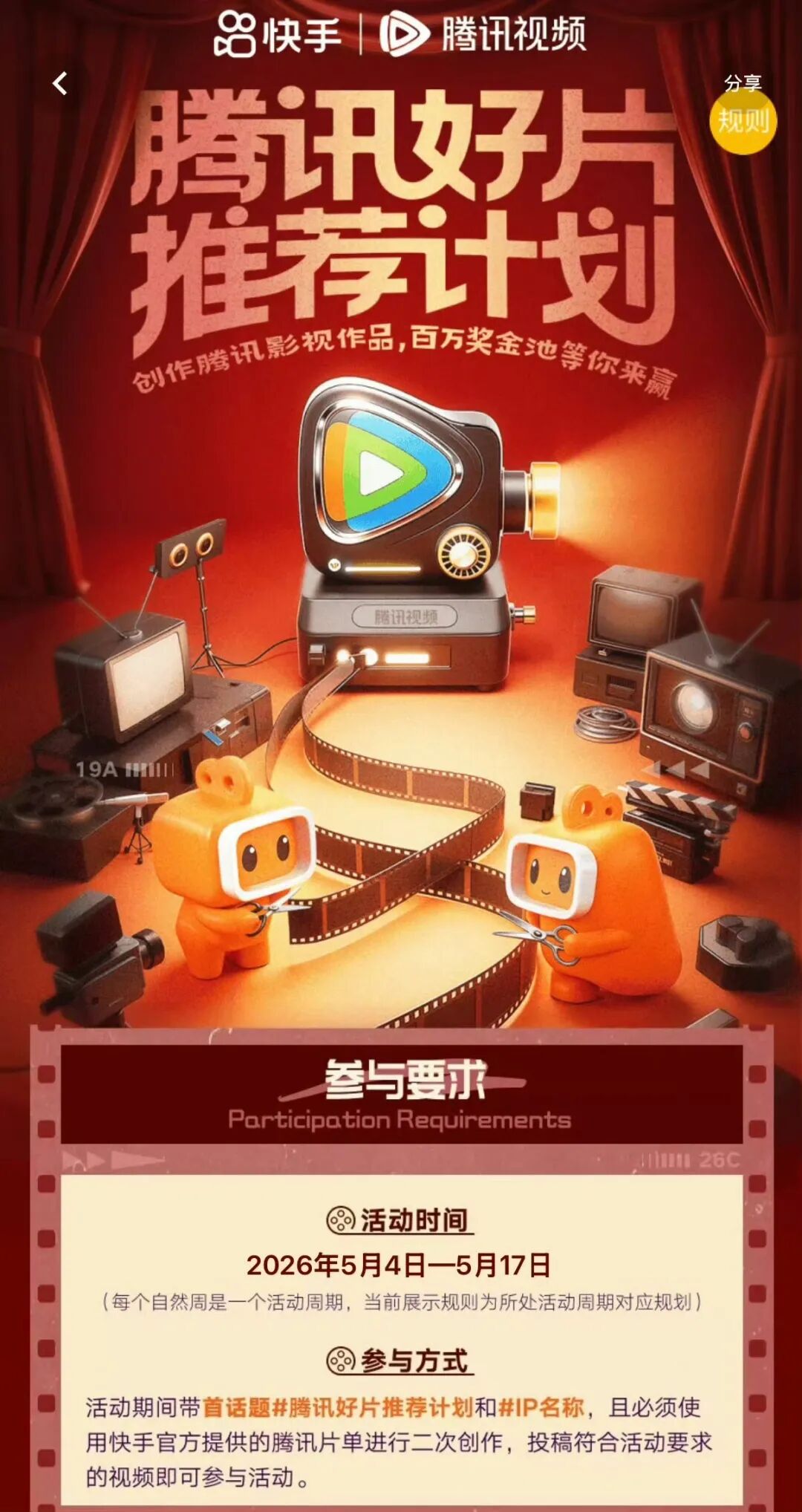
The most direct change comes from Tencent. After the three - year copyright cooperation with Douyin expired, Tencent Video quickly shifted its marketing resources to Kuaishou and Video Account. Kuaishou got the first - hand promotion resources of Tencent's TV series, and the two sides are also bound at the capital level in the AI video large - model Keling. Relying on the WeChat ecosystem, Video Account is becoming a quiet but effective promotion channel. It doesn't have as strong an algorithm - based push as Douyin, but it excels in social fission and endorsement from acquaintances. When a TV series is repeatedly mentioned in Moments and group chats, the conversion rate is often not low.
Other platforms eyeing Douyin are also looking for their own ecological niches. Xiaohongshu is becoming an important platform for the spread of film and TV word - of - mouth. Different from Douyin's strong emotions and fast pace, the discussions about movies on Xiaohongshu are more inclined to aesthetic analysis and detailed interpretations. Users are more willing to believe the real viewing feelings of amateur bloggers rather than the popular video clips pushed by the algorithm. This kind of grass - planting logic gives Xiaohongshu a longer - tail effect than Douyin in content such as art movies and dramas that require in - depth understanding. A few months after a movie is released, it can still continue to be discussed on Xiaohongshu.
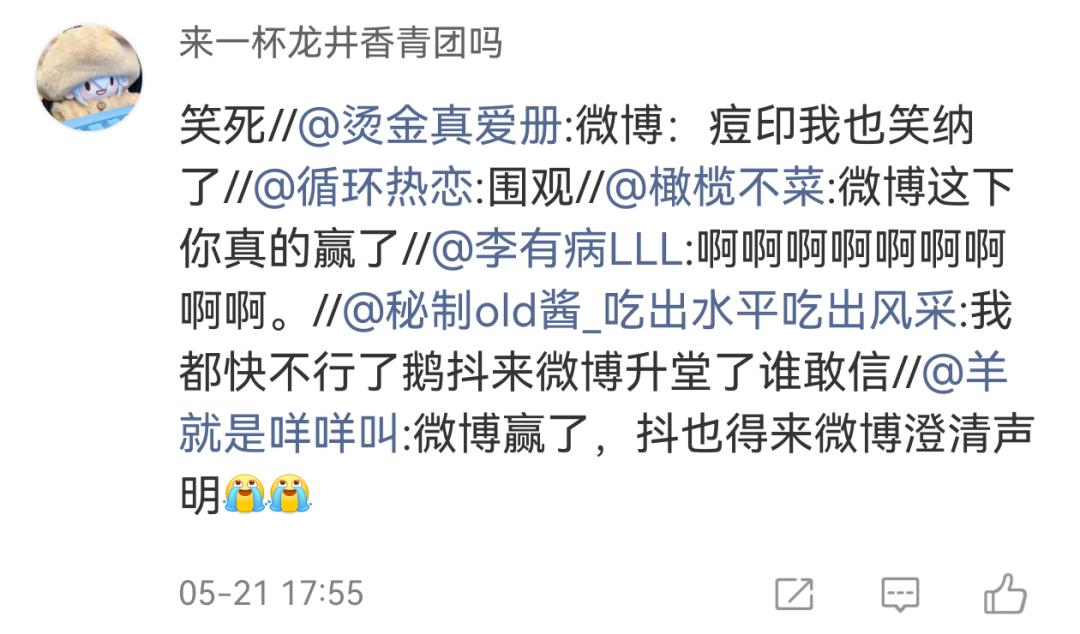
Weibo is still the main battlefield for topic detonation. The hot search of "The First Shot Against Douyin's Marketing" this time fermented on Weibo. Douban still holds on to the rating position. Although its daily active users are not high, its rating system is still an important yardstick for the industry and audiences to measure the quality of content. These platforms each hold a position, and although Douyin has the largest traffic, it is no longer the only choice.
But these scattered forces are not fighting on their own. Behind them, there are the strategic chessboards of three companies.
Tencent's approach is the most straightforward. From reconciling with Douyin to firmly cutting off, turning to Kuaishou and strengthening Video Account, it aims to defend the moat of social and content. Douyin has the largest traffic pool and the most mature algorithm, but it is in a passive position in terms of film and TV copyrights. Although Damai Entertainment seems low - key, in fact, through its entertainment matrix such as Youku, Damai, and Taopiaopiao, as well as its own production ability, it occupies a position in the upstream of the film and TV industry chain.
In the past few years, Douyin has established an obvious leading advantage in the promotion field, and the bargaining power of the channel has increased. Content providers often have little room for negotiation. But now, this pattern is being loosened by multiple forces. Platforms such as Kuaishou, Video Account, Xiaohongshu, and Weibo have each found