It plunged 83% on the 1st, and the southbound funds became the most unfortunate "knife catchers".
On May 21st, another super "pump-and-dump scheme" in the Hong Kong stock market crashed.
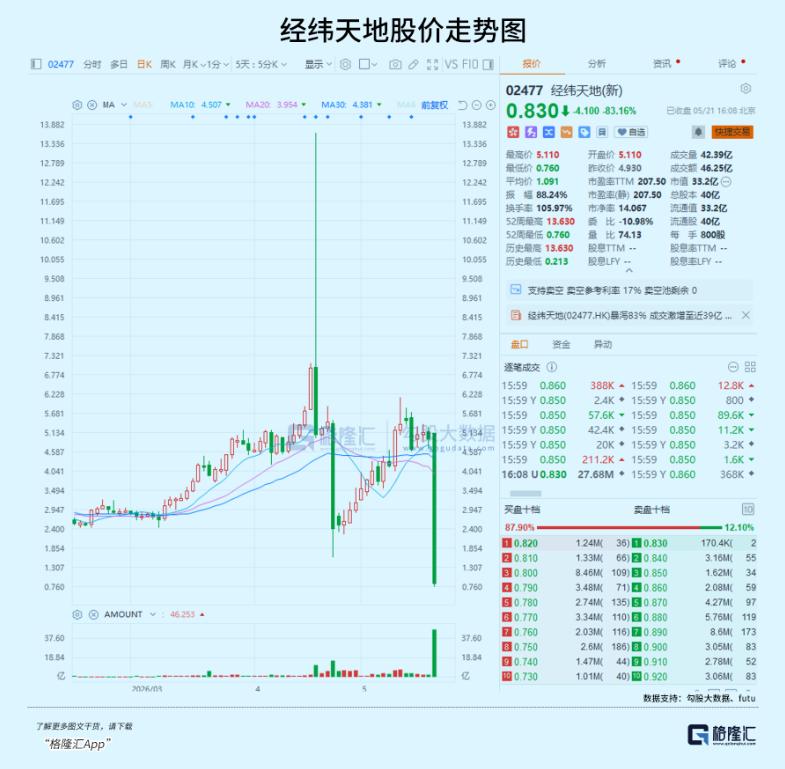
The Hong Kong stock named Jingwei Tiandi opened 3.65% higher at HK$5.11 per share in the morning session. Immediately after the opening, it entered a continuous free - fall and sharp decline mode.
What's even more astonishing is that, different from most penny stocks that experience a "cliff - like" plunge within just ten-odd minutes, usually no more than an hour, this stock continued to decline after the opening, cutting like a dull knife. There was no decent rebound until the mid - day closing. Countless retail investors who rushed in to catch the rebound were brutally harvested.
Finally, the stock closed at HK$0.83 per share. The decline was as high as 83.16%, with the market value evaporating by over HK$20 billion. It finally closed at HK$3.32 billion. The full - day turnover rate was as high as 105.97%, and the trading volume was HK$4.625 billion, far exceeding the latest market value.
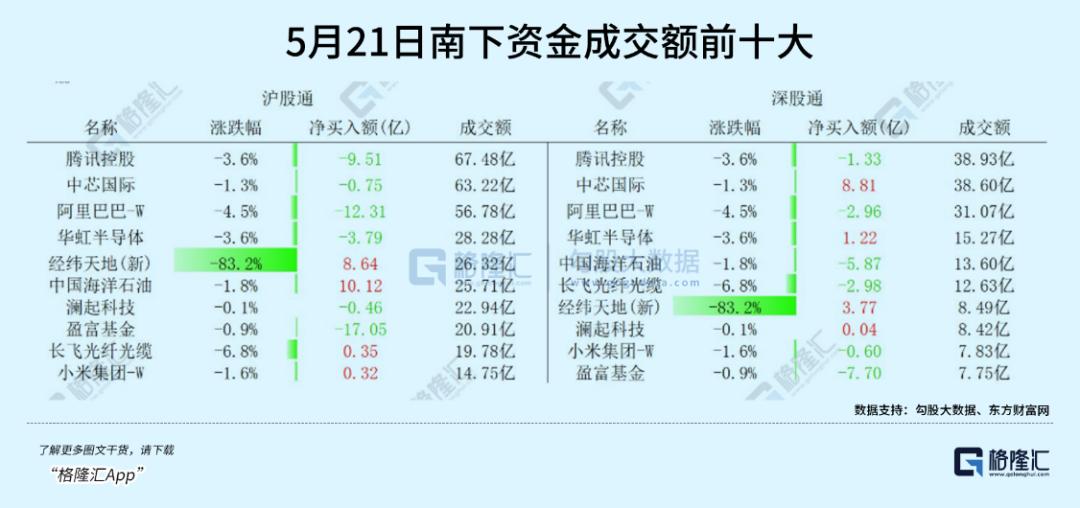
What's even worse is the southbound funds. Data shows that the southbound funds net bought a total of HK$1.241 billion worth of Jingwei Tiandi (New) today, becoming the most severely - hit "knife - catcher".
Harvested 3 times within a month!
Data shows that Jingwei Tiandi Holdings was established in 2003. In its early years, it mainly engaged in basic communication supporting services such as telecommunications network support and ICT system integration. Its business scenarios were concentrated in the traditional operator operation and maintenance track, with a mature technical model and limited industry growth space.
The company's capital path has been full of twists and turns. It was listed on the New Third Board in 2016 and delisted in 2018. Subsequently, it made three attempts to list on the Hong Kong stock market through IPO. Finally, on January 12, 2024, it was officially listed on the main board of the Hong Kong Stock Exchange. On the first day of listing, its stock price soared by over 140%, reaping short - term new - stock premiums.
However, after listing, the company completely lost the popularity of a new stock. Its fundamentals continued to weaken, and its growth came to a complete standstill.
In 2025, both the company's revenue and net profit declined. The growth momentum of its main business continued to decline, lacking internal profit - growth points. It gradually became a typical marginalized low - price stock in the Hong Kong stock market, laying the groundwork for subsequent capital operations and concept speculation for harvesting.
As early as 2025, the company first implemented a 1 - for - 2 share split operation to test the market liquidity;
In April 2026, it implemented a high - ratio 1 - for - 4 share split plan again, significantly diluting the share face value and greatly expanding the share capital scale.
After completing the liquidity preparation, the company precisely targeted the hottest AI computing power track in the first half of 2026 and started concept packaging and publicity. Relying on its original communication operation and maintenance and payment businesses, it forcibly associated with popular track concepts such as computing power scheduling, Token aggregation API, and computing power leasing. It officially announced its full entry into the AI computing power service and established an AI strategic special team, disguising itself as a high - growth AI technology target and deliberately creating the illusion of "low valuation, high growth, and occupying a golden track", completing a key step in market - value reshaping.
Soon, with the concept narrative, the stock price soared several times in just a few months, accumulating a large number of speculative floating - profit chips.
On April 21, 2026, the company's 1 - for - 4 share split officially took effect. At the same time, it started a special mechanism of parallel trading with old and new codes. The low - price stock price after the share split greatly attracted retail investors to follow the trend and enter the market, stimulating a significant increase in market participation.
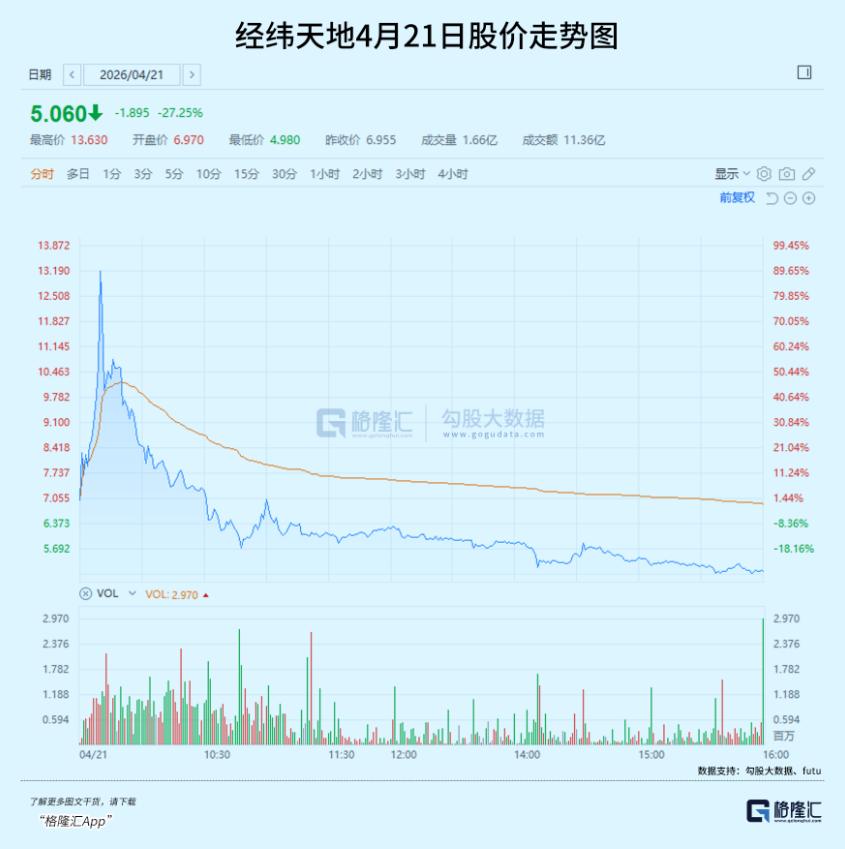
On April 21st, Jingwei Tiandi quickly rose after the opening. The stock price soared by 95% within just ten minutes and then fell sharply under a huge selling pressure. Finally, on that day, the stock price went from nearly doubling to a 27.25% decline, with a full - day trading volume of HK$1.136 billion.
Two days later, the company released its 2025 annual financial report. Since the performance was really poor (revenue was 219 million yuan, a year - on - year decrease of 21.5%; net profit was 15.24 million yuan, a year - on - year decrease of 24.3%), the stock price plunged again by 55.82% the next day.
Some investors who entered the market at a high price in the previous two days saw their book losses reach as high as 90% before they even had time to understand what was going on.
But it didn't end there. On May 6, 2026, Jingwei Tiandi (New) was officially included in the Hong Kong Stock Connect targets. After the inclusion was completed, domestic funds fully took over, and the main players successfully distributed their chips. On May 21st, without any sudden negative news in the market, no performance thunder, and no changes in industry policies, the stock finally encountered a third and more violent selling wave, eventually leading to a cliff - like crash and an extreme liquidity stampede.
According to post - market data, the southbound funds net bought as much as HK$1.241 billion worth of Jingwei Tiandi (New) today, becoming complete "knife - catchers".
Looking at the entire cycle of Jingwei Tiandi's sharp rise and fall, the whole process was precisely paced and clearly stepped. It perfectly utilized the Hong Kong stock trading rules, market sentiment, and the Hong Kong Stock Connect mechanism, which can be regarded as a textbook - level pump - and - dump scheme.
The suspected "pump - and - dump scheme" phenomenon in the Hong Kong stock market is flooding again
This kind of extreme decline of Jingwei Tiandi is not an isolated case in the Hong Kong stock market.
After a simple query and sorting, since 2026, at least more than twenty suspected new - style "pump - and - dump schemes" relying on hot - concept packaging, Hong Kong Stock Connect rule arbitrage, and liquidity manipulation have emerged in batches in the Hong Kong stock market.
Among them, most stocks fell by more than 50% within a month or even several trading days, and more than half of the core cases had a decline of more than 70%. The speed and amplitude of the harvesting are shocking.
From the perspective of industry distribution, these targets are highly concentrated in the two high - story - telling tracks of innovative drugs/internet medicine and AI/internet technology. At the same time, many traditional construction and financial targets are continuing the old - style pump - and - dump methods.
Among them, innovative drugs and internet medicine are the core high - incidence areas in the Hong Kong stock market in 2026.
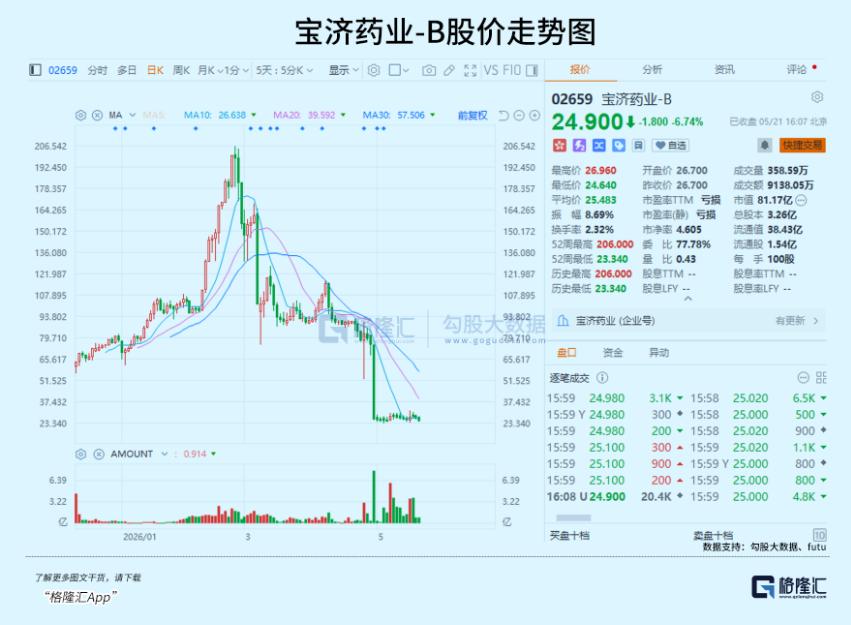
Baoji Pharmaceutical - B is one of the most representative cases of a sharp decline in stock price after being included in the Hong Kong Stock Connect.
The company previously continued to create momentum with the concepts of AI - based drug development and new tumor drug research. The stock price soared from HK$50 to HK$206 in the short term, a rise of more than 300%;
However, after being included in the Hang Seng Composite Index and obtaining the access qualification for the Hong Kong Stock Connect (on March 9th), the market completely reversed. The stock price plunged by 63% in a single day, with a cumulative decline of more than 86% from the high point. Passive funds and retail investors who bought at the high point were all deeply trapped.
It is worth mentioning that in the same batch of stocks that were included in the Hong Kong Stock Connect target securities list when the list was adjusted and took effect on March 9, 2026, there were also many companies like Baoji Pharmaceutical - B that experienced a significant decline in stock price after being included.
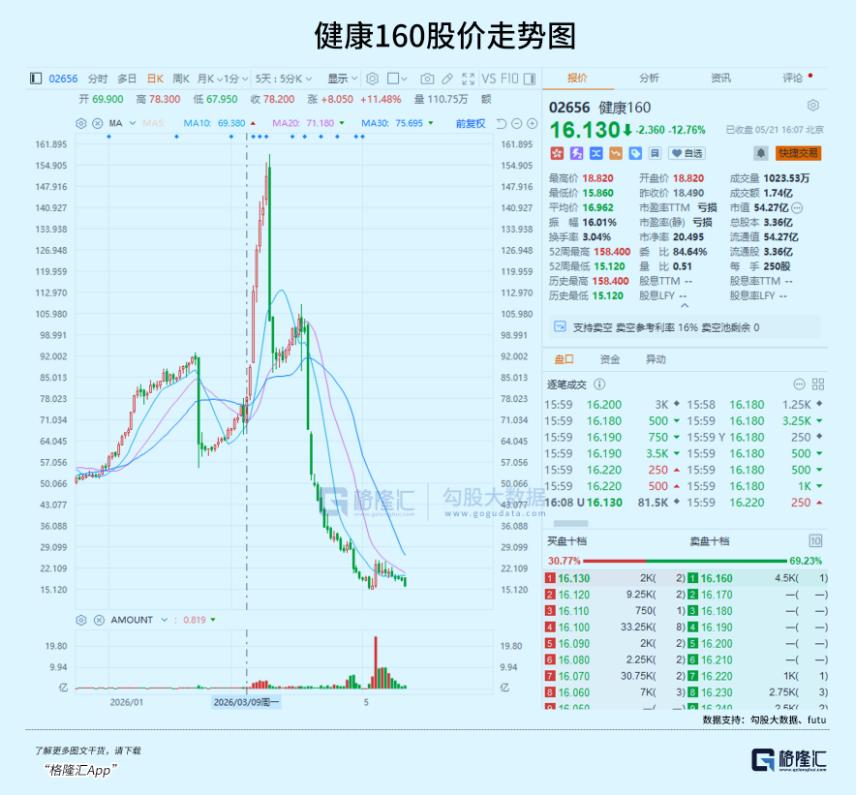
Health 160: After being officially included in the Hong Kong Stock Connect, its stock price was once doubled by funds. However, after reaching a high of HK$158.4 on March 18th, it started to decline sharply by 31.52% with heavy trading volume and continued to enter a volatile and sharp - decline market. So far, the stock price has fallen to HK$16.13, with a maximum decline of up to 90%.
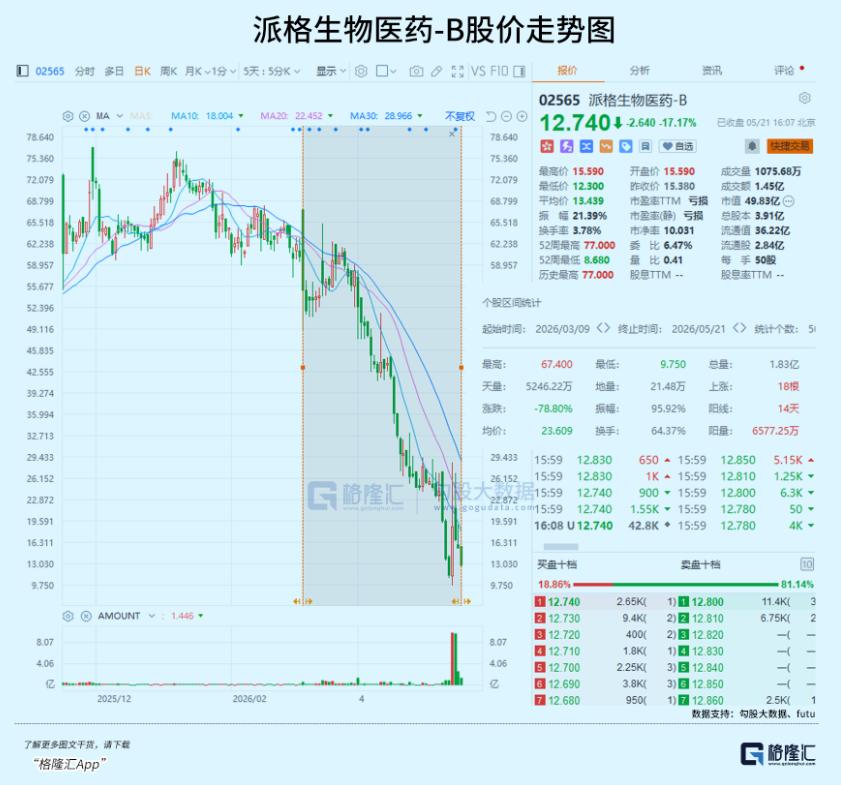
Piaget Biopharmaceutical - B: On March 9th, the day it was included in the Hong Kong Stock Connect, the stock price opened high and closed low, with a decline of 8.49%. Since then, it has continued to decline, with a cumulative decline of 78.8% so far.
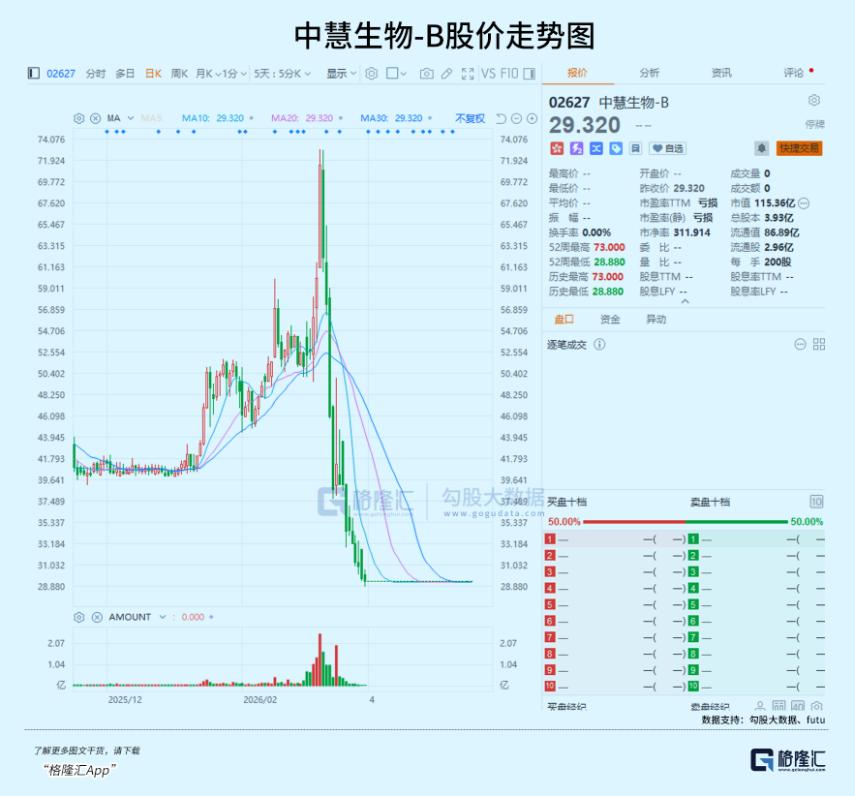
Zhonghui Biotech - B: After being included in the Hong Kong Stock Connect on March 9th, it once rose for three days. Then the stock price continued to plunge. At the end of March, it was ordered to be suspended by the Hong Kong Stock Exchange and required to be thoroughly investigated due to a major suspicious trading incident.
In addition to the way of harvesting investors by speculating on "being included in the Hong Kong Stock Connect", there are also many biopharmaceutical stocks that have a trend of rising the stock price through storytelling concepts and then quickly falling.
Compared with the biopharmaceutical industry with the most problems, the AI and internet technology tracks are also the core high - incidence tracks of pump - and - dump schemes in the Hong Kong stock market in 2026.
This kind of target has completely abandoned the rough rights issue and share consolidation routines of traditional penny stocks and upgraded to a modern harvesting combination of "professional public - opinion packaging + high - ratio share split and dilution + Hong Kong Stock Connect rule arbitrage + financial paper beautification".
Among them, Nuobikan (02635.HK) is the one that has received the most media attention.
Nuobikan was listed on the Hong Kong Stock Exchange in December 2025. The company only issued 3.7866 million shares globally, with a very low proportion of the total share capital. It is an extremely low - liquidity target, and the main funds can completely control the stock - price pricing power with very little capital.
During the listing period, the company precisely packaged high - end and hardcore technology narratives such as "AI digital twin, rail transit intelligentization, and AI operation and maintenance of energy infrastructure", and combined with the halo of a "specialized, refined, characteristic, and innovative" enterprise, continuously attracting market attention.
Relying on the premium advantage of the scarce tradable shares, the stock price soared by 364% on the first day of listing, setting the best first - day increase for a new Hong Kong stock in nearly a decade, quickly shaping the market image of a "ten - fold AI technology bull stock".
It is reported that within a few months after listing, the company continuously released industry research reports, positive news about the track, and cooperation rumors through channels, continuously strengthening the high - growth expectation and attracting retail investors and small and medium - sized institutions to continuously follow the trend and make layouts.
In 2026, the company began to promote a high - ratio 1 - for - 10 share split, significantly lowering the stock price and increasing the market liquidity, attracting a large number of retail investors to follow the trend and make layouts.
On April 20th, the company was officially included in the Hong Kong Stock Connect. Almost the same as the above - mentioned routine, the stock price tumbled by more than 70% within the next 10 trading days, and the market value of HK$30 billion quickly shrank to less than HK$10 billion.
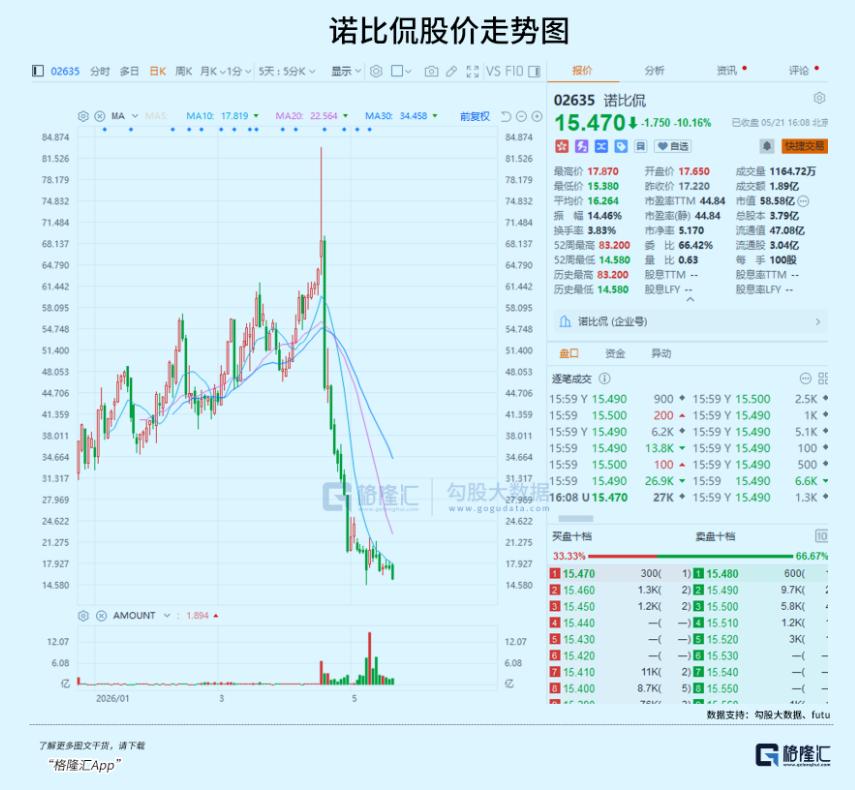
Without the AI technology halo, in fact, the company's fundamentals have obvious defects: In 2025, the debt scale doubled significantly, and the sharp increase in short - term borrowing led to an intensified liquidity risk; the accounts receivable scale exceeded the annual revenue, the collection cycle was extended to nearly a year, and most of the revenue was a virtual increase on the books without real cash - flow support;
To make matters worse, in April 2026, the company was involved in the financial fraud incident of A - share listed company Hengxin Oriental and was disclosed by the regulatory authorities as a relevant trading counterparty. Although it was not directly identified as participating in the fraud, it broke through the market's trust in the authenticity of its performance, ultimately causing a sharp decline in valuation.
In addition, there are also AI fintech targets such as QuantGroup, which also rely on the empty AI quantification concept to hype up the stock price. After a short - term sharp rise, they quickly fell by more than 67%, with highly homogeneous routines.
