Why does Airbnb refuse to become the next traditional OTA?
After 18 years since its establishment, Airbnb is once again trying to redefine itself.
On May 20th, Pacific Time, Airbnb announced multiple cross - category expansions at its 2026 Summer Product Launch event.
Brian Chesky, co - founder and CEO of Airbnb, introduced that this upgrade is reflected in multiple dimensions. In terms of services, new services such as fresh food delivery, private car airport pick - up and drop - off, luggage storage, and car rental have been added. In terms of accommodation, thousands of boutique and independent hotels have been added, with the first batch covering 20 popular cities such as New York and Paris, and platform price protection and cash - back policies are provided. In terms of experiences, new landmark attractions, food culture, and activities have been added. The relevant new businesses and functions are expected to be launched gradually this summer.
This also means that Airbnb is accelerating its transformation from a single - accommodation platform to an all - in - one travel booking platform.
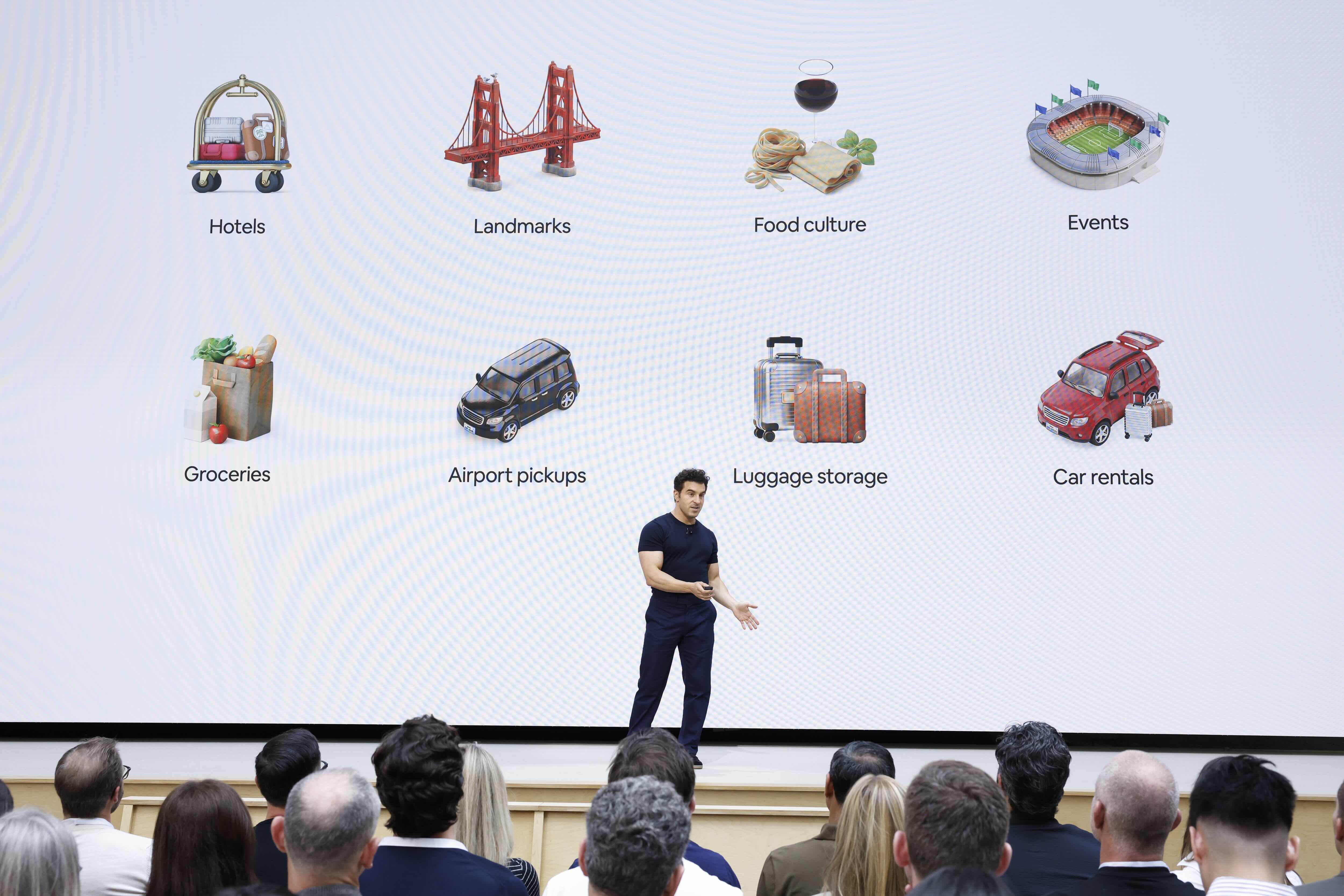
Brian Chesky. Image source: Airbnb
However, becoming a traditional OTA is not the direction Airbnb wants to take.
01
Nathan Blecharczyk, co - founder and Chief Strategy Officer of Airbnb, said in an interview with Jiemian News reporters, "Travel should be meaningful." Airbnb wants users to feel like locals (insiders) rather than foreign tourists (outsiders). This is the core proposition he uses to distinguish Airbnb from traditional OTAs.
When asked by Jiemian News reporters whether Airbnb will be more like a traditional OTA or create something new in the future, Nathan Blecharczyk gave the latter answer.
In his view, Airbnb "definitely won't" follow the old path of other traditional OTAs. "OTAs just list everything without their own perspective."
He added that Airbnb is building a multi - entry product matrix, where listings, hotels, experiences, and services are all entry points. Multiple business lines guide traffic to each other in the long term, and different products form a strategic synergy that supports each other.
The logic of the multi - entry approach can be traced in the company's financial report for the first quarter of this year. Brian Chesky mentioned in the Q1 earnings conference call on May 7th this year that experience products are becoming new demand - driving entry points: nearly a quarter of users who book experiences for the first time will subsequently book accommodation or services, and about a third will complete accommodation bookings within 90 days. In addition, about 55% of users who book hotels on Airbnb for the first time will return to book listings.
The latest financial report also shows positive signals. In the first quarter, Airbnb's revenue was $2.7 billion, a year - on - year increase of 18%; the net profit was about $160 million, a year - on - year increase of 3.9%; the adjusted EBITDA was about $519 million, a year - on - year increase of 24%.
In addition, in this major upgrade, the App is also fully introducing AI functions, including review summaries, listing comparisons, and shared itinerary lists.
AI is more deeply integrated within the company. Brian Chesky disclosed in the Q1 earnings conference call that nearly 60% of the code produced by Airbnb engineers is now generated by AI. The company estimates that this is about twice the industry average. The self - resolution rate of AI customer service has increased from about one - third in the fourth quarter of last year to over 40%. The cost per booking has decreased by about 10% year - on - year.
However, according to information revealed by Nathan Blecharczyk to media such as Jiemian News, Airbnb currently does not have an independent AI department. Instead, it regards AI capabilities as a basic skill that every employee needs to master. In his view, engineers are natural early adopters, and the company's current approach is to let early adopters with achievements share their experiences.
In Nathan Blecharczyk's view, the bottom - up diffusion method driven by early adopters is more in line with the company's current rhythm than setting up a separate AI department.

Nathan Blecharczyk. Image source: Airbnb
02
From the perspective of the industry as a whole, personalization and experiential consumption are becoming the main growth points in travel.
A report released by Allied Market Research predicts that the global personalized travel and experience market will reach $447.3 billion by 2030, with a compound annual growth rate of 17.8% from 2021 to 2030. Among them, the scale of the OTA channel will increase from $22.6 billion in 2020 to $132.6 billion in 2030.
Meanwhile, outbound travel from China is also on the rise. Data from the National Immigration Administration shows that the number of inbound and outbound trips in China approached 700 million in 2025, reaching a historical high. Reports from multiple platforms and institutions such as Ctrip and Mastercard all point out that China's outbound travel has entered a new stage of "short - distance first, experience - driven".
Nathan Blecharczyk also confirmed this trend in the interview. In the first few months of this year, the accommodation booking volume of Chinese users during the World Cup increased by more than twice. Their average trip was 9 days, and they preferred multi - destination combinations.
However, this path is not easy for Airbnb. In the overseas market, OTA giants such as Booking.com still have a huge traffic base and conversion rate advantage.
Brian Chesky also admitted in the conference call that the conversion rate of Airbnb's hotel business is still significantly lower than that of Booking.com and regarded it as a potential opportunity to tap into existing customers.
The Chinese market is more complex. Although Airbnb has currently avoided competing with other platforms in the Chinese domestic market, local platforms such as Meituan, Douyin, Ctrip, and Mafengwo have already entered the local tourism and small - group tour businesses, and the corresponding supply chains have formed a relatively dense coverage. The service categories that Airbnb focuses on are also more similar to the form of local - life platforms in China.
Meanwhile, Chinese OTAs are also accelerating their expansion overseas. Ctrip's financial report for Q1 2025 showed that the booking volume of its international platform, Trip.com, increased by more than 60% year - on - year. Ctrip has also publicly stated that it aims to double the proportion of its overseas business revenue in the next 3 - 5 years.
The Chinese market is not without opportunities for Airbnb. Airbnb executives have also repeatedly emphasized in public that China is one of its important markets. For this reason, questions about "whether it will return to the Chinese domestic business" always appear at Airbnb's global press conferences every year.
Airbnb announced its entry into the Chinese market in 2015 and officially entered in 2016. However, due to various comprehensive factors, it announced the suspension of its Chinese domestic business in 2022 and focused on the outbound travel market related to China.
In response to continuous attention, Nathan Blecharczyk said in an interview with Jiemian News reporters that the company's current focus is still on the rapidly growing Chinese outbound travel market. Regarding the possibility of returning to the Chinese domestic business in the future, he did not rule out the relevant possibilities and specific forms.
Nathan Blecharczyk frankly told Jiemian News reporters that with the favorable visa policies, China has great potential as a travel destination. However, given the huge competitive pressure in the Chinese market, Airbnb needs to carefully evaluate the "right way" to participate in the market before taking any action.
When pressed by Jiemian News reporters for a specific return target time, he clearly stated that there is currently no specific schedule to disclose.
This article is from Jiemian News, author: Xu Meihui, editor: Wen Shuqi. Republished by 36Kr with permission.