Under the wave of computing power, the wireless transformation of AI intelligent imaging | 2026 AI Partner · Beijing Yizhuang AI + Industry Conference
What Shenmu does is not to chase after NVIDIA. Instead, in the downstream of the computing power wave, it uses extremely low-power chip design to free cameras from the constraints of wires and open up a future with hundreds of billions of intelligent vision terminals.
Yang Zuoxing led Shenmu to achieve a breakthrough in reducing the power consumption of cameras by an order of magnitude. The power consumption of the first-generation chip is one-third of the industry average, and that of the second generation is one-tenth. For the first time, a 1-watt solar panel was used to drive an all-weather intelligent camera. He believes that the current annual shipment of global security cameras is only 300 to 400 million, but it will reach 10 billion by 2035 and 100 billion by 2045, because the world's large models need trillions of cameras to map the physical world in real time. In the field of inference computing power, Yang Zuoxing believes that Chinese start-up companies still have great opportunities.
The following is the full text of the speech, edited and organized by 36Kr:
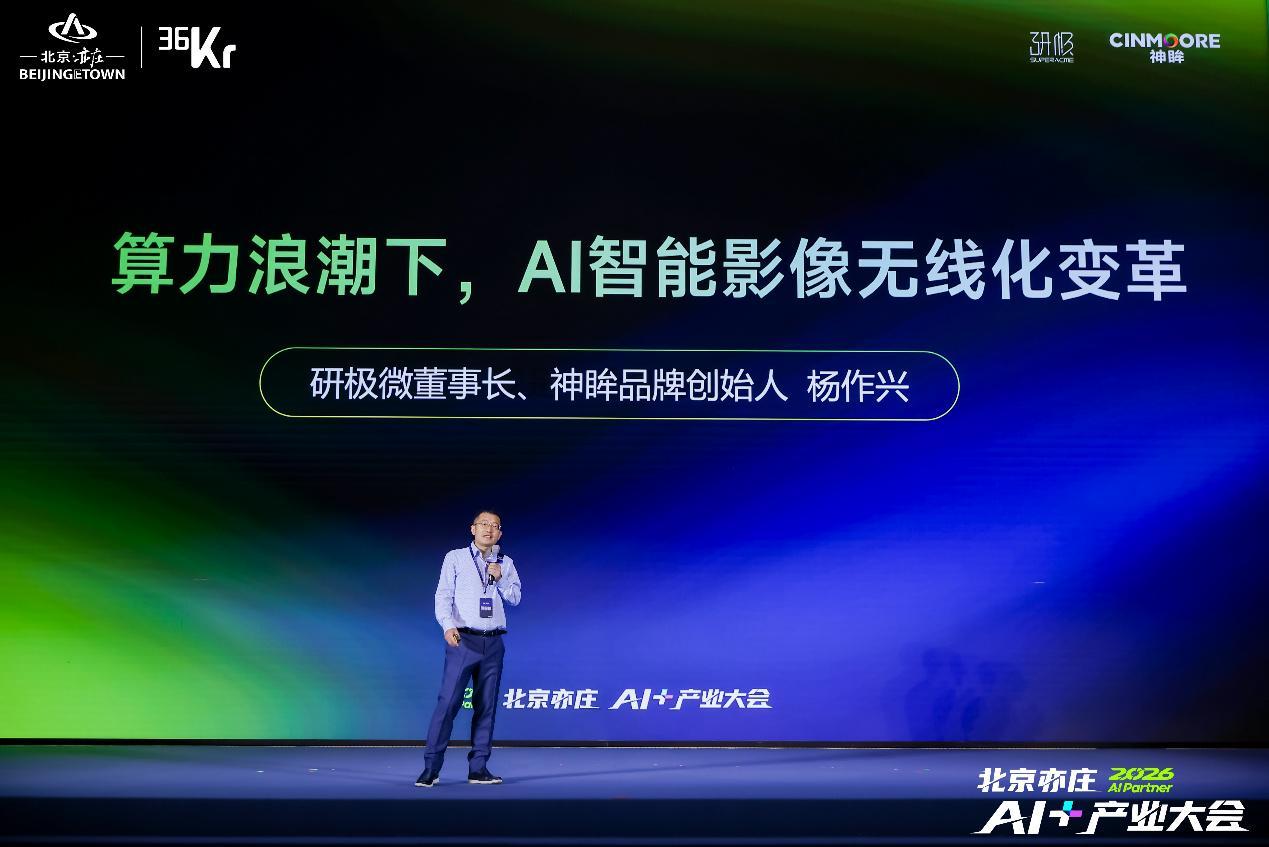
Yang Zuoxing | Chairman of Hangzhou Yanjimicro Electronics Co., Ltd. and Founder of Shenmu Brand
Good afternoon, everyone. I'm very happy today. I attended the 36Kr AI+ Conference in Shanghai last year, and this is the second time. One year has passed, and there have been great changes in AI. Everyone is extremely excited. At the 36Kr AI+ Conference, it's obvious that there are significant differences between this year and last year. Here, I'd like to thank the organizer, 36Kr.
I'm Yang Zuoxing, the chairman of Hangzhou Yanjimicro and the founder of the Shenmu brand. AI is at the center of the global storm. Can we look deeper into this storm center? What's at the eye of the storm? We believe it's new-quality productivity.
Currently, the company with the highest global market value is NVIDIA. It has surpassed Apple, Microsoft, Amazon, and TSMC because it has mastered new-quality productivity - GPU computing power.
Under the wave of computing power, what opportunities does Shenmu have?
We've observed that with the development of technology, mobile phones, computers, and tablets were freed from wires a long time ago. However, cameras, which are just visual sensors, still rely on wires, which greatly increases the installation cost of cameras. We can see that when installing cameras outdoors, one needs to set up a pole first, which costs 10,000 - 100,000 yuan. Digging a pit and laying cables costs another 10,000 yuan. The installation takes more than a week, and the annual maintenance cost of a camera is 3,000 yuan. The annual maintenance cost of cameras in the public security system is very high.
What we're doing is to achieve zero installation cost, zero usage cost, and zero maintenance cost for cameras. To achieve this, we need to reduce the power consumption of cameras by one to two orders of magnitude.
Low-power chip design involves a breakthrough in methodology. We've adopted a full-custom chip design methodology, which was initiated by our company. It has three differences. First, we use custom cell design. The traditional industry solution uses the standard cell libraries of TSMC or Samsung. Whether in school or in a company, when designing chips, we usually use static double latches. We can't use dynamic logic or single latches because EDA tools can't check them well. However, we do the opposite. We use dynamic single latches. A static double latch consists of 24 transistors, while our dynamic single latch has only 4 transistors. The area and power consumption are one-sixth of the ordinary method. Second, we use handwritten netlists. The traditional method uses high-level languages to write code. Using handwritten netlists is like software engineers writing code in assembly language. One of the reasons for the major breakthrough of DeepSeek is that they use PTX for programming, which is much better than others. We'll have several times the advantage by using handwritten netlists. Third, we use manual layout. The traditional method uses automatic layout, and the utilization rate of automatic layout is usually 50% - 60%, while ours exceeds 95%.
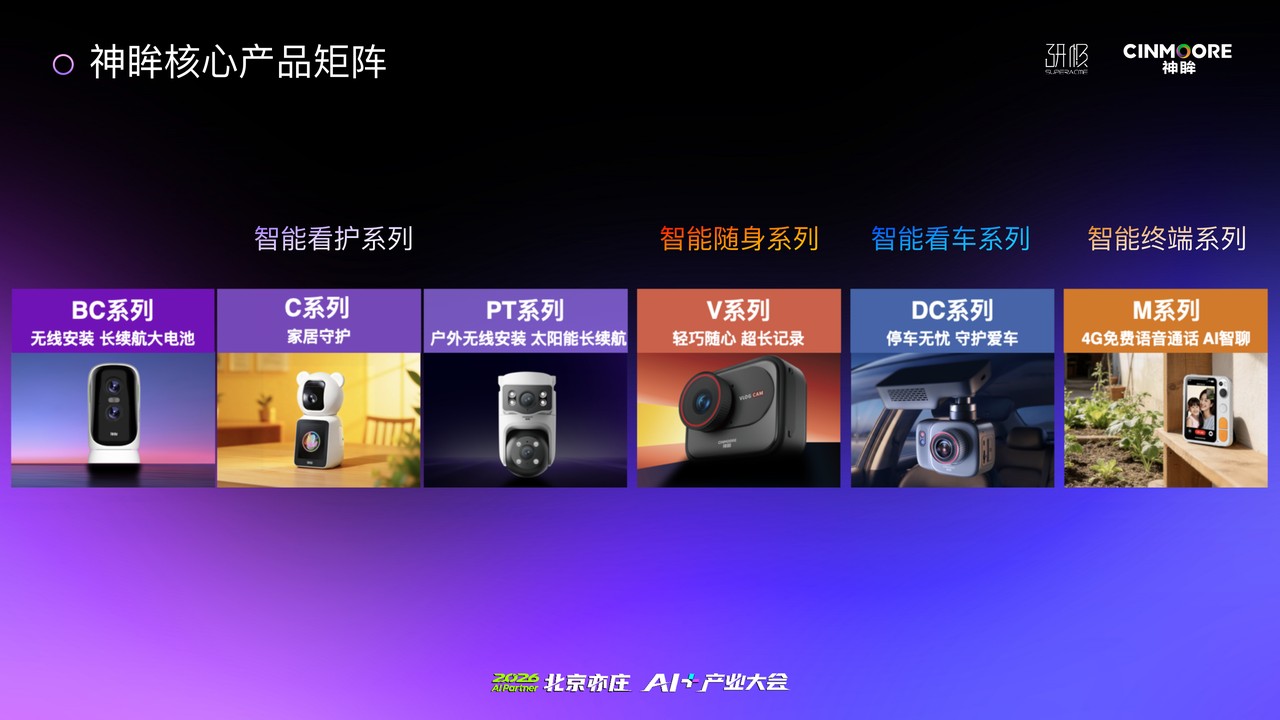
Through these methods, the product of power consumption and cost is reduced by an order of magnitude. This methodology is also used in the camera SOC chip. Our first-generation chip achieves one-third of the industry's power consumption and is used in Ideal AI glasses and our own product series of Shenmu, such as the intelligent pan-tilt camera BC4PRO+, the binocular gun-ball AOR battery pan-tilt camera PT4, and the sports imaging series product, the life recorder V1.
The second-generation chip achieves one-tenth of the industry's power consumption and has been applied to the Shenmu intelligent parking recorder DC1. This is the industry's first product developed for parking scenarios, with ultra-long battery life, no wiring required, and convenient installation. The second-generation chip is also applied to the Shenmu solar integrated intelligent camera BC7. For the first time, we use a 1-watt solar panel to achieve continuous cruising 24 hours a day, 365 days a year. In addition to the SOC, low-power design has also been carried out in CIS, PMU, Wi-Fi, and 4G. We want the entire product system to achieve one-tenth of the power consumption, so each component needs to reach one-tenth. It's not enough to just reduce the SOC to one-tenth.
These are a series of products based on the chips:
Currently, the annual shipment of cameras represented by security cameras is only 300 - 400 million, excluding mobile phone cameras. We think it will reach 10 billion by 2035. The number of mobile phone cameras has exceeded 5 billion. There are three or four cameras on one mobile phone, and there are more than one billion mobile phones sold every year. Mobile phone cameras serve people, while IoT cameras serve all things, and their quantity will be far greater than that of mobile phone cameras. Especially after Shenmu launched this wire-free camera, we estimate that the number of cameras will reach 10 billion by 2035. It may seem like a large number, but as long as it maintains a 30% annual growth rate, it can be achieved.
We think it will reach 100 billion by 2045. Because we predict that the fourth industrial revolution, artificial intelligence, will be fully completed by 2040. Finally, most of the current human jobs will be replaced by AI. Where will we go? We'll work, entertain, and find a sense of achievement in the virtual world. We need a world large model, which is very large. Everyone will see different scenes with each step. This world large model needs to be grounded; otherwise, it will float and produce hallucinations. How to ground it? We need countless cameras to input the real-time state of the world into the large model. To fully reflect the world in the large model, we need 1.2 trillion cameras. Built over ten years, that's 100 billion cameras per year.
In the era of large models, what Shenmu wants to do is "Divine Calculation", that is, large model inference computing power. Computing power is the latest new-quality productivity, without a doubt. Currently, NVIDIA is the king in our field. Do other companies still have opportunities? We can look at it from two aspects:
First, training computing power. Engineers use training computing power to iterate better large models. Second, inference computing power. Users ask the large model, such as DeepSeek, questions every day, and it gives an answer. This is inference computing power. It's difficult to have the opportunity to surpass in training computing power. Although many domestic companies are also making GPUs, the main reason is the CUDA interface. All large model frameworks are written based on CUDA. At the last ecological conference, I remember the boss of a well-known domestic large model company said that they used Huawei's cards and spent three months adapting them. Three months is equivalent to one generation for large models. Without a very strong revolutionary friendship, no one will spend three months adapting for you.
There are great opportunities in inference computing power for two reasons. First, inference computing power doesn't depend on the CUDA interface. Second, each large model has a unique algorithm. According to the differences in algorithms, operators, and data paths, we can make a lot of customizations. These customized chips naturally have considerable advantages in terms of power consumption and cost compared to general GPU chips. Moreover, the demand for inference computing power is far greater than that for training computing power. Even if there are one hundred world-class excellent large model teams in the world, with ten thousand cards per team, that's only one million cards. Inference computing power is for six billion natural people and more robots in the future. They also use computing power, so the demand is far greater than that for training computing power. This is also the reason why NVIDIA will spend 20 billion US dollars to acquire Groq, a start-up company in the field of inference computing power.
If we do a good job in inference computing power, our start-up companies still have the opportunity to stand at the forefront of the wave. How to do a good job in inference computing power? There are three key points. First, can we find an excellent large model that is suitable for us, either an open-source one or a closed-source one that can form a strategic partnership. Second, do we have advanced semiconductor processes. Third, does the chip design methodology, especially the low-power design methodology, have unique features.
We're doing well in all three aspects. Our full-custom chip design methodology achieves one-tenth of others' power consumption. One generation of process improvement can save 30% of power consumption. Two generations of semiconductor process optimization can save about 50%. Four generations of semiconductor process improvement can reduce it to one-eighth. One-tenth of the power consumption is equivalent to making up four to six generations in terms of process. We're currently a top partner of Samsung's most advanced process, and we can customize semiconductor processes.
Although most tokens come from closed-source models, the trend of open-source models is still very good. Moreover, although Chinese large model companies still have a little gap with the world's most advanced large model companies, it's only a matter of time and inevitable to surpass them.
Combining these three points, we still have great opportunities, especially in the CNN (Convolutional Neural Network) era. When we developed our self-developed Shenmu chips, we had already developed our own compiler based on CNN to map the CNN model to our chips. We've done a very good job with this compiler. We've been iterating it every day for five years and have withstood the test of commercialization. In addition, we also use large models for AI customer service and AI programming to provide AI application services for Shenmu customers. We're also using AI ourselves. Although the scale is not very large, we can form a closed loop internally from SOC chips to large model chips, sensor chips, products, and cloud applications, and iterate rapidly within ourselves. So we're still very hopeful in this regard.
Thank you all.