Is enterprise AI only capable of reporting numbers and afraid to make decisions? SmartBI Baize V5 provides a practical solution.
After BI integrates with AI, many enterprises are pleasantly surprised to find that business personnel no longer need to write SQL. They can retrieve data by simply inputting a sentence.
However, after the initial excitement, when entering serious business analysis scenarios, enterprises quickly face new "soul - searching questions":
- When the boss asks "Why has the profit declined", why can AI only repeat numbers and fail to provide attribution suggestions?
- Key data is scattered in Excel and old reports. Can AI even correlate them?
- The data provided by AI doesn't match the caliber, and there are even "hallucinations". Who would dare to make decisions based on it?
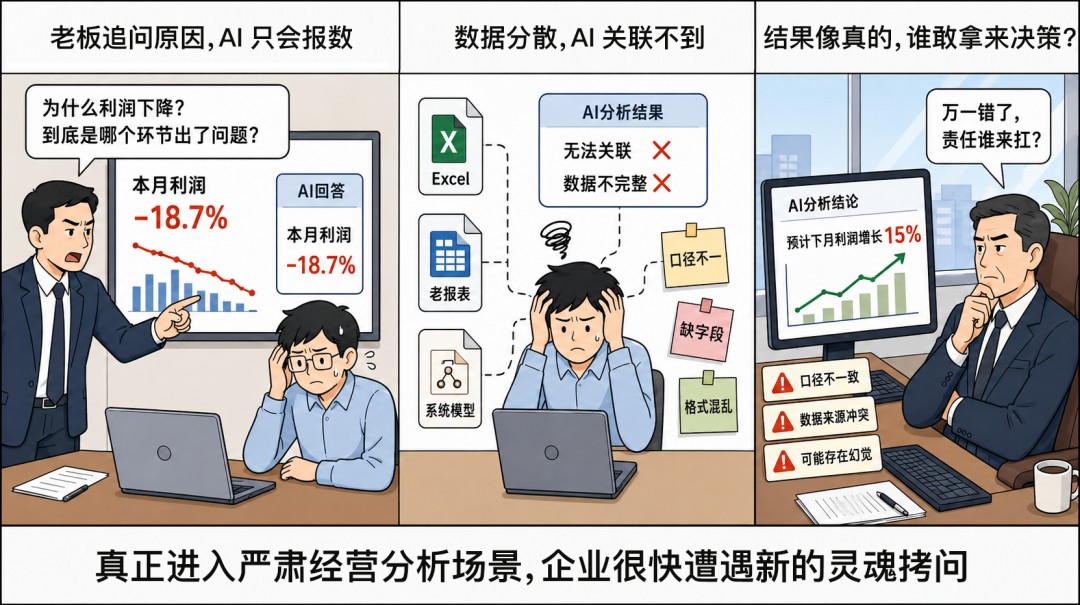
This indicates that what enterprises need is no longer a simple Q&A, but a complete analysis process from data understanding, cause analysis to result delivery. Once AI truly enters such a business process, enterprises will judge it by stricter standards:
Is it useful?: Can it explain the reasons and give suggestions, rather than just returning a number?
Is it reliable?: Can it clarify the indicator caliber and analysis basis, rather than letting AI guess intuitively?
Is it easy to implement?: Can it reuse existing reports and business systems, rather than starting from scratch?
Facing these "three major challenges" in the implementation of enterprise - level AI, SmartBI Baize V5 breaks through the situation with its new architecture: It enables AI to truly move from "answering a question" to "completing an enterprise - level analysis".
What has Baize V5 emphasized this time?
Centering around the real data analysis process of enterprises, Baize V5 organizes capabilities such as simple data query, attribution analysis, multi - source integration, dashboard creation, analysis report generation, and intelligent form filling into a complete link from question - asking to analysis, and then to result delivery and result review.
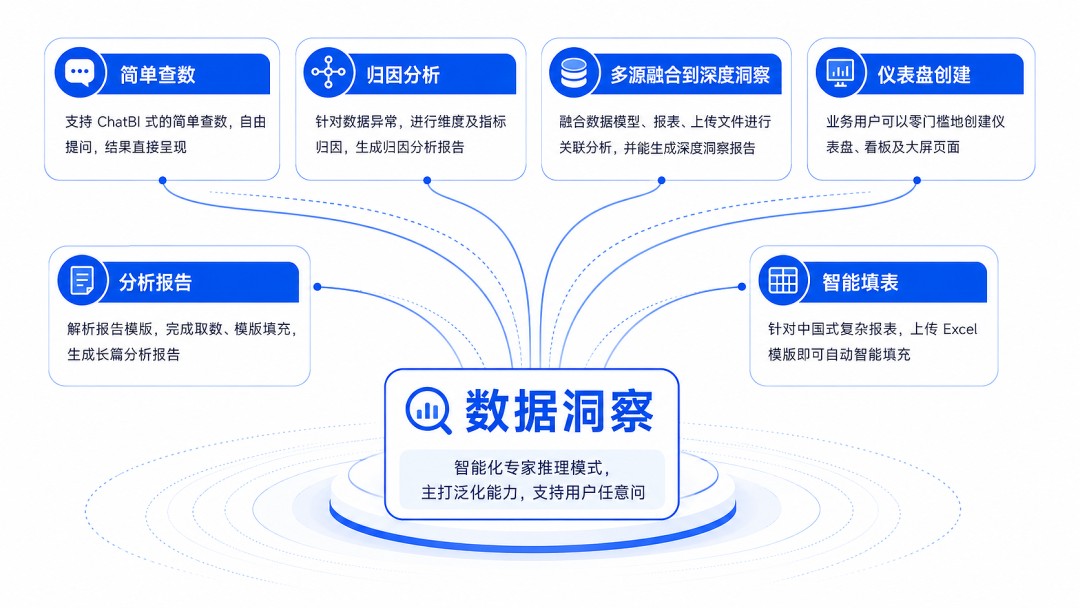
1. From "single - point capabilities" to "complete analysis tasks"
In the past, AI data analysis often stayed at the level of "asking one question and getting one answer".
However, real - world business analysis is usually a continuous link: first query indicators, then look for anomalies; after discovering changes, continue to ask about the reasons; after finding the reasons, form conclusions and suggestions to promote the next step of action.
What Baize V5 strengthens is to complete this entire link.
From simple data query, to attribution analysis, and then to generating insight reports, it not only answers "what happened", but also further explains "why it happened", "who is most affected", and "what can be done next".
This enables AI to no longer be just a Q&A entry, but to start participating in the entire process of a business analysis.
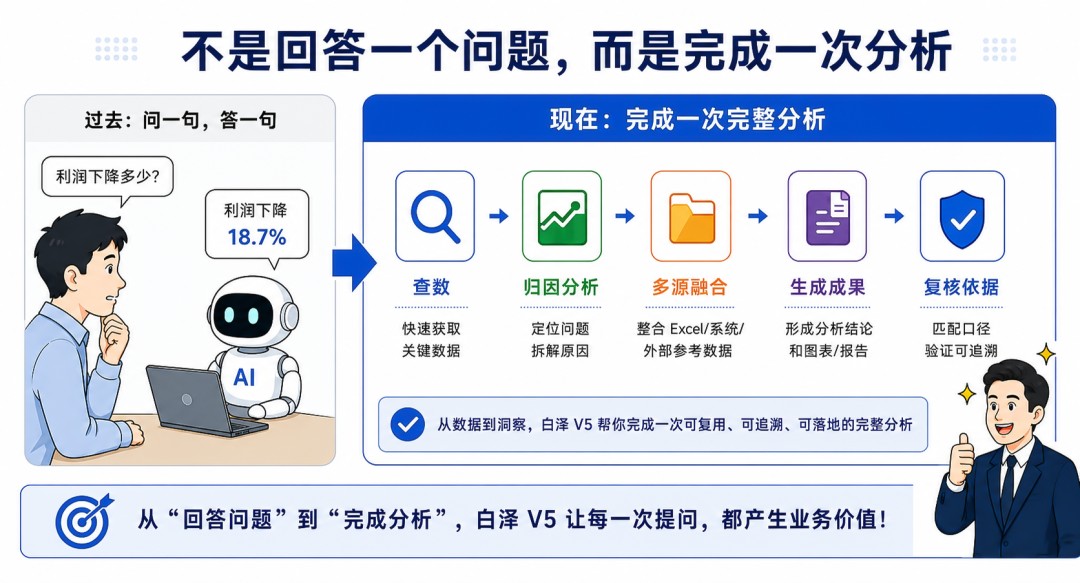
2. From scattered data to multi - source integrated analysis
Enterprises' real data is not only stored in databases. Many key data are scattered in Excel, existing reports, and system models. In the past, analyzing these data together often required manual sorting, development of associations, or repeated import and export.
Baize V5 can incorporate these scattered data into the same analysis process: identify file content, correlate system data and existing reports, and further generate insights and suggestions.
This makes AI analysis closer to the real business scenario, and enables the data at the disposal of business personnel, the data in the system, and the data in existing reports to be unified around the same problem.
3. From "generating content" to "delivering results"
The analysis results required by enterprises will not end up in the chat window.
What businesses really need are often a report, a complex report, a dashboard, or a set of actionable suggestions.
Baize V5 strengthens the ability to generate these "deliverable results": it can generate business analysis reports based on templates with analysis ideas, complete intelligent form filling according to complex Excel templates, and create sales analysis dashboards based on a single sentence.
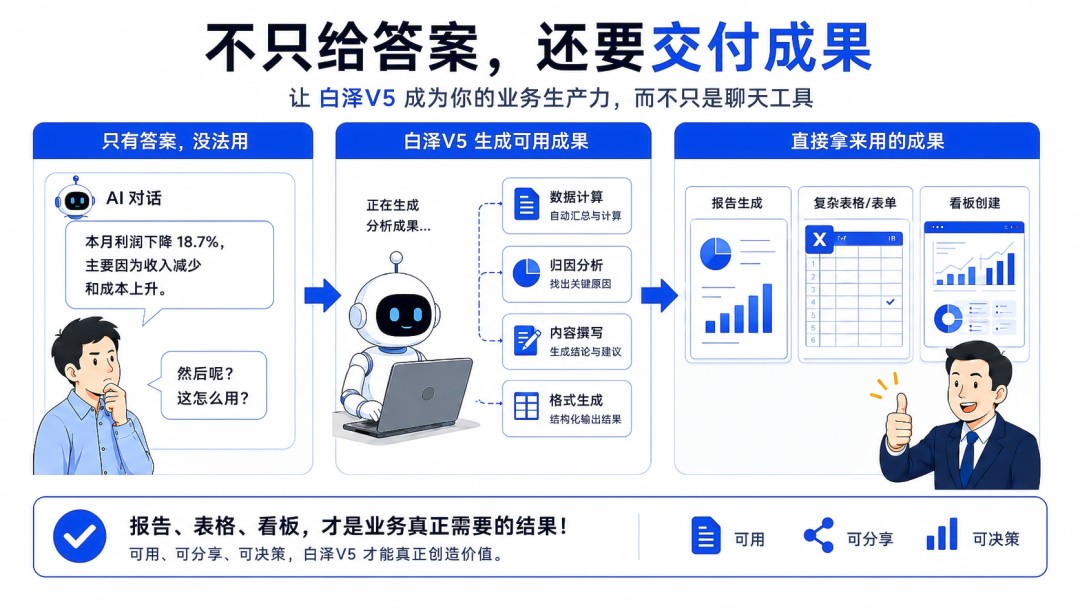
In other words, V5 not only "says" the answers, but also "produces" the results, turning the content generated by AI into analysis results that can be used in business.
4. From seemingly correct to verifiable
When enterprises use AI for data analysis, what they fear most is not that AI can't answer, but that the answers seem real, but the data caliber, calculation logic, and analysis process are unclear.
Therefore, Baize V5 not only focuses on "whether the results can be generated", but also on "whether the results can be checked".
For example, after generating an analysis report, the system not only outputs the final report, but also generates a data comparison table, listing the data models, fields, query conditions, statistical calibers, and calculation formulas corresponding to each chapter and each value.
After filling in a complex Excel form, it also outputs the field mapping relationship, filling review report, and verification details, making the data source and calculation logic of each cell traceable.
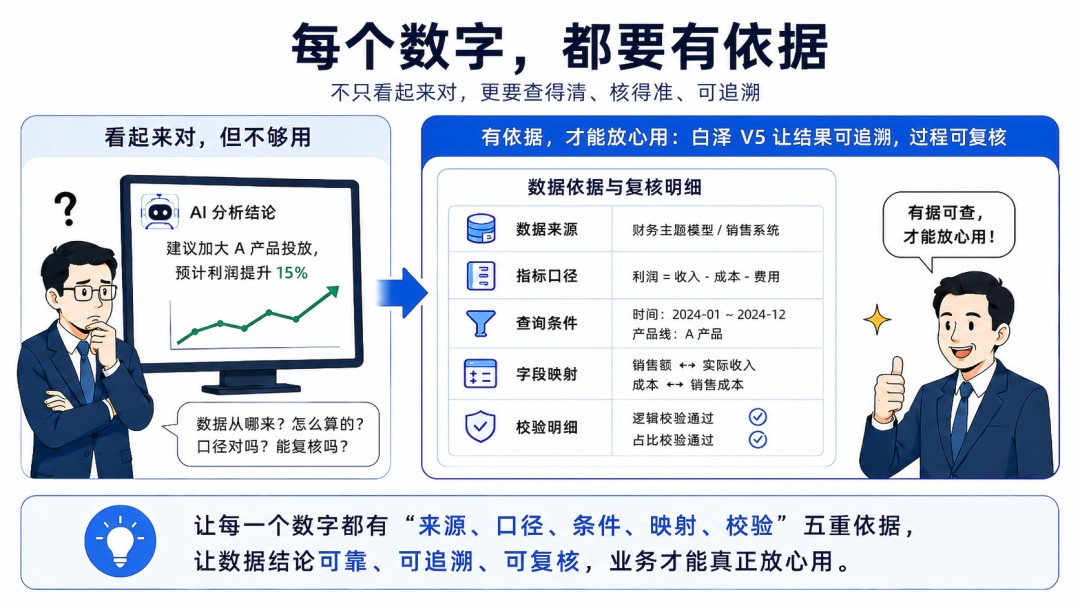
AI that can truly be used in business decision - making should not only give a "seemingly reasonable" conclusion, but also clarify the data source, calculation caliber, and execution process.
Only when the results can be traced and the process can be reviewed will enterprises dare to truly use AI for data analysis.
It's not a single large model, but an Agent BI architecture
Baize V5 can connect data query, attribution, reporting, reporting, and dashboards into a complete analysis process, not by simply integrating a large model.
In the enterprise data analysis scenario, a large model cannot operate freely. It needs to understand the enterprise's own indicator calibers, know when to query data, when to conduct attribution analysis, and when to generate reports. It also needs to complete tasks in a safe, controllable, and traceable environment.
Behind this is an Agent BI architecture for enterprise data analysis.
The first layer is a trustworthy data foundation
Terms like "revenue", "profit", and "completion rate" in an enterprise are not ordinary words, but indicators with clear business definitions, calculation rules, and permission boundaries.
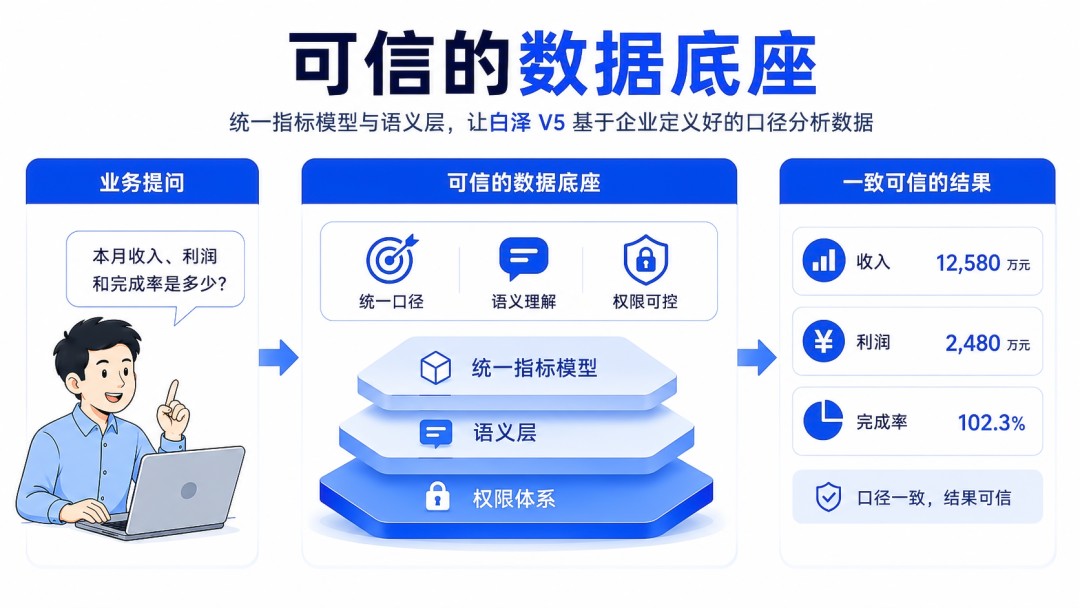
Baize V5 relies on the unified indicator model and semantic layer accumulated by SmartBI over the long term to stably connect user questions with underlying data, enabling AI to conduct analysis based on the indicators, dimensions, and rules defined by the enterprise, rather than guessing based on language intuition.
The second layer is an intelligent agent architecture for task execution
Why is the general large model often "maladapted" in enterprises? We can use an analogy: A large model is like a "wild horse" with super intelligence. It has powerful computing power but is difficult to control; while the Agent BI architecture of Baize V5 is like a set of strict "harness" for this wild horse.
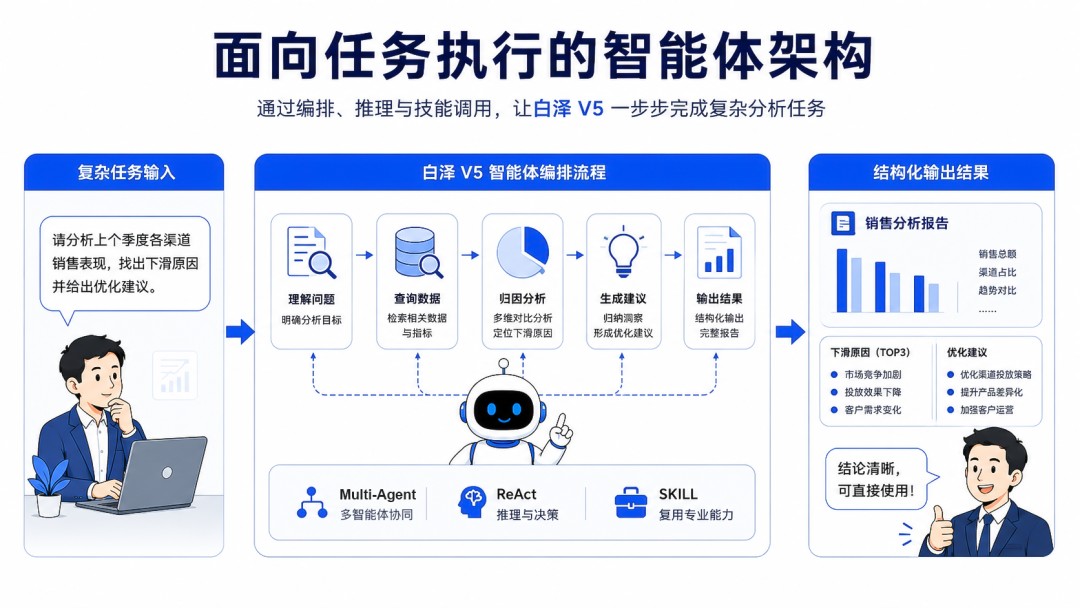
Under the constraint of this "harness", the large model no longer acts freely and talks nonsense. Baize V5 integrates the ReAct mechanism, allowing AI to observe, reason, and act simultaneously; at the same time, through SKILL (skill) expansion, it precipitates professional methodologies such as attribution analysis and complex form filling into exclusive capabilities. This enables AI to stably complete complex business tasks on a safe, controllable, and traceable track.
The third layer is enterprise - level engineering support
Enterprise - level analysis often involves cross - table queries, multi - source integration, complex indicators, and large - volume data calculations. It may also need to process Excel, files, and scripts.
Baize V5 provides support for different types of analysis tasks through composite computing capabilities such as SQL, Spark, MDX, and Python/Bash sandboxes; remote sandboxes, permission systems, and audit mechanisms ensure that data access and execution processes are controllable.
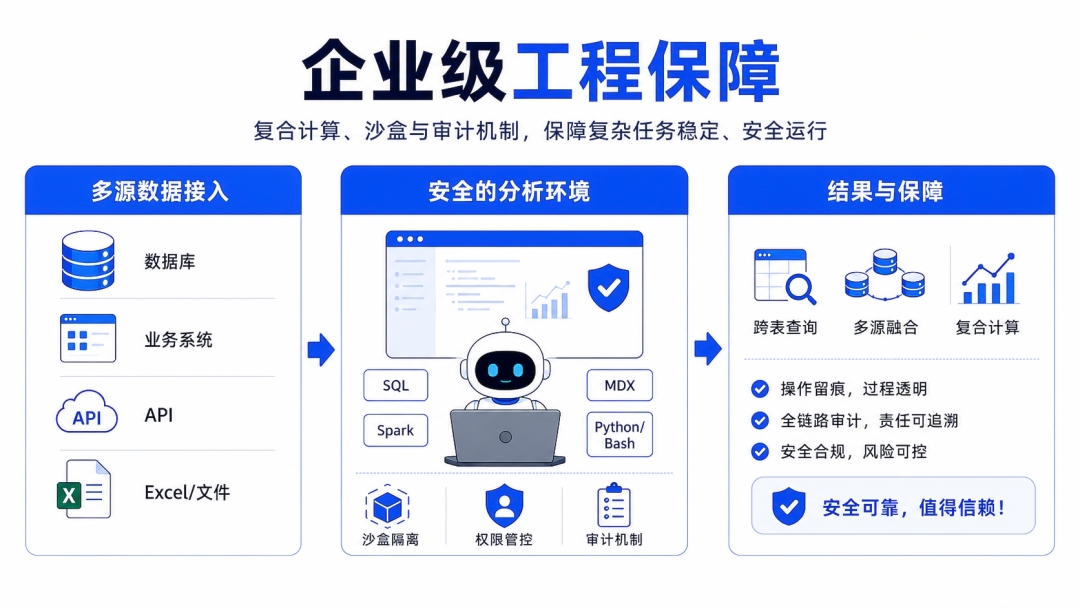
More importantly, these capabilities are not built as a separate system, but can be established on the enterprise's existing data models, indicator systems, report assets, and permission systems. AI capabilities can be superimposed on the existing BI foundation and continue to grow, rather than starting from scratch.
This is also the fundamental reason why Baize V5 can move from "being able to answer" to "being able to deliver".
In real - world business scenarios, AgentBI is delivering value
For enterprise - level AI, being able to run a demo is the foundation, and being able to enter real - world business is the real skill. Currently, Baize V5 has been continuously implemented in demanding scenarios such as energy and power, finance and insurance:
A large energy and power enterprise: Say goodbye to "one - size - fits - all" and make debt collection more caring
Business pain point: The manual electricity bill collection by front - line power supply station personnel is inefficient, and mass - sending text messages without discrimination has led to a decline in customer satisfaction.
Baize solution: Build intelligent agents for 【Intelligent Debt Collection】 and 【Step - based Electricity Bill Pre - Notification】.
Business result: Combining users' historical payment habits (such as paying bills on a fixed payday), AI automatically generates hundreds of personalized debt collection plans, automatically identifies customers about to upgrade their electricity consumption levels and sends reminders. This not only significantly improves business efficiency but also transforms grass - roots services from "cold - hearted bill collection" to "caring services".
A large comprehensive insurance group: In - depth attribution to penetrate the fog
Business pain point: The reasons for performance fluctuations are complex, and traditional troubleshooting is time - consuming and labor - intensive.
Baize solution: Relying on the unified semantic layer, Baize sorts out 50 dimensions and 400 core indicators around the financial management caliber.
Business result: Through "layer - by - layer attribution" and the "chain substitution method", AI can instantly break down the core driving factors behind performance growth (for example, whether the expansion of asset scale or the change in interest spread has a greater impact), enabling management to understand the origin and destination of every penny. These cases show that Baize is not only running smoothly in the demonstration environment but has also been implemented in real - world business scenarios. Based on long - term industry practice, Smartbi continuously accumulates generally applicable analysis indicators, business dimensions, and method systems, and gradually precipitates them into thousands of industry know - hows, enabling AI not only to answer questions but also to become an enterprise - level capability that can be used, verified, and continuously evolved.
Conclusion
AI's entry into enterprise data analysis is passing the initial stage of novelty.
In the next stage, enterprises will not only ask "Can AI answer?", but will be more concerned about: Can it understand the business, complete the analysis, deliver the results, and be trusted?
This is also the value of Baize V5: It not only makes it more convenient for business personnel to query data, but also enables AI to truly participate in the enterprise analysis process, clarify the problems, and deliver the results.
What Baize V5 hopes to promote is the new stage of enterprise data analysis from "humans searching for data" to "AI - assisted analysis".